With these paintings we are entering into Chapter 10: Enlightenment & Endarkenment. My contribution is “Blue Feather,” inspired by Richard Bach’s book, Illusions. In the book, the teacher Donald Shimoda is encouraging his student, Richard, to practice visualizing from imagination into reality.
Blue Feather, David Kopacz
The painting from Joseph is “Candle of the World #1 – Ordinary and Non-ordinary Realities,” showing 2 candles facing each other with a circular counter-clockwise movement between Ordinary and Non-ordinary Realities. We’ll have Candle of the World #2 in a later series.
Candle of the World #1 – Ordinary and Non-ordinary Reality, J. Rael (2017)
“Listen!” he called across the gulf between us. “This world? And everything in it? Illusions, Richard! Every bit of it illusions! Do you understand that?” (Richard Bach, Illusions, p. 69).
The first painting is “When the People Went into the Cave of Existence and Returned as Made People Ceremony.” Joseph often speaks of the True Human and how it is an ongoing process and effort to become a True Human. This painting links the cave as a place of self-connection and transformation, we are still in Chapter 9: Guha: Cave of the Heart.
When the People Went into the Cave of Existence and Returned as Made People Ceremony, J. Rael (2006)
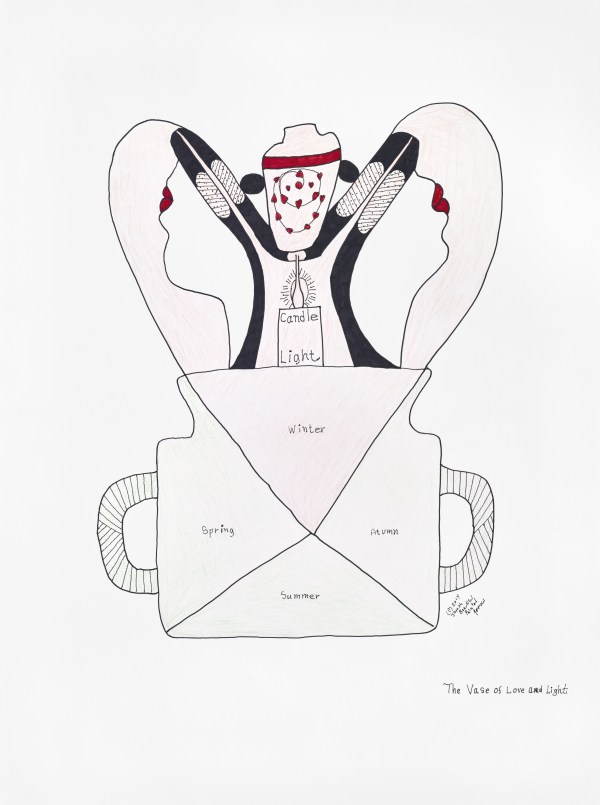
The next painting is “The Vase of Love and Light,” which features a vase with the medicine wheel of the four seasons.
The Vase of Love and Light, J. Rael (2014)
“The ‘c’ in ‘cave’ is pronounced ‘Kay.’ There is a blanket that has been placed over that moment when the people go into a cave, that is why caves were created in the beginning by the original architect, even before goodness. We don’t know who the original architect is. God is a phenomenon that we have created. Kay means to cover oneself up with the blanket of something, getting blindsided. But you have to do that, you have to go in blindsided, covering your vision, you can’t be a visionary unless you go into this darkness. Kay also means the beginning. Something has ended. Kay means something has ended because something has just been born, so the caves in ancient time, the caves over here in Colorado, the metaphor of the caves means a beginning. You are blindsided, you have to be blindsided to go into the caves.” (Becoming Medicine, p. 227, Joseph Rael)
The next two art works from Becoming Medicine: Pathways of Initiation into a Living Spirituality are both by Joseph Rael (Beautiful Painted Arrow). The first painting is “The Blowing Breath of Dark Energy.” I have a small photo of this piece in my office, near where I work. Joseph is fascinated by scientific discoveries around dark matter and dark energy. Joseph says that “darkness is where all the good ideas are.” I’m not sure how old this painting is – it is from a number of 35 mm slides of Joseph’s artwork that we had transferred to digital.
The Blowing Breath of Dark Energy, J. Rael (2020)
The next art work is “The Underside of a Far Larger Ship.” Joseph often speaks about space, ETs, and the stars as our relatives and home. He says that according to traditional teachings, we came from the stars and one day we will return there. This is an image of a vision of ship he saw flying above the Earth.
The Underside of a Far Larger Ship, J. Rael (2015)
These art works are from Chapter 7: Story Medicine and it opens with a vision Joseph had of a new creation story:
Joseph Rael’s New Creation Story
Joseph called me with a dream/vision he had one morning:
“Grandmother was making strong black coffee one morning and brought a cup to Grandfather. She also brought the coffee upstairs to the children and gave it to them so that they would get out of bed. She wasn’t supposed to do this, so she didn’t tell Grandfather this. [Joseph relates that this happened to him when he was a young boy, that he was given coffee secretly in the morning to wake him up so he would get dressed for school].
“When Grandfather drank the coffee he had an epiphany, an inspiration. He had a white sheet of paper in front of him and he hit it and it made the sound, one—weh-mu! He hit it again and it made the sound, two—wehseh! Then again, three—paah-chu! He continued to hit the paper ten times, counting out the numbers of inspiration one through ten: four—wii, five—paah-nu, six—maa-tschlay, seven—cho-oh, eight—wheh-leh, nine—whiii, ten—tehn-ku-teh. He hit the paper with a multi-colored colored pencil that he had and with each hit he created a circle of colored light that emanated out from the Big Bang of the central point.
We talked about this vision for a while and I wondered why God needed the cup of coffee for inspiration (I do live in Seattle). I wondered if the black liquid coffee could represent the blackness of the Void that existed before creation. I like this idea that God drank in liquid blackness and out of this inspiration came a vision, which Joseph describes as the soul drinking light—and out of inspiration comes rainbow circles of light creating Creation out of sound, light, color, breath, and vibration.
In Joseph’s vision, we also have the interaction of the feminine and the masculine in creation, the feminine providing the inspiration through the liquid black of coffee, but also showing the introduction of duality and the use of coffee for both the inspiration to create the Universe, but also abusing the coffee to force the children awake. In the exegesis of the vision, Joseph mentioned that the Grandmother was an older generation than the Grandfather, not necessarily the partner of the Grandfather, but maybe the Grandmother of the Grandfather—thus we have the interesting idea that perhaps the Grandfather was one of the children that the Grandmother was trying to get up, dressed and off to school, and what slipped out was that the child/Grandfather smacked the paper 10 times and created the Universe before running off to school.
Joseph explained that prior to the Grandfather having the epiphany, he was living in darkness, in the Vast Self. He was an artist who had learned to see in the dark, making his sketches. He hadn’t yet moved into the Circle of Light. “Darkness is where all the good ideas are,” says Joseph, this is where the source of inspiration is. With the first hit of the paper, simultaneously a sound and light are created. This is the point of light at the center of the medicine wheel. It is the light of epiphany, the light of movement, there is now a central organizing point. With each hit of the paper, a new colored circle of light of the medicine wheel is created.
In talking about this dream/vision, Joseph says, “Of course we are God, we are the artist.” Each of us is creation, but we also keep creation going through our lives and as we cycle through the medicine wheel we create energy—the friction in our lives creates sparks and gives off light. The medicine wheel gives a structure, organization and context to all life events. It shows how life moves in circles: each year we move from winter to spring to summer to fall and back to winter again; each life comes from the earth and returns to the earth; each inspiration and epiphany begins in the North (winter/spiritual) and then moves to the East (spring/mental), then to the South (summer/emotional), and then to the West (fall/physical). The medicine wheel explains how spiritual inspiration becomes mental idea, becomes emotional feeling, and then becomes a physical thing in material reality. The medicine wheel shows that there is no artificial boundary between the spiritual and physical, rather there is a bridge, or a rolling wheel that moves the energy along, manifesting in different dimensions at different times.
Elders Gathering at the Winter Solstice, J. Rael (2017)
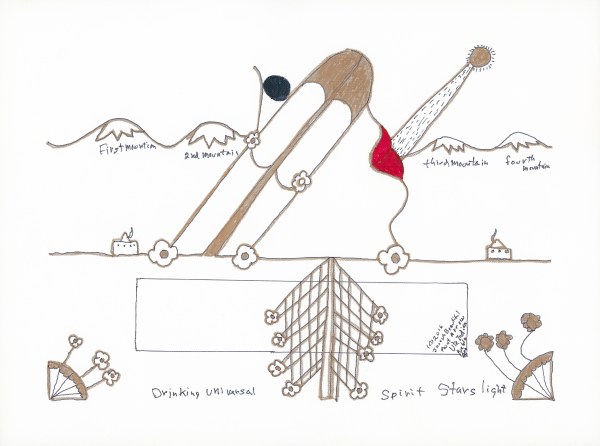
The next painting of Joseph’s is Drinking Universal Spirit Stars Light. This is one of a series of paintings that Joseph did featuring gold paint.
“A vision is the soul drinking light. It starts with descending light, falling like rain. . . . The visionary transformation happens in the act of perception. . . . It has the quality of “heaven is here now.” What you want to achieve is here now, ready, given.”
(Becoming Medicine, p. 76, from Ceremonies of the Living Spirit, p. 40)
From Joseph’s perspective, we are in continual interrelationship with the world and the stars are our ancestors, our elders, our relatives, we came from them and we will return to them. For Joseph the separation between subject and object which we have tried so hard to perfect in Western science is more fluid. We don’t just look at the stars, we drink their light and the ancestors and relatives nourish and support us.
“Kuaua: means hello, it is the greeting that you give when you meet someone. Ku means good and aua means life, so it means good life, have a good life, it is like a blessing. So when we say hello to someone, kuaua, we are instantly bringing out the goodness that exists in the world, in the bushes, the plants, and the trees, the stones, and the mountains. It is not that we say it and it travels over there. We say it and it re-awakens what is already there in the world. In that way we are bringing out the goodness in the world through our words and our actions. We are giving birth to the world in our everyday life. Isn’t that great?” (J. Rael, p. 155-156).
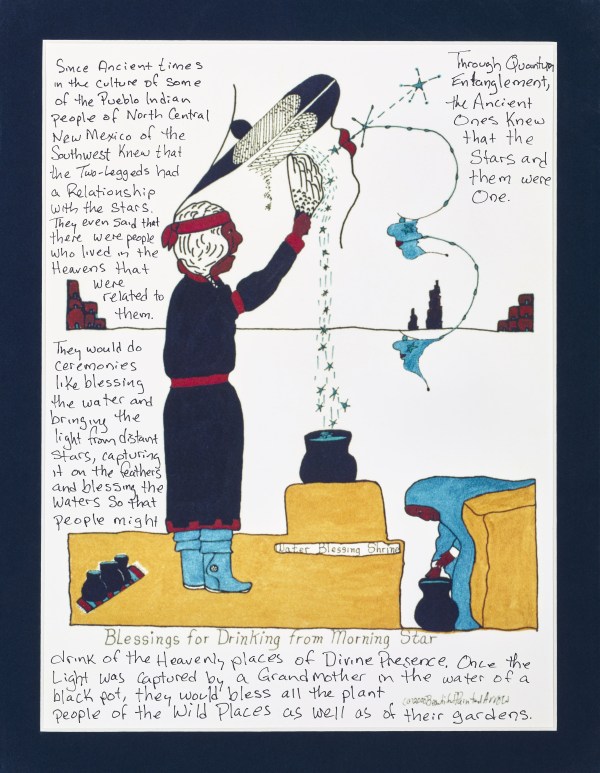
The first art work is “Blessings for Drinking from Morning Star,” and this one is interesting in that it was a completed painting, which Joseph had a print of, and he dictated to me some additional text which I wrote in my hand on the painting. I’ve always liked the intersection of art and text and this art work is as much a book as it is a painting.
Blessings for Drinking from Morning Star, J. Rael (2000), additional text dictated around 2018 by J. Rael, written by D. Kopacz
The next art work is “Sacred Offering of the Five-fingered,” and there are five offering pots that spell out the word, “peace.” This piece marks the transition from the chapter “Becoming Visionary” to the chapter “Becoming a Mystic.”
Sacred Offering of the Five-fingered, J. Rael (2005)
“Since Ancient times in the culture of some of the Pueblo Indian people of North Central New Mexico of the Southwest knew that the Two-leggeds had a Relationship with the stars. They even said that there were people who lived in the Heavens that were related to them.
They would do ceremonies like blessing the water and bringing the light from distant stars, capturing it on the feathers and blessing the waters so that people might drink of the Heavenly places of Divine Presence. Once the Light was captured by a Grandmother in the water of a black pot, they would bless all the plant people of the Wild Places as well as of their gardens.
Through Quantum Entanglement, the Ancient Ones knew that the Stars and them were One.” (Joseph Rael as dictated to David Kopacz)
For the next two art works from Becoming Medicine: Pathways of Initiation into a Living Spirituality, we have one from Joseph and one from myself. Joseph’s painting is “Vision of the Blessed Virgin.” Joseph told me of at least three different visions of the Madonna. The first visit I made to Colorado, Joseph directed me to drive around (it felt like we were driving in circles at times!) and one of the places he took me to was a house in Bayfield where there was a gas explosion and Joseph was blown over, injuring his knees. He had another vision one time in an AA meeting. That painting is in Walking the Medicine Wheel: Healing Trauma & PTSD, entitled “Awakening at AA Meeting,” (p. 135). We also have a painting of Joseph’s in that book entitled, “Madonna Over Sound Peace Chamber,” (p. 189).
Vision of the Blessed Virgin, J. Rael (2015)
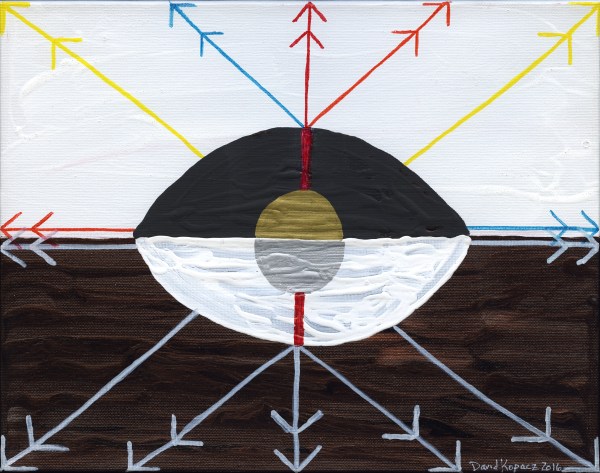
My painting I called, “Shamanic Vision,” I was trying to capture the two realities Joseph speaks of: Ordinary and Non-ordinary Reality. I also added the colors of the rainbows that Joseph uses in his paintings: yellow, orange, red, blue.
Shamanic Vision, D. Kopacz (2016)
That’s the way I live. I never know how the things I do are going to turn out. I just show up and do what I’m told. This energy follows me around, but I always know if I don’t do what I’m told I will be unhappy. I used to tell my students, be sure that you follow your guidance because that guidance is in your higher interest. From that, other experiences will come to you that will enhance your growth. (Joseph Rael, p. 108 – from House of Shattering Light, p. 110-111).
I met Usha Akella when she was doing a keynote presentation at the Power of Words conference in 2019, put on by the Transformative Language Arts Network. We both were interested in writing, poetry, creativity, and the spiritual path. Usha has long had a dream of developing an interview site online and I have been doing various interviews for my work – so it seemed like a good fit and less than a year later The-POV was born and launched into the world!
Usha’s first new interview is with Ann Ciccolella, Artistic Director of Austin Shakespeare since 2007. One of the things Usha has been impressed with is the depth and breadth of cultural programming Ann has curated.
Usha Akella: I am delighted to finally have an opportunity to explore your creative visions, Ann. I’ve attended your plays for years in awe at your ability to cast any play in a contemporary light. Your cross-cultural productions and multi-ethnic casts contribute to dialogue and peace-making. Your productions are playful, pushing the edge yet never lacking conviction or losing a grip on the playwright’s script. You’ve managed to bring Bollywood and Texas boots, and a female Hamlet to your stage. So, let’s begin by exploring the audacity of Ann Ciccolella. Why are you compelled to rewrite/reimagine or re-vision and can we chat about some of your productions that you felt were successful and those that were not—in your opinion.
Ann Cicolella: My own playwriting is a top value for me. Writing my own adaptations is something that I have been doing in the past couple of years. I want to do more playwriting, but finding the time needed to create scripts from their inception is something that I haven’t been able to do since leading Austin Shakespeare! So, I have been adapting classic stories. I used the plot of Homer’s epic poem The Odyssey and wrote a one-hour play version for middle and high school audiences. That experience was alternately challenging and delightful. During the rehearsal process, I try to inspire actors to create an imaginative performance, and with six actors we together created the many worlds of Homer’s The Odyssey. You see, adapting is a way to satisfy that thirst for my own playwriting.
David R. Kopacz: We’re going to have a section of Becoming Medicine reprinted in Parabola magazine – Jeff Zaleski wants the sections, “Initiation of the Circle” and “Moon Woman Vision.” You have statements in those sections that we are “circle people” and “what comes around goes around” and that “everything eventually becomes its opposite.” You also say, “Look at how we move in a circle, but then look at it from the side and it looks like we are moving forward and backward, back and forth. It depends on your perspective of seeing.”
Joseph Rael – Beautiful Painted Arrow (BPA): That’s apropos for this time. That’s how it is – we move back and forth and back and forth. We move forward and then we spoil it by invalidating it. In order to get in tune with it, we need to use our feet. That’s why we have these physical feet and they are made for traveling. When we go forward we add something. But then we go backward and we forget it. In this life, you have to be constantly correcting yourself.
That’s what my dances are supposed to do. They check everything on the list. When you are dancing you move forward and backwards in balance. You dance to cover the winter; you dance to cover the spring; you dance to cover the summer; and you dance to cover the autumn. You also dance to cover the North, South, East, West – the directions.
I’m just being a book from the universe and showing you what to do.
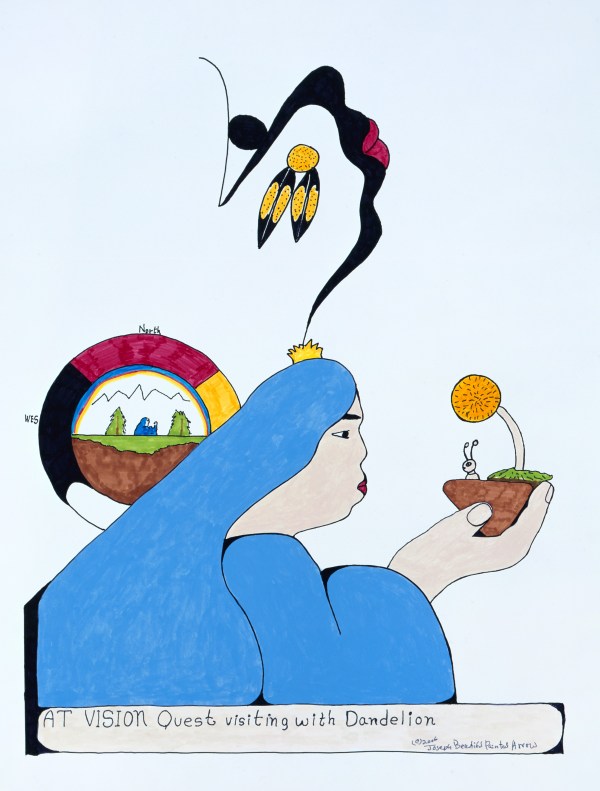
At Vision Quest Visiting with Dandelion, Joseph Rael (2006)
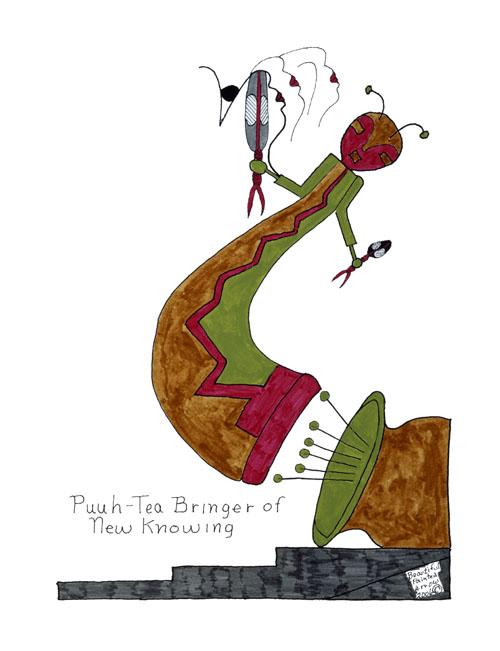
Visions are new knowledge, guiding insights that come in visual form, rich with symbolism and archetypes. Visions are different than intellectual, linear thought – they are in-breakings of the divine into ordinary life.
Puuh-Tea Bringer of New Knowing, Joseph Rael (2006)
“Ceremony is the way to do this. It gives us powers. Ceremony works because there is crying for a vision. By crying for a vision, I mean that the soul is longing for light, so it can drink it in and thus fulfill its nature. If light – vision – is lacking, there is sadness,” (J. Rael, cited, p. 89).
Mike is a friend of mine whom I met through Joseph Rael (Beautiful Painted Arrow) and he gave me a copy of this book and I would like to return the gift by writing this review.
Mike is a sincere and compassionate seeker and this book tells the story of his journey building the Circle of Light Peace Chamber. Mike followed his dreams and visions to bring them into reality and he has many spiritual adventures along the way. I would say that Mike is a gentle soul.
Like many mystics, Mike’s journey takes him from a sense of an isolated ego to the experience of interconnected being – “Being awake and open to All,” (205).
He learns about the meaning and purpose of life and the importance of attending to inner visions and bringing them into material reality, thus becoming a Liminal Being, or, as Joseph Rael might say, an “In-Betweener,” or a “hollow bone.”
“What you need is to let go of all the fear and let go of all the pain in you, and then you are not competing and you know you are on your soul’s journey and living your purpose – when you are that pure love that you are. Just trust in the love that you are, and you’re always living your purpose and on your path,” (166).
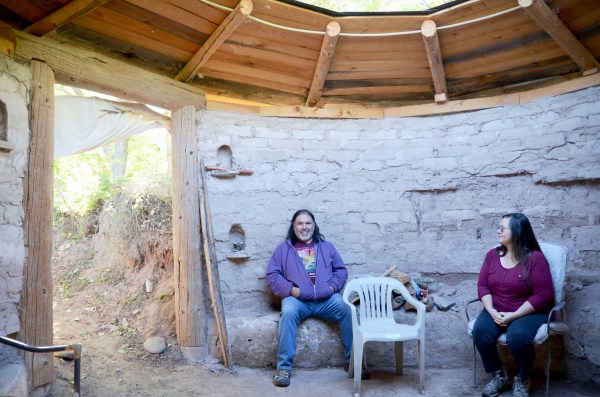
I have been to visit Mike, and his wife Marie, several times after meeting him at the book release and 80th birthday party of Joseph Rael (Beautiful Painted Arrow) in 2015. We featured a picture of The Circle of Light Sound Peace Chamber in Walking the Medicine Wheel: Healing Trauma & PTSD, (page 95 – I still feel bad about the typo of your surname in the caption – sorry about that Mike!).
My sister, Karen, and I met with Mike & Marie in October, 2018 and filmed them talking about the construction of the chamber. You can watch the video of that, here. And see other videos of my work with Joseph Rael here, and here.
Mike & Marie Pedroncelli, Circle of Light Sound Peace Chamber, photo K. Kopacz (2018)
Here are the next two paintings from Becoming Medicine: Pathways of Initiation into a Living Spirituality, by David R. Kopacz, MD & Joseph Rael (Beautiful Painted Arrow). The first painting is by Joseph, Where God and Humans Meet. This was one of the first paintings that Joseph gifted me when we first started working together. These paintings are found in chapter 4, Becoming a Visionary. Here is what I wrote about the painting in the book:
ON VISIONS
“Joseph’s artwork comes from his visions. What he sees in his visions he puts in his artwork. I keep a number of Joseph’s paintings around my desk. One of these is “Where God and Humans meet.” This painting is in the shape of a large vase, filled with tiny dots—like stars or molecules of gas. There is a central point, like a sun, which shines two rays downward to the top of two people’s heads and there is a little star where that divine energy enters in through the crown (7th) chakra. Arching upwards from the central sun is a divine being, God or Vast Self. As always in Joseph’s paintings, this divine being is looking upwards and has a large black eye (which is a black hole, Joseph says, and this black hole is about the same size as the light giving central sun). The edge of the vase and the back of this divine being are the same line, the vase grows out of the divine being which creates a container of and for existence. We are the vase that contains the space where God and humans meet, but from a visionary perspective, the material we are made of, the vase, is the material of Wah-Mah-Chi, Breath-Matter-Movement, in other words, God. Visions come from the divine and they reveal to us who we are.Visions are the soul drinking light, Joseph says,” (78).
Where God and Humans Meet, J. Rael 2015
The next painting is one of mine. When I was living in New Zealand I began reading Henry Corbin and was fascinated by his description of the ‘alam al-mithal, the place where “Spirits are corporealized and bodies are spiritualized,” (Corbin, Spiritual Body, Celestial Earth, 177). I would sit and meditate, looking out at the volcano, Rangitoto, and would try to find what this place of ‘alam al-mithal would be like. I painted 10 different paintings, but I’m not sure I could capture my vision.
‘Alam al-mithal, D. Kopacz (2016)
“Visions are at the center of this book, just as the heart is at the center of the medicine wheel and our hearts are the center of our being. A vision is a little bit like a poem, or maybe a dream. It can be of brief, passing interest, or it can be an orienting structure for the rest of your life,” (78).