The first painting is “Crystal Chamber Taken Up into the Sky.” This painting represents a vision Joseph had of his first Sound Chamber that he built north of Albuquerque, New Mexico. He had embedded various crystals in the wall of the chamber, which is why it is called a “crystal chamber.” He had a vision of the chamber being taken up into the sky where it continued to be availalbe in non-ordinary reality. When Joseph left that land, the physical chamber was taken down. This is also one of the first paintings that Joseph had me do some finishing work on – he asked that I paint in the water and table when he gave it to me.
Crystal Chamber Taken Up into the Sky, Joseph Rael (2017)
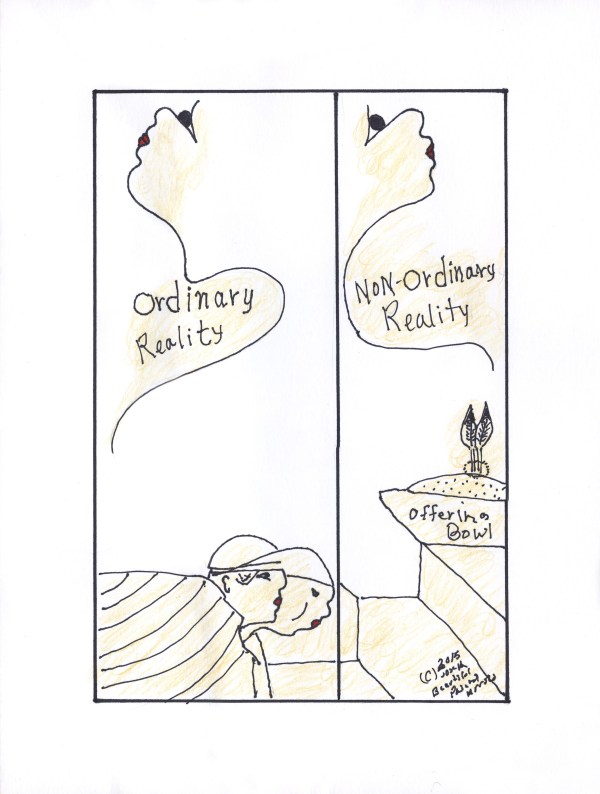
The next painting by Joseph is a favorite of mine that I keep above my writing desk. It shows two people whose heads are inclining from ordinary reality toward non-ordinary reality. It shows that the separation between ordinary and non-ordinary reality is but a thin line.
Ordinary, Non-Ordinary Reality Offering Bowl, Joseph Rael (2015)
“When I built the sound chamber here in Bernalillo I created a ceremony where I did a rainbow from the chamber that I had here with the chamber there at the monument where we went (the Painted Kiva). But when the people bought the place here I guess they tore it down. People call it a crystal chamber because I buried crystals in the wall. One day it became a crystal chamber and it went straight up into the sky and it is still there. So it didn’t bother me when they tore it down because it was just the physical structure. The little boy went with it up into the sky, 10,000 feet up. So it is sitting up there in the sky over Albuquerque, New Mexico.” (As part of the vision, Joseph was also given a little boy, a spirit child, who grows as the Sound Chambers grow.) (Joseph Rael, Becoming Medicine, p. 257).
What we call things creates not just discourse, but reality. The words that we use and the words that we do not use lead us in certain directions and have different effects. Words are not just words, they are tools that shape, and give expression to, reality.
Words are Spiritual & the World is Spiritual
In the beginning was the Word, and the Word was with God, and the Word was God. He was in the beginning with God; all things were made through him, and without him was not anything that was made, (John 1:1).[2]
Advaita Vedanta of Hinduism also recognizes the importance of the Word, as Nataraja Guru has written in The Word of the Guru: The Life and Teachings of Narayana Guru:
There is nothing to know beyond the Word. The known, knowledge, and the knower meet in one presence in the Word…In never-ending beats, it continues in quantum pulsations of energy, to be calculated in split seconds or in millions of light-years, while new and unknown galaxies leap within the ken adding to wonder that is dumbfounding.[4]
Similarly, Southern Ute mystic, Joseph Rael (Beautiful Painted Arrow) sees the connection between sound and reality, as he writes, the “true basis for Universal Intelligence is sound. Out of sound comes everything.” It is through perception that creation comes into being. “We are perceivers, and it is in our act of perceiving that vibrations become sounds, smells, feelings and colors. In our act of perceiving, things take form.”[5]
Sun Through Trees Near Sol Duc River, Washington state, D. Kopacz (2019)
Words create our reality and our current reality is in crisis.
Across the world, in many different countries, politicians are rising to power using words of separation rather than words of union. This political crisis is a spiritual crisis because using words to create reality is a spiritual act.
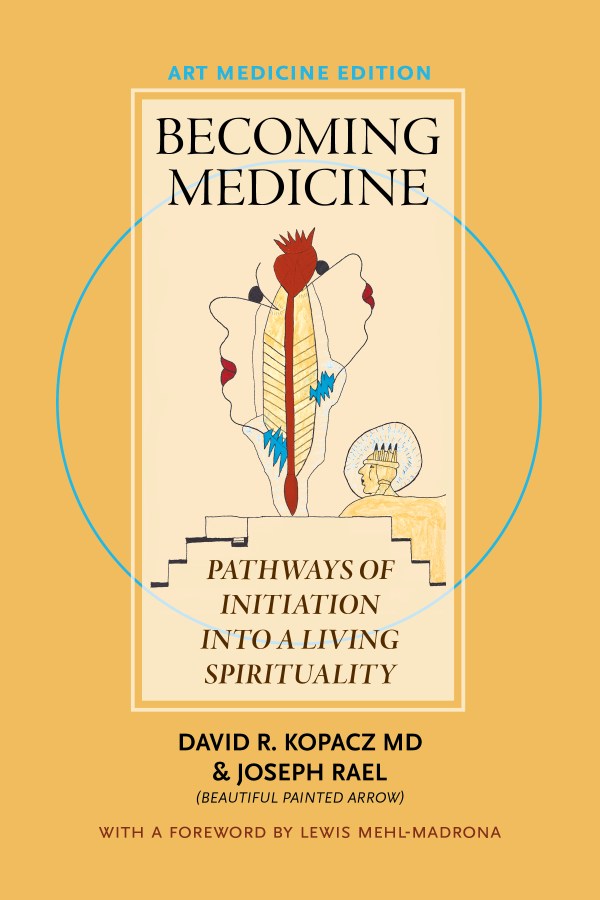
In our book, Becoming Medicine: Pathways of Initiation into a Living Spirituality,[1] Joseph Rael and I felt that we had to include something about the pathway that the world is heading down, a pathway that can lead to a loss of peace, to the start of war. The world is currently on a pathway that is being paved with words of separation: racist words, belittling words, disrespectful words, manipulative words, fundamentalist words, totalitarian words, and fascist words. Common to all of these words is an underlying attempt to recreate a world of separation, isolation, and hate. Joseph has long been committed to world peace and he has worked toward this through the development of his Sound (Peace) Chambers on four continents. In Becoming Medicine we write about Spiritual Democracy (you can download that chapter here), which is the opposite of fundamentalism―it is about opening our hearts to others and seeking to act in such a way that encourages others to open their hearts. Fundamentalism is idolatry―the worship of a fixed thing. Spiritual Democracy is about allowing ourselves to be shaped and continually reshaped by Breath-Matter-Movement, by Wah-Mah-Chi (the Tiwa word for God). I came across Walt Whitman’s concept of Spiritual Democracy in the work of Stephen Herrmann in his book, Spiritual Democracy.
Adopting the big idea of Spiritual Democracy, the realization of oneness of humanity with the universe and all its forces, can help people feel joy, peace, and interconnectedness on an individual basis. It can also inspire us to undertake sacred activism, the channeling of such forces into callings that are compassionate, just, and of equitable heart and conscience, and give us some tools to start solving some of these grave global problems, while uniting people on the planet.[6]
Sun Through Trees, Mt. Muller, Washington State, D. Kopacz (2019)
The Crisis of this Moment is Linguistic
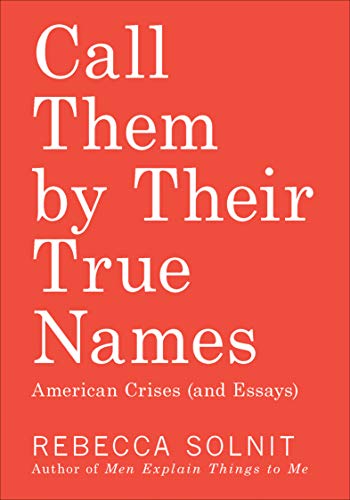
Rebecca Solnit’s Call Them by Their True Names (2018) examines the uses and abuses of language in politics, stating that “one of the crises of this moment is linguistic.” The linguistic crisis confuses us about what is real, what is true, about who we are, and about our relationships with each other and the natural world. “Calling things by their true names,” Solnit writes, “cuts through the lies that excuse, buffer, muddle, disguise, avoid, or encourage inaction, indifference, obliviousness. It’s not all there is to changing the world, but it’s a key step.” Solnit has long been concerned with the use of language and power in her writings on hope, trauma, community, and environment. She writes artful and thoughtful memoir that weaves in the political and the creative spirit. Her writings are not overtly spiritual, but I imagine she would be comfortable with the concept of spiritual democracy as she writes about human rights, human dignity, environment, and on women’s and indigenous rights. Her writing is a form of activism and she encourages us to make the world a better place. She sees that we are currently going down a pathway of brutality and if we do not start calling this pathway by its true name, we risk being swept into deeper brutality. “Once we call it by name, we can start having a real conversation about our priorities and values. Because the revolt against brutality begins with a revolt against the language that hides brutality.”[7]
One of the elements of the current pathway the United States (as well as many other countries across the world) is walking down is a pathway of isolation. Isolation and separation are based on dividing people into the “good and the bad,” those who belong and those who do not, those who have rights and those who do not. Anyone with a sense of history can pick out words and phrases that were used in racist, totalitarian, fascist regimes: “enemy of the people,” “those are some very bad people,” and “send them back.”
Glorious Disconnect
Solnit writes about what she calls a “Glorious Disconnect:”
If you boil the strange soup of contemporary right-wing ideology down to a sort of bouillon cube, you find the idea that things are not connected to other things, that people are not connected to other people, and that they are all better off unconnected.[8]
Solnit points out how this underlying philosophy of disconnection and separation, which results in concrete policies, is also behind the current proliferation of “fake news.” “Taken to its conclusion,” she writes, “this worldview dictates that even facts are freestanding items that the self-made man can manufacture for use as he sees fit.”[9] This worldview influences our interdependence and interrelatedness with each other and the environment. In the mania to deregulate social and environmental protection, she sees the attempt to “deregulate meaning.”
If you begin by denying social and ecological systems, then you end by denying the reality of facts, which are, after all, part of a network of systematic relationships among language, physical reality, and the record, regulated by the rules of evidence, truth, grammar, word meaning, and so forth. You deny the relationship between cause and effect, evidence and conclusion; or, rather, you imagine both as products on the free market that one can produce and consume according to one’s preferences. You deregulate meaning.
. . .
And this is how the ideology of isolation becomes nihilism, trying to kill the planet and most living things on it with a confidence born of total destruction.[10]
This pathway of isolation is rooted in and creates loneliness, in fact, Solnit has an essay entitled, “The Loneliness of Donald Trump.” She writes about this loneliness coming out of power and privilege that insulates and isolates, until,
In the end there is no one else in their world, because when you are not willing to hear how others feel, what others need, when you do not care, you are not willing to acknowledge others’ existence.. . . When you don’t hear others, they become unreal, and you are left in the wasteland of a world with only yourself in it. That surely makes you starving, though you know not for what, if you have ceased to imagine that others exist in any true, deep way.[11]
Gerald Arbuckle, a New Zealander living in Australia who is a Catholic priest and anthropologist, also sees the current crisis of global political and religious fundamentalism as being rooted in loneliness and creating loneliness. His follow-up book to Fundamentalism at Home and Abroad (2017) is Loneliness: Insights for Healing in a Fragmented World (2018). Arbuckle points out that the United States is extreme in its individualism and that the “American Dream” includes contradictory values of competitive utilitarian individualism and egalitarianism. This pits the “rights of the individual” against the “common good.” The founding “myth” of the United States includes this tension between individualism (which when extreme creates isolationism and loneliness) and egalitarianism (which can create community and equality).
Arbuckle draws on his training as a cultural anthropologist to understand how groups function and to diagnose the various forces leading to our current epidemic of loneliness and fundamentalist totalitarianism. He points out how and why people use tactics of scapegoating, splitting and separating people into us and them, into “member” and “stranger.” He also draws on his training as a Catholic priest to point out how we can treat the current epidemic through creating love between neighbors. “The universal call to love one’s neighbor commits us to struggle for the common good. Individualism and individual and corporate greed contradict this imperative,” he points out. He quotes Pope Francis calling for a revolution of tenderness. “A single individual is enough for hope to exist, and that individual can be you. And then there will be another ‘you,’ and another ‘you,’ and it turns into an ‘us.’ . . . When there is an ‘us’ there begins a revolution [of tenderness].”[12]
Rialto Beach, Washington state, D. Kopacz (2019)
Doing the Work that Matters
Both Solnit and Arbuckle tells us that our civil society and spiritual values are being degraded and negated. They point out how our current global epidemic of loneliness and totalitarianism is rooted in our use of language and how we use words to create worlds. We have a choice between worldviews of separation and worldviews of union. Making this choice begins with the words we use to describe and create reality. One of our choices is whether we focus on “me” or “we.” ME and WE are actually mirror images of each other, if you place WE over ME, you can see that they both are reflections as in a lake. There is a saying, which I have seen variously attributed, that “When you replace I with We, Illness becomes Wellness.” The words that we use create different stories, and we need to choose whether we want stories of inclusion (we) or stories of exclusion (me). As Rebecca Solnit writes:
The only power adequate to stop tyranny and destruction is civil society, which is the greater majority of us when we remember our power and come together. The job begins with opposition to specific instances of destruction, but it is not ended until we have made deep systemic changes and recommitted ourselves, not just as a revolution, because revolutions don’t last, but as a civil society with values of equality, democracy, inclusion, full participation—a radical e pluribus unum, plus compassion. This work is always, first and last, a storytelling work, or what some of my friends call ‘the battle of the story.’ . . . To sustain it, people have to believe that the myriad small, incremental actions matter.
. . .
To believe it matters—well, we can’t see the future, but we have the past. Which gives us patterns, models, parallels, principles, and resources; stories of heroism, brilliance, and persistence; and the deep joy to be found in doing the work that matters. With those in hand, we can seize the possibilities and begin to make hopes into actualities.[13]
Doing the work that matters, this is what we are called to do. Joseph Rael reminds us that work is worship, so this work of activism, this work of story, this work of loving our neighbors, is a sacred work that we are called to do and that we are called to put into words so that we can create (instead of a world of hate, separation, and war) a world of love and peace.
Rialto Beach, Washington state, D. Kopacz (2019)
Next:
Worlds Create Worlds.3
Madeleine Albright’s Fascism: A Warning.
Jason Stanley’s How Fascism Works: The Politics of Us and Them.
Throughout 2019 I was writing these Words Create Worlds essays that appeared in The Badger. In working with Joseph Rael, writing our next book, Becoming Medicine: Pathways of Initiation into a Living Spirituality, I felt compelled to write about the responsibility of mystical, visionary, and shamanic experience—that we must work toward “Spiritual Democracy.” At its deepest point, mystical experience leads to an awareness that we are all one and this comes with a responsibility to challenge words of separation which ultimately lead to fascism. Mystical experience is a pathway that leads us to question who we are and gives us a responsibility to use our words wisely to create worlds where we are becoming the medicine that our world needs. As Rumi says, “We are pain and what cures the pain.”[14]
[1] David Kopacz & Joseph Rael (Beautiful Painted Arrow), Becoming Medicine: Pathways of Initiation into a Living Spirituality. Seattle & Marvel: Condor & Eagle Press, 2020.
Joseph phoned me one night (2/18/16) as I was getting off of work and told me he had a dream or a vision in which God told him that there is a heldback place of goodness in everyone’s heart, no matter what you have done and no matter what has been done to you. When he told me this I knew we had the organizing framework and ending of the book! I grumbled a little, internally, thinking, “Gee it would have been nice to have had this vision when we started writing the book,” but I got over that pretty quickly. This vision meant that trauma did not destroy our goodness and innocence, although we can lose touch with it. It is waiting right there in the heart and all we have to do is make the inner journey to that place of heldback goodness. We further develop this idea in chapter 9, “Guhā: Cave of the Heart,” in Becoming Medicine: Pathways of Initiation into a Living Spirituality.
“Dreaming a New Future,” Joseph Rael (2005)
The chapter starts off with a painting of Joseph’s, “Dreaming a New Future.” After Joseph phoned me about his vision of the heldback place of goodness, I quickly wrote out a number of related concepts in trauma and healing work: Peter Levine’s work on healing through embodiment; Donald Kalsched’s The Inner World of Trauma, and Trauma & the Soul; Richard Miller’s concept of the “inner resource” in iRest (Integrative Restoration/yoga nidra); Lewis Mehl-Madrona’s “inner healer;” Hindu traditions about the guhā (cave of the heart); and Martia Nelson’s Coming Home: The Return to True Self. Many different writers and traditions speak of an inner source of healing in the heart.
Here are some excerpts from chapter 14 “Return to the Place of Heldback Goodness:”
I madly scribbled down his words in a notebook. In talking about this held-back place of Goodness, Joseph spoke about how the sweat lodge can help veterans reconnect with this hidden place. He says that this goodness is hidden within the “cloak of Divine Energy,” and that, through the symbolic rebirthing of the sweat lodge processes, it can be brought back into a person’s life. Joseph describes how, in the sweat lodge, you sit on the ground in the darkness. At the end of the ceremony, you move from sitting to crawling on your hands and knees out through the flap of the sweat lodge door, moving from darkness and re-emerging into light. We do not remember our original birth, but this recreates our birth, crawling on hands and knees, struggling to our feet, and then staggering in our steps…
Joseph used to perform the sweat lodge ceremony at Indian Health Service hospital and clinics. He worked a lot with addictions. In the sweat lodge, there is first “placement,” in sitting, then crawling out into the light, the re-birthing process. He says that this is a “going back to Goodness, to the Source of Renewal.” This is the pathway to our inner home, which has been waiting for us and for veterans as they have journeyed forth into the world of war and trauma. We have to “repeat what we did as a baby” and this helps us reconnect to our inner home, to that place of held-back Goodness.
Joseph reminds me again to put in the book that he uses lava rocks for the sweat lodge and that these are “from the core of the Earth, the Mother of all of us. We reach through the center of her to her heart to heal.” The Earth’s heart, Mother Nature’s heart, our heart, are all the same. In connecting to Mother Nature’s heart, we can reconnect back to our own heart and heal. Joseph then said of veterans that the “Divine Mother loves them, and can wipe away their pain . . . all that is needed is a second or one or two seconds, or even no seconds, and just instantly we are forgiven.” Joseph reminisces that when he was growing up, he would meet people from many different tribes, but the Native American people were always the “most nature-oriented people.” He says that we must “Understand that we all belong to Mother Nature. We look like a beautiful man, or a beautiful woman, or a beautiful child, but still we are all Mother Nature’s children.”
It was a pleasure to have this conversation with Marianela Medrano and Anjana Deshpande. The conversation ranged across topics of post-traumatic growth, creativity, resilience, and vulnerability.
This is a series I have been publishing over the past couple years in the online journal The Badger. The Badger is not a political journal, but in my work with Joseph Rael (Beautiful Painted Arrow) I have been seeing the intersection between spirituality and politics – particularly when politics is against peace and is against human rights. The spiritual path leads to ever greater states of union and love – and yet we are witnessing a resurgence of fascism which is based on separation, division and hate.
Thank you to The Badger for giving permission to post these essays in my blog. You can find the hub for all the issues here, and I will provide a link to the specific issue for each of these essays.
Words Create Worlds.1
A Memoriam for those Killed in the Christchurch Mosque Shootings
“Words create worlds.” These are the words of Rabbi Abraham Joshua Heschel, here is the full quote, remembered by his daughter, Susannah Heschel:
“Words, he often wrote, are themselves sacred, God’s tool for creating the universe, and our tools for bringing holiness — or evil — into the world. He used to remind us that the Holocaust did not begin with the building of crematoria, and Hitler did not come to power with tanks and guns; it all began with uttering evil words, with defamation, with language and propaganda. Words create worlds he used to tell me when I was a child. They must be used very carefully. Some words, once having been uttered, gain eternity and can never be withdrawn. The Book of Proverbs reminds us, he wrote, that death and life are in the power of the tongue.”[1]
I am writing this the day after 49 people were killed in two mosques in Christchurch, New Zealand (March 16, 2019). I have a personal connection to New Zealand, having lived there from 2010 – 2013. I visited Christchurch days before the second earthquake in 2011. I have a series of selfies my wife and I took walking across the courtyard in front of the Christchurch Cathedral, which was destroyed in the quake.
Since leaving New Zealand, I have been working with military veterans. The way I conceptualize my work is that I am helping to guide veterans from a war culture of the military world to the peace culture of the civilian world. It can be a tough journey after speaking words of war to speaking words of peace.
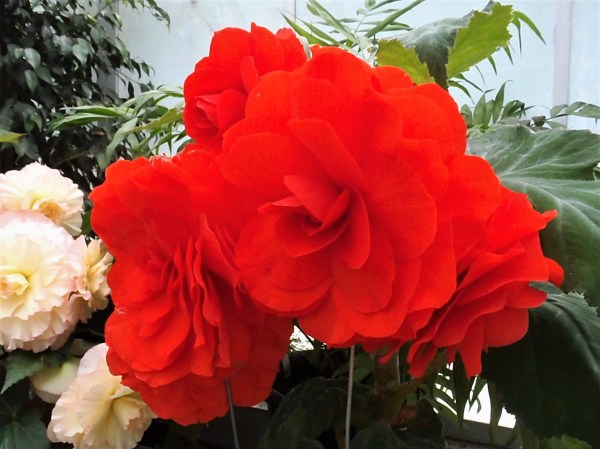
Red Begonias, Christchurch Botanical Garden, (D. Kopacz, 2011)
During this work, I was befriended by Joseph Rael (Beautiful Painted Arrow), who has been working for world peace since the 1980s when he had visions of Sound Chambers, Peace Chambers: circular structures, half above ground, half below ground, with men and women chanting for peace. He has created over 50 chambers for peace across four continents.
Working with Joseph has reinforced and shaped my identity as a psychiatrist who is not just treating mental illness, but is supporting cultural transitions and transformations, and is creating peace. Joseph would agree that “words create worlds.” He often talks about the power of sound and speech. When we were working on our book, Walking the Medicine Wheel: Healing Trauma & PTSD, Joseph would tell me, “I am my brother’s keeper.” As I contemplated this saying, I realized he was not just stating a world-view of many indigenous people—that we are all interrelated and connected—but that he was also speaking an antidote to the first murder documented in the Bible. After Cain killed his brother, Abel, God asks Cain where Abel is and Cain says, “I do not know; am I my brother’s keeper?”[2] With these words an identity of separation is created in the Biblical tradition. Joseph, in saying “I am my brother’s keeper,” is using words as an antidote for an illness of separation which is once again becoming an epidemic in our world.
“Words create worlds.” J.M. Berger, author of Extremism, would likely agree with this statement. Writing for the Atlantic, he writes of the dangerous impact of publishing and thus publicizing the words of mass murderers.
“It is far past time to reconsider the standard for publishing such manifestos. That does not mean we should abandon the search for meaning. But manifestos are rarely simple confessional documents. They are works of propaganda, just like ISIS beheading videos and al-Qaeda’s Inspire magazine. Like those publications, journalists should report on manifestos, but they should mediate their propagandistic intent instead of blindly amplifying it. . .We have only begun to suffer the cost of these writings, crafted with an intent no less lethal than their authors’ violent crimes.”[3]
We find ourselves in a war of words. I try not to use the word “enemy.” To think of someone as an enemy is to make them “other” and this is the very root cause of violence, hatred, racism, and bigotry. To meet violence with violence or hate with hate does not create peace. Rather than enemy, I think opponent is a better term. The United States fought wars against England, Japan, and Germany. They were our opponents during the wars, but they are not our enemies. Consider the relationship between Gandhi and Jan Smuts. Smuts was the only person to sign the peace treaties ending both World War I & II. He advocated for the League of Nations following World War I. Yet, earlier in his life, he was a proponent of apartheid and he had a worthy opponent in South Africa on this, Gandhi. While Gandhi was imprisoned he made Smuts a pair of sandals. He returned the sandals for Gandhi’s 70th birthday, writing, “I have worn these sandals for many a summer, even though I may feel that I am not worthy to stand in the shoes of so great a man.”[4]
These two men struggled against each other for their beliefs, and yet they were not life-long enemies. Smuts literally walked in Gandhi’s shoes. We can wonder if this influenced Smuts’ later 1926 book, Holism and Evolution, in which he coined the word, “holism,” the concept of not seeing things through separation and isolation, but as component parts of a larger whole.
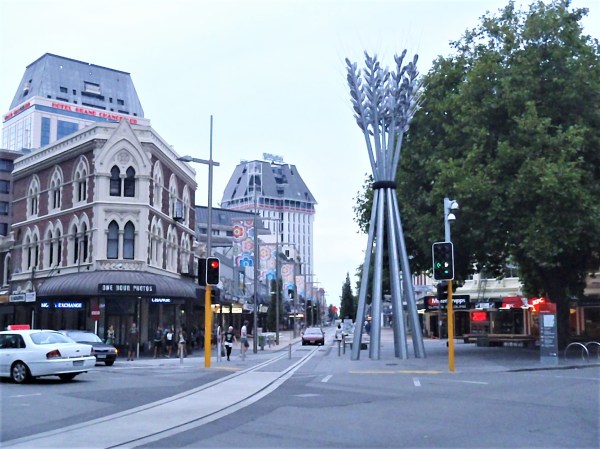
Christchurch, New Zealand (D. Kopacz, Feb 2011)
In this war of words we are struggling with our own darker natures, as well as the darker nature of all humanity. It is human nature to view ourselves as separate tribes and clans and peoples based on the superficial colour of our skin or which football team we support, or which religion we belong to. Yet there is also a deeper truth that we are all one, we are all interconnected, sharing the same Earth. The findings of scientists about Mitochondrial Eve and Y-Chromosome Adam tell us that we all are, literally—not just figuratively—brothers and sisters.[5]
This war of words is a struggle about what kind of world we are going to create: a world in which everyone is equal and everyone has a place and a voice, or a world which is only for some people, a world where some people have more rights than others. This is a struggle of words and world-views which is being waged in the hearts and minds of all human beings on planet Earth as we try to come to terms with our interrelatedness and oneness.
Gerald Arbuckle, a Catholic priest and cultural anthropologist (who is from New Zealand and lives in Australia) has been studying the effects of loneliness and isolation and the resurgent rise of fundamentalism in our world.
He calls this a “global epidemic of fundamentalism both religious and political,” and he defines fundamentalists as “boundary-setters . . . marking themselves off from others.” Arbuckle sees, “A typical fundamentalist leader is a populist, homophobic, charismatic, authoritarian man who likes to bully,” a personality type that is only all too common in positions of power across the world.[6]
To see ourselves as separate from others opens the doors to discrimination, racism, and violence. Separation leads to loneliness and authoritarian and fascist movements promise a way out of loneliness through belonging to a tight-knit in-group based on an exclusionary identity opposed to another group or culture. Fascisms power comes from having an “other” who is an enemy. We should be very suspicious of the use of this word “enemy,” for instance in hearing the press called the “enemy of the people,” which is an age-old fascist trope.
Christchurch Cathedral – February 2011, prior to being destroyed in earthquake (D. Kopacz)
New Zealand Prime Minister, Jacinda Ardern’s response to these recent killings was this: “Because we represent diversity, kindness, compassion. A home for those who share our values. Refuge for those who needs it. And those values will not and cannot be shaken by this attack.”[7]
New Zealand is geographically isolated, tucked away in the South Pacific, it has a strong anti-nuclear policy, refusing to allow nuclear U.S. warships into port. In New Zealand, the police do not openly carry guns. One former patient of mine, a teenage refugee from the Balkans, told me, “As soon as I saw the police here in New Zealand do not carry guns, I finally felt safe after years of war.” Now we have a major act of terrorism in New Zealand. In the United States we have debates over gun violence. Second Amendment Rights advocates always argue for more guns after gun violence, but research on gun ownership and gun violence shows that guns are more likely to be used in suicide or against someone in the home than they are against a violent “other.” In the United States, powerful lobbies and ideologies actually banned scientific research on gun violence for fear that it will lead to restrictions in gun ownership.[8] How do we respond to gun violence, terrorism and acts of hatred? Research for individual gun ownership does not support that we should all arm ourselves. The suspected killer in Christchurch, a 28 year-old, Australian born man targeted this gun debate and wanted to fuel the flames. Reporting in the New York Times states:
“Writing that he had purposely used guns to stir discord in the United States over the Second Amendment’s provision on the right to bear arms, he also declared himself a fascist. ‘For once, the person that will be called a fascist, is an actual fascist,’ he wrote.”[9]
We should take a closer look at this word, “fascist,” including its current manifestations and history, because it is like a disease that our global civilization has had a recurrence of in recent years.
Duke professor of Asian and Middle Eastern Studies, Omid Safi writes of these killings,
“This terrorist attack is not an aberration. This is not about mental illness, it is not about one person. This is where all the anti-Muslim, anti-immigrant discourse over the last few years leads to.”[10]
Safi sees the roots of these killing in the ideas and words of white supremacy and he anticipates the gun rights arguments that “guns don’t kill people, people with mental illness kill people.” Yet when we have the confluence of easily accessible lethal means and a growing epidemic of violent words, there is an increase in violent actions. “Words create worlds.”
Nietzsche warned us that those who fight something risk becoming the very thing they fight, “Whoever fights monsters should see to it that in the process he does not become a monster. And when you look too long into an abyss, the abyss also looks into you.”[11]
Pink Begonias, Christchurch Botanical Gardens (D. Kopacz, 2011)
Clarrissa Ward, from CNN, sees a similarity in the ideas and words of the far-right and terrorist organizations.
“To me, there’s almost a symbiotic relationship happening right now between extreme terrorists on the far-right and between some of these other terrorist organizations that we’re more familiar with.
The other thing that’s interesting, and disconcerting, frankly, is how much of the language and ideas he [the Christchurch killer] talks about have also seeped into mainstream political rhetoric.
He talks a lot about the idea of invasion, that Muslim migrants are invading white Western countries. He talks about the birth rate, the idea of replacement, that white culture is being replaced. We’ve heard such words coming from the President of the United States. We’ve heard them coming from far-right governments in Europe, whether it be Italy, whether it be Hungary. . . .
When you look at the zeitgeist and the rise of the far right in Europe and the US, ideas that were once considered as taboo to talk about are now being flaunted and public discourse invariably sets a tone.”[12]
Ward raises this disturbing spectre that Western Democracies are at risk of becoming our enemies—state-sponsored terrorism and extremism. The disturbing rise of far-right ideologies and words is being supported at the highest levels of governments across the globe.
Over the next year, I would like to write about some of these topics of how our “words create worlds.” In working with Joseph Rael, writing our next book, Becoming Medicine: Pathways of Initiation into a Living Spirituality, I felt compelled to write about the responsibility of mystical, visionary, and shamanic experience—that we must work toward “Spiritual Democracy.” At its deepest point, mystical experience leads to an awareness that we are all one and this comes with a responsibility to challenge words of separation which ultimately lead to fascism. Mystical experience is a pathway that leads us to question who we are and gives us a responsibility to use our words wisely to create worlds where we are becoming the medicine that our world needs. As Rumi says, “We are pain and what cures the pain.”[13]
Cape Reinga, North Island, New Zealand – meeting of the Pacific Ocean and the Tasman Sea (D. Kopacz, 2013)
[4] Mahatma Gandhi, The Essential Gandhi: An Anthology of His Writings on His Life, Work, and Ideas, ed. Louis Fischer, 98.
[5] This is discussed in National Genographic DNA results. Also see Siddhartha Mukherjee’s The Gene: An Intimate History and “Y-Chromosomal Adam,” Wikipedia.
[6] Gerald Arbuckle, Fundamentalism At Home and Abroad, 28, 9, 15. Also see his recent book, Loneliness: Insights for Healing in a Fragmentary World.
With these paintings we are entering into Chapter 10: Enlightenment & Endarkenment. My contribution is “Blue Feather,” inspired by Richard Bach’s book, Illusions. In the book, the teacher Donald Shimoda is encouraging his student, Richard, to practice visualizing from imagination into reality.
Blue Feather, David Kopacz
The painting from Joseph is “Candle of the World #1 – Ordinary and Non-ordinary Realities,” showing 2 candles facing each other with a circular counter-clockwise movement between Ordinary and Non-ordinary Realities. We’ll have Candle of the World #2 in a later series.
Candle of the World #1 – Ordinary and Non-ordinary Reality, J. Rael (2017)
“Listen!” he called across the gulf between us. “This world? And everything in it? Illusions, Richard! Every bit of it illusions! Do you understand that?” (Richard Bach, Illusions, p. 69).
The first painting is “When the People Went into the Cave of Existence and Returned as Made People Ceremony.” Joseph often speaks of the True Human and how it is an ongoing process and effort to become a True Human. This painting links the cave as a place of self-connection and transformation, we are still in Chapter 9: Guha: Cave of the Heart.
When the People Went into the Cave of Existence and Returned as Made People Ceremony, J. Rael (2006)
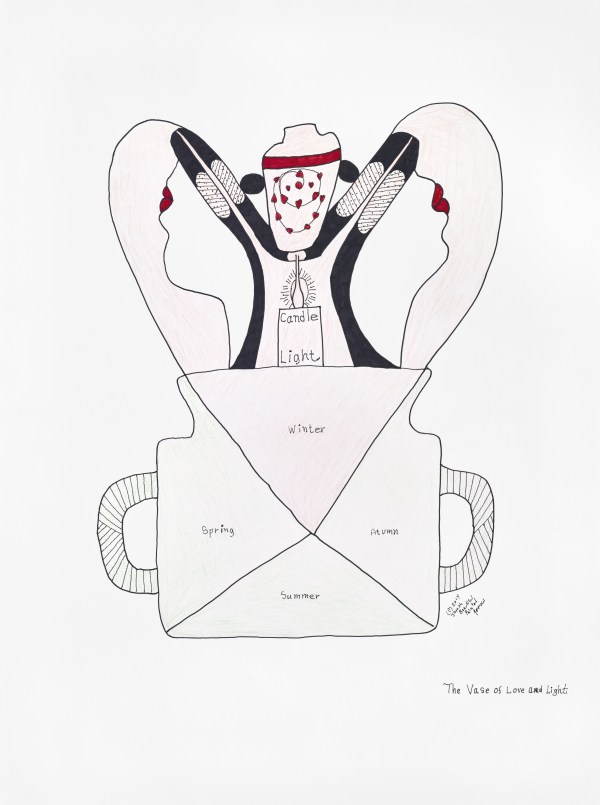
The next painting is “The Vase of Love and Light,” which features a vase with the medicine wheel of the four seasons.
The Vase of Love and Light, J. Rael (2014)
“The ‘c’ in ‘cave’ is pronounced ‘Kay.’ There is a blanket that has been placed over that moment when the people go into a cave, that is why caves were created in the beginning by the original architect, even before goodness. We don’t know who the original architect is. God is a phenomenon that we have created. Kay means to cover oneself up with the blanket of something, getting blindsided. But you have to do that, you have to go in blindsided, covering your vision, you can’t be a visionary unless you go into this darkness. Kay also means the beginning. Something has ended. Kay means something has ended because something has just been born, so the caves in ancient time, the caves over here in Colorado, the metaphor of the caves means a beginning. You are blindsided, you have to be blindsided to go into the caves.” (Becoming Medicine, p. 227, Joseph Rael)
The next two paintings from Becoming Medicine: Pathways of Initiation into a Living Spirituality are both by me. They are both from Chapter 9: Guhā: Cave of the Heart. I came across this Sanskrit word, guhā, meaning “cave of the heart,” and I thought it fit quite well with Joseph’s description of the human being as a medicine bag and the center of the heart being represented by the essence of carrying. Our hearts need to be empty at some point in order that we can find their fullness at a later point.
The first painting for this chapter is “Heart Meditation” which I painted around the start of working on Walking the Medicine Wheel: Healing Trauma & PTSD. I realized, at some point, that our heart, although we often think of it as light, labours away in the darkness of our chest. Our heart never sees the light of day. It is up to us to enter into the darkness of ourselves, the darkness of our chests, to bring forth this light hidden in the darkness.
Heart Meditation, D. Kopacz (2014)
The next painting is “Heart at the Center of Dark Matter.” Joseph is always sending me clippings from science news sources about dark matter and dark energy. The Tiwa mysticism is based on going into the kiva and sitting in the darkness to await the emergence of visions and revelations. In this painting I tried to capture the central medicine wheel within the darkness of the heart sending out energy into the cosmos. This painting was from near the end of Walking the Medicine Wheel.
Heart at the Center of Dark Matter, D. Kopacz (2016)
I asked Joseph about the meaning of caves and this is what he said:
“Nah au kwee leh neh is the Tiwa word for cave. Nah means ‘self.’ Au kwee – means ‘curved.’ Leh neh means ‘straight like a fence.’ “Nah means that when we enter a cave, we are entering into ourselves and we should think of the cave as our self. We should expect that when we first enter the cave it will turn every which way and it can get confusing, but eventually it will straighten out and you will then find what you are seeking.
“When I was a kid, I would ride my bike and swerve back and forth. I would pretend that I was riding in a cave and swerving down the passageways.. . . I would pretend I was in a golden, diamond-studded cave with jewels as big as coffee cups. Each jewel would have a special sound—I would listen for it in my imagination. My grandfather said that I should listen to things as I moved through them, like passing by rows of trees on either side as I rode my bike and I would listen to them singing. I always was really fond of trees and I spent as much time with them as I could.”
My concerns of the risk to our Union are even greater now than they were in 2017. This article was inspired by the removal of the motto of the United States from the presidential coin as described in the Washington Post article by David Nakamura & Lisa Reinin in the Dec 22, 2017 article, “It’s ‘very gold’: The presidential coin undergoes a Trumpian makeover.”
“The presidential seal has been replaced by an eagle bearing President Trump’s signature. The eagle’s head faces right, not left, as on the seal. The 13 arrows representing the original states have disappeared. And the national motto, “E pluribus unum” — a Latin phrase that means “Out of many, one” — is gone.”
Instead, both sides of the coin feature Trump’s campaign slogan, “Make America Great Again.”
The Great Seal of the United States, Public Domain, Wikipedia
The motto of the United States is E pluribus unum, which is Latin for “Out of many, one.” Joseph Rael (Beautiful Painted Arrow) and I have written about the importance of this motto in our book, Walking the Medicine Wheel: Healing Trauma & PTSD. This motto is of crucial importance for helping veterans return home after war and reconnect to their own hearts and to society, which is why Joseph and I wrote about it, but it is also crucial for all of us and the very fabric of democracy―in the United States as well as in the rest of the world. The ability to see our similarities rather than our differences allows us to see that the suffering of others suffering is our suffering and that others joy is our joy. When we view other human beings as “other,” this sense of separation makes violence possible. Peace comes from a sense of unity, not a sense of “otherness.” “The heart of violence is the divided and separated heart,” we write, the heart of violence is “the heart that cannot see other hearts as interrelated and interconnected.”
“Violence has its roots in the false idea of separation. Physically we appear separate, but even physically we are in a complex web of life with animals, plants, and the earth. When we begin to speak about human realities beyond the physical: emotion, heart, intuition, and spirit, the idea of ourselves as separate beings no longer makes sense. One can only be violent against someone or something seen as ‘other,'” (Kopacz & Rael, Walking the Medicine Wheel:Healing Trauma & PTSD, 214).
Currently in the world, we are seeing more division and separation than coming together in unity. The recent order by the president of the United States banning all international refugees and also citizens of Iran, Iraq, Libya, Somalia, Sudan, Syria, and Yemen from entering our Nation of Immigrants is the latest and most extreme example of this. This breaks my heart and it breaks the heart of democracy. I worry for the future because, through my work with Joseph, I know that peace depends upon unity and similarity and that the current mania for separation and division is very dangerous. The rise of nationalism has historically been associated with violence and the rise of totalitarian regimes for the very fact that an over-emphasis on “me first” leads to seeing “others” as getting in my way. We teach our little children, “Don’t rush to the front of the line, don’t push others aside.” We teach our children to respect others, and yet respect has been one of the first casualties in the current national and world-wide Me First Movement. In a very, very short time, the public dialogue has shifted so far toward disrespect and hatefulness that people feel justified in hate speech and separation speech.
We are seeing the rise of nationalism world-wide: Brexit, throughout Europe, the Philippines, the United States, Russia, and Turkey. Nationalism very easily leads to violence against “others” and once the mad dog of nationalism is let off leash, even a country’s own people can all too easily be labeled as “others.” The media, which often serves as a watch dog to power, is often the first to be vilified and silenced.
Our institutions of unity and collectivism are being seen as obsolete, holding us back, ineffective. The institution of democracy, the United Nations, NATO, the European Union―these are the organizations that we have created to moderate human selfishness in order to promote peace and equality. Parker Palmer, in his book Healing the Heart of Democracy, writes that democracy is one of the ways that we, as human beings, seek to civilize ourselves. Palmer sees democracy as one of our best tools of civilization and that these tools “constitute the core self-hood called the human heart” (Palmer, 81).
“For those of us who want to see democracy survive and thrive―and we are legion―the heart is where everything begins: that grounded place in each of us where we can overcome fear, rediscover that we are members of one another, and embrace the conflicts that threaten democracy as openings to new life and for our nation,” (Palmer, 10).
How much are we the people of the United States of America making decisions from the heart? To what extent are our current elected officials leading from the heart? What will happen to us if we give up on unity, if we glorify everything falling apart? Louis Ferdinand Céline, writing about World War I, wrote that people had become “madder than mad dogs” because dogs don’t worship their madness.
“Could I, I thought, be the last coward on earth? How terrifying! … All alone with two million stark raving heroic madmen, armed to the eyeballs? With and without helmets, without horses, on motorcycles, bellowing, in cars, screeching, shooting, plotting, flying, kneeling, digging, taking cover, bounding over trails, root-toot-tooting, shut up on earth as if it were a loony bin ready to demolish everything on it, Germany, France, whole continents, everything that breathes, destroy, destroy, madder than mad dogs, worshipping their madness (which dogs don’t) a hundred, a thousand times madder than a thousand dogs, and a lot more vicious! A pretty mess we’re in!” (Céline, Journey to the End of the Night).
Céline bore witness to the brutality of World War I and he calls himself a “coward” because he doesn’t want to join in the blood bath of killing “others.” However, non-violence has been raised to a spiritual virtue and political power by people like Martin Luther King Jr. and Gandhi. (Céline did succumb to his own madness and cowardice in turning against the Jewish people in the lead-up to World War II, and citing him here in regard to World War I in no way condones his later anti-Semitism). I choose to quote Céline because his phrase “madder than mad dogs, worshipping their madness (which dogs don’t)” keeps echoing in my mind recently. There is something very scary about the Me First Movement in U.S. politics that is worshipping madness, division, and hatred. This is happening in the United States of America―right now, yet it has roots going back over the past decades, and honestly back to the history of the European colonization of this land.
Going back to the early days of the U.S. “war on terror,” journalist, Andrew Cohen, wrote “Our journey toward Abu Ghraib began in earnest with a single document — written and signed without the knowledge of the American people” (The Atlantic, “The Torture Memos, 10 Years Later,” February 6, 2012). Cohen continues:
“On February 7, 2002…President George W. Bush signed a brief memorandum titled ‘Humane Treatment of Taliban and al Qaeda Detainees.’ The caption was a cruel irony, an Orwellian bit of business, because what the memo authorized and directed was the formal abandonment of America’s commitment to key provisions of the Geneva Convention. This was the day, a milestone on the road to Abu Ghraib: that marked our descent into torture — the day, many would still say, that we lost part of our soul.”
White House Counsel, Alberto Gonzales wrote that the Geneva Conventions should not restrain the United States any longer in how we treat prisoners. “In my judgment, this new paradigm renders obsolete Geneva’s strict limitations on questioning of enemy prisoners and renders quaint some of its provisions,” he wrote. I remember this as a very disturbing philosophical position our government took as it eroded the work of many countries and peoples work to prevent war crimes. When we stop appealing to our higher humanity and to our collective sense of ourselves as brothers and sisters―even while temporarily enemies―we not only take away what makes others human, but we lose our humanity as well. This is because humanity is a two-way street of interaction and of unity. Humanity is a state of interactive being and when we take away this human state of being from others (whether they be Muslims, women, African-Americans, American Indians, people with different sexual orientations or identities, or anyone who disagrees with us), we lose our own humanity as well and we risk becoming mad dogs worshipping our madness as we have let ourselves of the leash of humanity. It is difficult to understand the current anti-immigrant sentiment in the U.S. because anyone who is not a full-blooded American Indian is an immigrant to the United States. The current president of the United States is an immigrant, as are most of us who have come together as one people in the United States.
It breaks my heart to see the people of the world turn our backs on the institutions we have worked so hard to create that call forth our higher humanity and work to promote peace. What we are witnessing is a kind of war of the many against the One. William Butler Yeats, writing in the aftermath of WWI, in 1919 captured this spirit in his poem, “The Second Coming,” which includes the lines:
“Things fall apart; the centre cannot hold;
Mere anarchy is loosed upon the world,
The blood-dimmed tide is loosed, and everywhere
The ceremony of innocence is drowned;
The best lack all conviction, while the worst
Are full of passionate intensity.”
The loss of central cohesion, the centripetal force of humanity, leads to the break-down of our sense of shared humanity paves the way for dangerous economic and social policies and paves the way for violence against “others” whose humanity we have taken away, thereby losing our own humanity.
“And we want Americans to know that the torch borne by the Statue of Liberty is not just a magnet for immigrants, it is a projector, shining the promise of democracy around the world. The United States is the world’s greatest economic power, the world’s greatest military power, and with your vigilance, it always will be. But the greatest power we project is hope, the promise that people can establish liberty in their own country without leaving it.”
“I mean that the promise of America is not just that people can come here and build a better life, a free life. But I’ve been overseas in countries where the American model of democracy has been a powerful inspiration for people to build democracy at home without the need to immigrate to the United States. And if we build walls between ourselves and other countries, we will dim that light forever.”
One of our primary global institutions of peace is the United Nations. The United Nations, formed in 1945 in the aftermath of World War II, includes 193 states and serves as the earth’s only inclusive organization that promotes peace between countries and condemns violence. The newly appointed U.S. Ambassador to the U.N., Nikki Haley threatened the organization in her first speech, saying that “we are taking names” and repeating that “this is a time of strength” (Somini Senguptajan, “Nikki Haley Puts U.N. on Notice: U.S. Is ‘Taking Names,’” The New York Times online, January 27, 2017). The speeches and positions coming out of the current administration sound more like those of school-yard bullies than of elected democratic officials. “War is peace, freedom is slavery, ignorance is strength,” this motto of George Orwell’s dystopian society in his book, 1984, warns us about the kind of rhetoric we are now hearing from the Nation of Immigrants. The ME First Movement does not play well with others and it distorts facts and reality to suit its needs. The only thing more dangerous than a bully is a group of people blindly following a bully.
Joseph Rael (Beautiful Painted Arrow) was recognized by the United Nations in a 2/20/89 letter for his work promoting peace through building Peace Chambers on four different continents. What Joseph has taught me is that the work of peace is spiritual work, and spiritual work is what makes us true human beings. Peace requires us to be seekers of our common goodness, our common shared humanity. The place that we find this common goodness and unity is in our hearts.
“If we remember E pluribus unum on the Great Seal of the United States, we will remember that we are called to work toward an ideal that moves us from our many individual identities into a larger Union. E pluribus unum is Latin for ‘Out of many, one.’ This identity is not just the social body of peacemakers, it is also the mystical and spiritual identity of visionaries and mystics. This is the realm of unity that Joseph is familiar with as a visionary and healer,” (Kopacz & Rael, 215).
If we focus on separation and division, we not only destroy peace, we promote violence. This is why Joseph and I say that we all must move from seeing each other as “other” and move toward seeing each other as brother and sister. This is why we cannot give up on E pluribus unum―within the myriad of forms, we must always be seeking the spiritual unity of humanity and the cosmos.











 Being Fully Human