Words Create Worlds.11: What Are We Going to Do Now?

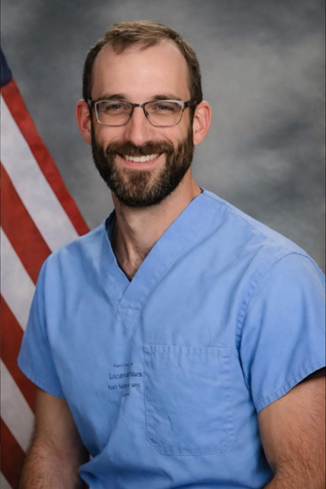
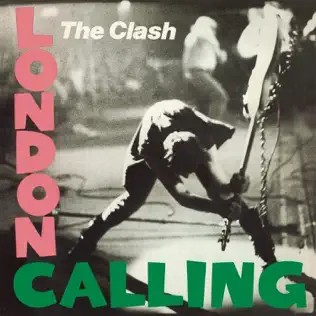
Images: Renee Nicole Good and Alex Pretti were shot and killed by ICE in January, 2026. ICE photo by David Guttenfelder/The New York Times/Redux. The cover of The Clash’s 1979 album London Calling.

The Clash song, “Clampdown,” from the 1979 double album Londong Calling, starts with the question: “What are we going to do now?”

I have had this song by The Clash going through my head this past week. Now after the second killing of American Citizens by ICE in the past month, I keep asking myself, asking us, “What are we going to do now?”

The shooting death by masked government agents of Alex Pretti strikes close to home as he was a VA ICU nurse. Having trained and worked in the VA system for close to 20 years, I know the kind of professional dedication and commitment that VA employees bring to caring for Veterans who have served their country.

Renee Nicole Good had just dropped off her 6-year old at school before she was shot by armed masked government agents. Her last words were reportedly, “That’s fine, dude. I’m not mad at you.”

“What are we going to do now?”

I always wondered what “the clampdown” was when I listened to this Clash song as a kid. I wasn’t sure what it was, but I knew I didn’t want to work for it – and I know I don’t want to work for it now.

Taking off his turban, they said, is this man a Jew?
‘Cause they’re working for the clampdown
They put up a poster saying we earn more than you!
When we’re working for the clampdown

I pictured something like Hitler’s paramilitary Brownshirts, or some other loosely organized group that came together to inflict violence on it’s own people. I suppose this queston of those working for the clampdown about “is this man a Jew” made me think of the Nazis.

We will teach our twisted speech
To the young believers
We will train our blue-eyed men
To be young believers

The Clampdown seems to require teaching “twisted,” violent speech to the young of the nation, and invoking “our blue-eyed men” again recalls the Nazis. It continues to confound me how many MAGA and now ICE believers there are, who don’t see how words create worlds. The deaths of Renee Nicole Good and Alex Pretti are the worlds that have been created by the words of name calling and bullying and “othering” of Americans.

The judge said five to ten, but I say double that again
I’m not working for the clampdown
No man born with a living soul
Can be working for the clampdown

At least some judges are finding for the rule of law, but what happens when the judges are working for the Clampdown? I hesitate to dehumanize others and say they don’t have a “living soul,” but dehumanization, scapegoating, projection, and “othering” are key psychosocial operations that pave the way for violence. I can see questioning the humanity of those working for the Clampdown when the Clampdown dehumanizes others.

Kick over the wall ’cause government’s to fall
How can you refuse it?
Let fury have the hour, anger can be power
D’you know that you can use it?

It does seem like government is falling. We have a crisis between the federal government’s masked paramilitary organization. The Feds are blocking city and state government from investigating these shooting deaths of American citizens. Who holds the power here? Why are there armed masked men kicking down doors and kicking over walls? The seem to encapsulate the fury of the hour, which is how I always heard that line. The current President seems to have a fury of the hour, but The Clash seem to say that those with the fury are carrying the hour. Anger can be power. That is true. Anger can be power. “Do you know that you can use it?” This could be giving permission for paramilitary organizations to channel their fury and anger into anti-democratic activities and violence. But we can also hear this line from the perspective of those asking “What are we going to do now?” We can channel our anger into peaceful protest, into not looking away from abuses of power and tyranny. But again, this line could also be from the hooligans who have risen to power, looking toward their leader, ready to carry out the fury of the hour.

The voices in your head are calling
Stop wasting your time, there’s nothing coming
Only a fool would think someone could save you

Here The Clash tell us that it would be foolish to think that someone is coming to save us, we each have to refuse to work for the Clampdown.

The men at the factory are old and cunning
You don’t owe nothing, so boy get running
It’s the best years of your life they want to steal

Now the Clampdown also takes the form of the “old and cunning” men who want to steal the “best years of your life.” The Clampdown takes away your rights, it takes away your soul, it can steal away the best years of your life, and, apparently, it can even take your life with impunity.

You grow up and you calm down
You’re working for the clampdown
You start wearing the blue and brown
You’re working for the clampdown

I heard this as a warning. It is one thing to be full of a piss and vinegar as a young punk, but there is a risk that you “grow up” and you “calm down” and end up working for the Clampdown, even though you resisted it in your youth. I knew about the Brownshirts, but I didn’t know about the Blueshirts – are The Clash singing about the Irish party of that name? I’m not sure. It is clear though, The Clash are warning you not to work for the Clampdown, no matter whether you are wearing a brown shirt, a blue shirt, or a red white and blue shirt.

So you got someone to boss around
It makes you feel big now
You drift until you brutalize
You made your first kill now

This is always a chilling stanza. I always think of the kids who I had been friends with in elementary school who became thugs and bullies in high school. People who feel small and have listened to the “twisted speech” and become “young believers” that the way to feel big and powerful is to find someone to “boss around.” Once you have given over your power to the fury of the hour, you cease to direct your own actions, you become a puppet who drifts “until you brutalize,” and from there the next step is making “your first kill now.” Words lead to action which leads to creating worlds of violence and when you are working for the Clampdown, you can easily end up killing.

I had to look this line up on The Clash website because Google Lyrics listed it as “Doesn’t make you first kill now,” which really doesn’t make any sense.

In these days of evil presidentes
Working for the clampdown
But lately one or two has fully paid their due
For working for the clampdown

Doesn’t that just capture it! It sure seems like we are living in the “days of evil presidentes/working for the clampdown.” We can only hope that one or two will fully pay their due. Right now it seems like the Clampdown is in charge and unrestrained.

Ha! Gitalong! Gitalong!
Working for the clampdown
Ha! Gitalong! Gitalong!
Working for the clampdown

Not much more to say here – sounds like a cattle drive with masked armed men who have immunity under the Federal government, trying to heard along protesters and killing the occasional one or two.

Yeah I’m working hard in Harrisburg
Working hard in Petersburg
Working for the clampdown

Everyone, no matter they are, they’re working – and either your working hard for the Clampdown, or your working hard against it.

Ha! Gitalong! Gitalong
Begging to be melted down
Gitalong, gitalong
(Work)
(Work)
(Work) And I’ve given away no secrets – ha!
(Work)
(Work)
(More work)
(More work)
(Work)
(Work)
(Work)
(Work)
Who’s barmy now?

The song just tails off with “work” and “more work,” finally asking “who’s barmy now?” Meaning who’s crazy, I suppose. “Clampdown” gives us much to think about in the United States at this moment. It gives us pause and reminds us that the Clampdown could be almost anything and could be almost anywhere, but right now it is here…now.

“What are we going to do now?”

Maybe the answer to that question is: you are either working for the Clampdown – or you are not.

Are you working for the Clampdown?

Clampdown, Live – Fridays 1980: shorturl.at/TdE5A

London Calling album, studio version: rb.gy/kdhzxe

Words Create Worlds.10: Jung Did Not Write about Empaths vs. Narcissists

The last Words Create Worlds essay in this blog was “Words Create Worlds.9: Life and Death are in the Power of the Tongue” on January 7th, 2021, the day after the insurrection. I am feeling the need to start writing this series, again, though, with current events in the United States and abroad.

The inspiration for this essay series comes from Rabbi Heschel. He said, as recounted by his daughter, Susannah Heschel:

“Words, he often wrote, are themselves sacred, God’s tool for creating the universe, and our tools for bringing holiness—or evil—into the world. He used to remind us that the Holocaust did not begin with the building of crematoria, and Hitler did not come to power with tanks and guns; it all began with uttering evil words, with defamation, with language and propaganda. Words create worlds, he used to tell me when I was a child. They must be used very carefully. Some words, once having been uttered, gain eternity and can never be withdrawn. The Book of Proverbs reminds us, he wrote, that death and life are in the power of the tongue.”[1]

We live in what is increasingly called a post-truth world and with the growth of AI, truth is getting even more difficult to ascertain. Truth may become only one perspective amongst many in the marketplace and in politics.

The reason I am reviving this essay series is because I have recently had two clients refer to videos by “Carl Jung” discussing empaths and narcissists. I found this very strange, as the word “empath” is a contemporary term which Jung did not use. “Narcissist” is also a term he rarely used. I cautioned my clients that these could be AI created fictions and began looking into the source of this misinformation.

I count 208 videos posted by Surreal Mind (listed as joining April 26, 2025) on YouTube, with 137K subscribers. Most of these videos contain AI images of Jung in different settings and give a muddled mixture of occasional true quotes from Jung (unrelated to empaths and narcissists) in a morass of misattributions. I hesitate to go deeply into these false attributions, lest I lend them credence they don’t deserve. Let us just look at one in video, “4 Stages Every Empath Abuse By Narcissist Goes Through / Carl Jung Psychology,” [sic] (with 31K views), whose first words are a deceptive falsehood. The video starts with the words, “Carl Jung discovered that empaths who survive narcissistic abuse go through four distinct psychological stages, and the final stage terrifies narcissists more than anything else.” These stages are listed on the screen as: 1) “The Light Trap” (a term not found in Jung’s Collected Works – CW); 2) “Soul Extraction” (not found in the CW); 3) “The Dark Night” (found in discussions of St. John of the Cross’ “dark night of the soul” and the nigredo stage in alchemy, but nowhere in regards to “empaths” or “narcissists”); and 4) “The Phoenix Rebirth” (not found in the CW). We do not have to go any further into the video to know that it is not founded on Jung’s works and is therefore a deceptive untruth.

The videos are narrated in a deep English-accented voice (sounding like Terrence Stamp in the movie “Yes Man”) with eerie background tones. (If you get creeped out by these videos, please watch the “Yes Man” scene as an antidote!) The narrator often will quote Jung directly, then blur into a statement such as “stage 2 is what I call the great devouring.” It is not clear who the “I” is who is appropriating Jung’s name, you can’t even say he is appropriating Jung’s work, more stringing together a few unconnected quotes and creating, what could be called a manifesto for empaths fighting narcissists.

As a scholar, I feel obligated to give a few references to debunk the claim that Jung’s work has anything to do with the conceptual framework of these videos.

I have the complete Collected Works of Jung, in book and e-book form, so I did a quick search for “narcissist” and only found 3 instances of variations of that word in the entire twenty volumes of the Collected Works.

“This kind of analysis brings the work of art into the sphere of general human psychology, where many other things besides art have their origin. To explain art in these terms is just as great a platitude as the statement that ‘every artist is a narcissist.’ Every man who pursues his own goal is a ‘narcissist’— though one wonders how permissible it is to give such wide currency to a term specifically coined for the pathology of neurosis.”[2]

The context of this quote is a critique of psychoanalysis reducing the production of art to a neurotic and pathological activity. Jung is in no way writing about the dangers of “narcissists.”

The only other appearance of a variation on the word “narcissist” is in a critique of Freud’s view of introversion and Eastern spirituality as pathological self-focus.

“Freud identifies it with an autoerotic, ‘narcissistic’ attitude of mind. He shares his negative position with the National Socialist philosophy of modern Germany, which accuses introversion of being an offence against community feeling. In the East, however, our cherished extraversion is depreciated as illusory desirousness, as existence in the samsāra, the very essence of the nidāna-chain which culminates in the sum of the world’s sufferings.”[3]

If anything, Jung’s three instances of the word “narcissist” in the CW are a defense of introversion and artistic creation as not being a narcissistic preoccupation with the self, but impliy that there is a healthy form of self-focus possible.

The word “empath” or the concept of a “highly sensitive person” is not found in any of Jung’s writing as these are terms that were developed long after he had died in 1961. Variations of “empathize,” “empathizes,” and “empathized” appear twenty-three times in the collected works, but these are used in the ordinary manner of speech and not referring to “empaths” or “narcissistic abuse of empaths.”

Why would someone create obviously untrue videos and make false attributions to Carl Jung, replete with AI generated images of Jung? I really couldn’t tell you. Maybe someone thinks that invoking Jung gives their ideas credibility or validity?

There is a $39 The Alchemist’s Path: Perception Training for Empaths that can be purchased through the Surreal Mind YouTube site. So, there is possibly some money being made from the popularity of these deceptive videos through sales, but maybe more through ad revenue.

Since initially posting this, I have found another site, The Unconscious Guide, which takes the deception a step further by adding AI voice-over that is supposed to sound like Carl Jung, again speaking about empaths and narcissists.

I am disturbed, on multiple levels, by these empaths vs narcissists videos that are said to grow out of “Carl Jung Psychology:”

  1. These videos are blatantly untrue. They have nothing to do with Jung’s work and misrepresent him as founding a contemporary pop psychology misinformation mill.
  2. The videos clog the internet with AI misinformation.
  3. The videos further the dehumanization we have been trying to counter in medicine and health care by reducing human beings to labels, in this case, “empath” or “narcissist.” We have worked diligently in medicine to shift from the language of “he’s a schizophrenic” to “he is a person living with schizophrenia.” To call oneself an “empath” and another a “narcissist” diminishes the humanity of both people to a label.
  4. The videos promote a division of the world into the good: empaths, and the bad: narcissists. We don’t need further polarization and “othering” in the world at this time, even if it is currently very popular to demonize “others.” These videos encourage people to enter into a kind of “psychological warfare” against an inhuman enemy instead of focusing on one’s own humanity.
  5. Both the medium (the AI aesthetics and auditory tones) and the message (the false attributions to Jung) feel sticky, creepy, and cult-like.

What I am concerned about, beyond the obvious misappropriation, is that I hear clients latching on to the victim aspect of this empath/narcissist narrative. The risk is that people can over-focus on the power of the “narcissist” and ignore their own power. Healing is about caring for Self, not about finding fault in others. As Nietzsche wrote,

“Whoever fights monsters should see to it that in the process he does not become a monster. And when you look long into the abyss, the abyss looks back into you.”[4]

What this quote means to me is that we must be careful in studying the wrongs of others, lest we become like them to “overcome” them. True healing is self-connection and awakening the goodness of your own heart. In addition to the deceptiveness and misrepresentation of Jung, I do worry that this narrative risks being too much about the “other” and not enough about the Self.

Jung is important to me, his book, Modern Man in Search of a Soul, was one of the two books that led me on the path of becoming a psychiatrist (psyche-iatros: soul healer). The other book was M. Scott Peck’s The Road Less Traveled. In Modern Man in Search of a Soul, I learned of a view of the profession of psychiatry that was more than a reductionistic approach to brain chemicals, but a complex psychotherapy focused on personal growth. For Jung, the study of psychiatry included the arts and humanities, anthropology, archaeology, the study of language, dreams, and spirituality. The goal of life, and therefore psychotherapy, was the path of individuation, a journey from the limitation of one’s childhood and public persona to states of greater wholeness. This psychological journey shares a great deal with the spiritual quest. Jungian psychology tends to focus more on the inner journey of growth in which the ego clings to its limited persona and the obscuration of the personal shadow in order to manifest more of the “self.” This path of growth focuses on inner experiences of dreams and visions from the unconscious. This growth is in service to the self, not in service of the ego. Jung’s psychology is not for those who wish to be comfortable in the everyday world, but it is for those who wish to undertake a journey of self-discovery to become not who they think they should be, but to become who they are truly capable of becoming.

Here is the last paragraph of Modern Man in Search of a Soul:

“The living spirit grows and even outgrows its earlier forms of expression; it freely chooses the…[people]…in whom it lives and who proclaim it. This living spirit is eternally renewed and pursues its goal in manifold and inconceivable ways throughout the history of…[humanity]. Measured against it, the names and forms which men have given it mean little enough; they are only the changing leaves and blossoms on the stem of the eternal tree.”[5]

These videos obscure more than reveal Jung and his writings – they are predominantly misinformation and deception. I find them creepy, cult-like AI fantasies. I encourage you to watch the Terrence Stamp scene in “Yes Man” and then go back and watch these videos and see if you look at them differently. If you would really like to learn about Jung, read Memories, Dreams, Reflections autobiographical sketches written by Aniela Jaffé through conversations with Jung, or the newly published Jung’s Life and Work: Interviews for Memories, Dreams, Reflections with Aniela Jaffé, or Carl Jung Speaking: Interviews and Encounters, or The Essential Jung: Selected Writings.


[1] Heschel, S. in “Introduction,” Heschel, Abraham Joshua. Moral Grandeur and Spiritual Audacity: Essays. Farrar, Straus and Giroux. Kindle Edition, 1997.

[2] Jung, CG. “On the Relation of Analytical Psychology to Poetry,” The Spirit in Man, Art, and Literature (CW 15), ¶ 102, p. 68. The Collected Works of C.G. Jung (Kindle Locations 221217-221220). Princeton University Press. Kindle Edition.

[3] Jung, CG. “Psychological Commentary on ‘The Tibetan Book of the Great Liberation,’” Psychology and Religion: West and East (Collected Works 11), ¶770, p. 481. The Collected Works of C.G. Jung (Kindle Locations 148354-148359). Princeton University Press. Kindle Edition.

[4] Nietzsche, F. Aphorism 146, Beyond Good & Evil: Prelude to  Philosophy of the Future, Kaufmann, W (trans). New York: Vintage Books, 1989, p 89.

[5] Jung, CG. Modern Man in Search of a Soul. New York: Harvest, (1933), p. 244. Kindle Edition. Location 3572, (pp. 250-251).

Burnout & Telemental Health: Re-connecting to Ourselves while Connecting to Others

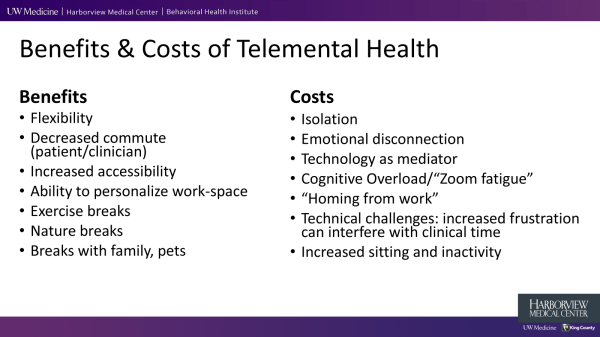
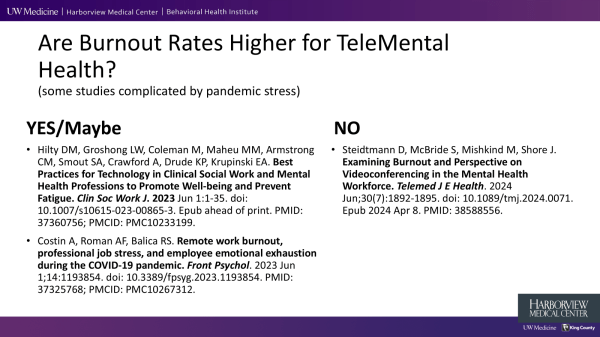
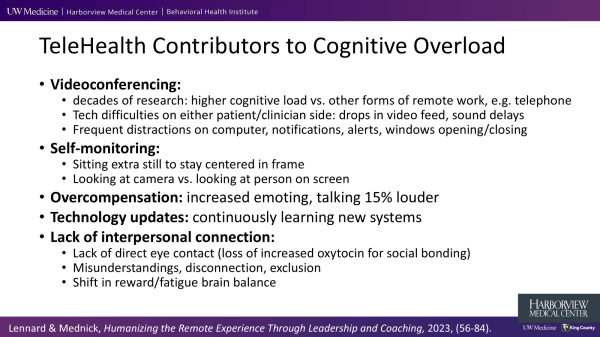
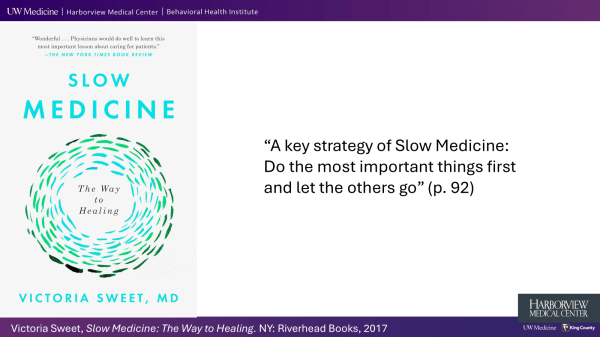
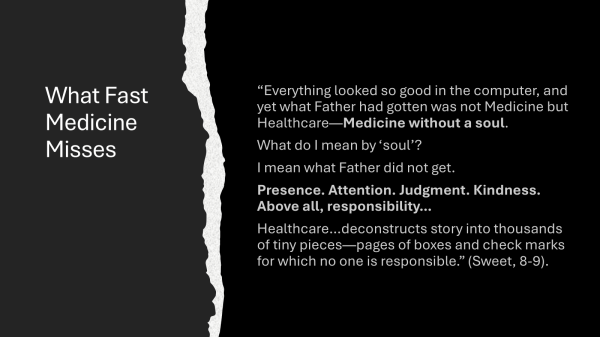
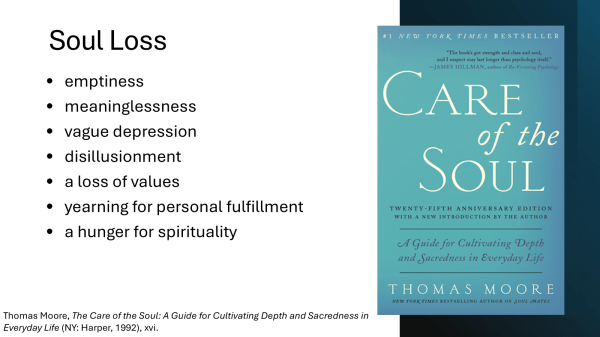
This is the powerpoint of a talk I gave on 1/17/25 on Telemental Health and Burnout through the UW/Haborview TeleBehavioral Health Training Series. Thanks to the team for inviting me.

https://www.theinvisiblegorilla.com/IGvideos.html

Post-Burnout Growth

My friend Lucy Houghton and I have been working on this idea of post-burnout growth, analogous to the concept of posttraumatic growth. We published a preliminary essay in Closler October 18, 2022 called A New Paradigm for Growth.

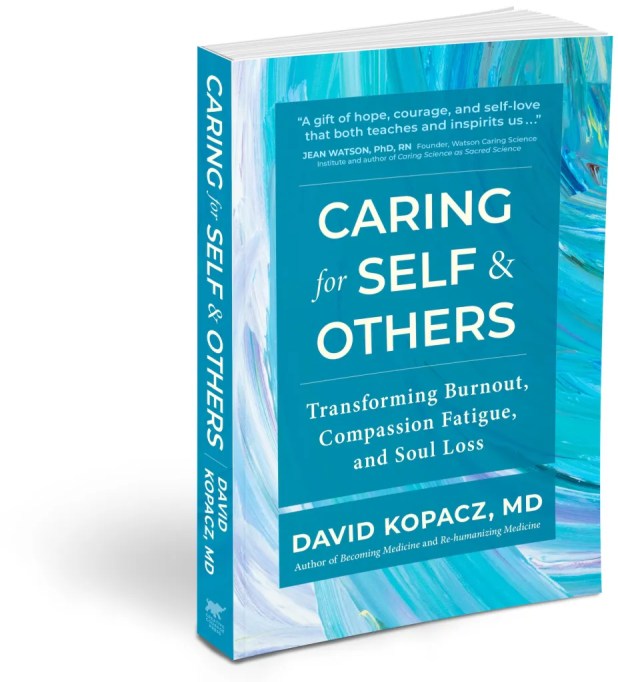
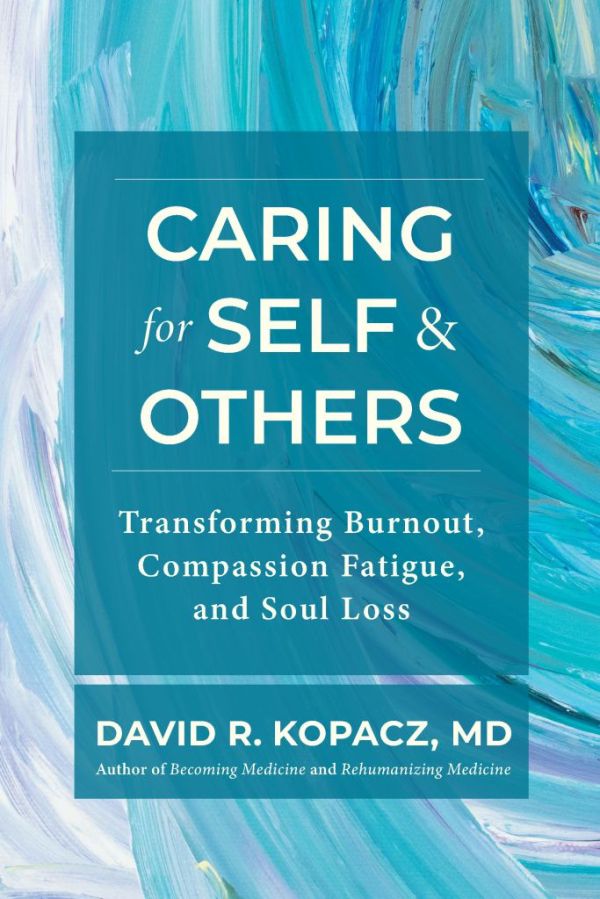
Since then I have continued to elaborate this concept and wrote about it in my latest book, Caring for Self & Others: Transforming Burnout, Compassion Fatigue, and Soul Loss. I would like to offer some sections of the book on the topic of post-burnout growth as a new paradigm for growing through suffering – burnout, compassion fatigue, and soul loss.


Transforming Suffering

Initiation is a model of transformation that is ancient and is found in many Indigenous traditions as well as in the wisdom stories of many religions. In Becoming Medicine, Southern Ute elder Joseph Rael (Beautiful Painted Arrow) and I structured our book based on the three stages of initiation: separation, initiation, and return. While Joseph Campbell came to these stages through the study of stories and cultures, Joseph Rael has lived them through various initiation ceremonies in his education at Picuris Pueblo and the Southern Ute Reservation. Since 2014, Joseph and I have been working together, focusing on different ways that people can transform their own trauma and suffering by becoming healers―that is what it means to be becoming medicine: becoming a healer for yourself, others, and the world.

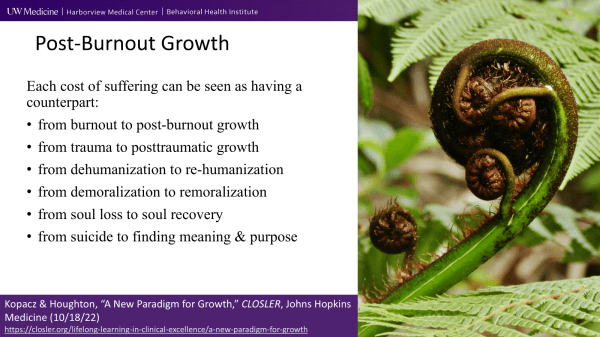
This kind of transformation is what Lucinda Houghton and I have been working on in regard to burnout. We have been calling this post-burnout growth, similar to posttraumatic growth―where suffering is used for personal and professional growth.[i] Posttraumatic growth has been described as: increased appreciation for life, more meaningful interpersonal relationships, increased sense of personal strength, changed priorities, and a richer existential and spiritual life.[ii] These are changes both in self as well as in relationships with others. We view post-burnout growth as not simple resilience of returning to who we were, but actually using suffering as a tool for growing beyond who we were into who we can become.

We can view burnout, compassion fatigue, and even soul loss as calls to initiation, just as Joseph Campbell described the call to adventure in the hero’s or heroine’s journey.[iii] The quest to reconnect with the soul is a kind of heroism that leads to healing. As storyteller Michael Meade tells us, “Life is change and the life of the soul is transformation.”[iv]

David Kopacz, Caring for Self & Others: Transforming Burnout, Compassion Fatigue, and Soul Loss. Palisade: Creative Courage Press, 2024, (pages 19-20)

While burnout and compassion fatigue can feel like we have lost our souls, it is not so much our souls that are lost as we who are lost—we have lost touch with the innermost being of ourselves. As Joseph Rael teaches, Wah-Mah-Chi, Breath-Matter-Movement, holds back a place of goodness in each of our hearts, no matter what we have done and no matter what has been done to us. Burnout and compassion fatigue can be viewed as disorienting dilemmas that start the initiation of transformative learning―post-burnout growth! In this way, periodically losing touch with ourselves (our souls) is actually an ongoing invitation to enter into the healing space of transformational initiation. Our troubles, disorienting as they are, can be the call of transformation. “Thus,” writes Meade, “the troubles we find ourselves in are intended to wake us up to a greater sense of life and awaken the underlying soul, which knows better than us what our life is for.”[v] The loss of energy in burnout and compassion fatigue creates a space that offers us the opportunity to be guided by our inner knowing and inner wisdom of the soul. For, as Meade tells us, “when our energy drains from life’s outer projects, our attention is drawn inward, downward and back towards the original spark of our lives and the genuine project of our soul.”[vi]

Kopacz, Caring for Self & Others, pages (148-149)

Beyond Resilience to the Joys of Caring

While resilience and self-care are part of the puzzle for recovering from burnout and soul loss, to only focus on these individual responsibilities runs the risk of blaming the victim. Are high rates of burnout actually due to the way our systems are designed? Swensen and Shanafelt think so, writing that the “current health care delivery system is perfectly designed to create high rates of professional burnout in physicians, nurses, advanced practice providers, and other health care professionals.”[vii] The problem, then, is not a lack of resilience within staff, but an institutional structure that does not support human flourishing. To address burnout and compassion fatigue, we have to go beyond individual resilience.[viii]

resilience (n.) “act of rebounding” … from Latin resiliens, present participle of resilire “to rebound, recoil,” from re- “back” … + salire ”to jump, leap”[ix]

While the ability to bounce back is important, we also need to transform, which means to grow beyond our previous limits. Transformation means we are not trying to be who we were, rather we are growing into the potential of who we can become. Many are questioning whether resilience is really the answer to the burnout pandemic, particularly within the field of posttraumatic growth. As Edith Shiro writes in The Unexpected Gift of Trauma: The Path to Posttraumatic Growth, “resilience doesn’t help us grow from adversity, it helps us cope with it, and further, “sometimes resilience actually hinders the possibility of achieving” posttraumatic growth.[x]

Richard Tedeschi and Lawrence Calhoun have been studying posttraumatic growth for years and they point out that “continuing personal distress and growth often coexist.”[xi] In this sense, the goal is not to be free of suffering, but to grow from it. This distinguishes a transformative growth paradigm from the prevention and recovery focus on work-readiness of the resilience paradigm. Rather than bouncing back to our previous level of adaptation, transformation helps us grow beyond it. Just as Chenrezig was not put back together with two arms and two eyes, we want to grow in the ability to see and touch suffering. Tedeschi and Calhoun describe posttraumatic growth as an experience where development “has surpassed what was present before the struggle with crises occurred,” and that this is not “simply a return to baseline―it is an experience of improvement that for some persons is deeply profound.” Posttraumatic growth “has a quality of transformation…unlike…resilience.”[xii]

Resilience and subjective well-being can be part of the approach to burnout, compassion fatigue, and soul loss, but only take us so far―they can restore previous functioning, but do not help us grow as healers or as human beings. Posttraumatic growth and post-burnout growth are transformation paradigms that take us beyond resilience, however we still need to look beyond the individual to the health care ecosystems we work in and the institutional variables that contribute to burnout, maintain it, and limit our focus to being the same productive work unit we were yesterday instead of supporting a transformational growth mindset. It is worth re-examining the costs of caring again, this time looking at the systemic and organizational issues, as we have been covering the personal and individual levels. We can look at the costs of caring from a different perspective after taking the journey of caring for self & others. Each cost of suffering can be seen as having a joyful counterpart: from burnout to post-burnout growth, from trauma to posttraumatic growth, from dehumanization to re-humanization, from demoralization to remoralization, from soul loss to soul recovery, and from suicide to finding meaning and purpose which leads to joy and flourishing. It is not easy work to dig ourselves out of the abyss of the costs of caring and to return, transformed, back into the health care world armed with our rejuvenated joys of caring.

Working with people is stressful and exposes us to direct and vicarious trauma. We can’t eliminate exposure to suffering from our work. But we can build in ways to grow in our capacity for caring―this doesn’t mean never suffering, but developing a greater capacity to work with suffering. In addition to individual approaches, we also need to go beyond resilience to create organizations that measure employee idealism and well-being as well as measuring productivity. As the late Alessandra Pigni, a former Doctors Without Borders psychologist, stated:

But is self-care enough to prevent burnout? Yes and no. There is self-care as in “a day at the spa,” recreational self-care, and there is self-care as “care of the self,” a deeper kind of attention to ourselves, the sort that asks questions like, “What am I doing in this group/organization/community? Do I still belong here?” We call this transformational self-care.[xii]

Alessandra Pigni, The Idealist’s Survival Kit: 75 Simple Ways to Avoid Burnout

Transformational “care of the self” challenges us to look not just at ourselves as individuals, but how we fit in the larger institution. If an institution is not supporting our humanity and for whatever reason we are not able or in a position to transform the institution, that may mean we care for ourselves by changing jobs. If transformation is possible, then we roll up our sleeves and contribute to the challenging work of transforming systems and institutions.

Kopacz, Caring for Self & Others, pages (209-212)


References


[i] David Kopacz and Lucinda Houghton, “A New Paradigm for Growth,” CLOSLER, October 18, 2022, https://closler.org/lifelong-learning-in-clinical-excellence/a-new-paradigm-for-growth.

[ii] Richard G. Tedeschi and Lawrence G. Calhoun, “TARGET ARTICLE: ‘Posttraumatic Growth: Conceptual Foundations and Empirical Evidence,’” Psychological Inquiry 15, no. 1 (2004): 1–18, https://doi.org/10.1207/s15327965pli1501_01.

[iii] Campbell focused primarily on the masculine hero’s journey. Other authors have further developed the heroine’s journey, for instance Maureen Murdock’s The Heroine’s Journey and Marina Tatar’s The Heroine with 1001 Faces.

[iv] Michael Meade, Awakening the Soul: A Deep Response to a Troubled World (Vashon, WA: Greenfire Press, 2018), 73.

[v] Ibid., 120.

[vi] Ibid., 128.

[vii] Swensen and Shanafelt, Strategies to Reduce Burnout, 37.

[viii] Kopacz, “Beyond Resilience.”

[ix] Online Etymology Dictionary, s.v. “resilience,” accessed April 7, 2022, https://www.etymonline.com/word/resilience.

[x] Edith Shiro, The Unexpected Gift of Trauma: The Path to Posttraumatic Growth (New York: Harvest, 2023), 60–61.

[xi] Tedeschi and Calhoun, “Posttraumatic Growth,” 2.

[xii] Ibid., 4.

[xiii] Alessandra Pigni, The Idealist’s Survival Kit: 75 Simple Ways to Avoid Burnout (Berkeley, CA: Parallax Press, 2016), 55.

Announcing the Becoming A True Human podcast!

I’ve been thinking about how we need to build a community of practitioners discussing the problems of burnout, compassion fatigue, and soul loss. Isolation and loneliness contribute to burnout, and social connection is an antidote to burnout. To this end, we are creating the Becoming A True Human podcast. Who is “we”? Well, for now, it is me and my good friend Chris Smith – therapist, meditation teacher, Whole Health educator, storyteller, author (Be a Good Story), founder of the Academy for Mindfulness consulting, and all-around wise guy (and I mean that in multiple senses of the phrase).

The audio of the episode 1, Lost, is at the bottom of this post.

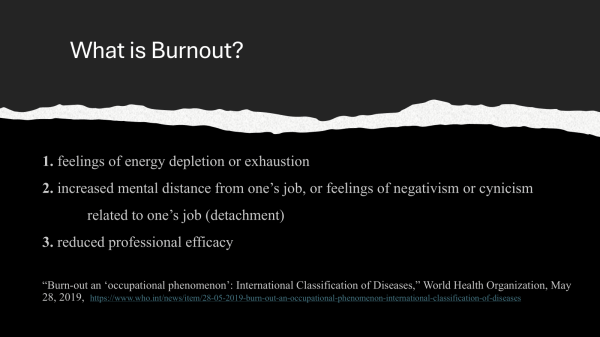
What is burnout? Just what exactly is it that burns out? How can whatever is burned out be re-ignited?

What is compassion fatigue? How does compassion wear out? Should it really be called empathy fatigue? Is the problem that there is too much compassion going out? Or not enough coming in? Or could it be that institutional structures and protocols make us busy with so many things that there is little time left in the clinical encounter for caring?

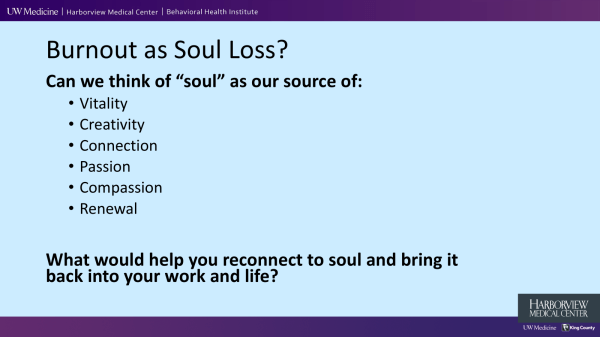
What is soul loss? Could we think of the soul being the “thing” that burns out? Not necessarily in a religious or metaphysical sense – although it could be if that fits your belief system – but in a metaphorical and psychological sense. If in burnout we lose connection with our souls, how can we reconnect and either go on a quest to find our lost souls, or create a welcoming environment in our bodies and lives so that our souls can return and flourish?

I address these questions in my book, Caring for Self & Others: Transforming Burnout, Compassion Fatigue, and Soul Loss, but we need to have further discussions around these topics as I feel strongly that we need a kind of ongoing practice, a yoga of burnout, in which we continually work in our own practices as well as in building communities of caring to support each other with this human, all too human dilemma.

Based on the topics we discussed in the first episode we titled this episode “Lost,” even before we realized that we somehow lost video of me and only recorded video for Chris! In this episode we explore topics of burnout as an initiation into becoming a wounded healer, soul loss, yoga for the health of healers, and we end with a meditation exercise and a poem, “Lost” by David Wagoner.

We don’t really know what we are doing with the technology aspect.

Let me tell you a story that illustrates the problem.

My high school friend Jack and I drove across the country after college. We were into the beat poets and writers, reading Kerouac’s On the Road, and envisoned a trip full of excitement and philosophical observations. We had a microcassette recorder and would talk into as we were driving, having many deep discussions and creating a record of what we saw.

Somewhere around South Dakota (having left from Chicago area) I noticed that the wheels of the recorder weren’t moving when we were recording. It was then that I noticed that there was a pause switch that was clicked on and prevented any recordings from being made! All of our bits, routines, observations, and experiences were lost! We were a bit crestfallen and we made half-hearted attempt to resume recording, but something had been lost – the energy, the enthusiasm. I think we eventually gave up on it. Maybe you could say we burned out on the idea after investing so much energy and enthusiasm and not having anything to show for it.

From a mindfulness perspective, there is surely some kind of lesson here – about not being attached to goals or outcomes, about being in the present moment versus memorializing experience, and maybe even that the organizing ego is an illusionary construct for creating a reduced and more manageable limited reality (if you want to take it that far!).

Well…I remembered this story after Chris Smith and I had just had our wide-ranging and enthusiastic discussion as we recoreded it on Zoom, only to realize that I had messed up the settings and we only had Chris’ video and both our audio. Well, crestfallen again! Urgh, technology failure again!

So, I think I have figured out how to share the audio of our video podcast, rather than have video of just Chris and my disembodied voice. Titling this episode, “Lost,” was prescient as we lost the video. Chris also spoke of his caring for self routine and how he purposefully skips some days so as not to get caught up in perfectionism, performance, and productivity. We’ll consider the lost video as a sacrifice to the Divine or the Cosmos, a giveaway, in addition to it being a bumbling failure of technology.

So, welcome to the first episode of the Becoming A True Human podcast – Lost it highlights the vulnerability and imperfection of being human, that we are all a work in progress and that our work is a yoga practice – yoking mind, emotions, body, soul. The practice of Becoming A True Human is an ongoing practice, we can only do it in the present moment and the next moment we are again lost, at sea, trying to figure it out and Keep It All Together (KIAT). We will attempt to have the next episode as video and hope to post it on the Becoming a True Human YouTube site.

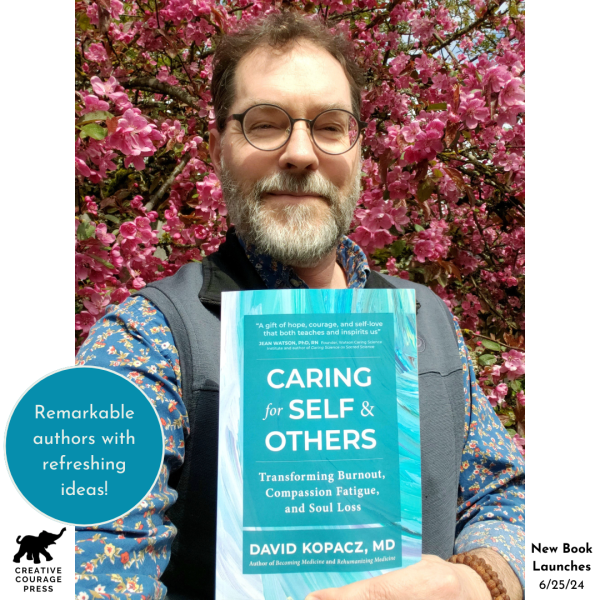
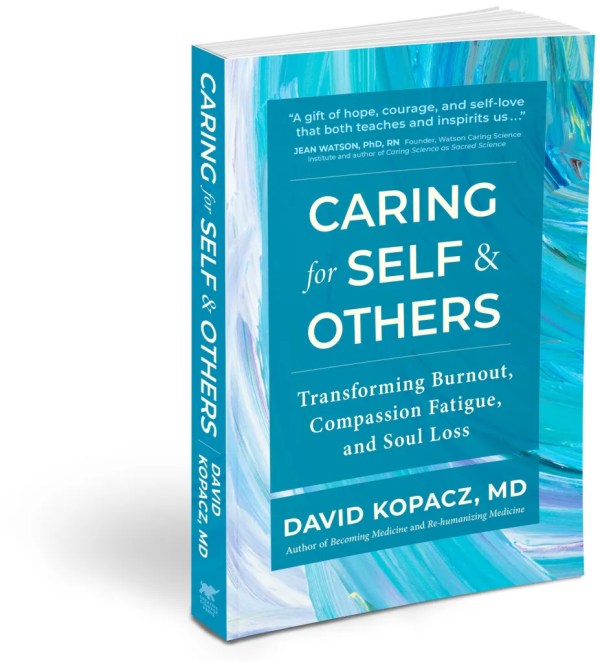
Caring for Self & Others: Transforming Burnout, Compassion Fatigue, and Soul Loss – released today (June 25, 2024)!

Caring for Self & Others: Transforming Burnout, Compassion Fatigue, and Soul Loss, Creative Courage Press (June 25, 2024).

I have been working on this book for ten years – the longest of any book I’ve written. In many ways it is a follow-up of Re-humanizing Medicine (2014) and yet it also is strongly influenced by my work over the past 10 years with Joseph Rael (Beautiful Painted Arrow). It brings together my work on physician and staff wellness in presentations and workshops, from my work Whole Health at the VA, and my work with The Doctor as a Humanist. Re-humanizing Medicine used a 9-dimensional model of the components of being fully human: body, emotions, mind, heart, creativity, intuition, spirituality, context, and time. In Caring for Self & Others, I’ve added the dimension of Becoming Caring: Caring for All, a kind of holistic leadership for self & others. Within each of the ten different dimensions of being fully human I have developed three different domains that end in an -ing (in honor of Joseph Rael’s emphasis on verb-ing in our conversations). I’ll now give a brief review of the journey of how this book has come into being.

After publishing Re-humanizing Medicine, I realized I needed to develop a set of practices to operationalize what I called the counter-curriculum. The counter-curriculum was a humanizing curriculum, a caring for self curriculum, which focused on how we do things, not just what we do in clinical settings. If our medical education and continuing medical education (CME) trains us to be good clinicians, the counter-curriculum trains us to be good human beings – thus I came to call this Continuing Human Education (CHE). In the age-old balance of being healers and technicians, I recognized that we have really given the education of ourselves as healers short shrift, and have almost exclusively focused on becoming technicians at the expense of our humanity. The loss of our role as healers and the loss of our human presence in medicine leads not only to impoverished clinical care (with patients feeling like they are being processed by protocols rather than cared for by human beings), but it also cut us off from the rejuvenating nature of the healing relationship which nourishes our own humanity as well as the humanity of our patients and clients. I realized that to care for others we must first care for ourselves and that in caring for ourselves we were developing the skills and aptitudes necessary to care for others.

In 2015 I was developing the idea of “Becoming a Whole Person to Treat a Whole Person,” which I presented in various forms at the Australasian Doctors’ Health Conference, and conferences of the Alliance of International Aromatherapists, and the Australasian Integrative Medicine Association.

In 2016, Joseph Rael and I published Walking the Medicine Wheel: Healing Trauma & PTSD. That year I deveoped presenations on Healing Circles, Pathways to Healing Moral Injury, and comparing the Medicine Wheel and the Hero’s Journey as pathways of initiation and healing – with presentations at the Mayo Clinic Humanities & Medicine Symposium, and various local settings. I developed a half-day workshop called “Caring for Self: Well-Being in the Workplace” that I gave for HopeWest hospice staff in Grand Junction, CO.

In 2017 I first started using the title of “Caring for Self & Others” in presentations, for instance at Western Sydney University in Australia. I continued developing ideas around Healing Circles and the Hero’s Journey, with presentations at the Australasian Doctors’ Health Conference and the University of the South Pacific in Fiji.

One of the dimensions of being fully human from Re-humanizing Medicine was spirituality and I had a sub-section on mysticism and medicine. My work with Joseph Rael, which has resulted in the publication of four books thus far, has allowed an in-depth exploration of the role of spirituality in healing. Our 2020 publication of Becoming Medicine: Pathways of Initiation into a Living Spirituality was a blending of Joseph Rael’s teachings within a framework of initiation, a review of healing through the lives and writings of visionaries, mystics, and shamans, and a survey of the perrenial philosophy of timeless healing wisdom. My subsequent training as an iRest certified teacher (a Western adaptation of yoga nidra from Kashmiri Shaivism by psychologist Richard Miller) and as a certified yoga teacher (CYT 200), has allowed me to study and explore nondualistic states – which I feel are foundational to breaking down the barriers between self and other – a kind of nondual medicine, as I call it in Caring for Self & Others.

As I have been working with burnout for myself and in staff and clinicians, I started to realize that there were many terms for health care worker suffering, not just burnout, but compassion fatigue, secondary and vicarious traumatization, PTSD, demoralization, moral injury, and even suicide could be an outcome of the burden of caring for others. I have come to use the term the costs of caring to encompass all these different dimensions of staff and clinician suffering. My good friend Greg Serpa and I published a chapter on “Clinician Resilience” in the Integrative Medicine, 5th edition textbook and I started to bring together a number of ideas I had been working on around burnout, moral injury, and the costs of caring, and even the idea of soul loss.

Soul loss is often considered one of the causes of illness in shamanic and indigenous traditions, such as in the work of Joseph Rael. It also has a resonance with the Western traditions that psychiatry and psychotherapy grow out of. The etymology of the word “psychiatry” comes from the Greek words psyche + iatros, soul healer. The Swiss psychiatrist, Carl Jung, frequently wrote of the psyche and also of the soul in his work as a healer and psychotherapist. The more recent, modern tradition of neglects the idea of the a vital essence of a person – yet there is a practical utility in addressing burnout as “soul loss.” In doctors and health care workers, as well as in teachers, and business, burnout is such a serious issue. We talk about burnout, but what is it that burns out? The soul is one answer – not necessarily in a metaphysical or religious sense, although it could be understood that way, but in a metaphorical and evocative way of describing what burnout and compassion fatigue feel like – that one has lost some core aspect of one’s being – a loss of soul. I gave presentations on burnout and soul loss at the Doctor as a Humanist’s on-line international conference, New Realities in the Times of COVID-19 (2020), University of Washington Psychiatry Grand Rounds (2021), and Seattle University’s Giving Voice to Experience Conference (2022).

A key idea in Caring for Self & Others is that suffering can be transformed – this is what healing is all about and this is the primary skill that a healer has, how to transform suffering. Our work as healers, doctors, technicians involves exposure to suffering, therefore we cannot eliminate suffering from our work as the very definition of our work is to engage with suffering. We can minimize the amount of collateral suffering that we experience from working in systems that do not support the full human being of clinicians and staff – that is the moral injury piece that we need to address. However, I think that burnout is inevitable when we are people who work with people, particularly people who work with suffering people. In my conversations during the pandemic, Lucy Houghton and I have been developing the idea of post-burnout growth, which is analogous to post-traumatic growth, in which we use suffering as a stimulus to personal and professional growth. Post-burnout growth captures the idea that burnout is not to be feared, but rather respected as a predictable occupational hazard – just like a firefighter working with fires is sooner or later going to get burned.

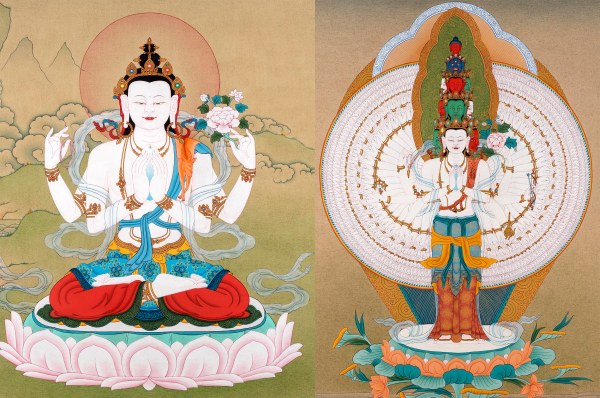
The Many Faces of Chenrezig, Image Credit: Enlightenment

The story of Chenrezig as a wounded healer captures this idea of post-burnout growth perfectly. Chenrezig vowed to alleviate all suffering in the world – which is not dissimilar to our own vows, spoken or unspoken, to heal others. If he was not successful in this vow, he pledged that he would shatter into a thousand pieces – a state akin to burnout, compassion fatigue, and soul loss, where we feel injured as a result of our caring. This is, in fact, is what happened – Chenrezig worked diligently, healing many, yet there was still more suffering than he could address and he shattered into a thousand pieces. This is where the story ends for so many health care workers and educators who become embittered, cynical, and maybe even leave their profession. But in the story of Chenrezig, there is a ritual elder, Avalokiteśvara, who sees Chenrezig’s suffering from addressing others suffering. Avalokiteśvara puts Chenrezig back together – not simply as he was before (this is my problem with the way resilience is often used in health care – as a way of going back to the past, or avoiding suffering), but rather as having a thousand eyes to better see suffering and a thousand arms to better touch suffering. Chenrezig becomes more capable of seeing and touching suffering – through post-burnout growth.

This book, Caring for Self & Others: Transforming Burnout, Compassion Fatigue, and Soul Loss, has grown over the last ten years and I am grateful to all the above mentioned organizations. The book and I have also been shaped by numerous conversations with friends and colleagues and I would particularly like to thank Laura Merrit, Shelly Francis (Creative Courage Press), Joseph Rael (Beautiful Painted Arrow), Steve Hunt, Jonathan McFarland, Usha Akella (The POV), J. Greg Serpa, Tulika Singh, Chris Smith, Lucy Houghton, Transformational Arts Network and their Power of Words conference, Gretchen Miller (and the editorial staff at the CLOSLER blog), and so, so, so many others. There truly is no self without others.

Advance Praise for Caring For Self & Others

We’ve gotten some really nice endorsements for the upcoming release of Caring for Self & Others: Transforming Burnout, Compassion Fatigue, and Soul Loss – which will be released on June 25th and is currently available for pre-order through Amazon. I’ll share some of the comments below:

“It is a healing experience to read the beautiful, self-journey into self-caring through the wounded depth of the dark night of soul. It is through such personal sharing of self that we learn from each other. David Kopacz ‘s book offers readers a gift of hope, courage and self love, that both teach and inspirit us with his soul’s path into self-caring and heart healing.”

Jean Watson, PhD, RN, AHN-BC, FAAN, LL (AAN), Founder Watson Caring Science Institute, Distinguished Prof/Dean Emerita University of Colorado Denver, College of Nursing

“This holistic, imaginative and soulful response to burnout is much needed in today’s world.”

Dr. Dina Glouberman, author of The Joy of Burnout: How the end of the world can be a new beginning

“As physicians, we may not always acknowledge that we each have a soul. However, we are in a sacred profession that truly holds the soul of our patients. Whatever we call it, there is a place deep within us–almost the elephant in the room–that is our compass guiding us, our North Star. Oftentimes we get lost because we don’t care for our internal compass. That is the essence of what’s lost in healthcare today. If we have the true soulful connection with our Self, it needs to be fed first so that we can be available to everyone else. 

When we make self-care and colleague care an unapologetic and unashamed priority, we can give the best care to our patients. David Kopacz invites us to reconnect to our humanity, nurturing our hearts and minds as healers and setting the stage for our systems to heal as well.”

Mukta Panda, MD, author of Resilient Threads: Weaving Joy and Meaning into Well-Being and co-author of The Oath to Self-Care and Well-Being

Caring for Self & Others Transforming Burnout, Compassion Fatigue, and Soul Loss is a blueprint for authentic happiness. Dr. David Kopacz has gifted us with an insightful guide for self-care. He points to how burnout and compassion fatigue lead to losing our souls and how the loss teaches us a way into depth and spirituality. He suggests ways to sit with equanimity between the wholeness of the sacred and the mundane. This book is an invitation to show up fully and to rediscover there is no split of body/mind or between the self and the collective; it contains perennial wisdom with all its regenerative power. 

Marianela Medrano, PhD, What a Word is Worth podcast, and author of Rooting, Diosas de la yuca, and other titles

“David Kopacz, versed in worldwide healing traditions where illness is approached as a loss of soul and healing involves its restoration, offers a complete vision of individual, social, and earth practice where everything contributes to a communion of creation that transforms afflictions into affirmations of life. His personal “dark night” shows the way to a timeless discipline of compassionate creation with others, helping us see that we participate in a process larger than ourselves yet sustained by our unique and personal contributions.”

Shaun McNiff, PhD, author of Art as Medicine, Art Heals, Integrating the Arts in Therapy, Trust the Process: An Artist’s Guide to Letting Go, Imagination in Action: Secrets for Unleashing Creative Expression, and other books. Lesley University, Cambridge, MA, 2021 to date: University Professor Emeritus

“Finally, a book that puts together what self-care and healing are really about! Kopacz, an exceptional healer, presents a comprehensive and holistic perspective on ideas and practices that can mitigate the burnout and fatigue that are rampant in healthcare. This is a handbook that will help every practitioner reclaim their role as healer and reconnect with the Soul of their practice. An exquisite, insightful and transformative work!”

Lucia Thornton, ThD, MSN, RN, Past President, American Holistic Nurses Association, Past President, Academy of Integrative Health and Medicine, and author of Whole Person Caring: An Interprofessional Model for Healing and Wellness

“As a clinician who has experienced deep burnout, I adore this book and find it endlessly useful. Dr. Kopacz aptly offers his work as an oxygen mask. He exquisitely supports attention toward the crucial self care healers of all kinds desperately need for thriving lives.”

Kate King, MA, LPC, ATR-BC, author of The Radiant Life Project

Caring for Self & Others: Transforming Burnout, Compassion Fatigue, and Soul Loss  demands to be read with our heads and our hearts.   David Kopacz challenges us to care for ourselves, others and the systems we work in.  The book is filled with exercises and meditations that can help us in this work.  David also shares his journey and how he was employed the ideas and exercises in his own life that reveal the depth of his commitment to caring.”

John (Jack) Miller, Professor at the University of Toronto and author of Education and the Soul, Love and Compassion: Exploring Their Role in Education, and A Holistic Educator’s Journey: Seeking Wholeness in America, Canada, Japan and AsiaThe Holistic Curriculum

Caring for Self & Others charts a path through the inevitable downturns and struggles of our lives by using our very suffering as material for transformation and growth. It elaborates a practice of caring that leads us from our individual pain into service to others by breaking down the mental barriers that lead us to believe that there is a self separate from others. This is perennial wisdom for the soul.”

Stephen Cope, Scholar Emeritus, Kripalu Center, bestselling author of The Great Work of Your Life, The Wisdom of Yoga: A Seeker’s Guide to Extraordinary Living, and The Dharma in Difficult Times: Finding Your Calling in Times of Loss, Change, Struggle, and Doubt

Caring for Self and Others speaks directly to us in these uncertain and difficult times; a book that we must read. The author uses his own experience both as a doctor and patient to deeply delve into the different kinds of caring: for the body, for emotion, for mind, heart. It is a book full of wisdom gained by the author’s insight and continuous growing curiosity about life and the importance of caring and healing. This book is written for you; that is, anyone with an interest in the world around us who knows that to live well (or thrive), we need to care for ourselves and others. David Kopacz both explains why we need to care but also gives practical ways of doing so.”

Jonathan McFarland, MA, President and Founder of The Doctor as a Humanist and co-editor of Health Humanities for Quality of Care in Times of COVID -19, Associate Professor, Universidad Autónoma de Madrid

Caring for Self & Others: Transforming Burnout, Compassion Fatigue, and Soul Loss will be published by Creative Courage Press – thanks to Shelly Francis for all the support in the publication process!

Lost in the Wilderness of the Body

I haven’t written anything for Being Fully Human for some time. I have been on an odyssey, a continuing journey, through the inner reaches of the body and the outer halls of academic medicine. You see, I have been lost in the wilderness of the body.

I was diagnosed with nevoid melanoma last year. Nevoid means mole-like, similar to the common nevus (mole). It did not look like a typical melanoma with irregular borders, asymmetry, or coloration. It looked like a regular mole. However, this was not a common mole, but a malignant cancer that had spread to two of the lymph nodes in my axilla (armpit), making it a Stage IIIa cancer.

My oncologist recommended adjuvant immunotherapy to prevent any recurrence. Immunotherapy is a relatively new treatment for cancer over the past decade or so. Nivolumab is a monoclonal antibody (-mab) that “switches on” the body’s own immune system in a way that over-rides the immune-blocking properties of cancer. The risk, however, is that one’s activated immune system can turn against the self, causing various autoimmune conditions anywhere in the body.

Numbers mean Everything & Numbers mean Nothing

The decision to start this medication was difficult for me. With roughly a 10% chance of potentially permanent side effects, this is a serious medicine. The decision was even more challenging because I was considered “cancer-free,” nothing was visible on any of the scans or blood tests. However, my oncologist thought there was a 10-20% chance that I could have a recurrence of melanoma without treatment.

The decision involved flailing back and forth between the numbers about recurrence and the numbers about serious side effects. I was intellectually trying to make the “right” decision. In oncology, treatment protocols are all about numbers – numbers are everything. For me, however, an individual, not a population statistic, I realized that numbers could also mean nothing. No matter what the statistics, what happened to me would happen to me. When my oncologist said that he thought my risk of recurrence might be closer to 20% and immunotherapy could cut that risk in half, I decided to go on the year-long course of monthly IV infusions.

Still in Training

When I first was diagnosed with melanoma, my friend, co-author, and teacher, Joseph Rael (Beautiful Painted Arrow) asked me why I thought I had gotten cancer. I sputtered out a couple of things and he interrupted and simply said, “Because you are still in training.”

This attitude could actually apply to all of life. When anything goes the way we don’t want it to, we could say, well, this is a good training exercise – what can I learn from it, how can I grow? To approach life as a student, rather than a victim, is the road less traveled, the pathway of transformation.

The first infusion of Nivolumab was uneventful. I felt a little tired after, but nothing dramatic. However, about two weeks later my right foot hurt every time I took a step. This lasted about three days and then the pain resolved but I had tingling paresthesia of neuropathy. When I told my oncologist, he said somewhat incredulously and dismissively that this medication had a less than one percent chance of causing neuropathy, other medications could cause it more commonly. He seemed suspicious of my symptom and then referred me to another doctor, a neurologist. That appointment was three months out.

Two weeks after the third infusion the neuropathy symptoms intensified and began to move up my legs – tingling, electric jolts, burning sensations, aches, and cramping pains.

Like A Brush Fire

Over two weeks the neuropathy picked up speed, reaching my chest (which led to an emergency room visit to evaluate chest pressure and cramping that later seemed to be related to the spread of the neuropathy). I was alarmed at the rapidity of the upward spread – like a brush fire – and I began reviewing different kinds of rapidly ascending neuropathies.

During my neurology rotation in my medical education I had met an unconscious neurologist who had developed Guillain-Barré that paralyzed his breathing muscles and he was on a ventilator. This was one of my concerns given that rapid spread and for a time it seemed like the neuropathy might also be involving my heart. I underwent another series of tests: brain and spinal MRI, chest CT, EMG, autonomic testing, nerve biopsy and lab test after lab test.

Drowing in Quicksand

I felt like my team was always a couple steps behind the rapidly evolving symptoms and that they lacked imagination to think beyond reductionistic symptoms to encompass the overall pattern of what was happening. The image came to me of sinking in quick sand and the medical team watching me from the solid ground, telling me they wouldn’t toss me the life preserver until they determined what kind of sand I was drowning in. I imagined them requesting a geology consult that would take three months to arrive and then the geologist would send samples of the sand to the lab for analysis while I slowly drowned right in front of them. It was a strange and unsettling feeling of being seen and not being seen, as if they were more interested in the composition of the sand than they were in my own life and well-being.

Eventually they started Prednisone to shut off the immune activation. This was a high dose of steroids, up to 100 mg and then a slow taper down. It pushed the neuropathy symptoms mostly back down below my waist, but I was still having active symptoms in my lower body. During the taper, at about 60 mg the symptoms began spreading into my chest again, but at a slower speed. At around 20 mg the neuropathy symptoms moved into my neck, face, forehead and scalp.

Now, off prednisone, I continue to have head-to-toe neuropathy symptoms. I have continuous aches and cramps in my limbs – from shoulder to hands and hips to feet. We still don’t have a definitive diagnosis for the neuropathy, although the neurologists suspect small fiber neuropathy. The results of the nerve biopsy, which may confirm the diagnosis, are still pending after six weeks.

In addition to the paresthesia, tingling, burning, aching, cramping symptoms, I also developed a heavy feeling in my legs, difficulty standing straight (but walking ok), leg tremor, low back pain, and balance problems. After describing my unsteadiness to two oncologists and three neurologists, a practical ER resident suggested I get a cane so I didn’t fall. That was quite helpful if I had to stand for a while when I was out walking or going to the clinic for an appointment, I could use the cane as a prop or kickstand to steady my legs. This obvious recommendation was overlooked in the mania of medical/technological medicine.

Despite my detailed descriptions, and even the doctors own objective findings on physical exam, I haven’t felt that any of the doctors have adequately explained the balance symptoms and instead have focused on trying to determine what kind of neuropathy I have.

I’ve been off work for two and a half months and just returned to work part-time this week. I still have head-to-toe neuropathy symptoms. I don’t have to use a cane for short walks, or prop myself up with the counter if cooking or doing dishes. I do still feel off-balance and use my hands to steady myself as I walk through the house, as if I was on a ship rolling at sea.

Modern-Day Alchemy

If I seem embittered toward the medical system – I am. I have had some very compassionate nurses, and a couple physicians who were not part of my immediate specialty care team. My primary care doctor is great, but I’ve been lost in the wilderness of medical specialties, medical technology and evaluations, and twice been to the emergency department. On the one hand, medical technology surgically removed the cancer and identified the two metastatic lymph nodes, and as far as we can tell, removed all visible signs of the cancer. On the other hand, I can’t help but think of immunotherapy as contemporary alchemy, with my young oncologist as a kind of modern-day alchemist, playing around with mercury and other arcane substances to try to create the philosopher’s stone that will be the panacea to cure all cancer.

Pharmakon: Poison & Cure

The ancient Greeks had a word for medicine – pharmakon. They also had a word for poison – pharmakon. These modern-day alchemists, in their zeal to cure, may be causing a whole panoply of iatrogenic diseases. The dual nature of pharmakon – a poison and a cure – should engender humility, caution, and a sense of awe at the mysterium tremendum et fascinans of life – the terrible yet fascinating mystery of health, life, illness, and death. The hubris of modern-day alchemy is that we reduce people to numbers and then we can plug those numbers into protocols, and we make the numbers go up or down. Doctors can lose a sense of personal responsibility and accountability because they are just “following orders” of the protocol. Health and illness are the great mysteries of life and we need to have a healthy appreciation of the mystery and uncertainty of life.

Please don’t mistake my personal narrative as medical advice. If I had advanced metastatic cancer, the trade-off of my ongoing symptoms for being cancer-free would be a different calculation. However, for me, I didn’t feel sick until I received the treatment to make me “healthy.” I’m not sure the trade-off, from a cost-benefit analysis was worth it.

Iatrogenic Soul Loss

I also feel like I have been hood-winked by contemporary medical, technological science again! When I was in medical school, I felt like I was losing an important part of my humanity as I grew in skill as a medical technician. I felt I was losing my soul and I developed the idea of a counter-curriculum of re-humanization – a kind of soul retrieval through meditation, reading, poetry, the arts, and creative practices. Now, as a patient, I feel another loss of my soul and humanity as I’ve been processed through the medical system. I’ve been continually frustrated as I’ve laid open my soul to these young doctors who are always attending to the demands of their computers. I’ve wondered if the problem is me – maybe I’m documenting in too much detail, or recounting too many symptoms. I’ve spent hours editing down my updates, trying to capture the complexity and evolution of my symptoms while simplifying it so that the briskly busy, multi-tasking young physicians can take in the information I am providing. Our medical system has no problem spending hundreds of thousands of dollars on pharmaceuticals and technology, but it is almost impossible to have a doctor sit down, person to person, and spend the time needed to understand what the patient is going through, let alone properly understand a complex system pattern.

I got excited about the new science and technology of immunotherapy for cancer treatment. I got caught up in the medical dream of curing cancer. But personally, I’m living out the dark side of pharmakon – feeling like I was a perfectly healthy human being (other than the surgically-removed melanoma) who now has a potentially permanent disability, that is still evolving, from the pharmaceutical tha was supposed to make me more healthy.

iatrogenic (adj.)
“induced by a physician,” 1920, from iatro- + -genic.
iatro-
word-forming element meaning “a physician; medicine; healing,” from Greek iatros “healer, physician” (see -iatric)
-genic
word-forming element meaning “producing, pertaining to generation;” see -gen + -ic

The Greek word for physician or healer is iatros. The Greek word for soul is psyche. As a psychiatrist – or psyche-iatros – I’ve viewed my calling and role as reminding medical professionals that we should be striving for a balance of our roles as technicians and our roles as healers. As we seek to modulate the inner workings of the body with technology, we should balance this with the role of the healer who works with our psyches – our souls – as well as with our bodies.

To treat the body without the psyche or the psyche without the mind is to be at least partially insane. Human reality is psyche-soma, mind-body. To ignore this holism is to ignore and blind ourselves to half of reality, which means we are voluntarily insane – if by insane we mean someone who ignores or is unaware of reality.

Lost in the Wilderness of the Body

I’ve been lost in the wilderness of the body – but to say it this way is really not quite true. This illness experience has shown me that my psyche and soma, my mind and body are one. I have been exploring the inner reaches of the territories of my being. This is not looking at the body from outside, trying to manipulate it into health, but rather exploring a vast wilderness of the unknown within myself. What we do not know at first appears dark until we bring the illumination of consciousness into that dark realm.

Rather than wail and gnash my teeth or rail at the contemporary medical technology system, I try to remember the words of Beautiful Painted Arrow, “You are still in training.” Then I ask myself, “What can I learn here, in this dark wilderness of the body, what treasures might lurk in the abyss, what vistas might be found over that mountain ridge?” Rather than trying to negate or eliminate sickness, or try to run out of this wilderness back into the light of the remembered memory of who I used to be in some sunny meadow outside of this dark wood, I will go deeper into the unknown realms of the body.

We need to explore ourselves, our inner natures as well as our outer natures. We need what Nietzsche called the great health:

…a new health that is stronger, craftier, tougher, bolder, and more cheerful than any previous health. Anyone whose soul thirsts to experience the whole range of previous values and aspirations, to sail around all the coasts of this ‘inland sea’ (Mittelmeer) of ideals, anyone who wants to know from the adventures of his own experience how it feels to be the discoverer or conqueror of an ideal, or to be an artist, a saint, a lawmaker, a sage, a pious man, a soothsayer, an old-style divine loner – any such person needs one thing above all – the great health, a health that one doesn’t only have, but also acquires continually and must acquire because one gives it up again and again, and must give it up!. . .And now, after being on our way in this manner for a long time, we argonauts of the ideal – braver, perhaps, than is prudent and often suffering shipwreck and damage but, to repeat, healthier than one would like to admit, dangerously healthy; ever again healthy – it seems to us as if, in reward, we face an as yet undiscovered land the boundaries of which no one has yet surveyed, beyond all the lands and corners of the ideal heretofore, a world so over-rich in what is beautiful, strange, questionable, terrible, and divine that our curiosity and our thirst to possess it have veered beyond control – alas, so that nothing will sate us anymore![1]


[1] Nietzsche, Friedrich. Nietzsche: The Gay Science: With a Prelude in German Rhymes and an Appendix of Songs (Cambridge Texts in the History of Philosophy) (pp. 246-247). Cambridge University Press. Kindle Edition.

Recent Podcasts & Articles

I’ve been doing a few podcasts lately – which is always a fun chance to talk about some of the work I have been doing. I’ll include a few photos from the past year to remind us of the world within which we all live & work.

Yellow Warbler in crab apple tree, Seattle, WA

I spoke with Andrea Nakayama on her 15-Minute Matrix Podcast on “Mapping the Costs of Caring,” looking at burnout, compassion fatigue, moral injury, and soul loss in health care workers. Here is an excerpt speaking about the similarities of burnout and soul loss:

The soul is the thing that makes us alive and vital and engaged and connected around the world. When we lose that, we lose all those kinds of things that connect us to ourselves and to others…How do we bring the soul back? It would be what things make the soul happy, what kinds of things bring you joy? And so how can you build this into your life? I think the distinction is you could start with self-care to support the ego, in the sense of your personality, but I think of the healer, the role of the healers, to be honest with delving into what can be the breakdown of the ego, and then the rebuilding back as a healer.

Yellow-Rumped Warbler in crab apple tree, Seattle, WA

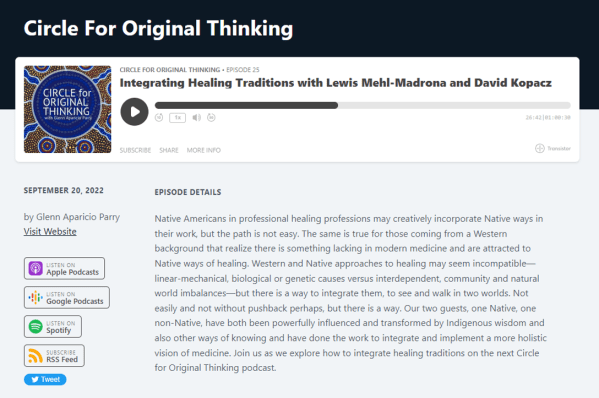
I had a very nice dialogue with Lewis Mehl-Madrona and Glenn Aparicio Parry on his Circle of Original Thinking Podcast, “Integrating Healing Traditions with Lewis Mehl-Madrona and David Kopacz.” Definitely check this out, such an honor to have a generous time to speak with Lewis & Glenn. Check out their great books as well!
The print edition of Parabola Magazine, Fall 2023 featured “This Vibrating Land,” an excerpt from an interview that I did with Glenn Aparicio Parry that we featured on The POV interview website.

I also had a book review “Lessons from A Field Guide to Getting Lost by Rebecca Solnit on CLOSLER as well as an essay “Building Cultures of Caring.” Here’s an excerpt:

Perhaps burnout is a symptom of a larger problem. Perhaps we’ve cut ourselves off from a root of support in our work, we have lost touch with a spiritual and humanistic dimension of who we are and that when one suffers, all suffer. We have lost touch with our interconnection, our non-duality. What did Mother Teresa, Mahatma Gandhi, and Martin Luther King Jr. draw upon when working with the immense suffering in the world? Gandhi spoke of satyagraha as “the Force which is born of Truth and Love,” and Dr. King, spoke of this as “soul force.” Perhaps we should consider developing some kind of non-dual medicine, some kind of practice of non-separation in our healing work.  

Whiskey Creek, Washington

A longer interview and dialogue was an invitation to speak on The Soul Space, entitled “Hero’s Journey & Resilience in the Face of Suffering,” (7/1/22).

Last, but not least – I had a chance to catch up with former Seattle VA Primary Care Mental Health Integration teammate Dr. Nicola De Paul on “Burnout, Moral Injury, and Radical Caring” on her Menders: Love & Leadership in Health Systems Podcast. Check out our dialogue as well Nicola’s discussions with other great thinkers working to bring Love & Leadership into Health Systems!

I also recently had the privilege of interviewing Richard C. Miller, PhD, the developer of iRest, Integrative Restoration, a form of yoga nidra. Here is the link to part I where we talk about his development of iRest and early influences, including J. Krishnamurti. Part II will be published soon on the interview site that Usha Akella and I developed, The POV.

If you have some down time, please check out any of these articles and podcasts that may be of interest to you, as well as look up some of the other great interviews on these podcasts!

Pacific Coast, Washington State

Burnout: Soul Loss & Soul Recovery keynote lecture at Seattle University, Saturday 6/25/22

The 13th Annual Giving Voice to Experience Conference will be available via online Zoom as well as for in-person attendence on Saturday 6/25/22 at Seattle University .

I will be giving the keynote 1:20 – 2:40 PM (Pacific Time), “Burnout: Soul Loss & Soul Recovery in Mental Health.” I’ve been interested in exploring the significant overlap between the ancient condition of soul loss and the modern occupational syndrome of burnout. I will be discussing burnout and soul loss from a variety of perspectives. I will be presenting material from my next book, Caring for Self & Others: Tools for Transforming Burnout, Compassion Fatigue, and Soul Loss. I have signed a contract with Creative Courage Press for publication early 2023.

I was originally going to present 3/7/20, but this was just at the start of the pandemic and as many events at that time it was cancelled. I am so exicted to be able to finally present this talk and the concepts of burnout and soul loss have a much deeper and personal meaning to me, now, after recent years.

The conference is $20 for students and $60 for general public and professionals. 6 CEUs (Continuing Education Units) are available.

Here is a link to the Conference Schedule, the theme is “Maintaining a Soulful Approach to Psychological Research & Practice: Swimming Upstream in a Technological Society.”

Here is the registration link.