In this series of essays, in the 250th year of the United States of America, I will develop the idea of Inner Democracy – a democracy of mind and heart and soul – to complement our outer democracy.
We are at a crisis of democracy, there is extreme polarization, accusations of “the other side” being “fascist” or “socialist/communist,” and levels of mistrust in each other and in our democratic institutions that have not been seen in generations.
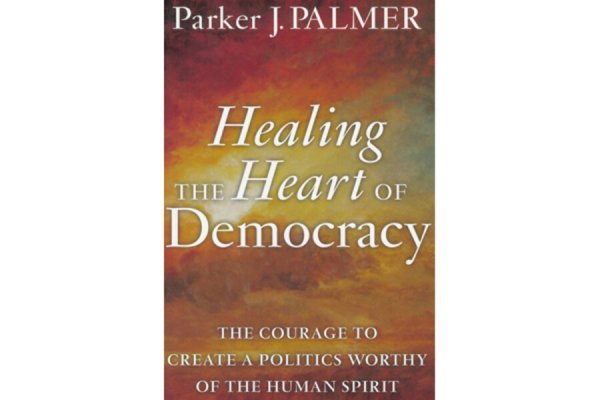
As Parker Palmer has written, in Healing the Heart of Democracy: The Courage to Create a Politics Worthy of the Human Spirit (2011),
“If American democracy fails, the ultimate cause will not be a foreign invasionor the power of big money or the greed and dishonesty of some elected officials or a military coup or the internal communist/socialist/fascist takeover that keeps some Americans up at night. It will happen because we—you and I—became so fearful of each other, of our differences and of the future, that we unraveled the civic community on which democracy depends, losing our power to resist all that threatens it and calls it back to its highest form,” (8).
We think of democracy as a form of government, as something outside of the individual person, but Palmer reminds us that democracy is ultimately about “you and I,” and not about something “out there.” Democracy is a “government by the people,”[1] and we are the people. The kind of democracy that Palmer envisions, one that is “worthy of the human spirit,” is the kind of democracy that moves us from Me to We. This Journey from Me to We is a difficult one, and it starts inside each of us.
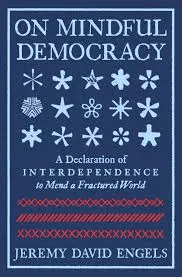
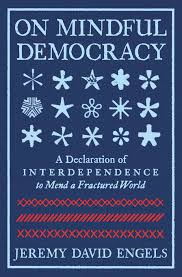
Jeremy David Engels, in his book, On Mindful Democracy: A Declaration of Interdependence to Mend a Fractured World, defines “true democracy” as “ working together to care for each other and for the life we share,” (4). Democracy, for Engels, is about collaborating and caring, not just for ourselves but for our shared life together on our only ecosystem of the Earth.
There is a crisis of democracy in what we even mean by “democracy.” Is democracy a libertarian ethos of being able to maximize one’s own life, liberty, and, happiness, regardless of the consequences to others and the environment; or, is democracy a higher, spiritual calling of caring and collaboration?
Engels brings our focus on democracy from the individual to the community through synthesizing the spiritual traditions of yoga, Buddhism, and Christianity. He draws on Vietnamese Zen Buddhist Thich Nhat Hanh’s, “interbeing,” an intellectual/spiritual understanding of the interconnectedness of life, and the Christian community building of Martin Luther King Jr.’s “beloved community,” which then leads to democratic action. Engels re-writes the Declaration of Independence into a Declaration of Interdependence, recognizing the inherent interconnectedness of life.
Mindful democracy is a pathway and practice for developing the experience of inner democracy which can then be practiced in its outer form as building the beloved community and democratic action in the world. Inner democracy is an inner experience within the individual that can then lead to an outer democratic citizenship and government. We can think of inner democracy as a variety of spiritual democracy.
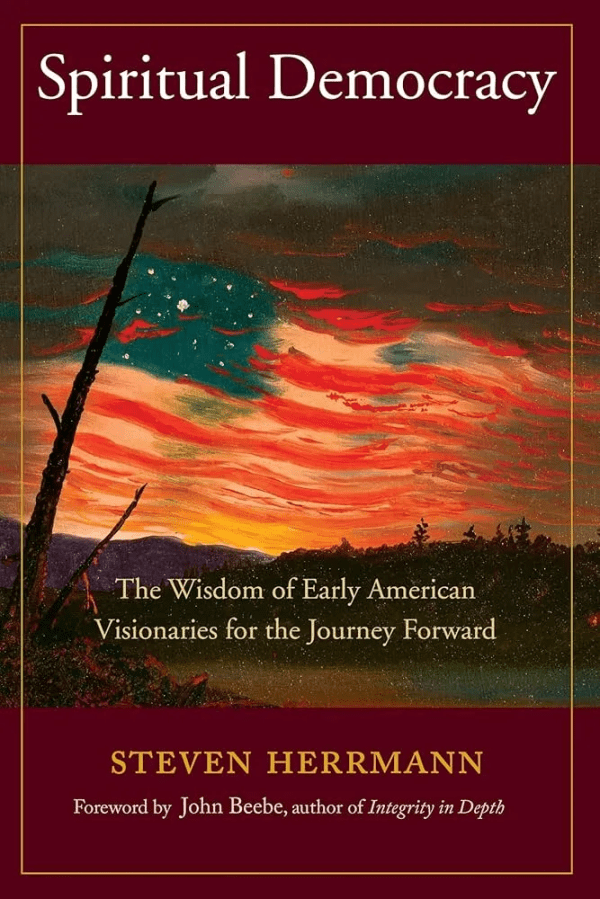
Steven Herrmann has written about the idea of “spiritual democracy:”
“Adopting the big idea of Spiritual Democracy, the realization of oneness of humanity with the universe and all its forces, can help people feel joy, peace, and interconnectedness on an individual basis. It can also inspire us to undertake sacred activism, the channeling of such forces into callings that are compassionate, just, and of equitable heart and conscience, and give us some tools to start solving some of these grave global problems, while uniting people on the planet.”[2]
Spiritual democracy, as defined by Herrmann, is founded upon an experience or realization of “oneness” and “interconnectedness.” He believes that this experience of inner democracy can lead to outer action, “sacred activism.”
Joseph Rael (Beautiful Painted Arrow) and I wrote about Spiritual Democracy in our book, Becoming Medicine: Pathways of Initiation into a Living Spirituality. We drew upon Herrmann’s ideas and combined these with Joseph’s perspectives, we spoke about the “inner journey of the democratic shaman,” and summarized a version of the Hiawatha story about Bringing the New Mind of the Great Peace. We made this chapter available as a free pdf download.
In a Becoming a True Human podcast interview with Jeremy David Engels, Chris Smith and I spoke with him about his book, On Mindful Democracy, and ideas about spiritual democracy, mystical democracy, inner democracy, and he had an idea of putting together a group of writers and thinkers to talk about The Varieties of Democratic Experience, with a nod to William James’ Varieties of Religious Experience.
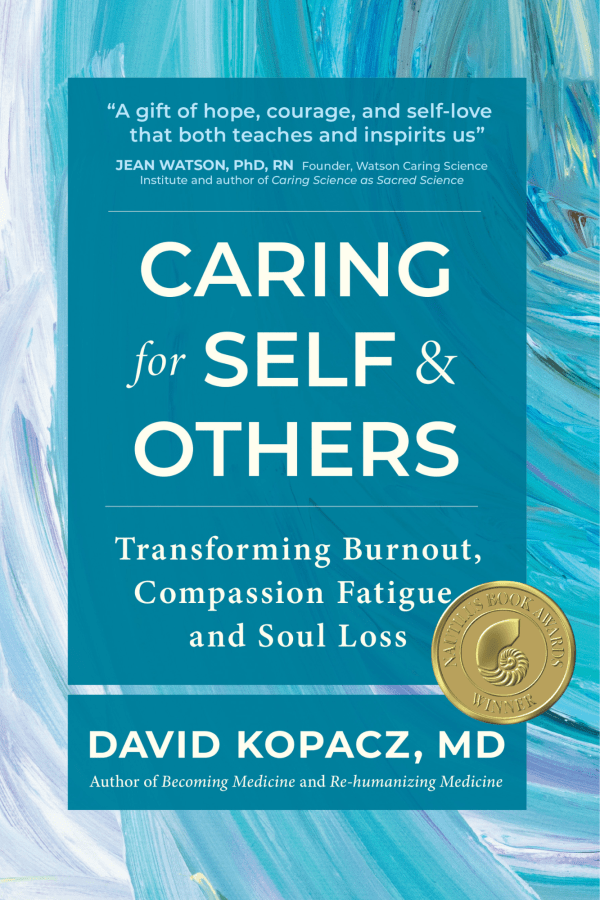
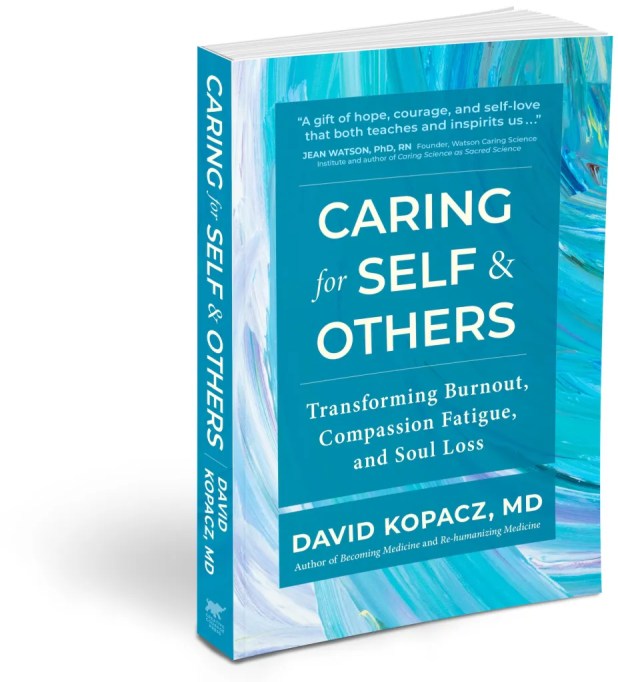
I would like to further develop some ideas around inner democracy, drawing upon the work of other writers and some of my past writing. Joseph Rael (Beautiful Painted Arrow) and I wrote a chapter on “Spiritual Democracy” in our book, Becoming Medicine: Pathways of Initiation into a Living Spirituality. This draws heavily on Steven Herrmann’s work as well as Joseph’s teachings on peace and the idea that we are cosmic citizens. As Engels did, I drew upon Thich Nhat Hanh’s concept of interbeing and Martin Luther King Jr.’s beloved community in my book, Caring for Self & Others: Transforming Burnout, Compassion Fatigue, and Soul Loss, particularly in chapter ten, “Becoming Caring: Caring for All.” I am indebted to Jeremy David Engels for his book and for such an inspiring discussion in our podcast interview.
The perspective on democracy I would like to develop is the idea that the greater sense of “oneness” (or interbeing, interdependence, nondualism) that an individual experiences, the more fully they will be able to embrace the idea of democracy, which will lead to more vigorous outer expressions of democracy. A practice of inner democracy would, thus, be a contemplative path of the development of a conscious experience of oneness. This leads to a tripartite structure:
Inner Experience of Oneness
Idea of Democracy
Outer Expression of Democracy
This tripartite structure follows the paths of the hero or heroine’s journey (as developed by Joseph Campbell), and the structure of initiation (separation/initiation/return) that Joseph Rael and I followed in Becoming Medicine. It also follows the structure of Jeremy David Engels’ book, On Mindful Democracy (xi-xii):
Stand on Common Ground (Interbeing)
Walk the Path of Interdependence in Community (Beloved Community)
Practice Democracy with Hands and Heart
The idea of mindful or inner democracy can be grasped with the mind, but a mental concept may not be as resilient as an inner experience of democracy – of interbeing, oneness, interdependence – which then leads to outer expression. In this sense, mindful democracy can be a pathway to creating a foundation of inner democracy that then supports the idea and what Engels calls the “hands and heart” of outer democracy.
Inner Democracy could be taught through practices of reflection, contemplation, deliberation, dialogue, meditation, experiences in nature, or any experience in which the individual developed an expanded sense of self beyond the limitations of the ego and the flesh.
The movement of the individual from an identity of “me” to an identity of “we” underlies the inner practice of democracy.
Interestingly, there are many names for an experience of Oneness: nondualism, interbeing, unity, transpersonal, and nondifference, to name a few. There are also many names for interrelationship and interdependence: I/Thou, Me/We, beloved community, and others.
One of the reasons I am excited about following this thread of Inner Democracy is that it provides a positive focus and practices that can be done irrespective of outer events in the world. In my Words Create Worlds series, I have focused more on resistance and opposition to words – uncaring words, words of Me-First, and words of fascism. Through Inner Democracy I am seeking to focus on building inner strength during difficult times. Perhaps chaotic and painful experiences in the outer world could even lead one to fall back upon practices of inner democracy. Inner democracy builds hope, resilience, post-burnout growth, post-traumatic growth. I agree with Jeremy David Engels’ view of democracy as caring and collaboration.
Ultimately, democracy isn’t something done “out there;” democracy is also, perhaps even originally, about doing something “in here,” in the inner space of the psyche, the work of cultivating inner democracy.
“government by the people, system of government in which the sovereign power is vested in the people as a whole exercising power directly or by elected officials; a state so governed,” 1570s, from French démocratie (14c.), from Medieval Latin democratia (13c.), from Greek dēmokratia “popular government,” from dēmos “common people,” originally “district” … + kratos “rule, strength.”
What we are experiencing now is a predictable, straight line from the words that Donald J. Trump has spoken.
The uncaring world we are living in has been created, uncaring word by uncaring word of our current president and those who are drawn to him. It is as simple as that. It is as simple as that.
What we put into the world in words, what we bring forth from that deep inner place of creative power within ourselves, creates the world we live in. We are makers and unmakers of our reality.
The inspiration for this essay series, Words Create Worlds, comes from Rabbi Heschel. He said, as recounted by his daughter, Susannah Heschel:
“Words, he often wrote, are themselves sacred, God’s tool for creating the universe, and our tools for bringing holiness—or evil—into the world. He used to remind us that the Holocaust did not begin with the building of crematoria, and Hitler did not come to power with tanks and guns; it all began with uttering evil words, with defamation, with language and propaganda. Words create worlds, he used to tell me when I was a child. They must be used very carefully. Some words, once having been uttered, gain eternity and can never be withdrawn. The Book of Proverbs reminds us, he wrote, that death and life are in the power of the tongue.”[1]
Rabbi Heschel warns us of the power of words and how they can bring holiness or evil into the world. This is the power of choice that we have and the power of our breath shaped into meaning and symbolism through the sound of the letters that we string together into words.
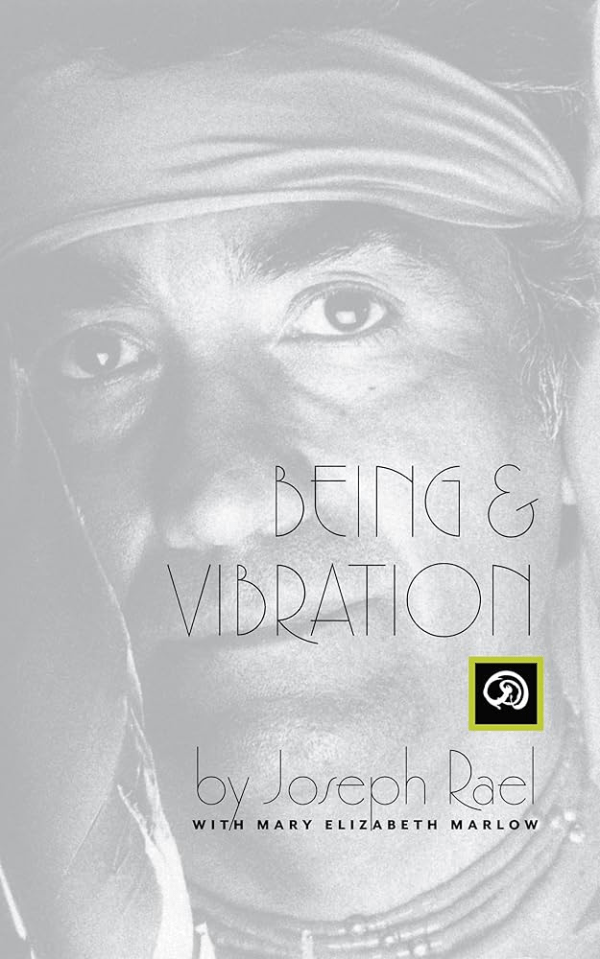
Joseph Rael (Beautiful Painted Arrow) also has taught about the power of Sound – of Being & Vibration – and how the sounds of letters and words carry the power of meaning. In the Tiwa language of Picuris Pueblo, the word for God is Wah-Mah-Chi, Breath-Matter-Movement. We could say that Wah-Mah-Chi, Breath-Matter-Movement, is a Word that creates other words and these words create our world. Creator, Wah-Mah-Chi, is a Word that creates other words and worlds. Breath comes through Matter and becomes Movement.
I am invoking spiritual teachers, but the principle of words create worlds also holds for poets, artists, singers, teachers, educators, and politicians – people who can use their words for either bad or good, or as Rabbi Heschel says, for holiness or evil.
How to Write About What You Are Not Supposed to Write About (But Are Ethically and Professionally Bound to Speak)
I started this series of essays out of my concern about the rise of Donald J. Trump as a political figure. His words were so clearly uncaring: he bullied, he name called, he threatened, he spoke about America First, but he really meant Me-First. I have felt compelled to speak the truth, as a psychiatrist, but even more so as a human being.
Lies as Politics
Lies. Donald Trump lies,[2],[3]habitually, repeatedly, and knowingly. He is trying to shape a narrative, he is trying to create your reality, he is trying to create your world.
Lying is not just a personality quirk, there is also a history of lies as politics. Bruno Frank wrote Lüge as Staatsprinzip (The Lie as State Principle) about Hitler and the Third Reich. Frank wrote: “Never before in history has any public group lies with such absolute, voracious, and poisonous shamelessness as has this party for more than a decade;” and further that the essence of fascism is “the total deception of the nation.”[4] Lying is not just a way of life for an individual, it is a political principle for fascism.
Trump believes that he is above the law, even more so as president. “On January 23, 2016, Donald Trump notoriously declared, ‘I could stand in the middle of Fifth Avenue and shoot somebody, and I wouldn’t lose any voters,’” quoted by Jonathan Chait in a piece entitled “The logical end point of Trump saying he could shoot somebody on Fifth Avenue,”[5] Trump’s words of getting away with murder are now creating our world. As Chait writes:
“That statement was understood at the time as a metaphorical expression of the depth of Republican voters’ commitment to him. Ten years and one day later, his administration’s agents shot a disarmed man on the street in full view of the public. Perhaps we should have taken him not only seriously but also literally.”[6]
The problem is, we didn’t know how to respond to Trump at the time in 2016, even though it was clear to me that his words were dangerous. As a physician, professional, and psychiatrist – I was (and am) concerned about the risk to the health of the populace and the health of our democracy, but I restrained myself out of an abundance of professional caution and also concern about the Goldwater Rule, which states that psychiatrists cannot “diagnosis” a public figure they have not met with clinically. But to warn about dangerousness is different than labelling a public figure with a diagnosis.
The Dangerous Case of Donald Trump
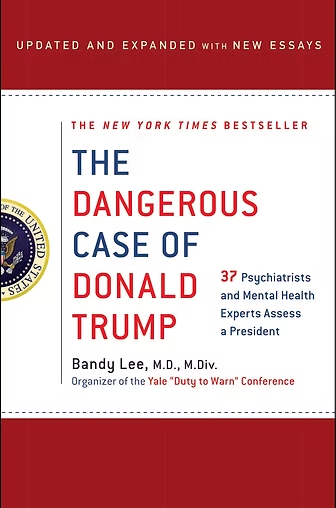
In 2017, Yale psychiatrist and expert in predicting violence, Bandy X. Lee convened a group of mental health professionals around the topic of The Dangerous Case of Donald Trump. The conference led to the publication of The Dangerous Case of Donald Trump: 27 Psychiatrists and Mental Health Experts Assess a President and then later expanded to a new edition with ten more experts, The Dangerous Case of Donald Trump: 37 Psychiatrists and Mental Health Experts Assess a President – Updated and Expanded with New Essays. Dr. Lee ended up losing her position at Yale, then she created the World Mental Health Coalition, and has dedicated her work to illuminating the dangerousness of the current president.
I watched the first Trump presidency with concern. I also recognized, as a psychiatrist and as a human being, how Trump’s words and actions were right out of the “fascist playbook.” In 2020 I was moved by the mosque shooting hate crime in Christchurch, New Zealand to start the Words Create Worlds column. (I will list each essay title with links at the end of this article). Looking back, I think the pandemic and Trump’s mishandling of it, and his use of it to divide the country rather than bring it together, helped tip my hand to write in a more open and critical way about the public health emergency of Donald J. Trump. While I was cautious back then and did not want to overstate the risk of “just words,” I now feel that my concerns are valid and vindicated by the second Trump presidency where his words are moving into action and creating our world. In fact, I called Trump the anti-Doctor as his words were not only hurtful of people’s feelings, but dangerous to people’s lives and to American democracy.
Fifth Avenue to Nicollet Avenue to Iran
Donald Trump did not shoot someone on 5th Avenue in New York City, but armed, masked men carrying out the orders of the president, shot and killed Renee Nicole Good in her car after dropping off her 6 year-old at school, near East 34th Street and Portland Avenue in Minneapolis on January 7th, 2026. This was, ominously, five years and a day after the January 6th 2021 attack on the United States Capitol.
Instead of Fifth Avenue, it was 34th Street and Portland Avenue. Instead of Fifth Avenue, it was Nicollet Avenue in Minneapolis, where Alex Jeffrey Pretti, an ICU nurse who worked at the VA (Veterans Affairs) was shot.
Trump and his team of ne’er do-wells immediately went into “blame-the-victim” mode. Homeland Security Secretary Kristi Noem lied about Renee Nicole Good, accusing her of “domestic terrorism.”[7] As with lies about Stephen Miller, Trump’s chief of staff, said that Pretti was an “assassin” who “tried to murder federal agents.”[8] Homeland Security Secretary Kristi Noem claimed Pretti “attacked” officers while “brandishing” a gun.”[9] However multiple eye witness reports and video footage showed that these were lies. The administration had to walk back its portrayal of a mother dropping off her child and a VA ICU nurse. The president even said he “felt bad” about the killings, but even worse about Renee Nicole Good’s killing as her parents were Trump supporters.[10]
Since I first started this essay, the United States of America and Israel have started a war with Iran. The lies continue…
“On February 28, during the opening hours of the assault on Iran, a missile struck a girls’ school in southern Iran, killing more than 170 people – most of them schoolgirls.”[11]
Rather than waiting for the truth of an investigation, Donald Trump immediately blamed Iran for using a US made missile to kill its own children. However, the evidence is pointing to the children being killed by the United States:
“Preliminary investigations suggest the school may have been hit by a US missile because of a targeting error, though the exact circumstances remain under investigation.
Analysts say the strike may have been caused by outdated targeting information, as the school is on the same block as buildings used by the IRGC’s navy and the site of the school was originally part of the base.”[12]
The Cusp Where Words Become Worlds
I have to keep writing this column on Words Create Worlds.
The risk of remaining silent, at this point, is greater to my humanity than the risk of speaking is to my conservative professionalism or my safety.
We are on the cusp of words becoming worlds – actually we are beyond the cusp, beyond the event horizon pulling us into the black hole of fascism. Donald J. Trump has told us, all along, what he intends to do. Republican politicians have minimized his words, saying “they are just words,” “that’s just who he is, he doesn’t really mean he is going to [fill in the blank: take over Greenland, make Canada the 51st state, invade Mexico to combat cartels, remove Palestinians from Gaza and build luxury hotels, jail his opponents, kill his opponents, run for a third term, invade Iran].
I have seen this coming. I did what I do as a writer, I wrote about it. I educated about fascism.
Yet, I feel I have not done enough. Is there anything one person can do to stop the steady slide from democracy into fascism? Actually, “steady slide” is a mischaracterization – the United States of America did not “fall” into fascism, it was pushed.
Politically, with the House, Senate, and White House controlled by Republicans, it seems to depend on Republican politicians who need to break with Trump before it is too late. But it is already too late. Trump began as much of a buffoon as Adolf Hitler was in the early 1930s – no one took him seriously. The power Trump has is the power of the tongue, the power of mass hypnosis, the power of lying to people, telling people what they want to hear and making them feel good about uncaring, and the power of intimidation. Republican politicians have colluded with him in deforming American Democracy into the power of American Empire.
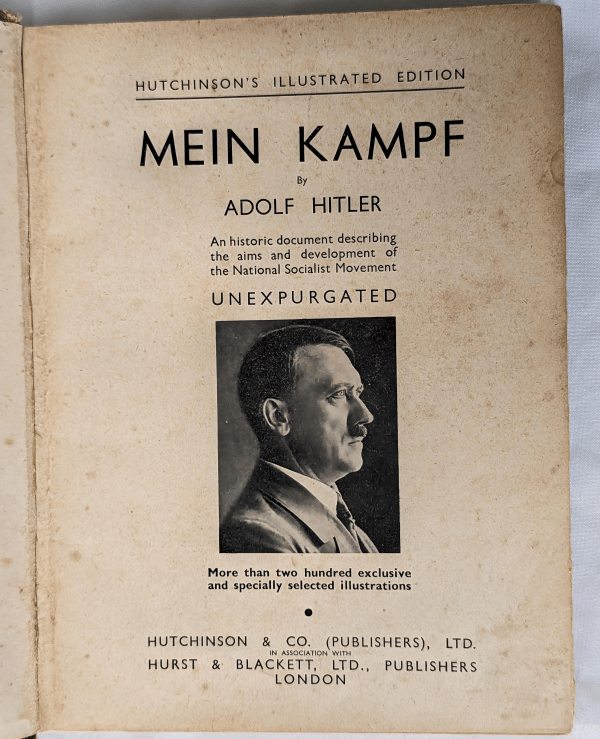
Bruno Frank, the author of Lüge as Staatsprinzip (The Lie as State Principle), whom I introduced earlier, quotes Adolf Hitler’s Mein Kampf on how lying words can create worlds:
“All this was inspired by principle ─ which is quite true in itself ─ that in the big lie there is always a certain force of credibility; because the broad masses of a nation are always more easily corrupted in the deeper strata of their emotional nature than consciously or voluntarily; and thus in the primitive simplicity of their minds they more readily fall victims to the big lie than the small lie, since they themselves often tell small lies in little matters but would be ashamed to resort to large-scale falsehoods…For the grossly impudent lie always leaves traces behind it, even after it has been nailed down, a fact which is known to all expert liars in this world and to all who conspire together in the art of lying. These people know only too well how to use falsehood for the basest purposes.”[13]
Uncaring Words Create Uncaring Worlds
What we are living in the United States right now is the uncaring world created by the uncaring words of Donald J. Trump. These are the words of fascism, authoritarianism, totalitarianism, infantilism, and me-first-ism. I have often thought that if Republican politicians asked themselves “Am I being kind, am I being compassionate,” that they would make different decisions. But kindness and compassion seem to have lost their appeal to MAGA and the Republican party. Instead, they speak words of power, words of me-first, words of us vs. them, words of hate thine enemies, and words of vengeance and retribution. MAGA and the Republican party have become, in the words of Adolph Hitler, “expert liars…who conspire together in the art of lying.”
If we hold uncaring feelings in our hearts and we speak uncaring words into the world, we will create an uncaring world.
Caring Words Create Caring Worlds
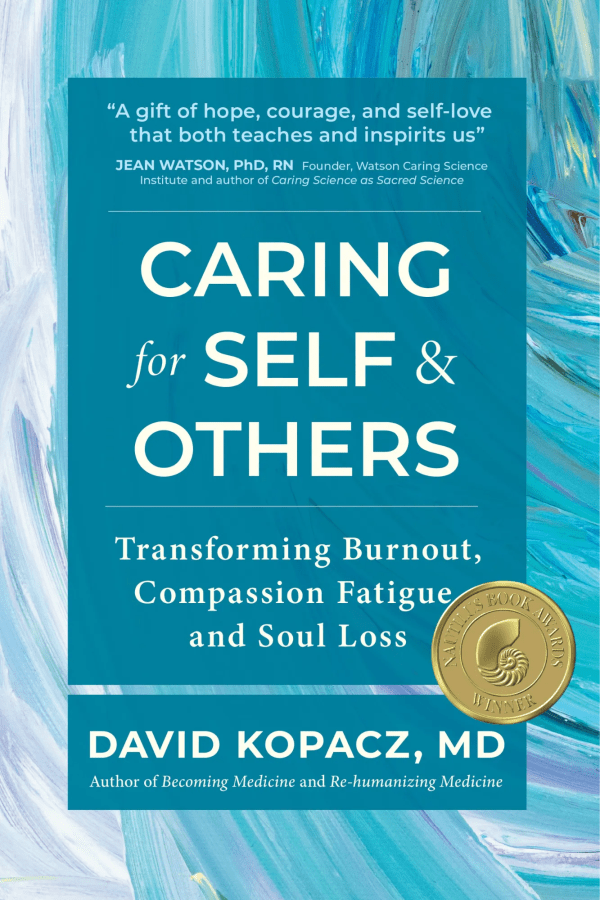
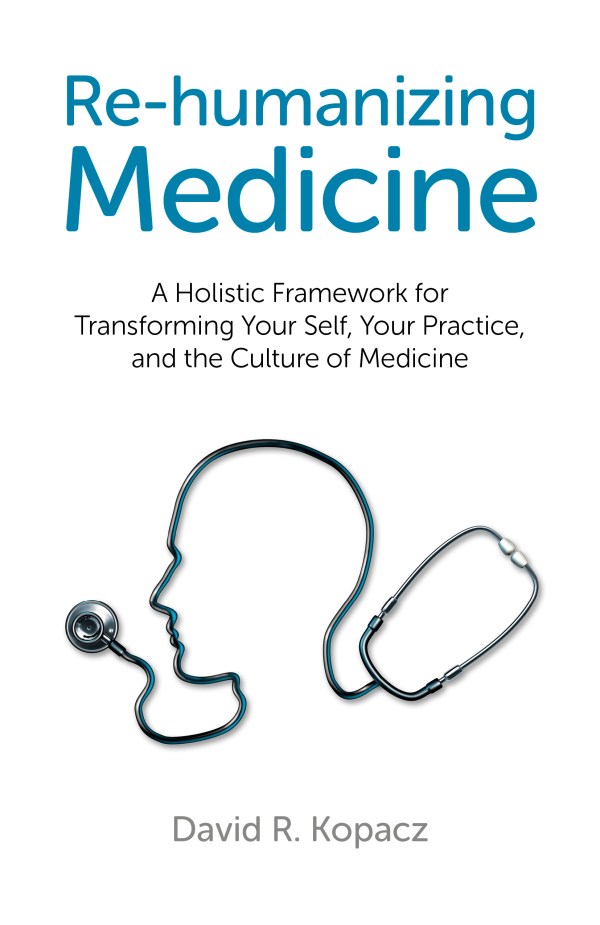
In 2025 I published my sixth book, Caring for Self & Others: Transforming Burnout, Compassion Fatigue, and Soul Loss. I wrote it as a follow-up to my first book, Re-humanizing Medicine (2014). I wrote Caring for Self & Others because I felt there was a need for a practical handbook for health care professionals, educators, and leaders – but it is really for anyone who cares for others as part of their life or jobs, which is most of us.
“Transforming burnout, compassion fatigue, and soul loss,” I wrote, “requires individual practices as well as institutional reform” (4). While I was mostly thinking about hospital and clinic settings as the place of institutional reform, we are in a place with our democracy that it also requires institutional reform in order to be a healthy place to live, love, and work.
Health Care Workers can burnout and develop compassion fatigue, where they feel they no longer have anything to give. The human imperative to resist fascism, you can call it activism if you like, also carries the risk of burnout and compassion fatigue – how can we keep caring when the suffering seems endless? We need to learn how to care for ourselves as we are caring for others. We need to learn how to replenish our own hearts of caring. The book has a number of exercises and meditations to help individuals to refill the cup of their hearts.
The Compassion Revolution & the Counter-Curriculum of Caring
In Re-humanizing Medicine I called for a Compassion Revolution in health care and now we need a Compassion Revolution in politics. We need to not just think about ourselves, we need to think about others. We need to not just care about ourselves, we need to care about others. Actually, I would argue that “caring” only for self is not really caring, it is more selfishness. Caring breaks down the boundaries and walls between self and other. Caring naturally shifts us into a transpersonal space, what Thich Nhat Hanh called “interbeing” and Martin Luther King, Jr. called the “beloved community.”[14] Caring connects us – connects us to ourselves, our hearts, our souls; connects us to other human beings; and connects us to our environment and ecosystem.
In medical school, I felt I was losing an important part of myself, I felt like I was losing who I was, my kindness, my sensitivity, my caring – my soul. Over the years I have developed what I call a counter-curriculum of caring, or rehumanization, as an antidote to counter-act all the forces in our modern world that leave us feeling dehumanized.
“These counter-curriculum practices grew into the practices for the ten dimensions of caring in this book. This book is a counter-curriculum of caring, reminding us in the midst of our busy days as technicians, educators, and leaders to take the time to care. Our current curriculum and operating procedures are creating burnout, compassion fatigue, and soul loss. The proposed counter-curriculum transforms burnout, reigniting the heart of the healer, the soul of the educator, and the vision of the leader; it gives us an antidote for compassion fatigue by giving compassion to ourselves―refilling the medicine bags of our hearts; and it helps us recover and nourish our souls, revitalizing and reconnecting all the dimensions of our humanity.”[15]
It is one thing to define a problem, to understand it, but how do we address the problem of uncaring in the USA and the world? I wish I had an answer for you, but I think each person has to figure this out for themselves, consulting their own hearts in the darkness of sleepless nights. I do think the heart can guide us.
And our souls? What about our souls?
I use the concept of “soul loss” as a metaphor for burnout and compassion fatigue – for the costs of caring. How do we recover our souls when we feel we are losing them – as individuals and as a country? We have to search, we have to be still, we have to go into the darkness – our own and that of our times. As Michael Mead writes in Awakening the Soul:
“As the inner dynamic of transformation, initiation means the continuous breaking open of areas of the soul to reveal hidden capacities and inherent gifts. When life pulls at us from the outside and the soul pushes us from the inside, we reach the point where pain and longing requires that we change. … Whatever interrupts, breaks us open, or breaks us down―whether it is the trauma and shock of a loss in life or the drama and exhilaration of success―also initiates us into a greater knowledge of ourselves.”[16]
Meade’s book repeatedly reinforces the idea that the crisis can awaken the soul which then gives the support that is needed for the particular crisis. Caring for ourselves entails caring for our souls, which then give us the strength to further care for ourselves and then to care for others.
What can we do? When you find yourself in a dark place, when you feel you are at your limit, when you feel burnout and compassion fatigue, when you feel a sense of soul loss – that is the time to consult with your soul through inner practices that lead to outer actions and outer actions that lead to inner practices.
Q: What are we going to do now? A: Whatever needs doing.
Q: How are we going to do it? A: I’m not sure, but check with your heart, check with your soul. Let your heart and soul find the caring response as the antidote to the uncaring world we are living in. The answer is in caring. Caring for what? Caring for yourself & caring for others.
Inner Democracy
One way of caring for Self is cultivating Inner Democracy. I am starting another series of essays on this topic and will be posting them soon. In addition to the outer work of challenging words creating worlds of fascism, this inner work is an antidote to uncaring. Creating Inner Democracy is a practice of Caring for Self & Caring for Others.[17] This work owes a great deal to Steven Herrmann’s work on Spiritual Democracy and Jeremy David Engels On Mindful Democracy: A Declaration of Interdependence to Mend a Fractured World.[18]
I will leave you with an exercise from Caring for Self & Others, one that actually came to me when I was working with Joseph Rael on our book, Walking the Medicine Wheel: Healing Trauma & PTSD.
Imagine and visualize what the heart does on a physiological level in the body.
The heart receives (through the right atrium) the blood that has traveled throughout the entire body. This blood has the lowest oxygen content; all the tissues of the body have already absorbed oxygen from this blood―it is blue, venous blood. From the perspective of tissues, it is “bad” blood, no longer oxygen-rich. As the heart receives and accepts this “bad blood,” it doesn’t complain or cling to it, but gives it away, lets it go, and it passes on to the lungs. There the blood is replenished with oxygen. The heart then receives again, only this time it is the “best blood,” the most oxygen-rich. Once again, however, the heart doesn’t cling or hoard the goodness for itself, but gives it away to the rest of the body.
Hopefully you are seeing the metaphor of how your heart works physiologically and how you can work with suffering in your life. How much do you cling to the good? How much to you reject “bad” life experiences, which could be blessings in disguise?
Sit back for a moment, closing your eyes. Focus on what your heart is doing an average of 60 to 80 times a minute. Receiving depleted blood, giving it away; receiving replenished blood, and giving it away. Become aware of this ongoing process within you.
If you would like, focus on this same movement in your life.
Think about a situation in which you experienced suffering. Remember to step back and use some of the grounding techniques discussed in chapter 2 if you feel overwhelmed.
Allow yourself to receive it. Once you have received it, give it away again, allow it to transform, and then allow yourself to receive it again, then give it away once again. Go through this cycle of giving and receiving for as long as feels right to you. Breathe in deeply―let it flow through you; breathe out―let it go. Practice this breathing in/letting go three more times. Feel the movement of the action of your heart throughout your being. Take a deep breath, and open your eyes.
This exercise of giving and receiving shows that compassion begins within our own hearts, that we must be willing to accept both the good and the bad in order to fully feel and fully live and fully love. Transformation occurs when we accept through receiving and let go through giving.
[1] Heschel, S. in “Introduction,” Heschel, Abraham Joshua. Moral Grandeur and Spiritual Audacity: Essays. Farrar, Straus and Giroux. Kindle Edition, 1997.
[16] Michael Meade, Awakening the Soul: A Deep Response to a Troubled World (Vashon, WA: Greenfire Press, 2018), 72-73
[17] For now, you can reference my writings on spiritual democracy and caring for all:
Caring for Self & Others: Transforming Burnout, Compassion Fatigue, and Soul Loss (ch. 10, Becoming Caring: Caring for All). Becoming Medicine: Pathways of Initiation into a Living Spirituality (ch. 14, Spiritual Democracy) – this is available as a free pdf download: https://www.davidkopacz.com/becoming-medicine
My friend Lucy Houghton and I have been working on this idea of post-burnout growth, analogous to the concept of posttraumatic growth. We published a preliminary essay in Closler October 18, 2022 called A New Paradigm for Growth.
Since then I have continued to elaborate this concept and wrote about it in my latest book, Caring for Self & Others: Transforming Burnout, Compassion Fatigue, and Soul Loss. I would like to offer some sections of the book on the topic of post-burnout growth as a new paradigm for growing through suffering – burnout, compassion fatigue, and soul loss.
Transforming Suffering
Initiation is a model of transformation that is ancient and is found in many Indigenous traditions as well as in the wisdom stories of many religions. In Becoming Medicine, Southern Ute elder Joseph Rael (Beautiful Painted Arrow) and I structured our book based on the three stages of initiation: separation, initiation, and return. While Joseph Campbell came to these stages through the study of stories and cultures, Joseph Rael has lived them through various initiation ceremonies in his education at Picuris Pueblo and the Southern Ute Reservation. Since 2014, Joseph and I have been working together, focusing on different ways that people can transform their own trauma and suffering by becoming healers―that is what it means to be becoming medicine: becoming a healer for yourself, others, and the world.
This kind of transformation is what Lucinda Houghton and I have been working on in regard to burnout. We have been calling this post-burnout growth, similar to posttraumatic growth―where suffering is used for personal and professional growth.[i] Posttraumatic growth has been described as: increased appreciation for life, more meaningful interpersonal relationships, increased sense of personal strength, changed priorities, and a richer existential and spiritual life.[ii] These are changes both in self as well as in relationships with others. We view post-burnout growth as not simple resilience of returning to who we were, but actually using suffering as a tool for growing beyond who we were into who we can become.
We can view burnout, compassion fatigue, and even soul loss as calls to initiation, just as Joseph Campbell described the call to adventure in the hero’s or heroine’s journey.[iii] The quest to reconnect with the soul is a kind of heroism that leads to healing. As storyteller Michael Meade tells us, “Life is change and the life of the soul is transformation.”[iv]
David Kopacz, Caring for Self & Others: Transforming Burnout, Compassion Fatigue, and Soul Loss. Palisade: Creative Courage Press, 2024, (pages 19-20)
While burnout and compassion fatigue can feel like we have lost our souls, it is not so much our souls that are lost as we who are lost—we have lost touch with the innermost being of ourselves. As Joseph Rael teaches, Wah-Mah-Chi, Breath-Matter-Movement, holds back a place of goodness in each of our hearts, no matter what we have done and no matter what has been done to us. Burnout and compassion fatigue can be viewed as disorienting dilemmas that start the initiation of transformative learning―post-burnout growth! In this way, periodically losing touch with ourselves (our souls) is actually an ongoing invitation to enter into the healing space of transformational initiation. Our troubles, disorienting as they are, can be the call of transformation. “Thus,” writes Meade, “the troubles we find ourselves in are intended to wake us up to a greater sense of life and awaken the underlying soul, which knows better than us what our life is for.”[v] The loss of energy in burnout and compassion fatigue creates a space that offers us the opportunity to be guided by our inner knowing and inner wisdom of the soul. For, as Meade tells us, “when our energy drains from life’s outer projects, our attention is drawn inward, downward and back towards the original spark of our lives and the genuine project of our soul.”[vi]
Kopacz, Caring for Self & Others, pages (148-149)
Beyond Resilience to the Joys of Caring
While resilience and self-care are part of the puzzle for recovering from burnout and soul loss, to only focus on these individual responsibilities runs the risk of blaming the victim. Are high rates of burnout actually due to the way our systems are designed? Swensen and Shanafelt think so, writing that the “current health care delivery system is perfectly designed to create high rates of professional burnout in physicians, nurses, advanced practice providers, and other health care professionals.”[vii] The problem, then, is not a lack of resilience within staff, but an institutional structure that does not support human flourishing. To address burnout and compassion fatigue, we have to go beyond individual resilience.[viii]
resilience (n.) “act of rebounding” … from Latin resiliens, present participle of resilire “to rebound, recoil,” from re- “back” … + salire ”to jump, leap”[ix]
While the ability to bounce back is important, we also need to transform, which means to grow beyond our previous limits. Transformation means we are not trying to be who we were, rather we are growing into the potential of who we can become. Many are questioning whether resilience is really the answer to the burnout pandemic, particularly within the field of posttraumatic growth. As Edith Shiro writes in The Unexpected Gift of Trauma: The Path to Posttraumatic Growth, “resilience doesn’t help us grow from adversity, it helps us cope with it, and further, “sometimes resilience actually hinders the possibility of achieving” posttraumatic growth.[x]
Richard Tedeschi and Lawrence Calhoun have been studying posttraumatic growth for years and they point out that “continuing personal distress and growth often coexist.”[xi] In this sense, the goal is not to be free of suffering, but to grow from it. This distinguishes a transformative growth paradigm from the prevention and recovery focus on work-readiness of the resilience paradigm. Rather than bouncing back to our previous level of adaptation, transformation helps us grow beyond it. Just as Chenrezig was not put back together with two arms and two eyes, we want to grow in the ability to see and touch suffering. Tedeschi and Calhoun describe posttraumatic growth as an experience where development “has surpassed what was present before the struggle with crises occurred,” and that this is not “simply a return to baseline―it is an experience of improvement that for some persons is deeply profound.” Posttraumatic growth “has a quality of transformation…unlike…resilience.”[xii]
Resilience and subjective well-being can be part of the approach to burnout, compassion fatigue, and soul loss, but only take us so far―they can restore previous functioning, but do not help us grow as healers or as human beings. Posttraumatic growth and post-burnout growth are transformation paradigms that take us beyond resilience, however we still need to look beyond the individual to the health care ecosystems we work in and the institutional variables that contribute to burnout, maintain it, and limit our focus to being the same productive work unit we were yesterday instead of supporting a transformational growth mindset. It is worth re-examining the costs of caring again, this time looking at the systemic and organizational issues, as we have been covering the personal and individual levels. We can look at the costs of caring from a different perspective after taking the journey of caring for self & others. Each cost of suffering can be seen as having a joyful counterpart: from burnout to post-burnout growth, from trauma to posttraumatic growth, from dehumanization to re-humanization, from demoralization to remoralization, from soul loss to soul recovery, and from suicide to finding meaning and purpose which leads to joy and flourishing. It is not easy work to dig ourselves out of the abyss of the costs of caring and to return, transformed, back into the health care world armed with our rejuvenated joys of caring.
Working with people is stressful and exposes us to direct and vicarious trauma. We can’t eliminate exposure to suffering from our work. But we can build in ways to grow in our capacity for caring―this doesn’t mean never suffering, but developing a greater capacity to work with suffering. In addition to individual approaches, we also need to go beyond resilience to create organizations that measure employee idealism and well-being as well as measuring productivity. As the late Alessandra Pigni, a former Doctors Without Borders psychologist, stated:
But is self-care enough to prevent burnout? Yes and no. There is self-care as in “a day at the spa,” recreational self-care, and there is self-care as “care of the self,” a deeper kind of attention to ourselves, the sort that asks questions like, “What am I doing in this group/organization/community? Do I still belong here?” We call this transformational self-care.[xii]
Alessandra Pigni, The Idealist’s Survival Kit: 75 Simple Ways to Avoid Burnout
Transformational “care of the self” challenges us to look not just at ourselves as individuals, but how we fit in the larger institution. If an institution is not supporting our humanity and for whatever reason we are not able or in a position to transform the institution, that may mean we care for ourselves by changing jobs. If transformation is possible, then we roll up our sleeves and contribute to the challenging work of transforming systems and institutions.
[ii] Richard G. Tedeschi and Lawrence G. Calhoun, “TARGET ARTICLE: ‘Posttraumatic Growth: Conceptual Foundations and Empirical Evidence,’” Psychological Inquiry 15, no. 1 (2004): 1–18, https://doi.org/10.1207/s15327965pli1501_01.
[iii] Campbell focused primarily on the masculine hero’s journey. Other authors have further developed the heroine’s journey, for instance Maureen Murdock’s The Heroine’s Journey and Marina Tatar’s The Heroine with 1001 Faces.
[iv] Michael Meade, Awakening the Soul: A Deep Response to a Troubled World (Vashon, WA: Greenfire Press, 2018), 73.
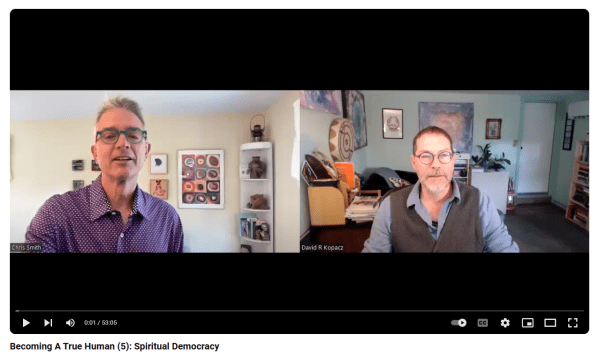
Spiritual Democracy episode 5 of Becoming a True Human podcast with Chris Smith and Dave Kopacz is now available!
Ideas for finding micro-compassion breaks for self & others during these turbulent times.
Chris Smith facilitates a discussion with Dave Kopacz on the concept of Spiritual Democracy, which is a chapter from Dave’s book with Joseph Rael: Becoming Medicine. Spiritual Democracy asks each of us, citizens and politicians alike, to ask ourselves before speaking any words or taking any actions: “Am I starting with the heart? Am I using words to divide or to invite togetherness?”
We talk about Steven Hermann’s books, Spiritual Democracy and Walt Whitman: Shamanism, Spiritual Democracy, and the World Soul. We also discuss Parker Palmer’s Healing the Heart of Democracy and his idea of the two ways that the heart can break: 1) it can break apart, creating shards and wounds in self and others, or 2) it can break open into greater compassion. Chris also brings up Frank Ostaseski’s Five Invitations to be present with ourselves and others in the moment, opening up into fearless receptivity and continuous discovery of our lives during these turbulent times.
We offer practices for doing the work of Spiritual Democracy, including finding space within each breath for micro-compassion for your self and for others.
I’ve been thinking about how we need to build a community of practitioners discussing the problems of burnout, compassion fatigue, and soul loss. Isolation and loneliness contribute to burnout, and social connection is an antidote to burnout. To this end, we are creating the Becoming A True Human podcast. Who is “we”? Well, for now, it is me and my good friend Chris Smith – therapist, meditation teacher, Whole Health educator, storyteller, author (Be a Good Story), founder of the Academy for Mindfulness consulting, and all-around wise guy (and I mean that in multiple senses of the phrase).
The audio of the episode 1, Lost, is at the bottom of this post.
Chris SmithDave Kopacz
What is burnout? Just what exactly is it that burns out? How can whatever is burned out be re-ignited?
What is compassion fatigue? How does compassion wear out? Should it really be called empathy fatigue? Is the problem that there is too much compassion going out? Or not enough coming in? Or could it be that institutional structures and protocols make us busy with so many things that there is little time left in the clinical encounter for caring?
What is soul loss? Could we think of the soul being the “thing” that burns out? Not necessarily in a religious or metaphysical sense – although it could be if that fits your belief system – but in a metaphorical and psychological sense. If in burnout we lose connection with our souls, how can we reconnect and either go on a quest to find our lost souls, or create a welcoming environment in our bodies and lives so that our souls can return and flourish?
I address these questions in my book, Caring for Self & Others: Transforming Burnout, Compassion Fatigue, and Soul Loss, but we need to have further discussions around these topics as I feel strongly that we need a kind of ongoing practice, a yoga of burnout, in which we continually work in our own practices as well as in building communities of caring to support each other with this human, all too human dilemma.
Based on the topics we discussed in the first episode we titled this episode “Lost,” even before we realized that we somehow lost video of me and only recorded video for Chris! In this episode we explore topics of burnout as an initiation into becoming a wounded healer, soul loss, yoga for the health of healers, and we end with a meditation exercise and a poem, “Lost” by David Wagoner.
We don’t really know what we are doing with the technology aspect.
Let me tell you a story that illustrates the problem.
My high school friend Jack and I drove across the country after college. We were into the beat poets and writers, reading Kerouac’s On the Road, and envisoned a trip full of excitement and philosophical observations. We had a microcassette recorder and would talk into as we were driving, having many deep discussions and creating a record of what we saw.
Somewhere around South Dakota (having left from Chicago area) I noticed that the wheels of the recorder weren’t moving when we were recording. It was then that I noticed that there was a pause switch that was clicked on and prevented any recordings from being made! All of our bits, routines, observations, and experiences were lost! We were a bit crestfallen and we made half-hearted attempt to resume recording, but something had been lost – the energy, the enthusiasm. I think we eventually gave up on it. Maybe you could say we burned out on the idea after investing so much energy and enthusiasm and not having anything to show for it.
From a mindfulness perspective, there is surely some kind of lesson here – about not being attached to goals or outcomes, about being in the present moment versus memorializing experience, and maybe even that the organizing ego is an illusionary construct for creating a reduced and more manageable limited reality (if you want to take it that far!).
Well…I remembered this story after Chris Smith and I had just had our wide-ranging and enthusiastic discussion as we recoreded it on Zoom, only to realize that I had messed up the settings and we only had Chris’ video and both our audio. Well, crestfallen again! Urgh, technology failure again!
So, I think I have figured out how to share the audio of our video podcast, rather than have video of just Chris and my disembodied voice. Titling this episode, “Lost,” was prescient as we lost the video. Chris also spoke of his caring for self routine and how he purposefully skips some days so as not to get caught up in perfectionism, performance, and productivity. We’ll consider the lost video as a sacrifice to the Divine or the Cosmos, a giveaway, in addition to it being a bumbling failure of technology.
So, welcome to the first episode of the Becoming A True Human podcast – Lost – it highlights the vulnerability and imperfection of being human, that we are all a work in progress and that our work is a yoga practice – yoking mind, emotions, body, soul. The practice of Becoming A True Human is an ongoing practice, we can only do it in the present moment and the next moment we are again lost, at sea, trying to figure it out and Keep It All Together (KIAT). We will attempt to have the next episode as video and hope to post it on the Becoming a True Human YouTube site.
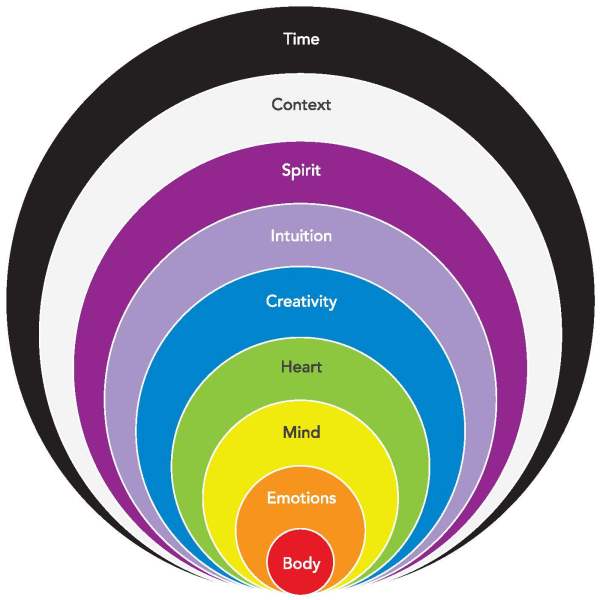
I have been working on this book for ten years – the longest of any book I’ve written. In many ways it is a follow-up of Re-humanizing Medicine (2014) and yet it also is strongly influenced by my work over the past 10 years with Joseph Rael (Beautiful Painted Arrow). It brings together my work on physician and staff wellness in presentations and workshops, from my work Whole Health at the VA, and my work with The Doctor as a Humanist. Re-humanizing Medicine used a 9-dimensional model of the components of being fully human: body, emotions, mind, heart, creativity, intuition, spirituality, context, and time. In Caring for Self & Others, I’ve added the dimension of Becoming Caring: Caring for All, a kind of holistic leadership for self & others. Within each of the ten different dimensions of being fully human I have developed three different domains that end in an -ing (in honor of Joseph Rael’s emphasis on verb-ing in our conversations). I’ll now give a brief review of the journey of how this book has come into being.
After publishing Re-humanizing Medicine, I realized I needed to develop a set of practices to operationalize what I called the counter-curriculum. The counter-curriculum was a humanizing curriculum, a caring for self curriculum, which focused on how we do things, not just what we do in clinical settings. If our medical education and continuing medical education (CME) trains us to be good clinicians, the counter-curriculum trains us to be good human beings – thus I came to call this Continuing Human Education (CHE). In the age-old balance of being healers and technicians, I recognized that we have really given the education of ourselves as healers short shrift, and have almost exclusively focused on becoming technicians at the expense of our humanity. The loss of our role as healers and the loss of our human presence in medicine leads not only to impoverished clinical care (with patients feeling like they are being processed by protocols rather than cared for by human beings), but it also cut us off from the rejuvenating nature of the healing relationship which nourishes our own humanity as well as the humanity of our patients and clients. I realized that to care for others we must first care for ourselves and that in caring for ourselves we were developing the skills and aptitudes necessary to care for others.
In 2015 I was developing the idea of “Becoming a Whole Person to Treat a Whole Person,” which I presented in various forms at the Australasian Doctors’ Health Conference, and conferences of the Alliance of International Aromatherapists, and the Australasian Integrative Medicine Association.
In 2016, Joseph Rael and I published Walking the Medicine Wheel: Healing Trauma & PTSD. That year I deveoped presenations on Healing Circles, Pathways to Healing Moral Injury, and comparing the Medicine Wheel and the Hero’s Journey as pathways of initiation and healing – with presentations at the Mayo Clinic Humanities & Medicine Symposium, and various local settings. I developed a half-day workshop called “Caring for Self: Well-Being in the Workplace” that I gave for HopeWest hospice staff in Grand Junction, CO.
In 2017 I first started using the title of “Caring for Self & Others” in presentations, for instance at Western Sydney University in Australia. I continued developing ideas around Healing Circles and the Hero’s Journey, with presentations at the Australasian Doctors’ Health Conference and the University of the South Pacific in Fiji.
One of the dimensions of being fully human from Re-humanizing Medicine was spirituality and I had a sub-section on mysticism and medicine. My work with Joseph Rael, which has resulted in the publication of four books thus far, has allowed an in-depth exploration of the role of spirituality in healing. Our 2020 publication of Becoming Medicine: Pathways of Initiation into a Living Spirituality was a blending of Joseph Rael’s teachings within a framework of initiation, a review of healing through the lives and writings of visionaries, mystics, and shamans, and a survey of the perrenial philosophy of timeless healing wisdom. My subsequent training as an iRest certified teacher (a Western adaptation of yoga nidra from Kashmiri Shaivism by psychologist Richard Miller) and as a certified yoga teacher (CYT 200), has allowed me to study and explore nondualistic states – which I feel are foundational to breaking down the barriers between self and other – a kind of nondual medicine, as I call it in Caring for Self & Others.
As I have been working with burnout for myself and in staff and clinicians, I started to realize that there were many terms for health care worker suffering, not just burnout, but compassion fatigue, secondary and vicarious traumatization, PTSD, demoralization, moral injury, and even suicide could be an outcome of the burden of caring for others. I have come to use the term the costs of caring to encompass all these different dimensions of staff and clinician suffering. My good friend Greg Serpa and I published a chapter on “Clinician Resilience” in the Integrative Medicine, 5th edition textbook and I started to bring together a number of ideas I had been working on around burnout, moral injury, and the costs of caring, and even the idea of soul loss.
Soul loss is often considered one of the causes of illness in shamanic and indigenous traditions, such as in the work of Joseph Rael. It also has a resonance with the Western traditions that psychiatry and psychotherapy grow out of. The etymology of the word “psychiatry” comes from the Greek words psyche + iatros, soul healer. The Swiss psychiatrist, Carl Jung, frequently wrote of the psyche and also of the soul in his work as a healer and psychotherapist. The more recent, modern tradition of neglects the idea of the a vital essence of a person – yet there is a practical utility in addressing burnout as “soul loss.” In doctors and health care workers, as well as in teachers, and business, burnout is such a serious issue. We talk about burnout, but what is it that burns out? The soul is one answer – not necessarily in a metaphysical or religious sense, although it could be understood that way, but in a metaphorical and evocative way of describing what burnout and compassion fatigue feel like – that one has lost some core aspect of one’s being – a loss of soul. I gave presentations on burnout and soul loss at the Doctor as a Humanist’s on-line international conference, New Realities in the Times of COVID-19 (2020), University of Washington Psychiatry Grand Rounds (2021), and Seattle University’s Giving Voice to Experience Conference (2022).
A key idea in Caring for Self & Others is that suffering can be transformed – this is what healing is all about and this is the primary skill that a healer has, how to transform suffering. Our work as healers, doctors, technicians involves exposure to suffering, therefore we cannot eliminate suffering from our work as the very definition of our work is to engage with suffering. We can minimize the amount of collateral suffering that we experience from working in systems that do not support the full human being of clinicians and staff – that is the moral injury piece that we need to address. However, I think that burnout is inevitable when we are people who work with people, particularly people who work with suffering people. In my conversations during the pandemic, Lucy Houghton and I have been developing the idea of post-burnout growth, which is analogous to post-traumatic growth, in which we use suffering as a stimulus to personal and professional growth. Post-burnout growth captures the idea that burnout is not to be feared, but rather respected as a predictable occupational hazard – just like a firefighter working with fires is sooner or later going to get burned.
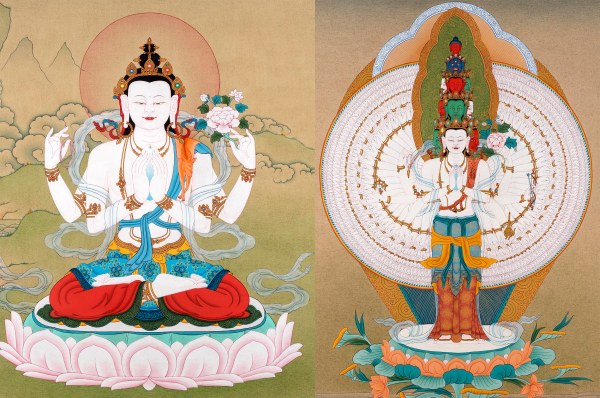
The Many Faces of Chenrezig, Image Credit: Enlightenment
The story of Chenrezig as a wounded healer captures this idea of post-burnout growth perfectly. Chenrezig vowed to alleviate all suffering in the world – which is not dissimilar to our own vows, spoken or unspoken, to heal others. If he was not successful in this vow, he pledged that he would shatter into a thousand pieces – a state akin to burnout, compassion fatigue, and soul loss, where we feel injured as a result of our caring. This is, in fact, is what happened – Chenrezig worked diligently, healing many, yet there was still more suffering than he could address and he shattered into a thousand pieces. This is where the story ends for so many health care workers and educators who become embittered, cynical, and maybe even leave their profession. But in the story of Chenrezig, there is a ritual elder, Avalokiteśvara, who sees Chenrezig’s suffering from addressing others suffering. Avalokiteśvara puts Chenrezig back together – not simply as he was before (this is my problem with the way resilience is often used in health care – as a way of going back to the past, or avoiding suffering), but rather as having a thousand eyes to better see suffering and a thousand arms to better touch suffering. Chenrezig becomes more capable of seeing and touching suffering – through post-burnout growth.
This book, Caring for Self & Others: Transforming Burnout, Compassion Fatigue, and Soul Loss, has grown over the last ten years and I am grateful to all the above mentioned organizations. The book and I have also been shaped by numerous conversations with friends and colleagues and I would particularly like to thank Laura Merrit, Shelly Francis (Creative Courage Press), Joseph Rael (Beautiful Painted Arrow), Steve Hunt, Jonathan McFarland, Usha Akella (The POV), J. Greg Serpa, Tulika Singh, Chris Smith, Lucy Houghton, Transformational Arts Network and their Power of Words conference, Gretchen Miller (and the editorial staff at the CLOSLER blog), and so, so, so many others. There truly is no self without others.
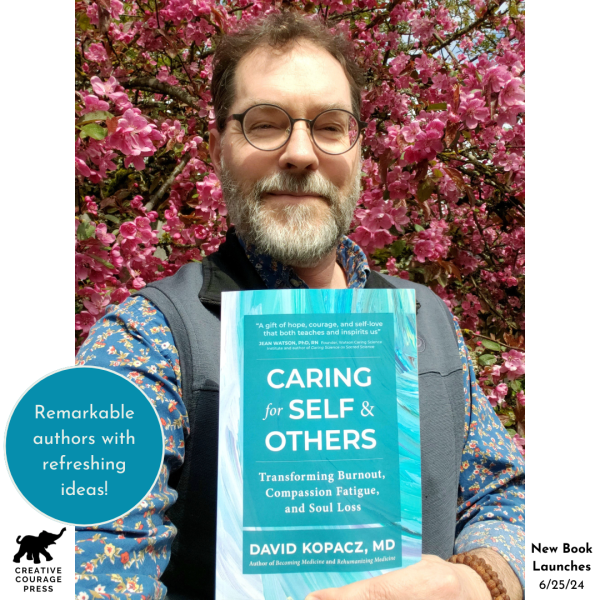
We’ve gotten some really nice endorsements for the upcoming release of Caring for Self & Others: Transforming Burnout, Compassion Fatigue, and Soul Loss – which will be released on June 25th and is currently available for pre-order through Amazon. I’ll share some of the comments below:
“It is a healing experience to read the beautiful, self-journey into self-caring through the wounded depth of the dark night of soul. It is through such personal sharing of self that we learn from each other. David Kopacz ‘s book offers readers a gift of hope, courage and self love, that both teach and inspirit us with his soul’s path into self-caring and heart healing.”
Jean Watson, PhD, RN, AHN-BC, FAAN, LL (AAN), Founder Watson Caring Science Institute, Distinguished Prof/Dean Emerita University of Colorado Denver, College of Nursing
“This holistic, imaginative and soulful response to burnout is much needed in today’s world.”
Dr. Dina Glouberman, author of TheJoy of Burnout: How the end of the world can be a new beginning
“As physicians, we may not always acknowledge that we each have a soul. However, we are in a sacred profession that truly holds the soul of our patients. Whatever we call it, there is a place deep within us–almost the elephant in the room–that is our compass guiding us, our North Star. Oftentimes we get lost because we don’t care for our internal compass. That is the essence of what’s lost in healthcare today. If we have the true soulful connection with our Self, it needs to be fed first so that we can be available to everyone else.
When we make self-care and colleague care an unapologetic and unashamed priority, we can give the best care to our patients. David Kopacz invites us to reconnect to our humanity, nurturing our hearts and minds as healers and setting the stage for our systems to heal as well.”
Mukta Panda, MD, author of Resilient Threads: Weaving Joy and Meaning into Well-Being and co-author of The Oath to Self-Care and Well-Being
Caring for Self & Others Transforming Burnout, Compassion Fatigue, and Soul Loss is a blueprint for authentic happiness. Dr. David Kopacz has gifted us with an insightful guide for self-care. He points to how burnout and compassion fatigue lead to losing our souls and how the loss teaches us a way into depth and spirituality. He suggests ways to sit with equanimity between the wholeness of the sacred and the mundane. This book is an invitation to show up fully and to rediscover there is no split of body/mind or between the self and the collective; it contains perennial wisdom with all its regenerative power.
Marianela Medrano, PhD, What a Word is Worth podcast, and author of Rooting,Diosas de la yuca, and other titles
“David Kopacz, versed in worldwide healing traditions where illness is approached as a loss of soul and healing involves its restoration, offers a complete vision of individual, social, and earth practice where everything contributes to a communion of creation that transforms afflictions into affirmations of life. His personal “dark night” shows the way to a timeless discipline of compassionate creation with others, helping us see that we participate in a process larger than ourselves yet sustained by our unique and personal contributions.”
Shaun McNiff, PhD, author of Art as Medicine, Art Heals, Integrating the Arts in Therapy, Trust the Process: An Artist’s Guide to Letting Go, Imagination in Action: Secrets for Unleashing Creative Expression, and other books. Lesley University, Cambridge, MA, 2021 to date: University Professor Emeritus
“Finally, a book that puts together what self-care and healing are really about! Kopacz, an exceptional healer, presents a comprehensive and holistic perspective on ideas and practices that can mitigate the burnout and fatigue that are rampant in healthcare. This is a handbook that will help every practitioner reclaim their role as healer and reconnect with the Soul of their practice. An exquisite, insightful and transformative work!”
Lucia Thornton, ThD, MSN, RN, Past President, American Holistic Nurses Association, Past President, Academy of Integrative Health and Medicine, and author of Whole Person Caring: An Interprofessional Model for Healing and Wellness
“As a clinician who has experienced deep burnout, I adore this book and find it endlessly useful. Dr. Kopacz aptly offers his work as an oxygen mask. He exquisitely supports attention toward the crucial self care healers of all kinds desperately need for thriving lives.”
Kate King, MA, LPC, ATR-BC, author of The Radiant Life Project
“Caring for Self & Others: Transforming Burnout, Compassion Fatigue, and Soul Loss demands to be read with our heads and our hearts. David Kopacz challenges us to care for ourselves, others and the systems we work in. The book is filled with exercises and meditations that can help us in this work. David also shares his journey and how he was employed the ideas and exercises in his own life that reveal the depth of his commitment to caring.”
John (Jack) Miller, Professor at the University of Toronto and author of Education and the Soul, Love and Compassion: Exploring Their Role in Education, and A Holistic Educator’s Journey: Seeking Wholeness in America, Canada, Japan and AsiaThe Holistic Curriculum
“Caring for Self & Others charts a path through the inevitable downturns and struggles of our lives by using our very suffering as material for transformation and growth. It elaborates a practice of caring that leads us from our individual pain into service to others by breaking down the mental barriers that lead us to believe that there is a self separate from others. This is perennial wisdom for the soul.”
Stephen Cope, Scholar Emeritus, Kripalu Center, bestselling author of The Great Work of Your Life, The Wisdom of Yoga: A Seeker’s Guide to Extraordinary Living, and The Dharma in Difficult Times: Finding Your Calling in Times of Loss, Change, Struggle, and Doubt
“Caring for Self and Others speaks directly to us in these uncertain and difficult times; a book that we must read. The author uses his own experience both as a doctor and patient to deeply delve into the different kinds of caring: for the body, for emotion, for mind, heart. It is a book full of wisdom gained by the author’s insight and continuous growing curiosity about life and the importance of caring and healing. This book is written for you; that is, anyone with an interest in the world around us who knows that to live well (or thrive), we need to care for ourselves and others. David Kopacz both explains why we need to care but also gives practical ways of doing so.”
Jonathan McFarland, MA, President and Founder of The Doctor as a Humanist and co-editor of Health Humanities for Quality of Care in Times of COVID -19, Associate Professor, Universidad Autónoma de Madrid
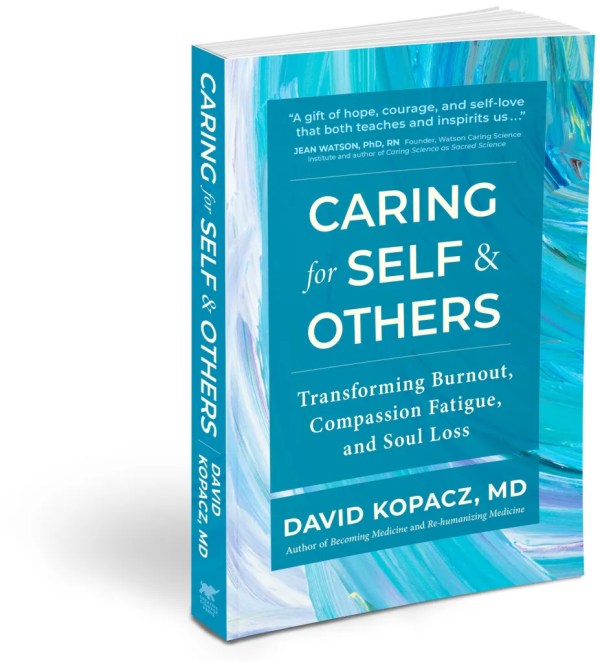
Caring for Self & Others: Transforming Burnout, Compassion Fatigue, and Soul Loss will be published by Creative Courage Press – thanks to Shelly Francis for all the support in the publication process!
As we enter into a new phase of the pandemic, I worry about myself and my colleagues in health care – how will we come out of this? How will health care change? When will we feel like we have recovered from the constant changes and worries about our personal and collective health?
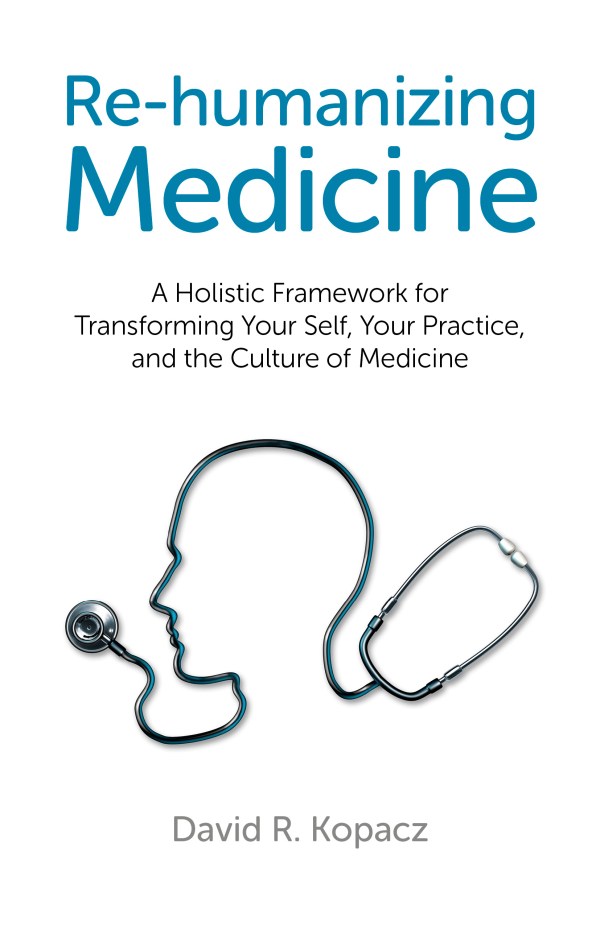
I’ve been working for a while on a workbook adaptation of Re-humanizing Medicine. I’ve been seeing if I can get this published or figure out a way to get it out to the larger world as a resource for caring for ourselves & others. I’m not sure exactly what form this will take, but in the meantime, I thought it might be worth revisiting some of the concepts and topics of Re-humanizing Medicine: A Holistic Framework for Transforming Yourself, Your Practice, and the Culture of Medicine that I published in 2014.
I’d like to give a few quotes from the book and put them out into the world as a small offering to address the suffering, burnout, compassion fatigue, soul loss, and moral injury of health care colleagues. The experience of dehumanization is all to prevalent in contemporary medicine and the need for re-humanization is just as needed as ever! Here is the introduction to the book:
Introduction
Only connect! … Live in fragments no longer.
E.M. Forster1
The great error of our day in the treatment of the human body is that physicians first separate the soul from the body.
Plato2
Dehumanization in Contemporary Medicine
This book takes on the task of re-humanizing medicine. We start by recognizing that there is a problem with how medicine is currently practiced: it dehumanizes staff and clients, creating dissatisfaction, suffering, poor performance and medical errors. Dehumanization is an iatrogenic effect of the dominant paradigms in contemporary medicine – the economic/business model and the reductionist and materialistic approach of biomedicine. In the day-to-day practice of medicine, doctors are expected to see more patients in less time and to efficiently reduce people to symptoms, diagnostic codes, prescriptions, procedures and billing codes. This leaves little time or space for people – physician or patient.
Future doctors are attracted to medicine for idealistic and humanitarian reasons, but through training they often lose this idealism.3,4 How can we preserve idealism and humanitarianism in medicine? Practicing physicians have high rates of burnout and job dissatisfaction. How can we reinvigorate the practice of medicine and make it sustainable?
A Counter-Curriculum of Re-Humanization
In medical school, I realized that I had to engage in a parallel education process in addition to the standard scientific curriculum. We could even call this a ‘counter-curriculum’, focusing on re-humanization. At times I found teachers, mentors, and fellow students who practiced this counter-curriculum, but often I had to seek it out on my own in order to balance my education. This book is about that counter-curriculum of re-humanization. Science and evidence-based interventions are one paradigm of medicine, but as human beings working with human beings, we must have a human framework as well as a scientific one.
As a medical student, the first research project I worked on was with Deb Klamen and Linda Grossman at the University of Illinois at Chicago. Our study examined symptoms of Posttraumatic Stress Disorder (PTSD) in relation to medical training and found that 13% of trainees in the study reported sufficient symptoms (relating to their internship year) to potentially qualify for a PTSD diagnosis.5 The findings provide evidence supporting the need to change postgraduate medical education to reduce stress and to enhance the well-being of trainees. I went on to work with Linda and Deb on three other papers that examined medical students’ beliefs and their attitudes toward the controversial issues of homosexuality, abortion, and AIDS.6,7,8 These papers examined how medical student beliefs can shape attitudes that adversely impact medical care. The studies also allude to the fact that people are not purely rational beings, and beliefs, fears and stigma can undermine scientific reasoning or professional ethics. Even my student research experience was concerned with the counter-curriculum of exposing dehumanization and seeking re-humanization.
To re-humanize medicine, the people who work in medicine must be well-rounded, well-developed human beings, as well as safe and effective technicians. A great deal of time, energy, and money is spent in making sure that physicians are good technicians, but are they good human beings? Being a good technician (objective, detached, unaffected by emotion, protocol-driven) can actually interfere with being a good human being. Clinicians should not stop being technicians or scientists, but they have a responsibility to attend to their own humanity, as well as that of the client. The counter-curriculum provides a holistic framework for being a human being, for working with human beings, and for creating systems that deliver care by human beings to human beings.
A Holistic Framework for Medicine
A holistic framework is founded on multiple interacting and mutually influencing sub-systems. Scientific medicine and the objective, observable body make up just one dimension of human health. Sometimes the physical dimension is primary, for instance in physical trauma and surgery. Sometimes other human dimensions are more important. Emotion, mind, love, self-expression, intuition, spirituality, context and time all play a role in health and illness.
A holistic framework is a paradigm for understanding and interacting with human beings. It is a human systems approach and a way of being in the world. Holistic medicine is a philosophy, or a paradigm for understanding what it is to be human, to suffer, to be ill, to be healthy; what it is to change, grow and live. It helps us understand how disconnection can lead to suffering and how connection can lead to healing. Holistic medicine is not defined by using an herb instead of a medication, or by any specific technique or intervention. Being a good technician (whether biomedical or ‘natural’) is part of being a good physician, but being a good physician is more than just being a good technician.
It is hard work to maintain a complex identity that includes being a technician and a human being, but that is what being a medical professional involves: balancing different roles for the purpose of alleviating suffering and treating disease. Re-humanization reconnects the art and science of medicine, the heart and the mind. A holistic framework encourages integration.
When you start to connect in a different way, you change the health care delivery system in which you work. What starts as personal dissatisfaction can become personal transformation, which changes systems. Institutions will always drift toward promoting their own interests over human interests. It is the responsibility of health professionals to ensure that they stay human, help their clients stay human, and ensure that health care delivery systems promote humanization rather than dehumanization.
Intended Audience and Purpose of the Book
I wrote this book for people who are looking for different ways of thinking about and practicing medicine. Dehumanization in medicine occurs throughout the world, particularly as business models replace humanitarian models of care. Many of the examples in the book are specific to the United States or New Zealand, drawing on my experience of practicing medicine in various settings in both countries; but whether dehumanization results from the profit motive of an insurance company (as in the US) or the bureaucratic processes of a national health system (as in New Zealand), the effect is the same. Re-humanizing medicine is a universal need.
This book is written specifically for clinicians, doctors, and physicians,9 who face daily humanitarian10 challenges in their roles, but is of interest to any health care professional or administrator. There are many fields where the application of a trained technique interferes with human connection, so teachers, trainers, educators and business people will find it relevant too. Of course, so will anyone interested in being a whole human being!
Since holistic medicine is a philosophy and a mode of being, I do not list diagnoses and alternative treatments. There are already a number of excellent books that review various complementary, alternative, and integrative medical techniques. The foundation of a holistic medical practice is you, not the services and techniques that you offer. Therefore, this is a book for people who are willing to change at a personal level in order to be better doctors and clinicians.
Contemporary medicine and holistic medicine are not inherently in conflict. My hope is that by defining holistic medicine as a paradigm, rather than as a specific technique, its benefits can be integrated with those of contemporary medicine. My primary argument is that the human elements of medicine need to be valued so that technical interventions occur within a human context.
Holistic Medicine, Re-humanization and the Quality Revolution in Health Care – A Convergence?
There is a worldwide trend in health care that, interestingly, overlaps with the philosophy of holistic medicine. This trend is a focus on quality, efficacy and safety, stimulated by the continual increase in the cost of health care. Experts are calling for a ‘revolution in health care delivery,’11 and ‘system-wide change.’12
Many of the suggestions involve cost-cutting and standardization of treatment. The ‘Quality Revolution’ also raises issues related to re-humanization, such as putting the patient at the center of treatment, making decisions collaboratively, and establishing a ‘continuous healing relationship.’13 These are the strengths of a holistic framework – not only is it patient-centered, but it includes the concept of healing in addition to treatment, and it often encourages low-cost, low-risk lifestyle changes and preventative medicine. It may be that it is time for a Compassion Revolution and a Quality Revolution to join forces in order to make medicine more affordable, safe and effective, as well as more compassionate, caring and human.
Structure of the Book
The book is divided into five major parts. The first discusses the underlying paradigms of the biomedical and economic models of contemporary medicine and how these models have side effects of dehumanization. This critique does not mean that there is no benefit in the contemporary paradigm; rather it is an examination of the strengths and weaknesses of the underlying paradigms of the current system. The second part describes the paradigm of holistic medicine as a way of understanding the whole person. The third part is a ‘self-help’ section that outlines how you, as a clinician, can develop a more holistic and deeper sense of your own humanity. The fourth part is a ‘how-to’ component that describes how to create a holistic practice in any setting and how to re-humanize your practice. The last part describes the benefits of a holistic paradigm for re-humanizing the culture of medicine.
Thanks again to the folks at CLOSLER for the next in a series of guest post on various forms of Circle Medicine & Circle Healing. This week’s post is titled, “The Circle of Re-humanizing Medicine.”
Here is the Takeaway summary:
We need human-based medicine in conjunction with evidence-based medicine. If we only identify as scientists and not as healers, we risk dehumanizing our patients and ourselves.
Next week is the last in my series of guest posts at CLOSLER, please check it out. It is on the VA Circle of Health, another holistic model of Circle Medicine.
Here is a link to an article, “We Need to Be Disoriented, Says Psychiatrist,” by Chris Kelly from my recent talk at Western Sydney University, Australia. The article appears in Hunter and Bligh.
Thank you Chris Kelly and Hunter and Bligh for this article that captures the essence of transformational learning – that we need to be disoriented and lose our bearings in order to really have the opportunity for transformational learning – learning that changes who we are beyond just learning new information. Transformational learning is a concept that Jack Mezirow developed. He listed ten different steps that I have condensed down to three steps in the circle below, corresponding to the circle of initiation: separation, initiation, return. This model also fits with Joseph Campbell’s hero’s journey model in which transformation comes through transitioning between worlds, cultures, or states of consciousness.
This was part of a 2 hour talk I did for staff and students called “Caring for Self & Others,” based on the Caring for Self & Others workbook that Laura Merritt and I have adapted from my first book, Re-humanizing Medicine: A Holistic Guide for Transforming Your Self, Your Practice, and the Culture of Medicine. We had a great discussion about creating a counter-curriculum of self-care and contributing to the compassion revolution!
Thank you to Sneh Prasad for connecting me with Dr. Asha Chand at Western Sydney University who coordinated this event while I was in Australia for the Australasian Doctors Health Conference. Thank you everyone involved in the talk! I will be posting about the other talks I did on my trip as well as some of the photos soon…
Dr David Kopacz speaking at Western Sydney University about anxiety and stress. Image: Christopher Kelly













 Being Fully Human