Creating Sanctuaries of Creativity & Imagination (Becoming A True Human podcast episode #13)

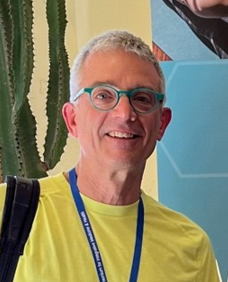
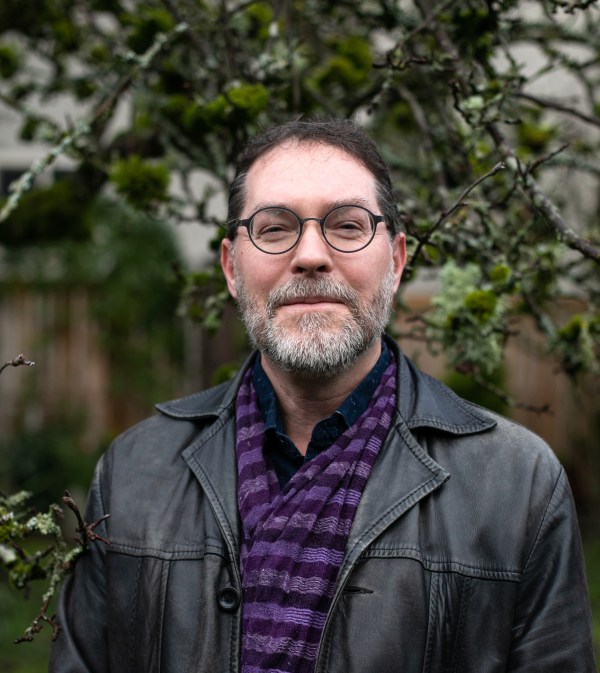
Chris Smith & Dave Kopacz bring the year to a close talking about a number of themes, such as looking back and looking forward, creating sanctuaries of creativity & imagination, the start of the healer’s council, and the question of whether our country and world is metaphorically stuck in something like a chronic illness pattern.

Chris starts with a story of creating workshops on Chronic Illness Meets Love, and Mindfulness Meets Chronic Illness – and not having anyone show up! But then he is invited to join a healthcare professional to run a series of workshops on Mindfulness and Irritable Bowel Disorders. Chris introduces the idea of creating a space that can become filled with creativity & imagination.

Dave introduces the Sanskrit term guhā or cave of the heart, which he and Joseph Rael wrote about in their book, Becoming Medicine: Pathways of Initiation into a Living Spirituality. This concept teaches that there is an inner space of stillness deep within the heart, a place where the individual meets the divine. The Greek terms kenosis (emptying) and hesychia (stillness) reflect a similar state of being or practice, as well as the practice of incubation in the ancient temples of Asklepios, where initiates would lie down in darkness and stillness and wait for inspiration from dreams or visions.

Dave and Chris talk about Albert Ellis’ three musts: 1) “I must do well” 2) “you must treat me well” 3) “life must be easy.” We spoke about similarities with the Buddha’s four noble truths that begins with “life is suffering.”

Chris read the poem, “Dropping Keys,” a version of Hafiz by Daniel Landinsky, based on a story from Sufism of looking for dropped keys. (The poem can be found in Ladinsky’s The Gift, p. 205 and his A Year with Hafiz, p. 395).

The podcast closes with Dave leading a guided meditation that combines The Cave of the Heart Ceremony from Becoming Medicine with the Coming Home Ceremony from Walking the Medicine Wheel. This meditation takes us on the journey of transformation of the circulation of the blood through the four chambers (four directions) of the heart, receiving the most oxygen-depleted blood into the heart and giving away the most oxygen-rich blood to the body. After circulating around, the meditation moves into the still point of the circle, the center, the cave of the heart – a place of stillness and emptiness where one can go to feel replenished, a sanctuary of creativity and imagination at our deepest being.

We look back over the life of the podcast, Becoming a True Human, and look forward to the new year where we plan to alternate between our usual dynamic duo podcast, guests who have been foundational in creating and implementing the VA Whole Health program, and special guests – authors, artists, healers, and poets we admire.

Video link

Audio link

I think we’ll call this the end of season 1! Have a great end of 2025 and we’ll see you again in 2026!

Moving (Becoming a True Human Podcast #12)

It has been a while since I’ve posted here – a lot has been happening. Our family moved from Seattle to Madison, Wisconsin. We’ve talked about this before and almost moved, but this time we finally did it. There was a pull to be closer to aging parents. There was a push to get out of the VA and being a federal employee during a time that federal employees were being scapegoated, demonized, and “othered.”

As I wrote in the prologue of the Hero’s Journey class I used to teach to Veterans:

All journeys begin with a loss. Sometimes we do not recognize the loss, because we are so focused on the excitement of the new outer vistas we are entering. Other times, loss is the only thing we are aware of; we don’t see adventure or experience, we only see tragedy.


All journeys begin with a gain. Sometimes we do not recognize the gain, because we are so focused on the grief of what we are leaving behind. Other times, gain is the only thing we are aware of; we don’t see the loss, just the excitement of the new.


All journeys are ultimately made alone. Resign yourself to be alone, as all journeys require being alone.


All journeys are made with others. Embrace fellowship, because no journey is done completely alone.


Perhaps the entire secret of life is to continually strive to create enough space within ourselves, in our souls to accommodate as many of our life experiences —be they good or bad, joyful or tragic — as we can.

Joseph Campbell said that it is not so much that we are searching for meaning as that “what we’re seeking is an experience of being alive, so that our life experiences on the purely physical plane will have resonances with our own innermost being and reality, so that we will actually feel the rapture of being alive,” (Joseph Campbell with Bill Moyers, The Power of Myth, 4-5).

At some point, maybe I will write more about the difficulties of this move, the death of our cat, Sofia, the week we were supposed to drive across the country, the cd player breaking in Idaho, the many delays and difficulties with moving into the new house, or our run in with a giant green man in Blue Earth, Minnesota.

For now, I’ll just introduce the next episode of the Becoming a True Human Podcast, Episode 12: Moving.

Episode 12: Moving:

After a long hiatus, Chris Smith and Dave Kopacz discuss the varied aspects of moving, from moving across the country, moving/transitioning jobs, being moved by stories, and the GI tract as a metaphor for life – moving too fast or moving too slowly can both be painful.

Chris shares a number of short readings from his work in progress, A Soft Way, a variation on the Tao Te Ching through the lens of chronic illness, specifically “moving disorders” such as Irritable Bowel Syndrome, Ulcerative Colitis, and Crohn’s Disease.

Dave muses about his recent cross-country move from Seattle to Madison, Wisconsin, applying the hero’s journey to everyday life, and changing jobs to allow greater movement and flexibility.

YouTube Video link

Spotify Audio link

Also, I didn’t post Episode 11: Freedom of Free Doom? Here it is for those who might want it:

With the 4th of July next week, Dave and Chris reflect on the relationship between Freedom and Free Doom. Is doom inherent in freedom, are they in some kind of relationship, can there be freedom without doom? They look at the inescapable reality of sickness and death in life and how these limitations can actually shape the kinds of human freedom that are available. We are “doomed” to die, and yet human freedom is possible within the span of birth to death. Limitation is also present in the choices that we make in life – one choice often precludes other options.

Dave draws on recent readings of Erich Fromm’s Escape from Freedom and Timothy Snyder’s On Freedom, which look at psychological and political perspectives on freedom and fascism. Chris ponders on the relationship between meditation and freedom. They discuss the relationship between individualistic and inter-relational freedom – agreeing that freedom of the individual is not possible without freedom of all as they draw on Dave’s Me/We version of the Circle of Health, Thich Nhat Hanh’s interbeing, and ubuntu as described by Archbishop Desmond Tutu. They end referencing Václav Havel’s definition of hope.

YouTube Video link

Spotify Audio link

Becoming a True Human Podcast: Episode 10: The Doctor as a Humanist

Episode 10: The Doctor as a Humanist

Guest: Jonathan McFarland

Spotify Audio: t.ly/6BHxl

YouTube Video: t.ly/yISVN

Dave Kopacz & Chris Smith are joined founder and president of The Doctor as a Humanist – Jonathan McFarland. Chris joins us from a visit to the Driftless Area of Wisconsin (which Jonathan uses as a metaphor for a sense of loss of humanity in contemporary society – https://en.wikipedia.org/wiki/Driftless_Area), Dave speaks from his home in Seattle, and Jonathan joins from Mallorca, Spain.

Jonathan gives a brief history of himself as a human being, growing up in Liverpool, UK, surrounded by medicine and the arts. He describes how when his father, a surgeon, had a heart attack and was in the hospital, he had the idea of starting The Doctor as a Humanist (DASH). Jonathan has reached hundreds and thousands of students, educators, doctors, and other health care professionals through DASH. Jonathan clarifies that when he speaks of “doctors,” he means that broadly, to include all in health care – as doctor comes from the root docere, to teach.

We talk about what it means to be a humanist and why medicine needs re-humanizing. We jokingly define a humanist as someone who can’t answer a yes or no question without offering a quote from the arts or literature. They also speak of the possibility that when one is speaking of numbers and quantitative paradigms – the human is not present. Being a Humanist (and Becoming a True Human) are about values, compassion, and interpersonal connection.

Jonathan offers a definition of a humanist, “someone who cares about what is happening in the world around them and cares about the cultures” and the Earth. He touches upon the meanings of dignity and responsibility.

Jonathan mentions a book by Robert McFarlane, The Gift, which is “about the importance of giving books to others.”

We speak of and quote: John Berger, Bob Dylan, Martin Buber, Philip K. Dick, the Greek philosophers, Descartes, Spinoza, Gavin Francis, and many others.

Chris offers the quote from Buber, “All real living is meeting,” which feels like a good description of this incredible meeting between the three speakers today.

The Doctor as a Humanist website will soon be revised, but here is the current site: https://doctorasahumanist.weebly.com/

ANNOUNCEMENTS:

Chris Smith has a recent publication in Pulse, “Medicine Without a Bottle”  https://pulsevoices.org/stories/medicine-without-a-bottle/

Dave Kopacz and Joseph Rael (Beautiful Painted Arrow) have a publication in About Place Journal, “My Collaboration with Joseph Rael (Beautiful Painted Arrow)” https://aboutplacejournal.org/issues/careful-care-full-collaboration/possibilities/david-r-kopacz-m-d-joseph-rael-beautiful-painted-arrow/

Dave was also interviewed by Claudiu Murgan on the Spiritually Inspired podcast: https://claudiumurgan.com/

Dave’s most recent book, Caring for Self & Others: Transforming Burnout, Compassion Fatigue & Soul Loss just won a Nautilus Gold Medal book Award: https://www.nautilusbookawards.com/2025-winners-11-20

Spotify Audio: t.ly/6BHxl

YouTube Video: t.ly/yISVN

Becoming a True Human podcast: Episode 9: Illness & Creativity

09 Illness & Creativity:

Dave and Chris talk about how illness can be a call to creativity. Chris starts out with a story of learning from a young cancer patient. We talk about how illness can break down the everyday mindset, or horizontal, material focus and introduce a vertical, or spiritual dimension in life. To make this shift requires an openness to creativity and also allowing inspiration, grace, or a sense of a gift to be received. This gift of creativity can then be shared with others. We talk about the lives and creative processes of Philip K. Dick and Carl G. Jung. As always, Chris and Dave share stories, humor, ideas, and books. Dave closes with a Daniel Ladinsky rendering of a Hafiz poem, “To Build a Swing.”

To Build a Swing
You carry
All the ingredients
To turn your life into a nightmare─
Don’t mix them!
You have all the genius
To build a swing in your backyard
For God.
That sounds
Like a hell of a lot more fun.
Let’s start laughing, drawing blueprints,
Gathering our talented friends.
I will help you.
With my divine lyre and drum.
Hafiz
Will sing a thousand words,
You can take into your hands,
Like golden saws,
Sliver hammers,
Polished teakwood,
Strong silk rope.
You carry all the ingredients
To turn your existence into joy,
Mix them, mix
Them!

Hafiz, “To Build a Swing,” Translated/Rendered by Daniel Ladinsky, The Gift, p. 48

View or Listen to Episode:

YouTube: https://youtu.be/NjjTr6SQZMY

Spotify: https://creators.spotify.com/pod/show/david-kopacz8/episodes/Episode-9-Illness-and-Creativity-e322oku

Becoming a True Human podcast, Episode 8: Let’s Do Something Positive

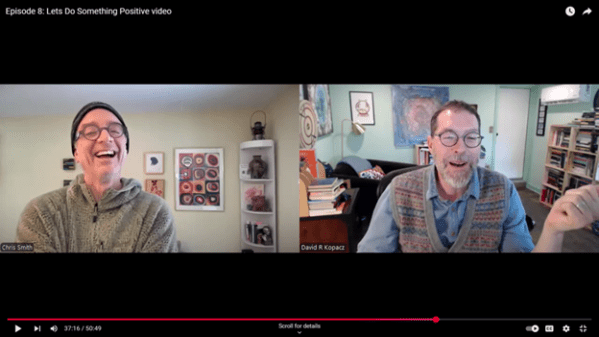
Welcome to Episode 8 of Becoming a True Human: Let’s Do Something Positive

Dave Kopacz & Chris Smith talk about different ways of transforming pain into passion in a discussion ranging from the poetry of Mirabai, the life and teachings of St. Francis, creating pockets of positivity, building caring communities, taking charge of your story, Rebecca Solnit’s The Faraway Nearby, making sure our actions are motivated by caring and uncaring, how fear can be the first shift from caring to a slippery slope of uncaring, and lastly noodling as a metaphor for life.

We offer a range of things that you can do right now to do something positive and shift from shock to action: reading and sharing quotes, different writing practices, building community, finding any of the “hundred objects close by” that can “cure sadness,” and canning tomatoes or apricots. Remember, “Don’t waste your suffering” and let’s all work at creating reservoirs of goodness – we are going to need them!

One more thing you can do positive, right now – go to the Dr. Lorna Breen Heroes’ Foundation and contact congrees to reauthorize the Lorna Breeen Act to improve health care worker well-being and to prevent suicide https://drlornabreen.org/reauthorizelba/

A Hundred Objects Close By

Mirabai (translated by Daniel Landinsky)

I know a cure for sadness:
Let your hands touch something that
makes your eyes
smile.

I bet there are a hundred objects close by
that can do that.

Look at
beauty’s gift to us─
her power is so great she enlivens
the earth, the sky, our
soul.

LINKS:

YouTube: https://youtu.be/bNh1KxCfyAA                                 
url short:           t.ly/6Bsmg

Spotify: https://creators.spotify.com/pod/show/david-kopacz8/episodes/Episode-8-Lets-Do-Something-Positive-e2uu171            
url short:           t.ly/JDRp4

Becoming A True Human Podcast, Episode 7: Practice

Episode 7: Practice

Life doesn’t have a pause button and neither do we…

Spotify Audio: http://t.ly/HKZGe

YouTube Video: http://t.ly/mluTN

Chris Smith and David Kopacz discuss the rewards and pitfalls of practice in yoga, meditation, writing, and life.

Sometimes practice clears a space where imperfections and flaws are seen. We are tempted to try to eliminate those specks of dust and scratches on our window, but accepting our imperfections may actually be the real part of practice. Practice is about reconnecting to our True Humanity, our inner held-back place of goodness, our source of love, compassion, and caring – and we may only reach these through suffering and imperfection.

For instance, we explore the Sanskrit term, samvega, which Stephen Cope describes as “complex state involving disillusionment with mundane life, and a wholehearted longing for a deeper investigation into the inner workings of the mind and self,” (The Wisdom of Yoga, 13).

Or as Karlfried Graf Dürckheim wrote in his book The Way of Transformation: Daily Life as Spiritual Practice, “Thus the aim of practice is not to develop an attitude which allows us to acquire a state of harmony and peace wherein nothing can ever trouble us. On the contrary, practice should teach us to let ourselves be assaulted, perturbed, moved, insulted, broken and battered” (107).

Chris and Dave discuss their own struggles with chronic illness/ongoing medical symptoms and the difficult work of turning personal illness and suffering into fuel for personal growth work.

We talk about:

  • using suffering as a spiritual practice
  • cleaning the windshield
  • “The Garden,” a reading from Chris’ next book, Hope Opens Doors
  • a workshop Chris is putting on in February, “Chronic Illness & Love”
  • Sean Mackey’s work on love & pain
  • finding inner calm and strength, even within chaos & suffering
  • Makransky & Condon’s Sustainable Compassion Training
  • making practices creative and fresh
  • the work of Joseph Rael (Beautiful Painted Arrow)
  • spanda – the divine creative pulsation
  • practice does not make perfekt
  • being capable of suffering may make us more capable of joy
  • the benefits of practice are not only for us, but are fully realized when we share with others and the Earth
  • practice is caring for ourselves and others

We close with a couple of practices, one from Dave’s book, Caring for Self & Others and short one from Chris Smith.

We have video links on YouTube and audio links on Spotify, here is the link to all episodes:

Spotify Audio: https://open.spotify.com/show/0VB79X56wuCj7jjj5E6oB4

YouTube Video: https://www.youtube.com/channel/UCk7iT73WTnMJdBwWBAc8zIw/videos

Becoming A True Human podcast.2: Health & Unhealth

Join Chris Smith & Dave Kopacz for the second episode – Health & Unhealth – of the Becoming a True Human podcast (the first where the video recording worked!). We discuss themes of the wounded healer, transforming suffering, caring moment meditation, Sustainable Compassion Training and the work of John Makransky and Paul Condon, the poetry of Rumi, and how hope can open doors. (1 hour)

From “Childhood Friends”

Trust your wound to a teacher’s surgery.
Flies collect on a wound. They cover it,
those flies of your self-protecting feelings,
your love for what you think is yours.

Let a teacher wave away the flies
and put a plaster on the wound. Don’t turn your head. Keep looking
at the bandaged place. That’s where
the light enters you.
     And don’t believe for a moment
that you’re healing yourself.

Rumi, Jalal Al-Din; Barks, Coleman.

The Essential Rumi – reissue: New Expanded Edition (p. 142).

Becoming A True Human.2: Health & Unhealth

Announcing the Becoming A True Human podcast!

I’ve been thinking about how we need to build a community of practitioners discussing the problems of burnout, compassion fatigue, and soul loss. Isolation and loneliness contribute to burnout, and social connection is an antidote to burnout. To this end, we are creating the Becoming A True Human podcast. Who is “we”? Well, for now, it is me and my good friend Chris Smith – therapist, meditation teacher, Whole Health educator, storyteller, author (Be a Good Story), founder of the Academy for Mindfulness consulting, and all-around wise guy (and I mean that in multiple senses of the phrase).

The audio of the episode 1, Lost, is at the bottom of this post.

What is burnout? Just what exactly is it that burns out? How can whatever is burned out be re-ignited?

What is compassion fatigue? How does compassion wear out? Should it really be called empathy fatigue? Is the problem that there is too much compassion going out? Or not enough coming in? Or could it be that institutional structures and protocols make us busy with so many things that there is little time left in the clinical encounter for caring?

What is soul loss? Could we think of the soul being the “thing” that burns out? Not necessarily in a religious or metaphysical sense – although it could be if that fits your belief system – but in a metaphorical and psychological sense. If in burnout we lose connection with our souls, how can we reconnect and either go on a quest to find our lost souls, or create a welcoming environment in our bodies and lives so that our souls can return and flourish?

I address these questions in my book, Caring for Self & Others: Transforming Burnout, Compassion Fatigue, and Soul Loss, but we need to have further discussions around these topics as I feel strongly that we need a kind of ongoing practice, a yoga of burnout, in which we continually work in our own practices as well as in building communities of caring to support each other with this human, all too human dilemma.

Based on the topics we discussed in the first episode we titled this episode “Lost,” even before we realized that we somehow lost video of me and only recorded video for Chris! In this episode we explore topics of burnout as an initiation into becoming a wounded healer, soul loss, yoga for the health of healers, and we end with a meditation exercise and a poem, “Lost” by David Wagoner.

We don’t really know what we are doing with the technology aspect.

Let me tell you a story that illustrates the problem.

My high school friend Jack and I drove across the country after college. We were into the beat poets and writers, reading Kerouac’s On the Road, and envisoned a trip full of excitement and philosophical observations. We had a microcassette recorder and would talk into as we were driving, having many deep discussions and creating a record of what we saw.

Somewhere around South Dakota (having left from Chicago area) I noticed that the wheels of the recorder weren’t moving when we were recording. It was then that I noticed that there was a pause switch that was clicked on and prevented any recordings from being made! All of our bits, routines, observations, and experiences were lost! We were a bit crestfallen and we made half-hearted attempt to resume recording, but something had been lost – the energy, the enthusiasm. I think we eventually gave up on it. Maybe you could say we burned out on the idea after investing so much energy and enthusiasm and not having anything to show for it.

From a mindfulness perspective, there is surely some kind of lesson here – about not being attached to goals or outcomes, about being in the present moment versus memorializing experience, and maybe even that the organizing ego is an illusionary construct for creating a reduced and more manageable limited reality (if you want to take it that far!).

Well…I remembered this story after Chris Smith and I had just had our wide-ranging and enthusiastic discussion as we recoreded it on Zoom, only to realize that I had messed up the settings and we only had Chris’ video and both our audio. Well, crestfallen again! Urgh, technology failure again!

So, I think I have figured out how to share the audio of our video podcast, rather than have video of just Chris and my disembodied voice. Titling this episode, “Lost,” was prescient as we lost the video. Chris also spoke of his caring for self routine and how he purposefully skips some days so as not to get caught up in perfectionism, performance, and productivity. We’ll consider the lost video as a sacrifice to the Divine or the Cosmos, a giveaway, in addition to it being a bumbling failure of technology.

So, welcome to the first episode of the Becoming A True Human podcast – Lost it highlights the vulnerability and imperfection of being human, that we are all a work in progress and that our work is a yoga practice – yoking mind, emotions, body, soul. The practice of Becoming A True Human is an ongoing practice, we can only do it in the present moment and the next moment we are again lost, at sea, trying to figure it out and Keep It All Together (KIAT). We will attempt to have the next episode as video and hope to post it on the Becoming a True Human YouTube site.