It has been a while since I’ve posted here – a lot has been happening. Our family moved from Seattle to Madison, Wisconsin. We’ve talked about this before and almost moved, but this time we finally did it. There was a pull to be closer to aging parents. There was a push to get out of the VA and being a federal employee during a time that federal employees were being scapegoated, demonized, and “othered.”
As I wrote in the prologue of the Hero’s Journey class I used to teach to Veterans:
All journeys begin with a loss. Sometimes we do not recognize the loss, because we are so focused on the excitement of the new outer vistas we are entering. Other times, loss is the only thing we are aware of; we don’t see adventure or experience, we only see tragedy.
All journeys begin with a gain. Sometimes we do not recognize the gain, because we are so focused on the grief of what we are leaving behind. Other times, gain is the only thing we are aware of; we don’t see the loss, just the excitement of the new.
All journeys are ultimately made alone. Resign yourself to be alone, as all journeys require being alone.
All journeys are made with others. Embrace fellowship, because no journey is done completely alone.
Perhaps the entire secret of life is to continually strive to create enough space within ourselves, in our souls to accommodate as many of our life experiences —be they good or bad, joyful or tragic — as we can.
Joseph Campbell said that it is not so much that we are searching for meaning as that “what we’re seeking is an experience of being alive, so that our life experiences on the purely physical plane will have resonances with our own innermost being and reality, so that we will actually feel the rapture of being alive,” (Joseph Campbell with Bill Moyers, The Power of Myth, 4-5).
At some point, maybe I will write more about the difficulties of this move, the death of our cat, Sofia, the week we were supposed to drive across the country, the cd player breaking in Idaho, the many delays and difficulties with moving into the new house, or our run in with a giant green man in Blue Earth, Minnesota.
For now, I’ll just introduce the next episode of the Becoming a True Human Podcast, Episode 12: Moving.
Episode 12: Moving:
After a long hiatus, Chris Smith and Dave Kopacz discuss the varied aspects of moving, from moving across the country, moving/transitioning jobs, being moved by stories, and the GI tract as a metaphor for life – moving too fast or moving too slowly can both be painful.
Chris shares a number of short readings from his work in progress, A Soft Way, a variation on the Tao Te Ching through the lens of chronic illness, specifically “moving disorders” such as Irritable Bowel Syndrome, Ulcerative Colitis, and Crohn’s Disease.
Dave muses about his recent cross-country move from Seattle to Madison, Wisconsin, applying the hero’s journey to everyday life, and changing jobs to allow greater movement and flexibility.
Also, I didn’t post Episode 11: Freedom of Free Doom? Here it is for those who might want it:
With the 4th of July next week, Dave and Chris reflect on the relationship between Freedom and Free Doom. Is doom inherent in freedom, are they in some kind of relationship, can there be freedom without doom? They look at the inescapable reality of sickness and death in life and how these limitations can actually shape the kinds of human freedom that are available. We are “doomed” to die, and yet human freedom is possible within the span of birth to death. Limitation is also present in the choices that we make in life – one choice often precludes other options.
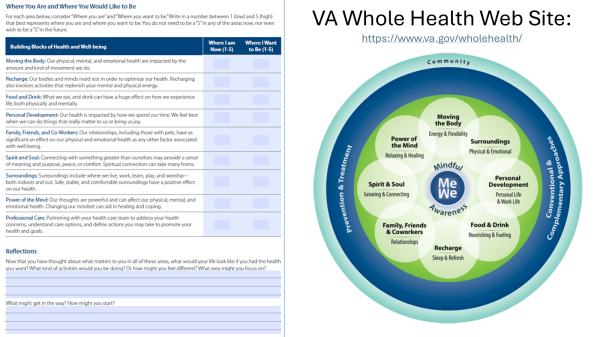
Dave draws on recent readings of Erich Fromm’s Escape from Freedom and Timothy Snyder’s On Freedom, which look at psychological and political perspectives on freedom and fascism. Chris ponders on the relationship between meditation and freedom. They discuss the relationship between individualistic and inter-relational freedom – agreeing that freedom of the individual is not possible without freedom of all as they draw on Dave’s Me/We version of the Circle of Health, Thich Nhat Hanh’s interbeing, and ubuntu as described by Archbishop Desmond Tutu. They end referencing Václav Havel’s definition of hope.
Dave Kopacz & Chris Smith are joined founder and president of The Doctor as a Humanist – Jonathan McFarland. Chris joins us from a visit to the Driftless Area of Wisconsin (which Jonathan uses as a metaphor for a sense of loss of humanity in contemporary society – https://en.wikipedia.org/wiki/Driftless_Area), Dave speaks from his home in Seattle, and Jonathan joins from Mallorca, Spain.
Jonathan gives a brief history of himself as a human being, growing up in Liverpool, UK, surrounded by medicine and the arts. He describes how when his father, a surgeon, had a heart attack and was in the hospital, he had the idea of starting The Doctor as a Humanist (DASH). Jonathan has reached hundreds and thousands of students, educators, doctors, and other health care professionals through DASH. Jonathan clarifies that when he speaks of “doctors,” he means that broadly, to include all in health care – as doctor comes from the root docere, to teach.
We talk about what it means to be a humanist and why medicine needs re-humanizing. We jokingly define a humanist as someone who can’t answer a yes or no question without offering a quote from the arts or literature. They also speak of the possibility that when one is speaking of numbers and quantitative paradigms – the human is not present. Being a Humanist (and Becoming a True Human) are about values, compassion, and interpersonal connection.
Jonathan offers a definition of a humanist, “someone who cares about what is happening in the world around them and cares about the cultures” and the Earth. He touches upon the meanings of dignity and responsibility.
Jonathan mentions a book by Robert McFarlane, The Gift, which is “about the importance of giving books to others.”
We speak of and quote: John Berger, Bob Dylan, Martin Buber, Philip K. Dick, the Greek philosophers, Descartes, Spinoza, Gavin Francis, and many others.
Chris offers the quote from Buber, “All real living is meeting,” which feels like a good description of this incredible meeting between the three speakers today.
Dave and Chris talk about how illness can be a call to creativity. Chris starts out with a story of learning from a young cancer patient. We talk about how illness can break down the everyday mindset, or horizontal, material focus and introduce a vertical, or spiritual dimension in life. To make this shift requires an openness to creativity and also allowing inspiration, grace, or a sense of a gift to be received. This gift of creativity can then be shared with others. We talk about the lives and creative processes of Philip K. Dick and Carl G. Jung. As always, Chris and Dave share stories, humor, ideas, and books. Dave closes with a Daniel Ladinsky rendering of a Hafiz poem, “To Build a Swing.”
To Build a Swing You carry All the ingredients To turn your life into a nightmare─ Don’t mix them! You have all the genius To build a swing in your backyard For God. That sounds Like a hell of a lot more fun. Let’s start laughing, drawing blueprints, Gathering our talented friends. I will help you. With my divine lyre and drum. Hafiz Will sing a thousand words, You can take into your hands, Like golden saws, Sliver hammers, Polished teakwood, Strong silk rope. You carry all the ingredients To turn your existence into joy, Mix them, mix Them!
Hafiz, “To Build a Swing,” Translated/Rendered by Daniel Ladinsky, The Gift, p. 48
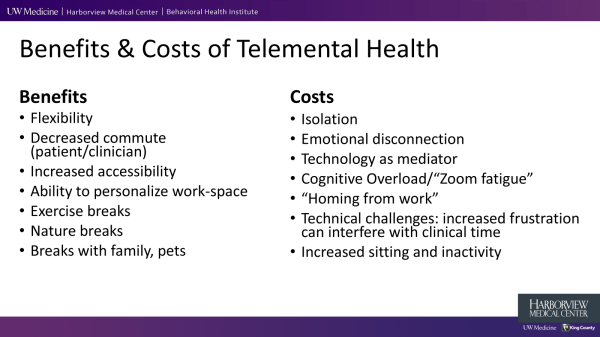
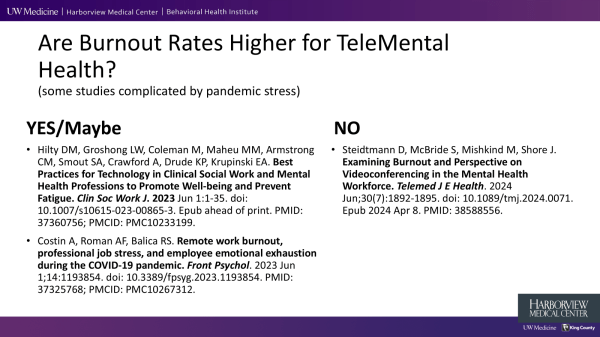
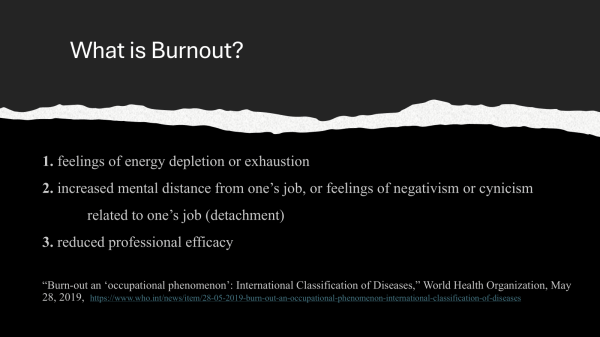
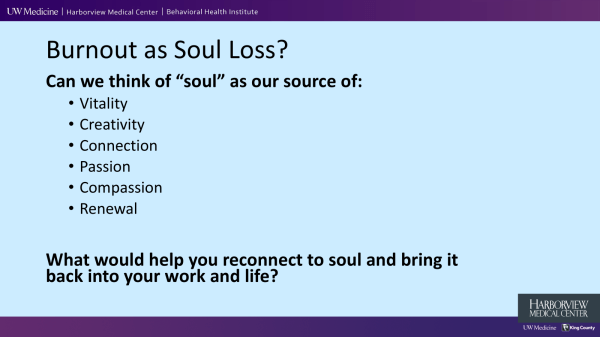
This is the powerpoint of a talk I gave on 1/17/25 on Telemental Health and Burnout through the UW/Haborview TeleBehavioral Health Training Series. Thanks to the team for inviting me.
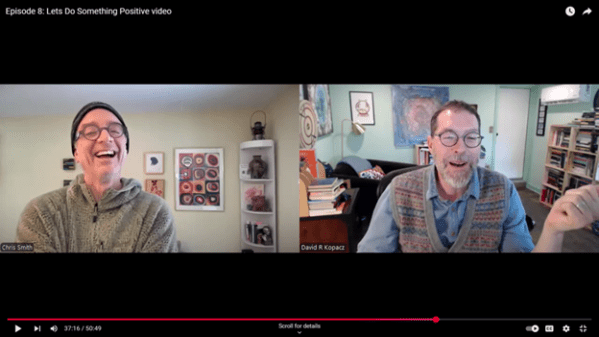
Dave Kopacz & Chris Smith talk about different ways of transforming pain into passion in a discussion ranging from the poetry of Mirabai, the life and teachings of St. Francis, creating pockets of positivity, building caring communities, taking charge of your story, Rebecca Solnit’s The Faraway Nearby, making sure our actions are motivated by caring and uncaring, how fear can be the first shift from caring to a slippery slope of uncaring, and lastly noodling as a metaphor for life.
We offer a range of things that you can do right now to do something positive and shift from shock to action: reading and sharing quotes, different writing practices, building community, finding any of the “hundred objects close by” that can “cure sadness,” and canning tomatoes or apricots. Remember, “Don’t waste your suffering” and let’s all work at creating reservoirs of goodness – we are going to need them!
One more thing you can do positive, right now – go to the Dr. Lorna Breen Heroes’ Foundation and contact congrees to reauthorize the Lorna Breeen Act to improve health care worker well-being and to prevent suicide https://drlornabreen.org/reauthorizelba/
A Hundred Objects Close By
Mirabai (translated by Daniel Landinsky)
I know a cure for sadness: Let your hands touch something that makes your eyes smile.
I bet there are a hundred objects close by that can do that.
Look at beauty’s gift to us─ her power is so great she enlivens the earth, the sky, our soul.
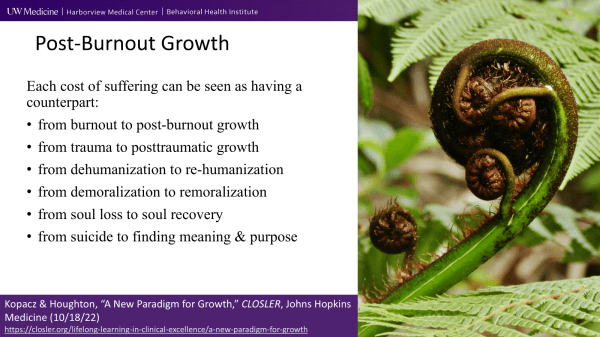
My friend Lucy Houghton and I have been working on this idea of post-burnout growth, analogous to the concept of posttraumatic growth. We published a preliminary essay in Closler October 18, 2022 called A New Paradigm for Growth.
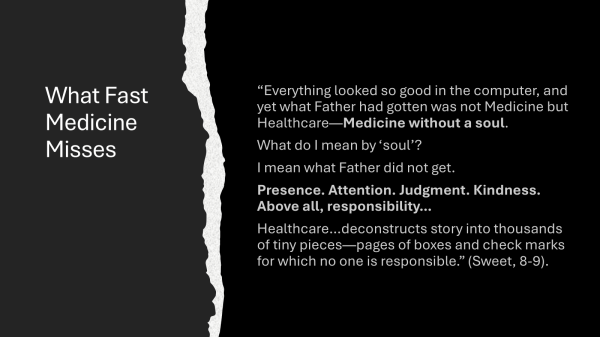
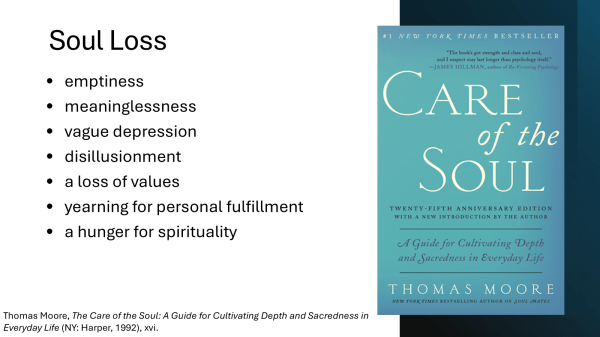
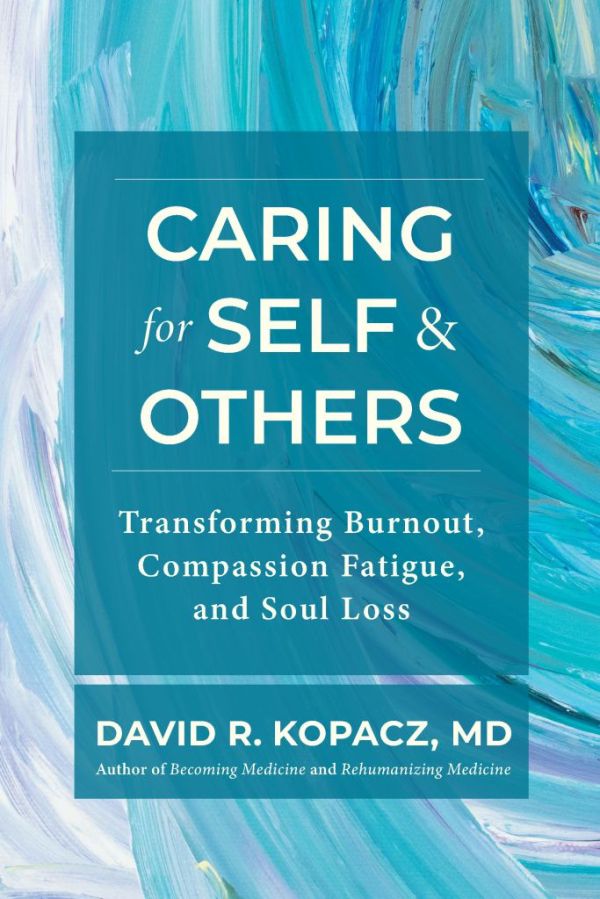
Since then I have continued to elaborate this concept and wrote about it in my latest book, Caring for Self & Others: Transforming Burnout, Compassion Fatigue, and Soul Loss. I would like to offer some sections of the book on the topic of post-burnout growth as a new paradigm for growing through suffering – burnout, compassion fatigue, and soul loss.
Transforming Suffering
Initiation is a model of transformation that is ancient and is found in many Indigenous traditions as well as in the wisdom stories of many religions. In Becoming Medicine, Southern Ute elder Joseph Rael (Beautiful Painted Arrow) and I structured our book based on the three stages of initiation: separation, initiation, and return. While Joseph Campbell came to these stages through the study of stories and cultures, Joseph Rael has lived them through various initiation ceremonies in his education at Picuris Pueblo and the Southern Ute Reservation. Since 2014, Joseph and I have been working together, focusing on different ways that people can transform their own trauma and suffering by becoming healers―that is what it means to be becoming medicine: becoming a healer for yourself, others, and the world.
This kind of transformation is what Lucinda Houghton and I have been working on in regard to burnout. We have been calling this post-burnout growth, similar to posttraumatic growth―where suffering is used for personal and professional growth.[i] Posttraumatic growth has been described as: increased appreciation for life, more meaningful interpersonal relationships, increased sense of personal strength, changed priorities, and a richer existential and spiritual life.[ii] These are changes both in self as well as in relationships with others. We view post-burnout growth as not simple resilience of returning to who we were, but actually using suffering as a tool for growing beyond who we were into who we can become.
We can view burnout, compassion fatigue, and even soul loss as calls to initiation, just as Joseph Campbell described the call to adventure in the hero’s or heroine’s journey.[iii] The quest to reconnect with the soul is a kind of heroism that leads to healing. As storyteller Michael Meade tells us, “Life is change and the life of the soul is transformation.”[iv]
David Kopacz, Caring for Self & Others: Transforming Burnout, Compassion Fatigue, and Soul Loss. Palisade: Creative Courage Press, 2024, (pages 19-20)
While burnout and compassion fatigue can feel like we have lost our souls, it is not so much our souls that are lost as we who are lost—we have lost touch with the innermost being of ourselves. As Joseph Rael teaches, Wah-Mah-Chi, Breath-Matter-Movement, holds back a place of goodness in each of our hearts, no matter what we have done and no matter what has been done to us. Burnout and compassion fatigue can be viewed as disorienting dilemmas that start the initiation of transformative learning―post-burnout growth! In this way, periodically losing touch with ourselves (our souls) is actually an ongoing invitation to enter into the healing space of transformational initiation. Our troubles, disorienting as they are, can be the call of transformation. “Thus,” writes Meade, “the troubles we find ourselves in are intended to wake us up to a greater sense of life and awaken the underlying soul, which knows better than us what our life is for.”[v] The loss of energy in burnout and compassion fatigue creates a space that offers us the opportunity to be guided by our inner knowing and inner wisdom of the soul. For, as Meade tells us, “when our energy drains from life’s outer projects, our attention is drawn inward, downward and back towards the original spark of our lives and the genuine project of our soul.”[vi]
Kopacz, Caring for Self & Others, pages (148-149)
Beyond Resilience to the Joys of Caring
While resilience and self-care are part of the puzzle for recovering from burnout and soul loss, to only focus on these individual responsibilities runs the risk of blaming the victim. Are high rates of burnout actually due to the way our systems are designed? Swensen and Shanafelt think so, writing that the “current health care delivery system is perfectly designed to create high rates of professional burnout in physicians, nurses, advanced practice providers, and other health care professionals.”[vii] The problem, then, is not a lack of resilience within staff, but an institutional structure that does not support human flourishing. To address burnout and compassion fatigue, we have to go beyond individual resilience.[viii]
resilience (n.) “act of rebounding” … from Latin resiliens, present participle of resilire “to rebound, recoil,” from re- “back” … + salire ”to jump, leap”[ix]
While the ability to bounce back is important, we also need to transform, which means to grow beyond our previous limits. Transformation means we are not trying to be who we were, rather we are growing into the potential of who we can become. Many are questioning whether resilience is really the answer to the burnout pandemic, particularly within the field of posttraumatic growth. As Edith Shiro writes in The Unexpected Gift of Trauma: The Path to Posttraumatic Growth, “resilience doesn’t help us grow from adversity, it helps us cope with it, and further, “sometimes resilience actually hinders the possibility of achieving” posttraumatic growth.[x]
Richard Tedeschi and Lawrence Calhoun have been studying posttraumatic growth for years and they point out that “continuing personal distress and growth often coexist.”[xi] In this sense, the goal is not to be free of suffering, but to grow from it. This distinguishes a transformative growth paradigm from the prevention and recovery focus on work-readiness of the resilience paradigm. Rather than bouncing back to our previous level of adaptation, transformation helps us grow beyond it. Just as Chenrezig was not put back together with two arms and two eyes, we want to grow in the ability to see and touch suffering. Tedeschi and Calhoun describe posttraumatic growth as an experience where development “has surpassed what was present before the struggle with crises occurred,” and that this is not “simply a return to baseline―it is an experience of improvement that for some persons is deeply profound.” Posttraumatic growth “has a quality of transformation…unlike…resilience.”[xii]
Resilience and subjective well-being can be part of the approach to burnout, compassion fatigue, and soul loss, but only take us so far―they can restore previous functioning, but do not help us grow as healers or as human beings. Posttraumatic growth and post-burnout growth are transformation paradigms that take us beyond resilience, however we still need to look beyond the individual to the health care ecosystems we work in and the institutional variables that contribute to burnout, maintain it, and limit our focus to being the same productive work unit we were yesterday instead of supporting a transformational growth mindset. It is worth re-examining the costs of caring again, this time looking at the systemic and organizational issues, as we have been covering the personal and individual levels. We can look at the costs of caring from a different perspective after taking the journey of caring for self & others. Each cost of suffering can be seen as having a joyful counterpart: from burnout to post-burnout growth, from trauma to posttraumatic growth, from dehumanization to re-humanization, from demoralization to remoralization, from soul loss to soul recovery, and from suicide to finding meaning and purpose which leads to joy and flourishing. It is not easy work to dig ourselves out of the abyss of the costs of caring and to return, transformed, back into the health care world armed with our rejuvenated joys of caring.
Working with people is stressful and exposes us to direct and vicarious trauma. We can’t eliminate exposure to suffering from our work. But we can build in ways to grow in our capacity for caring―this doesn’t mean never suffering, but developing a greater capacity to work with suffering. In addition to individual approaches, we also need to go beyond resilience to create organizations that measure employee idealism and well-being as well as measuring productivity. As the late Alessandra Pigni, a former Doctors Without Borders psychologist, stated:
But is self-care enough to prevent burnout? Yes and no. There is self-care as in “a day at the spa,” recreational self-care, and there is self-care as “care of the self,” a deeper kind of attention to ourselves, the sort that asks questions like, “What am I doing in this group/organization/community? Do I still belong here?” We call this transformational self-care.[xii]
Alessandra Pigni, The Idealist’s Survival Kit: 75 Simple Ways to Avoid Burnout
Transformational “care of the self” challenges us to look not just at ourselves as individuals, but how we fit in the larger institution. If an institution is not supporting our humanity and for whatever reason we are not able or in a position to transform the institution, that may mean we care for ourselves by changing jobs. If transformation is possible, then we roll up our sleeves and contribute to the challenging work of transforming systems and institutions.
[ii] Richard G. Tedeschi and Lawrence G. Calhoun, “TARGET ARTICLE: ‘Posttraumatic Growth: Conceptual Foundations and Empirical Evidence,’” Psychological Inquiry 15, no. 1 (2004): 1–18, https://doi.org/10.1207/s15327965pli1501_01.
[iii] Campbell focused primarily on the masculine hero’s journey. Other authors have further developed the heroine’s journey, for instance Maureen Murdock’s The Heroine’s Journey and Marina Tatar’s The Heroine with 1001 Faces.
[iv] Michael Meade, Awakening the Soul: A Deep Response to a Troubled World (Vashon, WA: Greenfire Press, 2018), 73.
Chris Smith and David Kopacz discuss the rewards and pitfalls of practice in yoga, meditation, writing, and life.
Sometimes practice clears a space where imperfections and flaws are seen. We are tempted to try to eliminate those specks of dust and scratches on our window, but accepting our imperfections may actually be the real part of practice. Practice is about reconnecting to our True Humanity, our inner held-back place of goodness, our source of love, compassion, and caring – and we may only reach these through suffering and imperfection.
For instance, we explore the Sanskrit term, samvega, which Stephen Cope describes as “complex state involving disillusionment with mundane life, and a wholehearted longing for a deeper investigation into the inner workings of the mind and self,” (The Wisdom of Yoga, 13).
Or as Karlfried Graf Dürckheim wrote in his book The Way of Transformation: Daily Life as Spiritual Practice, “Thus the aim of practice is not to develop an attitude which allows us to acquire a state of harmony and peace wherein nothing can ever trouble us. On the contrary, practice should teach us to let ourselves be assaulted, perturbed, moved, insulted, broken and battered” (107).
Chris and Dave discuss their own struggles with chronic illness/ongoing medical symptoms and the difficult work of turning personal illness and suffering into fuel for personal growth work.
We talk about:
using suffering as a spiritual practice
cleaning the windshield
“The Garden,” a reading from Chris’ next book, Hope Opens Doors
a workshop Chris is putting on in February, “Chronic Illness & Love”
Sean Mackey’s work on love & pain
finding inner calm and strength, even within chaos & suffering
Makransky & Condon’s Sustainable Compassion Training
making practices creative and fresh
the work of Joseph Rael (Beautiful Painted Arrow)
spanda – the divine creative pulsation
practice does not make perfekt
being capable of suffering may make us more capable of joy
the benefits of practice are not only for us, but are fully realized when we share with others and the Earth
practice is caring for ourselves and others
We close with a couple of practices, one from Dave’s book, Caring for Self & Others and short one from Chris Smith.
We have video links on YouTube and audio links on Spotify, here is the link to all episodes:
Spiritual Democracy episode 5 of Becoming a True Human podcast with Chris Smith and Dave Kopacz is now available!
Ideas for finding micro-compassion breaks for self & others during these turbulent times.
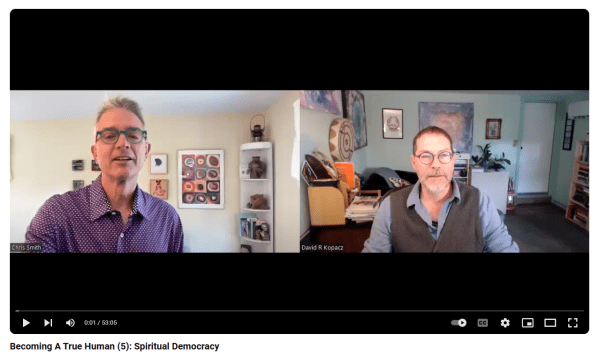
Chris Smith facilitates a discussion with Dave Kopacz on the concept of Spiritual Democracy, which is a chapter from Dave’s book with Joseph Rael: Becoming Medicine. Spiritual Democracy asks each of us, citizens and politicians alike, to ask ourselves before speaking any words or taking any actions: “Am I starting with the heart? Am I using words to divide or to invite togetherness?”
We talk about Steven Hermann’s books, Spiritual Democracy and Walt Whitman: Shamanism, Spiritual Democracy, and the World Soul. We also discuss Parker Palmer’s Healing the Heart of Democracy and his idea of the two ways that the heart can break: 1) it can break apart, creating shards and wounds in self and others, or 2) it can break open into greater compassion. Chris also brings up Frank Ostaseski’s Five Invitations to be present with ourselves and others in the moment, opening up into fearless receptivity and continuous discovery of our lives during these turbulent times.
We offer practices for doing the work of Spiritual Democracy, including finding space within each breath for micro-compassion for your self and for others.
We hope you enjoy our fourth podcast episode, this one exploring hope.
Chris Smith and Dave Kopacz speak about Chris’ forthcoming book, Hope Opens Doors. As we open one door of hope after another, we discuss the words of Vaclav Havel, Thomas Merton, Edna St. Vincent Millay, Rebecca Solnit, and F. Scott Fizgerald.
We talk about hope as a door that opens into rooms of new experience as well as the risk of being “imprisoned” in a room without a door, or a room that refuse to leave and are stagnating in. Yet, there is also the risk of opening the door too much, or opening Pandora’s Box.
Chris tells the following story about hope:
Thomas Merton, the writer and Trappist monk, is sometimes credited with saying, “Peace is not something you must hope for in the future. Rather, it is a deepening of the present, and unless you look for it in the present you will never find it.” If this quote is accurate, it reflects an important insight about hope, too. That is, hope is a “deepening” in the present, if we can be and listen long enough. It’s there. When Pandora was presented with a box and told not to open it, she, of course, removed the lid, releasing suffering and misery throughout the world. When the lid was finally secured, all that remained was hope.
And Chris read a little bit from his book, Hope Opens Doors:
As I was reflecting on this, our grandson, Angelo, was at our home. In the afternoon, we decided to take a walk. Angelo saw a rabbit in a neighbor’s yard and chased it. We ran through shrubs, bushes, and parts of my neighbor’s yard I’d never seen. The rabbit remained out of reach. It was frustrating. As I reflected on this later in the day, a question emerged: why is it the things that matter most often seem out of reach—like a rabbit? And, while it is true for rabbits, it seemed to apply to so many other things, too. For example, peace really matters and yet is out of reach. Health really matters and I recently had my appendix removed.
Hope, then, is often out of reach.
However, this isn’t the final answer. It is partial. Can you guess what’s missing? Though Angelo and I weren’t successful at catching the rabbit, there was, at least, a rabbit. We saw it. This point is often missed. Though peace is often out of reach, there is peace. Though health is sometimes out of reach, health exists. Peace, health, and rabbits. They exist. Just because we can’t contain them when we want doesn’t mean they do not exist.
Hope, then, is often simultaneously out of reach and present. Further, pursuing hope, though we may never be able to hold it in our hands or completely realize it, can still lead to adventure and self-understanding. I would have never seen different parts of my neighbor’s yard if it weren’t for that rabbit and an energetic two-year-old. Angelo and I discovered we like the challenge of chasing something that captures our curiosity. We learned both of us love navigating obstacles like shrubs and bushes. We also learned the rabbit was far better equipped to outrun and escape our best efforts.
Chris spoke about how the inspiration and title for his book came from a dream where he heard the phrase “Hope opens doors.” We then explored how sudden inspirations (as Havel says that hope is “anchored somewhere beyond the horizons” and that it comes to us from “elsewhere,” [Havel, Disturbing the Peace, 181]). I share how this idea of inspiration in the creative process reminded me of Kermit the Frog! I’m working on a book chapter with the working title, “Greening Medicine: The Role of the Medical Humanities,” and I suddenly remembered the Kermit the Frog song, “Bein’ Green,” and its line, “It’s not easy being green.” This song then provided the template for the beginning and end of the book chapter.
We include a guided meditation inspired by Joseph Rael’s teaching that no matter what you do in life, or what is done to you, that Wah-Mah-Chi (the Tiwa word for God, which he translates as Breath-Matter-Movement) holds back a place of goodness in your heart – which is always there, even if you have lost touch with it.
Hope, Chris says, is an “orthogonal perspective,” that to understand hope, we need to look at it from multiple different perspectives. While I agree with Chris on this, I told him that I have always thought that hope was “ornithological!” As this excerpt from Emily Dickinson’s poem, “‘Hope’ is the thing with feathers”
“‘Hope’ is the thing with feathers– That perches in the soul, And sings the tune without the words, And never stops–at all–”
We hope that you enjoy this podcast on hope, it went longer than we hoped it would, but maybe we are in a time where we all need a little more hope.
This next podcast is one from the archives – a conversation with my friend Jonathan McFarland (president of the Doctor as a Humanist) from July 29, 2023.
Jonathan and I have been comparing our KU (Kopacz Units) & MU (McFarland Units) as both of us have worked our way through phases of health and illness. I can tell that I was not feeling very well during this interchange, it was about a month after I started going back to work, after 2.5 months off for illness, and I was still quite fatigued.
We discuss wide-ranging array of topics, as usual, including:
holding our own
flourishing and thriving (or the lack thereof)
is health is more than the absence of disease?
the work of Doctor as a Humanist
shaking and quaking
the counter-curriculum
listening to the body
lost in the wilderness of the body
lost in the sterile corridors of contemporary medicine
Ivan Illich, Sir William Osler, Arthur Kleinman, CLOSLER, Siddhartha Mukherjee, Karl Marlantes
micro-invalidations in medicine
the project of science and the silencing of the human element
what it feels like to be on the receiving end of reductionistic medicine
doctors as information managers and technicans vs. healers
We close with the summary:
“Medical schools and medical education – and continuing medical education as well – are very good at taking a human being and turning them into a technician, but they’re not very good at helping that technician connect to the human being of themselves, or the patient.” (Kopacz)

















 Being Fully Human