
Episode 18: The Unfragile Mind with Gavin Francis
Scottish author and general practitioner, Gavin Francis, joins us to speak about his new book, The Unfragile Mind: A Physician’s Call for Restoring Hope and Humanity to Mental Health Care.
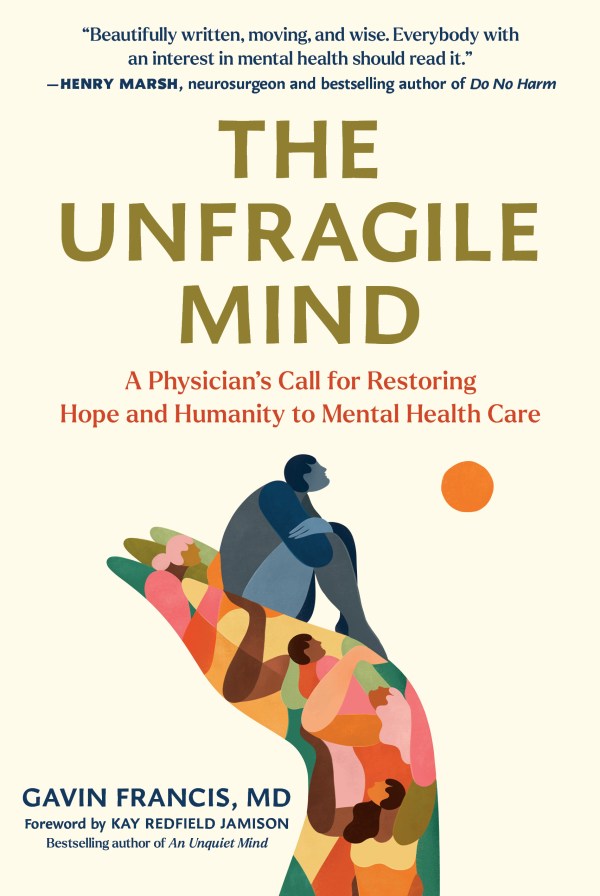
Gavin describes thinking about and working on this book for many years, and includes his own teenage experiences that he is grateful his own GP didn’t label as mental illness, but rather needing to learn how to make friends and share “food, time, stories, secrets” (10). He also was accepted into a master’s program in cognitive neuropsychology at Cambridge – which he decided not to pursue and ended up going back into clinical medicine, training in emergency medicine and as a general practitioner.
Gavin reviews themes of his book: that we are unfragile and have tremendous capacities to grow even after or in adversity, that diagnoses and medications can reinforce the mistaken belief that we are fragile, and that diagnoses are forms of pattern recognition – but with mental illness many of the influences are cultural and social, rather than biological.
In his book, he writes,
“Every mental health problem I see in clinic has at its core a tendency that, in a more measured dose, or different context, could contribute to human well-being, rather than detract from it,” (34).
He also speaks of the doctor as medicine and describes a distinction between the role of the doctor as a healer and as a technician, for instance, “It felt like the first time in my medical career that someone had earnestly tried to show me how to be a good doctor rather than a master of a set of technical skills. Dr. M called it being ‘an effective GP’ rather than ‘another pill-pusher’” (76).
Gavin gives a wonderful answer to our question of “What is a True Human?”
“For me, I would argue that all the world philosophies pretty much agree that the three big priorities for human life should be about developing your kindness and your compassion to your fellow man and being humble about the limits of what you really know and understand, and developing and fostering a kind of reverence both for the fact that we’re even here on earth and for earth itself and for other people. So those three: humility, compassion, reverence, I think becoming a true human is somebody who is able to prioritize those three and focus on them, and bring those…to fruition in their life.
But also, you know, you can get a bit too serious on this as well. I think it’s also really important to cultivate some levity and a little bit, well, a big dose of curiosity…and also equanimity, calm, even tempered in the face of adversities or in the face of bad news, good news. So those are like the added extras.”
Gavin ends the podcast with a quote from the closing of Robert Burton’s The Anatomy of Melancholy:
“Be not solitary, be not idle, SPERATE MISERI CAVETE FELICES [unhappy ones, have hope; happy ones, be cautious]” (Burton quoted in Francis, 250).