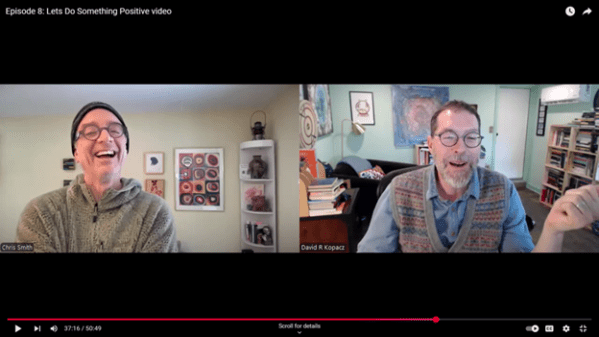
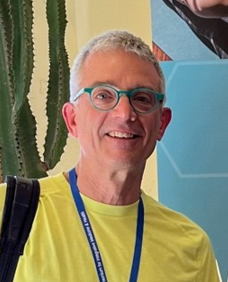
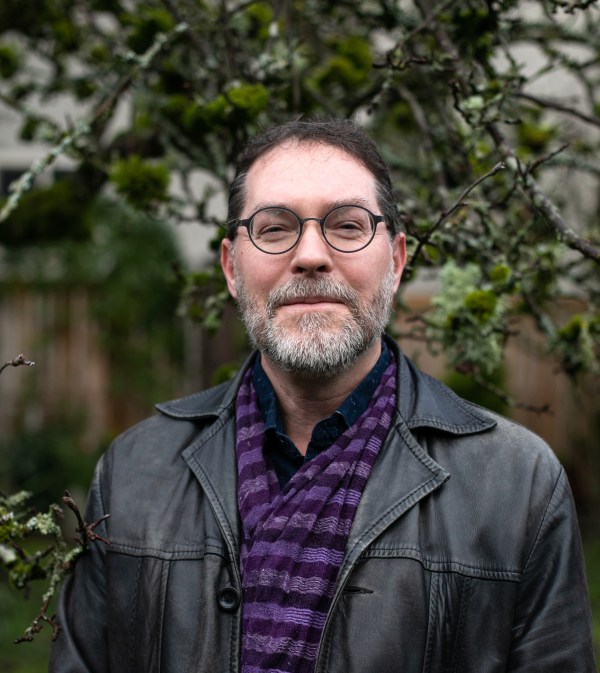
Dave Kopacz & Chris Smith talk about different ways of transforming pain into passion in a discussion ranging from the poetry of Mirabai, the life and teachings of St. Francis, creating pockets of positivity, building caring communities, taking charge of your story, Rebecca Solnit’s The Faraway Nearby, making sure our actions are motivated by caring and uncaring, how fear can be the first shift from caring to a slippery slope of uncaring, and lastly noodling as a metaphor for life.
We offer a range of things that you can do right now to do something positive and shift from shock to action: reading and sharing quotes, different writing practices, building community, finding any of the “hundred objects close by” that can “cure sadness,” and canning tomatoes or apricots. Remember, “Don’t waste your suffering” and let’s all work at creating reservoirs of goodness – we are going to need them!
One more thing you can do positive, right now – go to the Dr. Lorna Breen Heroes’ Foundation and contact congrees to reauthorize the Lorna Breeen Act to improve health care worker well-being and to prevent suicide https://drlornabreen.org/reauthorizelba/
A Hundred Objects Close By
Mirabai (translated by Daniel Landinsky)
I know a cure for sadness: Let your hands touch something that makes your eyes smile.
I bet there are a hundred objects close by that can do that.
Look at beauty’s gift to us─ her power is so great she enlivens the earth, the sky, our soul.
Chris Smith and David Kopacz discuss the rewards and pitfalls of practice in yoga, meditation, writing, and life.
Sometimes practice clears a space where imperfections and flaws are seen. We are tempted to try to eliminate those specks of dust and scratches on our window, but accepting our imperfections may actually be the real part of practice. Practice is about reconnecting to our True Humanity, our inner held-back place of goodness, our source of love, compassion, and caring – and we may only reach these through suffering and imperfection.
For instance, we explore the Sanskrit term, samvega, which Stephen Cope describes as “complex state involving disillusionment with mundane life, and a wholehearted longing for a deeper investigation into the inner workings of the mind and self,” (The Wisdom of Yoga, 13).
Or as Karlfried Graf Dürckheim wrote in his book The Way of Transformation: Daily Life as Spiritual Practice, “Thus the aim of practice is not to develop an attitude which allows us to acquire a state of harmony and peace wherein nothing can ever trouble us. On the contrary, practice should teach us to let ourselves be assaulted, perturbed, moved, insulted, broken and battered” (107).
Chris and Dave discuss their own struggles with chronic illness/ongoing medical symptoms and the difficult work of turning personal illness and suffering into fuel for personal growth work.
We talk about:
using suffering as a spiritual practice
cleaning the windshield
“The Garden,” a reading from Chris’ next book, Hope Opens Doors
a workshop Chris is putting on in February, “Chronic Illness & Love”
Sean Mackey’s work on love & pain
finding inner calm and strength, even within chaos & suffering
Makransky & Condon’s Sustainable Compassion Training
making practices creative and fresh
the work of Joseph Rael (Beautiful Painted Arrow)
spanda – the divine creative pulsation
practice does not make perfekt
being capable of suffering may make us more capable of joy
the benefits of practice are not only for us, but are fully realized when we share with others and the Earth
practice is caring for ourselves and others
We close with a couple of practices, one from Dave’s book, Caring for Self & Others and short one from Chris Smith.
We have video links on YouTube and audio links on Spotify, here is the link to all episodes:
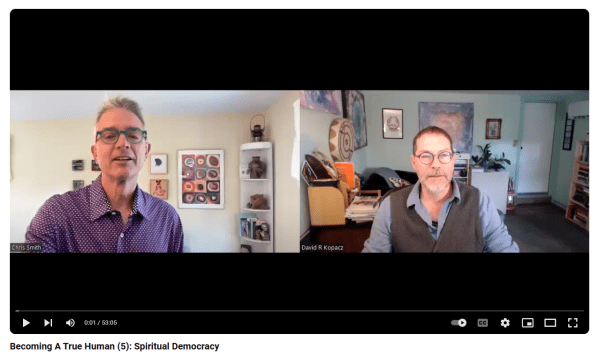
Spiritual Democracy episode 5 of Becoming a True Human podcast with Chris Smith and Dave Kopacz is now available!
Ideas for finding micro-compassion breaks for self & others during these turbulent times.
Chris Smith facilitates a discussion with Dave Kopacz on the concept of Spiritual Democracy, which is a chapter from Dave’s book with Joseph Rael: Becoming Medicine. Spiritual Democracy asks each of us, citizens and politicians alike, to ask ourselves before speaking any words or taking any actions: “Am I starting with the heart? Am I using words to divide or to invite togetherness?”
We talk about Steven Hermann’s books, Spiritual Democracy and Walt Whitman: Shamanism, Spiritual Democracy, and the World Soul. We also discuss Parker Palmer’s Healing the Heart of Democracy and his idea of the two ways that the heart can break: 1) it can break apart, creating shards and wounds in self and others, or 2) it can break open into greater compassion. Chris also brings up Frank Ostaseski’s Five Invitations to be present with ourselves and others in the moment, opening up into fearless receptivity and continuous discovery of our lives during these turbulent times.
We offer practices for doing the work of Spiritual Democracy, including finding space within each breath for micro-compassion for your self and for others.
We hope you enjoy our fourth podcast episode, this one exploring hope.
Chris Smith and Dave Kopacz speak about Chris’ forthcoming book, Hope Opens Doors. As we open one door of hope after another, we discuss the words of Vaclav Havel, Thomas Merton, Edna St. Vincent Millay, Rebecca Solnit, and F. Scott Fizgerald.
We talk about hope as a door that opens into rooms of new experience as well as the risk of being “imprisoned” in a room without a door, or a room that refuse to leave and are stagnating in. Yet, there is also the risk of opening the door too much, or opening Pandora’s Box.
Chris tells the following story about hope:
Thomas Merton, the writer and Trappist monk, is sometimes credited with saying, “Peace is not something you must hope for in the future. Rather, it is a deepening of the present, and unless you look for it in the present you will never find it.” If this quote is accurate, it reflects an important insight about hope, too. That is, hope is a “deepening” in the present, if we can be and listen long enough. It’s there. When Pandora was presented with a box and told not to open it, she, of course, removed the lid, releasing suffering and misery throughout the world. When the lid was finally secured, all that remained was hope.
And Chris read a little bit from his book, Hope Opens Doors:
As I was reflecting on this, our grandson, Angelo, was at our home. In the afternoon, we decided to take a walk. Angelo saw a rabbit in a neighbor’s yard and chased it. We ran through shrubs, bushes, and parts of my neighbor’s yard I’d never seen. The rabbit remained out of reach. It was frustrating. As I reflected on this later in the day, a question emerged: why is it the things that matter most often seem out of reach—like a rabbit? And, while it is true for rabbits, it seemed to apply to so many other things, too. For example, peace really matters and yet is out of reach. Health really matters and I recently had my appendix removed.
Hope, then, is often out of reach.
However, this isn’t the final answer. It is partial. Can you guess what’s missing? Though Angelo and I weren’t successful at catching the rabbit, there was, at least, a rabbit. We saw it. This point is often missed. Though peace is often out of reach, there is peace. Though health is sometimes out of reach, health exists. Peace, health, and rabbits. They exist. Just because we can’t contain them when we want doesn’t mean they do not exist.
Hope, then, is often simultaneously out of reach and present. Further, pursuing hope, though we may never be able to hold it in our hands or completely realize it, can still lead to adventure and self-understanding. I would have never seen different parts of my neighbor’s yard if it weren’t for that rabbit and an energetic two-year-old. Angelo and I discovered we like the challenge of chasing something that captures our curiosity. We learned both of us love navigating obstacles like shrubs and bushes. We also learned the rabbit was far better equipped to outrun and escape our best efforts.
Chris spoke about how the inspiration and title for his book came from a dream where he heard the phrase “Hope opens doors.” We then explored how sudden inspirations (as Havel says that hope is “anchored somewhere beyond the horizons” and that it comes to us from “elsewhere,” [Havel, Disturbing the Peace, 181]). I share how this idea of inspiration in the creative process reminded me of Kermit the Frog! I’m working on a book chapter with the working title, “Greening Medicine: The Role of the Medical Humanities,” and I suddenly remembered the Kermit the Frog song, “Bein’ Green,” and its line, “It’s not easy being green.” This song then provided the template for the beginning and end of the book chapter.
We include a guided meditation inspired by Joseph Rael’s teaching that no matter what you do in life, or what is done to you, that Wah-Mah-Chi (the Tiwa word for God, which he translates as Breath-Matter-Movement) holds back a place of goodness in your heart – which is always there, even if you have lost touch with it.
Hope, Chris says, is an “orthogonal perspective,” that to understand hope, we need to look at it from multiple different perspectives. While I agree with Chris on this, I told him that I have always thought that hope was “ornithological!” As this excerpt from Emily Dickinson’s poem, “‘Hope’ is the thing with feathers”
“‘Hope’ is the thing with feathers– That perches in the soul, And sings the tune without the words, And never stops–at all–”
We hope that you enjoy this podcast on hope, it went longer than we hoped it would, but maybe we are in a time where we all need a little more hope.
This next podcast is one from the archives – a conversation with my friend Jonathan McFarland (president of the Doctor as a Humanist) from July 29, 2023.
Jonathan and I have been comparing our KU (Kopacz Units) & MU (McFarland Units) as both of us have worked our way through phases of health and illness. I can tell that I was not feeling very well during this interchange, it was about a month after I started going back to work, after 2.5 months off for illness, and I was still quite fatigued.
We discuss wide-ranging array of topics, as usual, including:
holding our own
flourishing and thriving (or the lack thereof)
is health is more than the absence of disease?
the work of Doctor as a Humanist
shaking and quaking
the counter-curriculum
listening to the body
lost in the wilderness of the body
lost in the sterile corridors of contemporary medicine
Ivan Illich, Sir William Osler, Arthur Kleinman, CLOSLER, Siddhartha Mukherjee, Karl Marlantes
micro-invalidations in medicine
the project of science and the silencing of the human element
what it feels like to be on the receiving end of reductionistic medicine
doctors as information managers and technicans vs. healers
We close with the summary:
“Medical schools and medical education – and continuing medical education as well – are very good at taking a human being and turning them into a technician, but they’re not very good at helping that technician connect to the human being of themselves, or the patient.” (Kopacz)
Join Chris Smith & Dave Kopacz for the second episode – Health & Unhealth – of the Becoming a True Human podcast (the first where the video recording worked!). We discuss themes of the wounded healer, transforming suffering, caring moment meditation, Sustainable Compassion Training and the work of John Makransky and Paul Condon, the poetry of Rumi, and how hope can open doors. (1 hour)
From “Childhood Friends”
Trust your wound to a teacher’s surgery. Flies collect on a wound. They cover it, those flies of your self-protecting feelings, your love for what you think is yours.
Let a teacher wave away the flies and put a plaster on the wound. Don’t turn your head. Keep looking at the bandaged place. That’s where the light enters you. And don’t believe for a moment that you’re healing yourself.
Rumi, Jalal Al-Din; Barks, Coleman.
The Essential Rumi – reissue: New Expanded Edition (p. 142).
I’ve been thinking about how we need to build a community of practitioners discussing the problems of burnout, compassion fatigue, and soul loss. Isolation and loneliness contribute to burnout, and social connection is an antidote to burnout. To this end, we are creating the Becoming A True Human podcast. Who is “we”? Well, for now, it is me and my good friend Chris Smith – therapist, meditation teacher, Whole Health educator, storyteller, author (Be a Good Story), founder of the Academy for Mindfulness consulting, and all-around wise guy (and I mean that in multiple senses of the phrase).
The audio of the episode 1, Lost, is at the bottom of this post.
Chris SmithDave Kopacz
What is burnout? Just what exactly is it that burns out? How can whatever is burned out be re-ignited?
What is compassion fatigue? How does compassion wear out? Should it really be called empathy fatigue? Is the problem that there is too much compassion going out? Or not enough coming in? Or could it be that institutional structures and protocols make us busy with so many things that there is little time left in the clinical encounter for caring?
What is soul loss? Could we think of the soul being the “thing” that burns out? Not necessarily in a religious or metaphysical sense – although it could be if that fits your belief system – but in a metaphorical and psychological sense. If in burnout we lose connection with our souls, how can we reconnect and either go on a quest to find our lost souls, or create a welcoming environment in our bodies and lives so that our souls can return and flourish?
I address these questions in my book, Caring for Self & Others: Transforming Burnout, Compassion Fatigue, and Soul Loss, but we need to have further discussions around these topics as I feel strongly that we need a kind of ongoing practice, a yoga of burnout, in which we continually work in our own practices as well as in building communities of caring to support each other with this human, all too human dilemma.
Based on the topics we discussed in the first episode we titled this episode “Lost,” even before we realized that we somehow lost video of me and only recorded video for Chris! In this episode we explore topics of burnout as an initiation into becoming a wounded healer, soul loss, yoga for the health of healers, and we end with a meditation exercise and a poem, “Lost” by David Wagoner.
We don’t really know what we are doing with the technology aspect.
Let me tell you a story that illustrates the problem.
My high school friend Jack and I drove across the country after college. We were into the beat poets and writers, reading Kerouac’s On the Road, and envisoned a trip full of excitement and philosophical observations. We had a microcassette recorder and would talk into as we were driving, having many deep discussions and creating a record of what we saw.
Somewhere around South Dakota (having left from Chicago area) I noticed that the wheels of the recorder weren’t moving when we were recording. It was then that I noticed that there was a pause switch that was clicked on and prevented any recordings from being made! All of our bits, routines, observations, and experiences were lost! We were a bit crestfallen and we made half-hearted attempt to resume recording, but something had been lost – the energy, the enthusiasm. I think we eventually gave up on it. Maybe you could say we burned out on the idea after investing so much energy and enthusiasm and not having anything to show for it.
From a mindfulness perspective, there is surely some kind of lesson here – about not being attached to goals or outcomes, about being in the present moment versus memorializing experience, and maybe even that the organizing ego is an illusionary construct for creating a reduced and more manageable limited reality (if you want to take it that far!).
Well…I remembered this story after Chris Smith and I had just had our wide-ranging and enthusiastic discussion as we recoreded it on Zoom, only to realize that I had messed up the settings and we only had Chris’ video and both our audio. Well, crestfallen again! Urgh, technology failure again!
So, I think I have figured out how to share the audio of our video podcast, rather than have video of just Chris and my disembodied voice. Titling this episode, “Lost,” was prescient as we lost the video. Chris also spoke of his caring for self routine and how he purposefully skips some days so as not to get caught up in perfectionism, performance, and productivity. We’ll consider the lost video as a sacrifice to the Divine or the Cosmos, a giveaway, in addition to it being a bumbling failure of technology.
So, welcome to the first episode of the Becoming A True Human podcast – Lost – it highlights the vulnerability and imperfection of being human, that we are all a work in progress and that our work is a yoga practice – yoking mind, emotions, body, soul. The practice of Becoming A True Human is an ongoing practice, we can only do it in the present moment and the next moment we are again lost, at sea, trying to figure it out and Keep It All Together (KIAT). We will attempt to have the next episode as video and hope to post it on the Becoming a True Human YouTube site.