Words Create Worlds.12: Caring Words/Caring Worlds, Uncaring Words/Uncaring Worlds

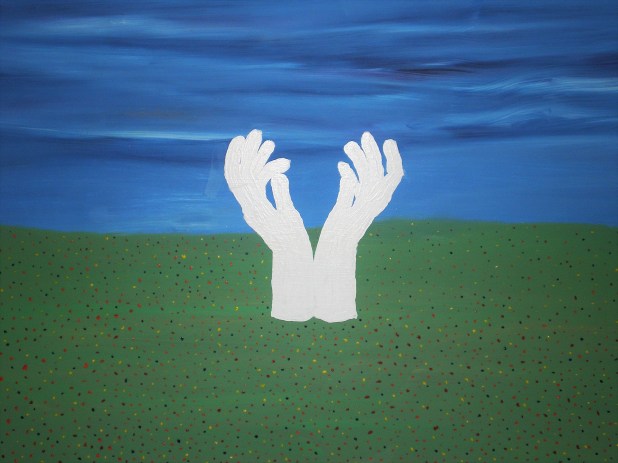
Helping Hands, D. Kopacz

What we are experiencing now is a predictable, straight line from the words that Donald J. Trump has spoken.

The uncaring world we are living in has been created, uncaring word by uncaring word of our current president and those who are drawn to him. It is as simple as that. It is as simple as that.

What we put into the world in words, what we bring forth from that deep inner place of creative power within ourselves, creates the world we live in. We are makers and unmakers of our reality.

The inspiration for this essay series, Words Create Worlds, comes from Rabbi Heschel. He said, as recounted by his daughter, Susannah Heschel:

“Words, he often wrote, are themselves sacred, God’s tool for creating the universe, and our tools for bringing holiness—or evil—into the world. He used to remind us that the Holocaust did not begin with the building of crematoria, and Hitler did not come to power with tanks and guns; it all began with uttering evil words, with defamation, with language and propaganda. Words create worlds, he used to tell me when I was a child. They must be used very carefully. Some words, once having been uttered, gain eternity and can never be withdrawn. The Book of Proverbs reminds us, he wrote, that death and life are in the power of the tongue.”[1]

Rabbi Heschel warns us of the power of words and how they can bring holiness or evil into the world. This is the power of choice that we have and the power of our breath shaped into meaning and symbolism through the sound of the letters that we string together into words.

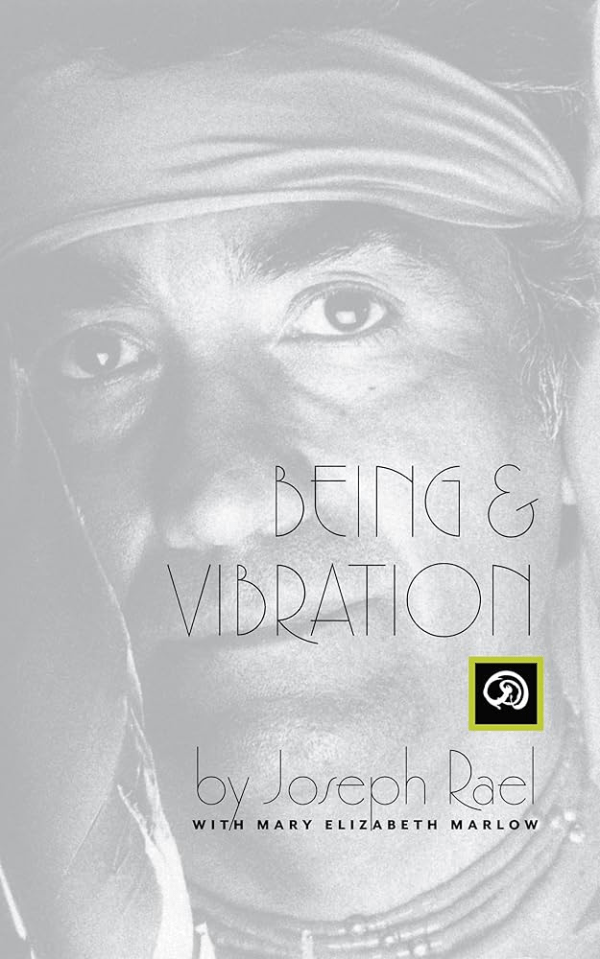
Joseph Rael (Beautiful Painted Arrow) also has taught about the power of Sound – of Being & Vibration – and how the sounds of letters and words carry the power of meaning. In the Tiwa language of Picuris Pueblo, the word for God is Wah-Mah-Chi, Breath-Matter-Movement. We could say that Wah-Mah-Chi, Breath-Matter-Movement, is a Word that creates other words and these words create our world. Creator, Wah-Mah-Chi, is a Word that creates other words and worlds. Breath comes through Matter and becomes Movement.
I am invoking spiritual teachers, but the principle of words create worlds also holds for poets, artists, singers, teachers, educators, and politicians – people who can use their words for either bad or good, or as Rabbi Heschel says, for holiness or evil.

How to Write About What You Are Not Supposed to Write About (But Are Ethically and Professionally Bound to Speak)

I started this series of essays out of my concern about the rise of Donald J. Trump as a political figure. His words were so clearly uncaring: he bullied, he name called, he threatened, he spoke about America First, but he really meant Me-First. I have felt compelled to speak the truth, as a psychiatrist, but even more so as a human being.

Lies as Politics

Lies. Donald Trump lies,[2],[3] habitually, repeatedly, and knowingly. He is trying to shape a narrative, he is trying to create your reality, he is trying to create your world.

Lying is not just a personality quirk, there is also a history of lies as politics. Bruno Frank wrote Lüge as Staatsprinzip (The Lie as State Principle) about Hitler and the Third Reich. Frank wrote: “Never before in history has any public group lies with such absolute, voracious, and poisonous shamelessness as has this party for more than a decade;” and further that the essence of fascism is “the total deception of the nation.”[4] Lying is not just a way of life for an individual, it is a political principle for fascism.

Trump believes that he is above the law, even more so as president.  “On January 23, 2016, Donald Trump notoriously declared, ‘I could stand in the middle of Fifth Avenue and shoot somebody, and I wouldn’t lose any voters,’” quoted by Jonathan Chait in a piece entitled “The logical end point of Trump saying he could shoot somebody on Fifth Avenue,”[5] Trump’s words of getting away with murder are now creating our world. As Chait writes:

“That statement was understood at the time as a metaphorical expression of the depth of Republican voters’ commitment to him. Ten years and one day later, his administration’s agents shot a disarmed man on the street in full view of the public. Perhaps we should have taken him not only seriously but also literally.”[6]

The problem is, we didn’t know how to respond to Trump at the time in 2016, even though it was clear to me that his words were dangerous. As a physician, professional, and psychiatrist – I was (and am) concerned about the risk to the health of the populace and the health of our democracy, but I restrained myself out of an abundance of professional caution and also concern about the Goldwater Rule, which states that psychiatrists cannot “diagnosis” a public figure they have not met with clinically. But to warn about dangerousness is different than labelling a public figure with a diagnosis.

The Dangerous Case of Donald Trump

In 2017, Yale psychiatrist and expert in predicting violence, Bandy X. Lee convened a group of mental health professionals around the topic of The Dangerous Case of Donald Trump. The conference led to the publication of The Dangerous Case of Donald Trump: 27 Psychiatrists and Mental Health Experts Assess a President and then later expanded to a new edition with ten more experts, The Dangerous Case of Donald Trump: 37 Psychiatrists and Mental Health Experts Assess a President – Updated and Expanded with New Essays. Dr. Lee ended up losing her position at Yale, then she created the World Mental Health Coalition, and has dedicated her work to illuminating the dangerousness of the current president.

I watched the first Trump presidency with concern. I also recognized, as a psychiatrist and as a human being, how Trump’s words and actions were right out of the “fascist playbook.” In 2020 I was moved by the mosque shooting hate crime in Christchurch, New Zealand to start the Words Create Worlds column. (I will list each essay title with links at the end of this article). Looking back, I think the pandemic and Trump’s mishandling of it, and his use of it to divide the country rather than bring it together, helped tip my hand to write in a more open and critical way about the public health emergency of Donald J. Trump. While I was cautious back then and did not want to overstate the risk of “just words,” I now feel that my concerns are valid and vindicated by the second Trump presidency where his words are moving into action and creating our world. In fact, I called Trump the anti-Doctor as his words were not only hurtful of people’s feelings, but dangerous to people’s lives and to American democracy.

Fifth Avenue to Nicollet Avenue to Iran

Donald Trump did not shoot someone on 5th Avenue in New York City, but armed, masked men carrying out the orders of the president, shot and killed Renee Nicole Good in her car after dropping off her 6 year-old at school, near East 34th Street and Portland Avenue in Minneapolis on January 7th, 2026. This was, ominously, five years and a day after the January 6th 2021 attack on the United States Capitol.

Instead of Fifth Avenue, it was 34th Street and Portland Avenue. Instead of Fifth Avenue, it was Nicollet Avenue in Minneapolis, where Alex Jeffrey Pretti, an ICU nurse who worked at the VA (Veterans Affairs) was shot.

Trump and his team of ne’er do-wells immediately went into “blame-the-victim” mode. Homeland Security Secretary Kristi Noem lied about Renee Nicole Good, accusing her of “domestic terrorism.”[7] As with lies about Stephen Miller, Trump’s chief of staff, said that Pretti was an “assassin” who “tried to murder federal agents.”[8] Homeland Security Secretary Kristi Noem claimed Pretti “attacked” officers while “brandishing” a gun.”[9] However multiple eye witness reports and video footage showed that these were lies. The administration had to walk back its portrayal of a mother dropping off her child and a VA ICU nurse. The president even said he “felt bad” about the killings, but even worse about Renee Nicole Good’s killing as her parents were Trump supporters.[10]

Since I first started this essay, the United States of America and Israel have started a war with Iran. The lies continue…

“On February 28, during the opening hours of the assault on Iran, a missile struck a girls’ school in southern Iran, killing more than 170 people – most of them schoolgirls.”[11]

Rather than waiting for the truth of an investigation, Donald Trump immediately blamed Iran for using a US made missile to kill its own children. However, the evidence is pointing to the children being killed by the United States:

“Preliminary investigations suggest the school may have been hit by a US missile because of a targeting error, though the exact circumstances remain under investigation.

Analysts say the strike may have been caused by outdated targeting information, as the school is on the same block as buildings used by the IRGC’s navy and the site of the school was originally part of the base.”[12]

The Cusp Where Words Become Worlds

I have to keep writing this column on Words Create Worlds.

The risk of remaining silent, at this point, is greater  to my humanity than the risk of speaking is to my conservative professionalism or my safety.

We are on the cusp of words becoming worlds – actually we are beyond the cusp, beyond the event horizon pulling us into the black hole of fascism.  Donald J. Trump has told us, all along, what he intends to do. Republican politicians have minimized his words, saying “they are just words,” “that’s just who he is, he doesn’t really mean he is going to [fill in the blank: take over Greenland, make Canada the 51st state, invade Mexico to combat cartels, remove Palestinians from Gaza and build luxury hotels, jail his opponents, kill his opponents, run for a third term, invade Iran].

I have seen this coming. I did what I do as a writer, I wrote about it. I educated about fascism.

Yet, I feel I have not done enough. Is there anything one person can do to stop the steady slide from democracy into fascism? Actually, “steady slide” is a mischaracterization – the United States of America did not “fall” into fascism, it was pushed.

Politically, with the House, Senate, and White House controlled by Republicans, it seems to depend on Republican politicians who need to break with Trump before it is too late. But it is already too late. Trump began as much of a buffoon as Adolf Hitler was in the early 1930s – no one took him seriously. The power Trump has is the power of the tongue, the power of mass hypnosis, the power of lying to people, telling people what they want to hear and making them feel good about uncaring, and the power of intimidation. Republican politicians have colluded with him in deforming American Democracy into the power of American Empire.

Bruno Frank, the author of Lüge as Staatsprinzip (The Lie as State Principle), whom I introduced earlier, quotes Adolf Hitler’s Mein Kampf on how lying words can create worlds:

“All this was inspired by principle ─ which is quite true in itself ─ that in the big lie there is always a certain force of credibility; because the broad masses of a nation are always more easily corrupted in the deeper strata of their emotional nature than consciously or voluntarily; and thus in the primitive simplicity of their minds they more readily fall victims to the big lie than the small lie, since they themselves often tell small lies in little matters but would be ashamed to resort to large-scale falsehoods…For the grossly impudent lie always leaves traces behind it, even after it has been nailed down, a fact which is known to all expert liars in this world and to all who conspire together in the art of lying. These people know only too well how to use falsehood for the basest purposes.”[13]

Uncaring Words Create Uncaring Worlds

What we are living in the United States right now is the uncaring world created by the uncaring words of Donald J. Trump. These are the words of fascism, authoritarianism, totalitarianism, infantilism, and me-first-ism. I have often thought that if Republican politicians asked themselves “Am I being kind, am I being compassionate,” that they would make different decisions. But kindness and compassion seem to have lost their appeal to MAGA and the Republican party. Instead, they speak words of power, words of me-first, words of us vs. them, words of hate thine enemies, and words of vengeance and retribution. MAGA and the Republican party have become, in the words of Adolph Hitler, “expert liars…who conspire together in the art of lying.”

If we hold uncaring feelings in our hearts and we speak uncaring words into the world, we will create an uncaring world.

Caring Words Create Caring Worlds

In 2025 I published my sixth book, Caring for Self & Others: Transforming Burnout, Compassion Fatigue, and Soul Loss. I wrote it as a follow-up to my first book, Re-humanizing Medicine (2014). I wrote Caring for Self & Others because I felt there was a need for a practical handbook for health care professionals, educators, and leaders – but it is really for anyone who cares for others as part of their life or jobs, which is most of us.
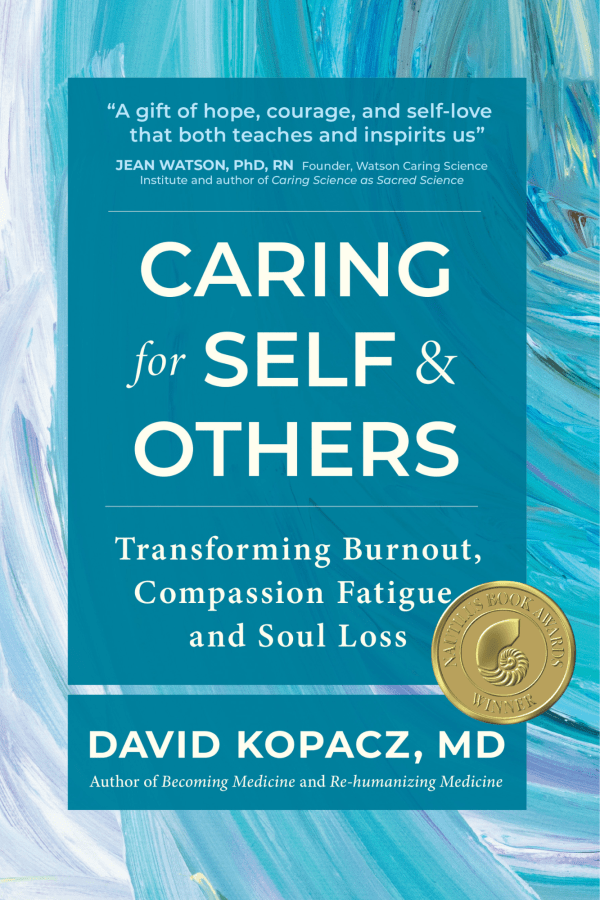
“Transforming burnout, compassion fatigue, and soul loss,” I wrote, “requires individual practices as well as institutional reform” (4). While I was mostly thinking about hospital and clinic settings as the place of institutional reform, we are in a place with our democracy that it also requires institutional reform in order to be a healthy place to live, love, and work.

Health Care Workers can burnout and develop compassion fatigue, where they feel they no longer have anything to give. The human imperative to resist fascism, you can call it activism if you like, also carries the risk of burnout and compassion fatigue – how can we keep caring when the suffering seems endless? We need to learn how to care for ourselves as we are caring for others. We need to learn how to replenish our own hearts of caring. The book has a number of exercises and meditations to help individuals to refill the cup of their hearts.

The Compassion Revolution & the Counter-Curriculum of Caring

In  Re-humanizing Medicine I called for a Compassion Revolution in health care and now we need a Compassion Revolution in politics. We need to not just think about ourselves, we need to think about others. We need to not just care about ourselves, we need to care about others. Actually, I would argue that “caring” only for self is not really caring, it is more selfishness. Caring breaks down the boundaries and walls between self and other. Caring naturally shifts us into a transpersonal space, what Thich Nhat Hanh called “interbeing” and Martin Luther King, Jr. called the “beloved community.”[14] Caring connects us – connects us to ourselves, our hearts, our souls; connects us to other human beings; and connects us to our environment and ecosystem.
In medical school, I felt I was losing an important part of myself, I felt like I was losing who I was, my kindness, my sensitivity, my caring – my soul. Over the years I have developed what I call a counter-curriculum of caring, or rehumanization, as an antidote to counter-act all the forces in our modern world that leave us feeling dehumanized.

“These counter-curriculum practices grew into the practices for the ten dimensions of caring in this book. This book is a counter-curriculum of caring, reminding us in the midst of our busy days as technicians, educators, and leaders to take the time to care. Our current curriculum and operating procedures are creating burnout, compassion fatigue, and soul loss. The proposed counter-curriculum transforms burnout, reigniting the heart of the healer, the soul of the educator, and the vision of the leader; it gives us an antidote for compassion fatigue by giving compassion to ourselves―refilling the medicine bags of our hearts; and it helps us recover and nourish our souls, revitalizing and reconnecting all the dimensions of our humanity.”[15]

Caring is the antidote to Uncaring

What are we going to do now?

It is one thing to define a problem, to understand it, but how do we address the problem of uncaring in the USA and the world? I wish I had an answer for you, but I think each person has to figure this out for themselves, consulting their own hearts in the darkness of sleepless nights. I do think the heart can guide us.

And our souls? What about our souls?

I use the concept of “soul loss” as a metaphor for burnout and compassion fatigue – for the costs of caring. How do we recover our souls when we feel we are losing them – as individuals and as a country? We have to search, we have to be still, we have to go into the darkness – our own and that of our times. As Michael Mead writes in Awakening the Soul:

“As the inner dynamic of transformation, initiation means the continuous breaking open of areas of the soul to reveal hidden capacities and inherent gifts. When life pulls at us from the outside and the soul pushes us from the inside, we reach the point where pain and longing requires that we change. … Whatever interrupts, breaks us open, or breaks us down―whether it is the trauma and shock of a loss in life or the drama and exhilaration of success―also initiates us into a greater knowledge of ourselves.”[16]

Meade’s book repeatedly reinforces the idea that the crisis can awaken the soul which then gives the support that is needed for the particular crisis. Caring for ourselves entails caring for our souls, which then give us the strength to further care for ourselves and then to care for others.

What can we do? When you find yourself in a dark place, when you feel you are at your limit, when you feel burnout and compassion fatigue, when you feel a sense of soul loss – that is the time to consult with your soul through inner practices that lead to outer actions and outer actions that lead to inner practices.

Q: What are we going to do now?
A: Whatever needs doing.

Q: How are we going to do it?
A: I’m not sure, but check with your heart, check with your soul. Let your heart and soul find the caring response as the antidote to the uncaring world we are living in. The answer is in caring. Caring for what? Caring for yourself & caring for others.

Inner Democracy

One way of caring for Self is cultivating Inner Democracy. I am starting another series of essays on this topic and will be posting them soon. In addition to the outer work of challenging words creating worlds of fascism, this inner work is an antidote to uncaring. Creating Inner Democracy is a practice of Caring for Self & Caring for Others.[17] This work owes a great deal to Steven Herrmann’s work on Spiritual Democracy and Jeremy David Engels On Mindful Democracy: A Declaration of Interdependence to Mend a Fractured World.[18]
I will leave you with an exercise from Caring for Self & Others, one that actually came to me when I was working with Joseph Rael on our book, Walking the Medicine Wheel: Healing Trauma & PTSD.

Compassioning Practice—Giving & Receiving Meditation[19]

Imagine and visualize what the heart does on a physiological level in the body.

The heart receives (through the right atrium) the blood that has traveled throughout the entire body. This blood has the lowest oxygen content; all the tissues of the body have already absorbed oxygen from this blood―it is blue, venous blood. From the perspective of tissues, it is “bad” blood, no longer oxygen-rich. As the heart receives and accepts this “bad blood,” it doesn’t complain or cling to it, but gives it away, lets it go, and it passes on to the lungs. There the blood is replenished with oxygen. The heart then receives again, only this time it is the “best blood,” the most oxygen-rich. Once again, however, the heart doesn’t cling or hoard the goodness for itself, but gives it away to the rest of the body.

Hopefully you are seeing the metaphor of how your heart works physiologically and how you can work with suffering in your life. How much do you cling to the good? How much to you reject “bad” life experiences, which could be blessings in disguise?

Sit back for a moment, closing your eyes. Focus on what your heart is doing an average of 60 to 80 times a minute. Receiving depleted blood, giving it away; receiving replenished blood, and giving it away. Become aware of this ongoing process within you.

If you would like, focus on this same movement in your life.

Think about a situation in which you experienced suffering. Remember to step back and use some of the grounding techniques discussed in chapter 2 if you feel overwhelmed.

Allow yourself to receive it. Once you have received it, give it away again, allow it to transform, and then allow yourself to receive it again, then give it away once again. Go through this cycle of giving and receiving for as long as feels right to you. Breathe in deeply―let it flow through you; breathe out―let it go. Practice this breathing in/letting go three more times. Feel the movement of the action of your heart throughout your being. Take a deep breath, and open your eyes.

This exercise of giving and receiving shows that compassion begins within our own hearts, that we must be willing to accept both the good and the bad in order to fully feel and fully live and fully love. Transformation occurs when we accept through receiving and let go through giving.


[1] Heschel, S. in “Introduction,” Heschel, Abraham Joshua. Moral Grandeur and Spiritual Audacity: Essays. Farrar, Straus and Giroux. Kindle Edition, 1997.

[2] “In 1,267 days, President Trump has made 20,055 false or misleading claims,” Updated July 9, 2020. The Washington Post’s Fact Checker’s ongoing database of the false or misleading claims made by President Trump since assuming office. https://www.washingtonpost.com/graphics/politics/trump-claims-database/?utm_term=.27babcd5e58c&itid=lk_inline_manual_2&itid=lk_inline_manual_2

[3] Daniel Dale, “Donald Trump’s top 25 lies of 2025, CNN (12/27/25) https://www.cnn.com/2025/12/27/politics/analysis-donald-trumps-top-25-lies-of-2025

[4] Cited in  László Földeényi, “Imprisoned in Cold Myth,” in The Quest for Vision in a Confused World, Cultura Animi VIII, Nexus Institute, p. 59.

[5] Jonathan Chait, “The logical end point of Trump saying he could shoot somebody on Fifth Avenue,” The Atlantic (1/25/26) https://www.msn.com/en-us/news/opinion/the-logical-end-point-of-trump-saying-he-could-shoot-somebody-on-fifth-avenue/ar-AA1UWa0h

[6] Ibid.

[7]  Maria Ramirez Uribe and Amy Sherman, (PolitiFact) “Experts question Noem calling Good a ‘domestic terrorist.’ Here’s what the term means” https://www.pbs.org/newshour/politics/experts-question-noem-calling-good-a-domestic-terrorist-heres-what-the-term-means

[8] Daniel Dale, “What Trump officials claimed about Alex Pretti — and what the evidence actually shows,” CNN (1/25/26) https://www.cnn.com/2026/01/25/politics/trump-officials-shifting-rhetoric-alex-pretti

[9] Ibid.

[10] Amy McCarthy, “Trump Says He Feels ‘Terrible’ About Alex Pretti but ‘Even Worse’ About Renee Good Since Her Parents Were ‘Tremendous Trump Fans” People, (1/27/26) https://people.com/trump-says-he-feels-terrible-about-alex-pretti-but-even-worse-about-renee-good-since-her-parents-were-tremendous-trump-fans-11893999

[11] Elizabeth Melimopoulos, “Who bombed the Iranian girls’ school, killing more than 170? What we know,” Aljazeera, March 12, 2026, https://www.aljazeera.com/news/2026/3/12/who-bombed-the-iranian-girls-school-killing-more-than-170-what-we-know

[12] Ibid.

[13] Cited in  László Földeényi, “Imprisoned in Cold Myth,” in The Quest for Vision in a Confused World, Cultura Animi VIII, Nexus Institute, p. 59-60.

[14] Discussed in Caring for Self & Others, p. 198-201, 171-173.

[15] Caring for Self & Others, p. 21.

[16] Michael Meade, Awakening the Soul: A Deep Response to a Troubled World (Vashon, WA: Greenfire Press, 2018), 72-73

[17] For now, you can reference my writings on spiritual democracy and caring for all:

Caring for Self & Others: Transforming Burnout, Compassion Fatigue, and Soul Loss (ch. 10, Becoming Caring: Caring for All). Becoming Medicine: Pathways of Initiation into a Living Spirituality (ch. 14, Spiritual Democracy) – this is available as a free pdf download: https://www.davidkopacz.com/becoming-medicine

[18] See our Becoming a True Human podcast interview with Jeremy David Engels, https://beingfullyhuman.com/2026/03/04/on-mindful-democracy-with-jeremy-david-engels/

[19] Caring for Self & Others, p. 83-84, adapted from David Kopacz and Joseph Rael, Walking the Medicine Wheel: Healing Trauma and PTSD (Tulsa, OK: Pointer Oak, 2016), 164–65.
Coniunctionis: Truma, Transformation & Punk Rock

Mental Contagion is publishing online some of its archive. Coniunctionis: Trauma, Transformation & Punk Rock was a column that I wrote from 2000 – 2002. My sister, Karen Kopacz started editing and publishing Mental Contagion and brought together a great group of writers, including Gene Dillon, Wendy Lewis, Dean Pajevic, and Eric Hoffman, as well as many others over the years.

I wrote a new introduction for this collection of essays and I’ll let it speak for itself as you can find it below along with the table of contents. You can download the complete archive through this link. I also have the individual essays on my website under the Creativity section.

CONIUNCTIONIS

Trauma, Transformation & Punk Rock

(2000 – 2002)

David R. Kopacz, MD

Table of Contents

.0  :    Introduction

.1  :     Why Coniunctionis? (November, 2000)

.2  :    Is Reality Real? (I) (December, 2000)

.3  :     Is Reality Real?  (II) (January, 2001)

.4  :     How Can Ugliness and Disharmony, Which Are the Content of Tragic Myth [and punk rock], Inspire Esthetic Delight?” (Joy Division, Punk Rock, Violence, Despair & Transformation Part I) (February, 2001)

.5  :     Why is Revolt Necessary? (Joy Division, Punk Rock, Violence, Despair & Transformation Part II) (March, 2001)

.6  :    Is Alienation Necessary for Creativity? (Joy Division, Punk Rock, Violence, Despair & Transformation Part III) (April, 2001)

.7  :      Is There an Inside/Outside? (Joy Division, Punk Rock, Violence, Despair & Transformation Part IV) (May, 2001)

.8  :     What is the Meaning of Ian Curtis’ Death?  Where is the line between the Art Object and the Artist? (Joy Division, Punk Rock, Violence, Despair & Transformation Part V) (June, 2001)

.9  :     What is Punk Rock? What is Not Punk Rock? (Joy Division, Punk Rock, Violence, Despair & Transformation Part VI) (July, 2001)

.10:     What Does the Shadow Know? (Joy Division, Punk Rock, Violence, Despair & Transformation Part VII) (August, 2001)

.11:      What is the Relationship Between Music and Religion? (Joy Division, Punk Rock, Violence, Despair & Transformation Part VIII) (September, 2001)

.12:      What Are We to Do? Quotations (October, 2001)

I:          Interview: Ouroboros (Houston) by David Kopacz – for Mental Contagion (MC) (November, 2001)

.13:      What Does Religion have to do with Rock? A review of Dan Graham’s Rock My Religion (December, 2001)

.14:     What Did You See There? Ian Curtis and the Visionary Quest of the Shaman (Joy Division, Punk Rock, Violence, Despair & Transformation Part IX) (January, 2002)

I:          Interview: Poster Children by David Kopacz (With Special Guests Doug McCarver and Mike Barry) (February 2002)

.15:     Afterwords

CONIUNCTIONIS.0

On stranger waves, the lows and highs Our vision touched the sky. “A Means to an End,” Joy Division, Closer, 1980.

There is a movement within me, a current and flow that lives through me. I have felt the pull to be inside, where everything is happening. I have felt the pull to be outside of it all, where nothing is happening. These essays, written between 2000-2002 for the online journal Mental Contagion, are attempts to understand the inside and the outside and the power that flows from outside to inside and from inside to outside. These essays are investigations into the nature of reality through Joy Division, trauma, transformation, and punk rock. 

There is a pull that some people feel, to go deeply inward, sometimes that pull is a push, from alienation or trauma in the outer world. Going into this inner wilderness is a kind of darkness and it can overlap with despair. Maybe despair is the cause of the inwardness or maybe despair is a station along the path of inwardness, like a phase of grief that one goes through, leaving the communal and collective world and entering into the sacred inner cave of consciousness and being. Jung wrote,

“As a child I felt myself to be alone, and I am still, because I know things and must hint at things which others apparently know nothing of, and for the most part do not want to know. Loneliness does not come from having no people about one, but from being unable to communicate the things that seem important to oneself, or from holding certain views which others find inadmissible. The loneliness began with the experiences of my early dreams, and reached its climax at the time I was working on the unconscious. . . . It is important to have a secret, a premonition of things unknown. If fills life with something impersonal, a numinosum,” (Carl Jung, Memories, Dreams, Reflections, 356).

For Jung, this loneliness was difficult to bear, but it was a source of learning and experience that he would not have traded for fitting in. Ian Curtis, the lead singer of Joy Division, also found a creativity in the darkness and the loneliness and he sent back missives from the depths, as a lone astronaut exploring space might send back scratchy transmissions from another galaxy:

“You’ve been seeking things in darkness, not in learning(No Love Lost)

“I’ve been waiting for a guide to come and take me by the hand. Could these sensation make me feel the pleasures of a normal man?These sensations barely interest me for another day I’ve got the spirit, lose the feeling, take the shock away” (Disorder)

Depending on how this pull is engaged in, one goes on an inner journey. If one goes deep enough, there is an inner well of transformation, drinking that water of the deep self is like a form of rebirth, but rebirth infers that there has been a death. Without guidance, many are lost on this path and there is untold loss of human potential. Yet, these brave souls, these inner warriors, can serve as heroes as well as cautionary tales. To give one’s self over to this inner secret is like taking the steps of what Joseph Campbell called the “Hero’s Journey,” with steps of 1) separating from the everyday world; 2) entering into a magical world or the underworld and going through an initiation and transformation into a new way of being; and 3) a return and reintegration into society. Jung’s process of individuation would say that the hero brings back energy and ideas from the collective unconscious, and yet the hero bringing this back is alone, because no one else made that journey and no one else yet understands the beauty and value of what the hero or heroine has brought back from the unconscious into the light of day. Joseph Campbell felt that the hero is rejected by society, because he or she has gone places that most people do not know or understand. Herman Hesse, in Steppenwolf, wrote of a similar concept, that creativity is infused into society by the lone wolf, the liminal being, the misfit.

“We are psychiatrists; we are German; we have read Nietzsche; we know that to gaze too long at monsters is to risk becoming one – that is what we get paid for,” (Huelsenbeck, quoted in Greil Marcus, Lipstick Traces, 226).

I was a young psychiatrist when I was writing these columns and I was trying to find my path as an artist, a writer, a professional and a person. I was not German, but I had read Nietzsche, Jung, and a number of other writers you’ll find in these pages. I had listened to Joy Division and punk rock and post-punk. I was gazing at monsters, both inner and outer, as Richard Huelsenbeck, the Dadaist Psychiatrist.

These essays were about me trying to figure some things out, but they are really more explorations than answers. Over the years, the topics in these essays have resurfaced and recurred in my life in various ways. After a period of some years, I found that I had more to write on these topics and began writing additional columns.

For the purpose of this archival collection, I have just collected those essays published in Mental Contagion 2000 – 2002. Post 9/11/2001, I mostly shifted to doing interviews for the column, for this collection I have kept just a few interviews as many of them seem more specific to that time and that place (Champain-Urbana, Illinois). You can read more recent Coniunctionis essays on my blog Being Fully Human. My website www.davidkopacz.com also has the original Coniunctionis essays, along with artwork, photography, poetry, publications, and other work. The work of Coniunctionis prefigures my current work with Joseph Rael (Beautiful Painted Arrow) and has continued to influence my writing and published work:

Re-humanizing Medicine: A Holistic Framework for Transforming Your Self, Your Practice and the Culture of Medicine (2014)

Walking the Medicine Wheel: Healing Trauma & PTSD (2016) with Joseph Rael (Beautiful Painted Arrow)

Becoming Medicine: Pathways of Initiation into a Living Spirituality (2020) with Joseph Rael (Beautiful Painted Arrow)


Interview with J. G. Ballard, 1997

ballard

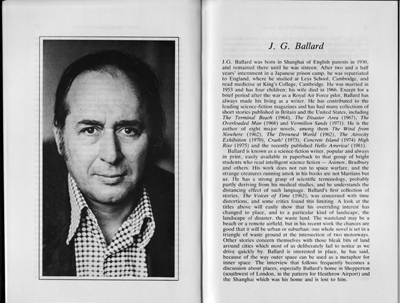
J G Ballard, (image from Alchetron)

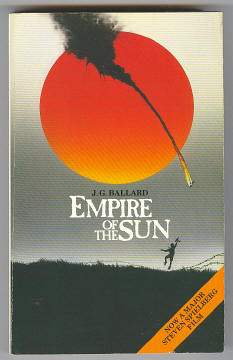
In September of 1997, I had just started my first job out of psychiatric residency at Omaha VA and University of Nebraska. I was keen to continue my scholarly work on creativity, trauma, and healing that I had started with my studies of Jerzy Kosinski and Louis Ferdinand Céline – writers who had lived through war. I envisioned a book examining the lives and writing of a series of authors and I contacted J. G. Ballard for an interview via the post. Life happened and other things came up and I did not get much further on that book idea. (Some of my writing of this era can be found on my webpage in the Coniunctionis column I had written for the on-line journal Mental Contagion). Somewhere along the way, I lost the original handwritten letters of my correspondence with J. G. Ballard, but my sister, Karen, recently gave me back a stack of my writings that I had sent her over the years and these contained a photocopy of the transcribed manuscripts. (Thanks to Shelby Stuart for transcribing from hard copy).

I am belatedly publishing this interview with J. G. Ballard from 1997. My initial questions appear immediately below and following this Ballard’s reply.

9/25/97

Dear Mr. Ballard,

Thank you for your response to my letter concerning an interview on the topic of trauma, literature, and autobiography. I appreciate your suggestion of a postal interview.

In trying to draft a few preliminary questions, I have been struggling to avoid simplistic and potentially leading questions. Rather than an isolated question, I have embedded the question in a context including my own musings and various references. I hope this does not prove too distracting.

What has fascinated me in your writings is your past experience as a child of war and the reappearance of images like the empty swimming pool and the young, male protagonist enthusiastically exploring physical and psychological landscapes in transition. How do you see the relation of these childhood experiences to your later writing? I have also wondered the unanswerable question: would you have been a writer without those experiences during the Japanese occupation?

The later traumatic incident that stands out is the death of your wife as described in The Kindness of Women. I became interested in your works during my clinical years of medical school when I had just finished reading a number of William S. Burroughs’ novels. I was struck by the loss of your wives’ deaths preceding (if my memory serves me) both of your careers as writers. Burroughs commented,

“I am forced to the appalling conclusion that I would never have become a writer but for Joan’s death, and to a realization of the extent to which this event has motivated and formulated my writing. I live with the constant threat of possession, from Control. So the death of Joan brought me in contact with the invader, the Ugly Spirit and maneuvered me into a lifelong struggle, in which I have had no choice except to write my way out,” (Miles, William Burroughs: El Hombre Invisible, 1993, pg. 53).


Could you comment on the early loss of your wife and your career as a writer?

Could you comment on how close to objective reality your books Empire of the Sun and The Kindness of Women are? Stated another way, where do you consider these books on the spectrum of objective history-symbolic representation? Spence, a psychoanalyst, has used the distinction between ‘historical truth’ and ‘narrative truth.’ These two realms of truth describe external and internal realities which are equally valid, although not necessarily identical. I notice that both of my copies of these two books of yours are classified as ‘fiction.’ I spent quite a bit of time on this question in relation to my work on Kosinski. There are great discrepancies between Kosinki’s documented biography and his fictional portrayals of his life which he encouraged to be taken as autobiography. While expressing some form of symbolic truth in his ‘auto-fiction,’ as he called it, he both revealed, disguised, and concealed certain elements of his self.

An observation that has struck me is that many of your books seem quite hopeful in contrast to those of Konsinski and Céline’s which I have been studying. You generally do not portray the despair and disappointment in human nature that they do. Kosinski’s books are filled with existential aloneness, sadism, and brutality, ultimately, he committed suicide. His life and writing could be viewed as being tainted and continually influenced by the events of his childhood, a Nazi victory almost 50 years after the fact. In your books and stories you seem to draw on childhood experiences and images, yet there is more of a sense of hope. Other related questions I have relate to a clinical phenomenon observed in survivors of trauma which Freud called the “repetition compulsion.” His view was that traumatized individuals recreate traumatic interactions in their later relationships in an attempt to have a better outcome. I have not seen this to hold true in many of the individuals with whom I have worked, instead they just seem to add new trauma to old. However, in writing, it does seem possible that some form of reworking and mastering of past experiences could take place. Writing can also be a form of witnessing, which in many theories of recovery from trauma is a necessary step for the individual objectified and isolated by trauma to reconnect with the community. Could you comment on this possible relation between trauma, repetition, and writing as witnessing?

Do you have any thoughts or comments on these interactions in the lives and writings of any of the other authors I am in the process of examining: Céline, Kosinski, Burroughs, Beckett, Woolf?

atrocity-exhibition

I have been curious about your portrayals of sexuality in some of your earlier works, such as The Atrocity Exhibition and Crash. These books examine a mode of sexual interaction which is objectified rather than focusing on the subjective or shared emotional experience. These two works seem to explore the potentialities of interaction and to develop modes of relating based on architecture or mechanics (perversions of geometry). To what extent were these personal struggles for you in your life, compared to philosophical explorations? I guess this gets back to the question of historical and narrative truth.

Also of interest is your writing yourself into your own novel in your own automobile accident. (Did you know that Stephen Crane also wrote of fictional situations which he later experienced in his life, such as a boat accident?) Could you comment on this reversal of life imitating art, rather than art imitating life?

Back to the issue of sexuality. Much clinical work has focused on survivors of trauma who have been treated in an objectified manner and who then relate to others in an objectified way, again, a form of repetition or re-enactment of the past. Flipping through The Atrocity Exhibition, I find Dr. Nathan’s comment, “However, you must understand that for Traven science is the ultimate pornography, analytic activity whose aim is to isolate objects or events from their contexts in time and space,” (Re/Search publication, 1990, p. 36). Some of the more enlightened psychiatrists have realized this insight about objectivity and the scientific method, as Stoller has stated, the “false self of psychoanalysis is our jargonized theory,” (Stoller, Observing the Erotic Imagination, 1985, p. 175). The jargon thus become the fetish which is used to objectify the other. This reminds me, in what way did your medical studies influence your writing?

9780312156831

Could you comment on your commitment to Science Fiction? I just finished your book of essays, A User’s Guide to the Millennium, (which is a great title, by the way) and I was struck by the extent that you consider yourself a S-F writer. In the States, Burroughs, Vonnegut, and Ballard are found in the general fiction section. I think that here S-F tends to be looked down on by the “serious” writers. Although, amongst many of my friends, reading S-F was a kind of rite of passage which led up to the journey away from planet “home.”

One last question, what did you think of the film adaptation of Crash? The movie and the novel have been the topic of a number of conversations that I have had with friends.

Well, I guess I did end up asking a few questions. I would like to go through your books in an orderly fashion and perhaps formulate a few more questions if you are willing to tolerate them. I appreciate your willingness to review these pages.

Sincerely,

David Kopacz

Omaha, NE

J. G. Ballard’s Reply

ballard-jg-1

http://www.jgballard.ca/criticism/experimental_fiction.html 


2/10/97


Dear Mr. Kopacz,

Happy to answer your questions, and I hope you can read my handwriting [transcribed from original] – I ought to say first that there seems to be an underlying assumption by both you and the received wisdom of the day that all disturbing or violent experience is inherently damaging – that is that experiences such as the death of a spouse or child, death of a parent, the stress of being uprooted from one’s home, the hunger and privations of war, will all leave indelible fracture lines that run through the wounded psyche like a crack through a glass pane, and that even the lightest tap is capable of inflicting irreparable damage – I very much doubt this, although I seem to be opposed to the entire apparatus of 20th century psychotherapy – the fact is that throughout most of their evolution, human beings have been exposed to constant threats and ordeals, both physical and mental, of every kind, and the majority of people recuperate and in due course make a full recovery – when Empire of the Sun was published many people remarked on the appalling hardships I described, as if they were wholly untypical of the lives led by most people of the time – but as I always retort, the experiences I described in Empire of the Sun are far closer to the way in which most people on this planet have always lived, even today – it is we in the suburbanized, welfare-state western democracies who lead untypical lives – if the death of a spouse, child, parent, if hunger, disease, and privation were unusual and deeply damaging, human beings would never have survived. In fact they have enormous powers of recuperation, and when a devastating blow like a child’s loss of a mother, an utterly irreparable disaster according to psychologists such as Bowlby, can be recovered from if the wider family supports and loves the child, and sometimes, I suspect, if it doesn’t – this is not to say that genuinely horrific experiences of a sustained kind – like Nazi death camps and so on – do not inflict lasting damage – of course they do, just as some people will never recover from the wounds of a serious car crash.

empire-of-the-sun

I think this preamble probably answers many of your questions, but I will deal with them one at a time –

Childhood experiences and my later writing, and would I have become a writer but for WWII?

I think those experiences were a remarkable education, introducing me to an immensely wider contact with the real world than I would have had if my father had been running a textile company in Manchester – I also saw adults under pressure – an education in itself – in fact I didn’t write Empire of the Sun until I was in my mid-50’s and I think that I had long since come to terms with my experience of the war and risen above it.

imagination_intro

http://www.jgballard.ca/media/1974_imagination_on_trial.html

Would I have been a writer but for WWII?

               Probably, since I was a tremendous day-dreamer and fantasist from an early age (five or six) – however, I think the first-hand experience of the war made me very suspicious of the ‘solidarity’ of everyday life (house and home, the securities of bourgeois life, etc.) and pointed me toward the surrealists – I think I relished the surrealists’ dislocations of the war-time landscape as I experienced them, possibly because I realized that the abandoned hotels and drained swimming pools addressed a deeper truth about the nature of so-called civilized settled life – in part I probably turned to science fiction because it allowed me to inflict just those corrective dislocations on the suffocating docility of English life and all its gentrified ordinariness.

cifali_erithpool

http://www.ballardian.com/drained-london 

No, my wife’s death, in 1964, came ten years after I began writing, and by then I had published 2 novels, and 2/3 book of short stories.

Trauma, repetition and writing?

I’m not sure that I have ever suffered irreparable trauma – the experience of psychotherapists is not a reliable guide, since they are dealing with a small number of genuinely wounded patients, who perhaps lack the constitutional strengths that allow most people to recover.

Of course the death of my wife was a devastating blow, and to some extent I still mourn her over 30 years later – I think it’s “inexplicable” cruelty (in fact, sadly, mortality often unexpected, is the ocean we swim in) led me to embark on the Atrocity Exhibition, with its attempt to make sense of another inexplicable death, that of J.F.K. – “he wants to kill Kennedy again, but in a way that makes sense,” someone says of the Traven figure.

I’ve never claimed that Empire and Kindness of Women were straight or were largely autobiographical. They are my life as seen through the mirror of the fiction generated by my life – I hope that all my fiction is optimistic, since it is a fiction describing various journeys of psychological fulfillment – my characters, including Jim in Empire, devise strategies that allow them to remythologize themselves – though often their behavior seems superficially paradoxical and even self-defeating – (Kosinski, from what one of his then British publishers told me, was a deeply unhappy man, obsessed with pornography, of which he had a huge collection that he swapped with another wayward Pole, Polanski – but I suspect he would have been deeply unhappy even if WWII had never occurred – I doubt if his suicide was a victory for the Nazis, since he was never interned and the ordeals he witnessed were those of a child – the older concentration camp victims were the true sufferers.

thekindnessofwomen1sted

Céline, if I remember, was wounded in the first World War, and this may have acted as a facilitator, revealing a thread of vicious misanthropy that found its most concentrated form in anti-Semitism – a brilliant writer, but deeply nasty man probably from childhood – Burroughs, whom I knew on and off for over 30 years, seemed to me to have entirely created his own world from his imagination, from his homosexuality and the worldview generated by heavy drug use – I never had the sense that any events of his childhood had profoundly influenced him – Woolf, I assume was flawed from the word go, a depressive who might have survived but for the war.

The sexuality portrayed in Atrocity Exhibition and Crash has very little to do with my own. I own no pornography, soon become bored with the films on the “adult” channels in European hotels, and have been lucky enough to have had long and emotionally close relationships with a remarkably few women. On the other hand, I am interested in the ‘idea’ of pornography and how our sexual imaginations are influenced and shaped by the alienating effects of late C20 life – as I keep saying, Crash is a love story, describing how a man and his wife rediscover their love for each other, a fierce love that may be its own [warning? I was unsure of the original handwritten word]. Atrocity is one sustained attempt to make sense of the dislocations of the world.

A User’s Guide – the pieces go back to the 1960’s, when I was still writing s-f, and when I certainly considered myself in part an s-f writer and still had hopes that the genre could escape its juvenile origins and amount to something. But todays -s-f, largely dominated by cinema, is wholly different, a form I suppose of commercial space fantasy – but I’m still interested in science and its handmaiden, technology, and how these play into the hands of our own latent psychopathology. Indeed the normalizing of the psychopathic is the main enterprise on which late C20 mankind has embarked – Crash, the film? A superb and brave adaptation by Cronenberg – I think it will prove to be a landmark film, the Psycho of the 90’s – in the future all films will try to be like Crash —–

Best Wishes,

J.G. Ballard