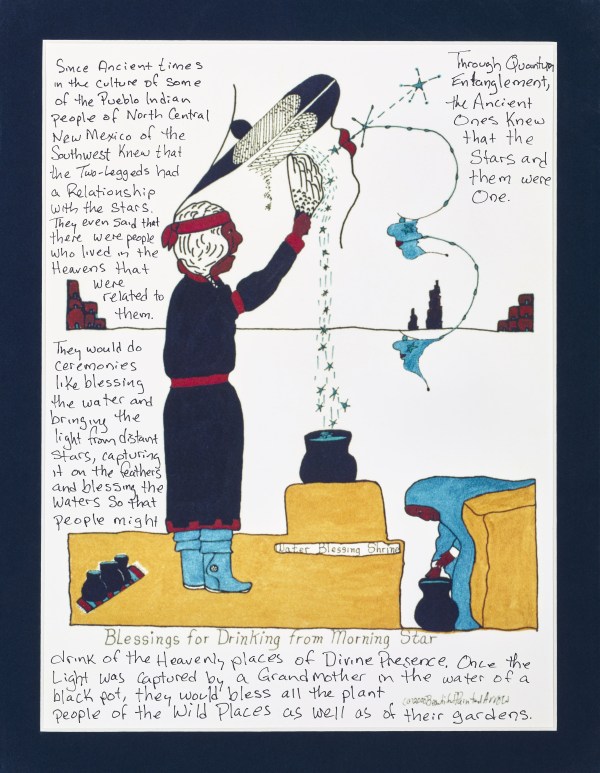
The first art work is “Blessings for Drinking from Morning Star,” and this one is interesting in that it was a completed painting, which Joseph had a print of, and he dictated to me some additional text which I wrote in my hand on the painting. I’ve always liked the intersection of art and text and this art work is as much a book as it is a painting.
Blessings for Drinking from Morning Star, J. Rael (2000), additional text dictated around 2018 by J. Rael, written by D. Kopacz
The next art work is “Sacred Offering of the Five-fingered,” and there are five offering pots that spell out the word, “peace.” This piece marks the transition from the chapter “Becoming Visionary” to the chapter “Becoming a Mystic.”
Sacred Offering of the Five-fingered, J. Rael (2005)
“Since Ancient times in the culture of some of the Pueblo Indian people of North Central New Mexico of the Southwest knew that the Two-leggeds had a Relationship with the stars. They even said that there were people who lived in the Heavens that were related to them.
They would do ceremonies like blessing the water and bringing the light from distant stars, capturing it on the feathers and blessing the waters so that people might drink of the Heavenly places of Divine Presence. Once the Light was captured by a Grandmother in the water of a black pot, they would bless all the plant people of the Wild Places as well as of their gardens.
Through Quantum Entanglement, the Ancient Ones knew that the Stars and them were One.” (Joseph Rael as dictated to David Kopacz)
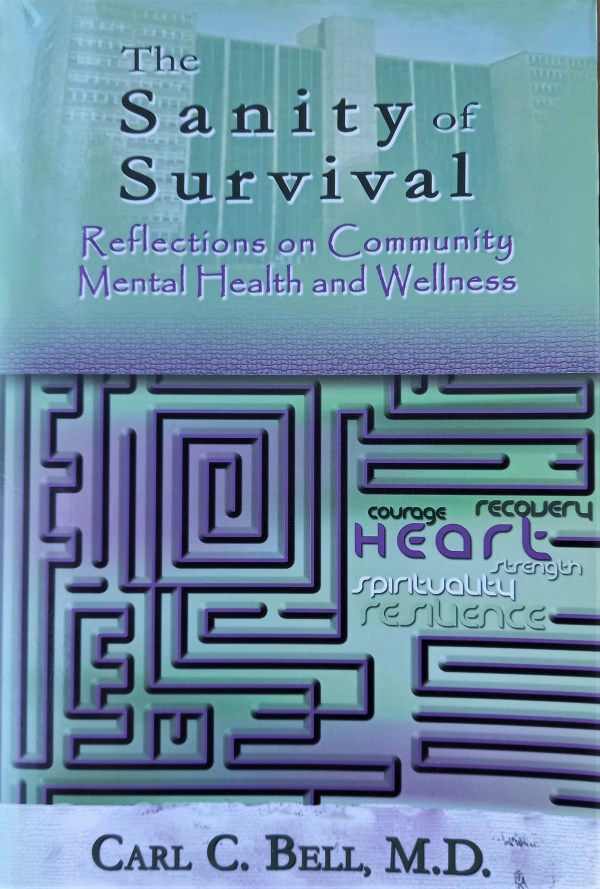
I reviewed Dr. Carl Bell’s collected papers, The Sanity of Survival: Reflections on Community Mental Health and Wellness in a previous blog (all quotes referenced by page number are from this book). This volume includes two papers that are worth dealing with at length as so many people are trying to understand how racism in the United States could be getting so much support from elected officials and even the president. Dr. Bell published “Racism, Narcissism, and Integrity” in the Journal of the National Medical Association 1978; (70):89-92 and “Racism: A Symptom of Narcissistic Personality Disorder” in the Journal of the National Medical Association, 1980; (72):661-665. Dr. Bell was not looking at politically motivated and politically encouraged racism, but racism in general. We will circle back around to the issue of politics, racism, and narcissism at the end of this paper.
One of Dr. Bell’s many interests, during his career, was whether racism should be considered a form of mental illness. In these papers he addresses racism as an expression of narcissism.
“Covert racism is a psychological attitude and as such, should fall under the scrutiny of psychiatry as a psychopathological symptom of personality disturbance,” (406).
“The racist individual suffers from a psychopathological defect of developmental processes involving narcissism, which precludes the subsequent development of such qualities as creativity, empathy, wisdom, and integrity,” (406).
Dr. Bell draws on the theoretical and clinical work of Kohut, Masterson, and Kernberg and sees the core lack of the development of empathy as common to “racists…murderers, child abusers, child molesters, and sadists” he has treated, (407). The behavior of these kind of crimes against humans has its roots in dehumanization and a lack of “respect for human life,” (407). Racism, says Dr. Bell, can thus lead to “violation of basic human rights” secondary to the racist individual’s “grandiosity, lack of self-boundaries, and dehumanization,” which are traits of narcissistic personality disorder, (407).
What’s Mine is Mine and What’s Your’s is Mine, Too
Dr. Bell noticed that, “Territoriality or boundaries are paramount for racists because of their lack of self-definition and tendency to extend their boundaries, which thus motivates them to make anything foreign a stimulus for protective action,” (407). This could explain the preoccupation with building walls and keeping out the “bad guys.” Even keeping medical supplies and protective equipment for the “government” rather than giving it the states and people could be seen in this light (consider “Trump’s use of medical stockpile veers from past administrations, leaving states in the lurch,” Shannon Pettypiece, NBC News April 6, 2020, and Daniel Dale, “Trump administration edits national stockpile website a day after it contradicted Jared Kushner,” CNN April 3, 2020, ).
Seeing the Other as Inferior and Less Than a Whole Person
Dr. Bell points to the “narcissist’s internal fragmentation” as leading to the inability to see others as whole people – in essence projecting off fragments on to others that one is unaware of in one’s self, (408). This is the essence of what Carl Jung called “the shadow,” which, if not owned and made conscious, gets projected off on to the “other.” What should be an internal psychological issue becomes an interpersonal, and even political, issue. Dr. Bell quotes the psychiatrist and activist, Frantz Fanon, “It is the racist who creates his inferior,” (408).
The Stress-Induced Racist, the Socially Misinformed Racist, and the Narcissistic Racist
Dr. Bell develops three categories or explanations for racist behavior: 1) the stress-induced racist (where racism arises only during stress); 2) the socially misinformed racist (due to ignorance and cultural indoctrination); and 3) the narcissistic racist, (418-420). The difference between socially-misinformed racism and that due to narcissism is in “the degree of hostility directed toward the perceived inferiors,” which stems from what is called narcissistic rage, (408).
These types of racism would require different kinds of responses. For the stress-induced racist, learning self-soothing skills from at a personal level and alleviating sources of economic stress at a collective level. For the socially misinformed racist, education and corrective experiences might suffice, if provided within a peer context. Sometimes this happens with military veterans who are acculturated into hating the “enemy” and seeing them as less than human. After returning home, the larger culture no longer supports such a degree of dehumanization of others and no longer condones using violence for problem-solving. For the narcissistic racist, none of these interventions or appeals will have any weight, because the narcissist is only motivated by self-interest.
The Narcissistic Racist
Dr. Bell mentions the work of Adorno and Allport looking at how so many people went along with fascism in World War II, for instance the work on “the authoritarian personality.” Milgram’s studies showing that study subjects were willing to punish others when told to do so by a man in a white coat (Milgram, Obedience to Authority: An Experimental View, 1974). Dr. Bell describes the symptoms of narcissistic personality disorder (as given by the DSM-III which was the edition at use at that time):
Grandiose sense of self importance or uniqueness
Preoccupation with fantasies of unlimited success, power, brilliance, beauty, or ideal love
Exhibitionistic: requires constant attention and admiration
Responds to criticism, indifference to others, or defeat with either cool indifference or with marked feelings of rage, inferiority, shame, humiliation, or emptiness
Two of the Following:
Lack of empathy: inability to recognize how others feel
Entitlement: expectations of special favors with reactions of surprise and anger when others don’t comply
Interpersonal exploitiveness
Relationships characteristically vacillate between the extremes of overidealization and devaluation
It may be impossible for many to read this list and not think of one person who is always in the news for the past four years or so. The risk of a narcissistic leader is that they will use the country to play out their own personal pathology. The fact that this pathology requires an “other” is similar between narcissism and fascism – as both seek to blame someone else for social problems and to strengthen us and them divisiveness. If one can magnify and increase social and personal stresses for others, stress-induce racism will increase. If one can exploit cultural narratives of racism, introducing continuous references to inferiority and superiority, one can amplify socially-misinformed racism. Dr. Bell wrote in 1980, “If the man behind the institution is a narcissist of the grandiose type, as was Hitler, then a racist institution is bound to be established,” (420). He quotes Kohut on the narcissist:
“They seem to combine an absolute certainty concerning the validity of their ideas with an equally absolute lack of empathic understanding for large segments of feelings, needs, and rights of other human beings and for the values cherished by them. They understand the environment in which they live only as an extension of their own narcissistic universe,” (Kohut, 420).
In The Dangerous Case of Donald Trump: 37 Psychiatrists and Mental Health Experts Assess the President, Bandy Lee, MD MDiv (ed.), two of the 37 papers have narcissism in their title and the word appears 62 times throughout the volume. The papers are, “Pathological Narcissism and Politics: A Lethal Mix,” by Craig Malkin, PhD, and “Who Goes Trump? Tyranny as a Triumph of Narcissism,” by Elizabeth Mika MA, LCPC. Two papers focus on race and immigration, “Persistent Enslavement Systemic Trauma: The Deleterious Impact of Trump’s Rhetoric on Black and Brown People,” by Kevin Washington, PhD, and “Traumatic Consequences for Immigrant Populations in the United States,” by Rosa Maria Bramble, LCSW. Many of the authors and clinicians prefer to focus on dangerous behavior patterns and the question of whether professionals “duty to warn” regarding the dangerousness of a person extends to the president.
If Dr. Bell were writing these articles now, rather than in 1978 – 1980, I imagine he would have something to say about our current political situation. Perhaps he would have said it in The Dangerous Case. The DSM-III description of Narcissistic Personality Disorder is almost a biographical sketch of the current president. The Dangerous Case appeared first in 2017 and it was cautionary. It was updated in 2019 and the warnings it raised seemed to be coming true, now, in 2020, we are witnessing greater levels of the behaviors Dr. Bell described and greater levels of fascism and totalitarianism. The example this week is the use of federal law enforcement in unmarked cars being used against protesters in Portland, Oregon, with threats to use them in other cities run by Democrats, whom the president calls the “radical left,” (“Trump Sends Federal Troops to Cities Run by Democrats,” Heather Cox Richardson, Moyers on Democracy, 7/21/20).
Dr. Bell cautions us about narcissistic racism with its “features of grandiosity―lack of empathic linkage…poor self-boundaries, with a tendency to intrude upon or molest others; and an underlying mood of fragmentation with anxiety, agitation, and rage,” (413). He could be cautioning us about the United States, right now.
The Sanity of Survival – A Review of the Collected Papers of Carl Bell, MD
The Sanity of Survival: Reflections on Community Mental Health and Wellness (2004) collects the papers of psychiatrist, Carl Bell, MD. Dr. Bell was on faculty at University of Illinois – Chicago, where I did my psychiatric education 1993-1997. I had the opportunity to hear him speak in grand rounds and other educational lectures, but I did not know him personally. I remember him as outspoken, with a keen intellect, and a person who was not afraid to challenge paradigms. Given the recent events in the United States, the death of George Floyd, and the Black Lives Matter movement, I thought back to my training and career, looking for someone who worked on racism and human rights within psychiatry and I thought of Carl Bell. I have also been doing a lot of thinking about what I am calling medical activism: the professional responsibility to go beyond the four walls of the clinic to be a moral agent promoting health & wellness in the world. Dr. Bell surely qualifies as a medical activist!
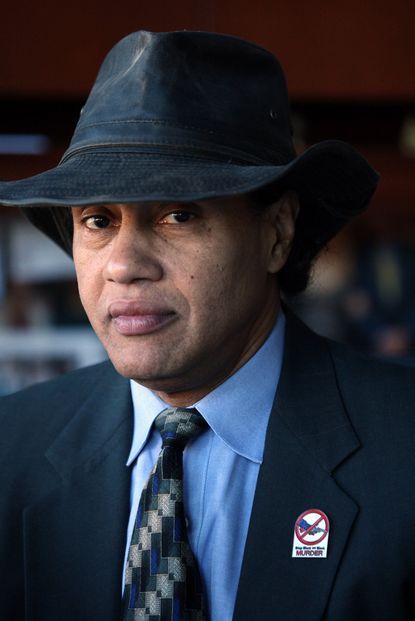
Carl Compton Bell (October 28, 1947 – August 2, 2019) was born in the Bronzeville neighborhood in Chicago, attended University of Illinois for undergraduate, Meharry Medical College, Illinois State Psychiatric Institute for psychiatric residency and then served in the Navy 1974-1976. He dedicated his life to improving the survival and health of inner city African-Americans: looking at violence as a public health issue, the effects of racism on health, educating residents on cultural sensitivity for working with Black populations, innovating programs and systems (developing day hospitals, crisis beds, outreach programs), engaging in medical activism, and focusing on health and well-being. A true renaissance man, Dr. Bell was a public health researcher, a front-line clinician, a systems innovator, a health advocate who appeared on many TV, radio, and popular magazines, and a public health policy consultant for the Department of Health & Human Services and the Surgeon General.
Two guiding principles he mentions in his book are “bent nail research” and “getting rid of the rats.” He learned that a good doctor won’t just treat a rat bite, but will help to get rid of the rats in the neighborhood. He thus saw the role of the doctor and psychiatrist as not a technician in an office, but as an engaged professional intervening in the world. Robert Jay Lifton calls this a “witnessing professional,” (Lifton RJ, Losing Reality: On Cultism, and the Mindset of Political and Religious Zealotry, p. 190). This role of the physician as a moral agent having a moral role is consistent with Virchow’s statement in the 19th Century, “Medicine is a social science, and politics is nothing else but medicine on a large scale,” (McNeely IF, Medicine on a Grand Scale: Rudolf Virchow, Liberalism, and the Public Health). Dr. Bell’s “bent nail research” developed when he was a kid and wanted to have a bookshelf and scavenged some boards and straightened out some bent nails.
“The completed bookcase leaned to one side and looked like hell! Yet it could always hold more than its share of books, and that was all that was important to me. The quality of research is very much like that bookcase. It may not be airtight scientifically because of limited resources and far-from-perfect methodology. However, our findings have been just as useful to as my bookcase was,” (xii).
These two guiding principles led to Dr. Bell’s “call for systemic interventions to address problems of the community rather than solving them on a case-by-case basis,” (xi). He describes other underlying principles of his life’s work as, “we’re all interdependent” and “states of consciousness…play a vital role in health and mental health,” (xii). This led to such things as developing a Wellness Institute, teaching Black Intrapsychic Survival Skills, researching states of consciousness in relationship to health, encouraging patients and trainees to learn martial arts, tai chi, and meditation. He expanded the concept of “combat fatigue” in veterans to “survival fatigue” in inner city African Americans exposed to daily stress of inner-city life (250-256). He sought to understand the effects of coma and brain injury on later violence, to understand and mitigate the effects of trauma on children and adults, and to understand and end inner city violence. He saw violence as a public health problem, presaging the recent move to consider gun violence as part of the “lane” or responsibility for doctors.
Violence is just one of the risks in the inner city, Dr. Bell saw the inequities in health between races in Chicago, as he wrote:
“As an African-American physician, I’ve always had a very different mission from most European-American physicians. European-American physicians are often concerned with trying to improve the ‘quality of life’ of their mainly European-American patients. Since leaving medical school, one of my major missions has been to save lives of my mainly African-American patients. Although I am interested in ‘wellness,’ until African-American life expectancy reaches that of European-Americans, I feel obligated to spend more time on ‘saving lives―making a difference’…There are very few people who value poor, mentally ill black people. As a result, resources allocated to help this population are scarce. This reality has always demanded the need to develop creative and innovative ways of effectively and efficiently serving the poor and underserved,” (50).
The title of his book, The Sanity of Survival, speaks to this focus on survival first and then sanity second – or perhaps it points out that without first dealing with the survival issues of the social (and moral) determinants of health, adverse childhood experiences, institutional racism, and violence, that there can be no sanity. Dr. Bell’s work developing programs such as day treatment and emergency housing (to help preserve community connections which can be disrupted by hospitalization), enhancing community support systems, assertive community treatment and case management, victim screening and support services, and a Wellness Institute, created an infrastructure (where there was none) to provide a spectrum of care for the whole person. He worked through Jackson Park Hospital and started the Community Mental Health Council. He also advocated for the use of “psychoanalytic theory in helping African-American patients cope with stress,” (91). He published papers on racism and narcissism and used psychoanalytic theory to understand racism, even considering whether racism, itself, should be considered a mental illness. (This is such important and relevant work that I will address it in a separate blog).
Dr. Bell’s concept of “survival fatigue” in inner city African-Americans compared the “high death rate, crime, unemployment, illness, and discrimination…inadequate housing, nutrition, education, and health and mental health care” to the stressors of combat and attendant combat fatigue, what we now call Posttraumatic Stress Disorder, (252). There is a growing awareness that another condition related to military service, moral injury, may also apply to systematic racism and Dr. Bell’s article, “Black Intrapsychic Survival Skills” could be seen as addressing moral injury. Through the cultural use of consciousness altering modalities in song and dancing in spiritual, ceremonial, and recreational settings, Dr. Bell saw resilience within the African-American community and culture. These consciousness altering techniques help to harmonize one with the environment, build community and help to process trauma and stress. These interests are part of Dr. Bell’s desire to “devise a true African-American-centered psychology,” (280). This was part of his shift to looking at “African-American strengths rather than deficits” for “cultivating resiliency” or even “resistance.” Through his clinical work and life, he concluded that, “there are two types of people when confronted with trauma: those who play funeral music deep inside and those who play adventure music,” (250-251). Dr. Bell always tried to be a person playing adventure music for himself and his patients.
This is just scratching the surface of the life and work of Dr. Carl Bell, a psychiatrist whose holistic focus on body, mind, race, culture, society, disease, wellness, and advocacy is an outstanding example of medical activism and compassionate humanism. Dr. Stevan Weine calls him “a saint of service to African American patients, a saint of ‘bent nail’ research and ‘make it plain’ advocacy,” (Weine, “Dr. Carl Bell’s ‘Bent Nail Research,’” Psychology Today, November 5, 2019). Dr. Bell’s desire to heal the hurts of individuals and society went beyond the prescription pad and the hospital. We know that medical students tend to lose idealism during medical training and that burnout and compassion fatigue are more the norm than the exception these days. Somehow Carl Bell nurtured and developed resilience and idealism throughout his life and work. He closes his book telling us to listen to the words of the song, “Dream the Impossible Dream,” in order to develop kokoro “(indomitable fighting spirit, in Japanese),” (467). Let’s let Dr. Carl Bell have the last words and close with quotes from his afterword and I will soon write the next installment on his thoughts on racism and narcissism.
“I’ve recently realized that a major problem with psychiatry is that it’s too focused on what we were trained to do. It sometimes feels like psychiatry is stuck in a box that only recognizes diagnosis and treatment. Unfortunately, being in this box precludes psychiatrists from involving themselves with prevention and from focusing on strengths and characteristics of resilience and resistance. These are just as much a part of the human condition as is the psychopathology we were trained to identify and treat. Fortunately, some of us are blessed enough to be on the fringe, which allows us to occasionally leave the box and get a different perspective. This brings new paradigms and models that benefit the human condition.”
“I recall Dr. Boris Astrachan, former Chairman of Psychiatry at the University of Illinois at Chicago…telling me that I’m on the fringe. Psychiatrists are already on the fringe of society because we address the ills of those who are on the fringe by virtue of their psychopathology…Being on the fringe of the fringe, if you will, by virtue of being ahead of your time, is a lonely existence.”
“I also recall Dr. Astrachan telling me that the fringe was the best place to be because I could bring new ideas and have a great deal of innovative influence. I’ve often wondered why I find myself at the seat of power since I’m usually the ‘odd man out,’ and based on the depth and breadth of my work, haven’t really belonged in many rooms. With time and experience, I’ve learned that my being the ‘odd man out’ has contributed greatly to the creativity, humor, leadership, and productive dynamic tension in the room, and that we all have walked out more enriched. So, being on the fringe of the fringe has been a curse but also a huge blessing,” (466-467).
References:
Bell, Carl. The Sanity of Survival: Reflections on Community Mental Health and Wellness. Chicago: Third World Press, 2004.
Lifton, Robert Jay. Losing Reality: On Cults, Cultism, and the Mindset of Political and Religious Zealotry. New York: The New Press, 2019.
McNeely Ian F, Medicine on a Grand Scale: Rudolf Virchow, Liberalism, and the Public Health. London: The Wellcome Trust Centre for the History of Medicine, University of London, 2002.
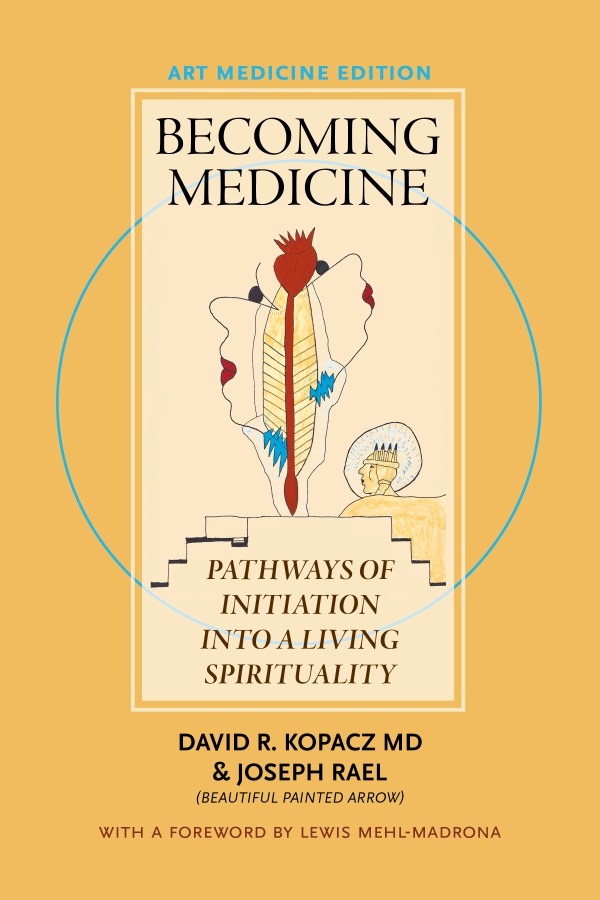
For the next two art works from Becoming Medicine: Pathways of Initiation into a Living Spirituality, we have one from Joseph and one from myself. Joseph’s painting is “Vision of the Blessed Virgin.” Joseph told me of at least three different visions of the Madonna. The first visit I made to Colorado, Joseph directed me to drive around (it felt like we were driving in circles at times!) and one of the places he took me to was a house in Bayfield where there was a gas explosion and Joseph was blown over, injuring his knees. He had another vision one time in an AA meeting. That painting is in Walking the Medicine Wheel: Healing Trauma & PTSD, entitled “Awakening at AA Meeting,” (p. 135). We also have a painting of Joseph’s in that book entitled, “Madonna Over Sound Peace Chamber,” (p. 189).
Vision of the Blessed Virgin, J. Rael (2015)
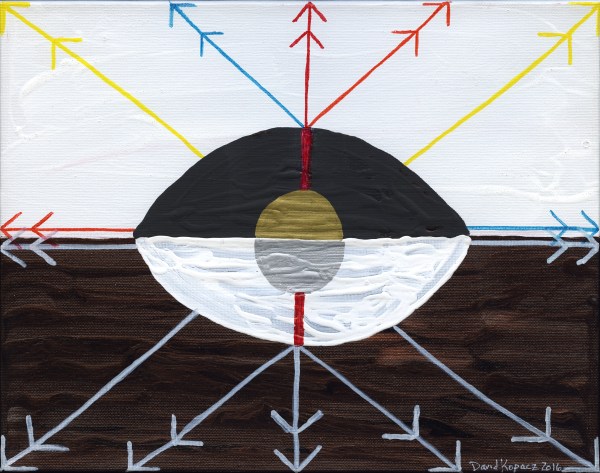
My painting I called, “Shamanic Vision,” I was trying to capture the two realities Joseph speaks of: Ordinary and Non-ordinary Reality. I also added the colors of the rainbows that Joseph uses in his paintings: yellow, orange, red, blue.
Shamanic Vision, D. Kopacz (2016)
That’s the way I live. I never know how the things I do are going to turn out. I just show up and do what I’m told. This energy follows me around, but I always know if I don’t do what I’m told I will be unhappy. I used to tell my students, be sure that you follow your guidance because that guidance is in your higher interest. From that, other experiences will come to you that will enhance your growth. (Joseph Rael, p. 108 – from House of Shattering Light, p. 110-111).
I met Usha Akella when she was doing a keynote presentation at the Power of Words conference in 2019, put on by the Transformative Language Arts Network. We both were interested in writing, poetry, creativity, and the spiritual path. Usha has long had a dream of developing an interview site online and I have been doing various interviews for my work – so it seemed like a good fit and less than a year later The-POV was born and launched into the world!
Usha’s first new interview is with Ann Ciccolella, Artistic Director of Austin Shakespeare since 2007. One of the things Usha has been impressed with is the depth and breadth of cultural programming Ann has curated.
Usha Akella: I am delighted to finally have an opportunity to explore your creative visions, Ann. I’ve attended your plays for years in awe at your ability to cast any play in a contemporary light. Your cross-cultural productions and multi-ethnic casts contribute to dialogue and peace-making. Your productions are playful, pushing the edge yet never lacking conviction or losing a grip on the playwright’s script. You’ve managed to bring Bollywood and Texas boots, and a female Hamlet to your stage. So, let’s begin by exploring the audacity of Ann Ciccolella. Why are you compelled to rewrite/reimagine or re-vision and can we chat about some of your productions that you felt were successful and those that were not—in your opinion.
Ann Cicolella: My own playwriting is a top value for me. Writing my own adaptations is something that I have been doing in the past couple of years. I want to do more playwriting, but finding the time needed to create scripts from their inception is something that I haven’t been able to do since leading Austin Shakespeare! So, I have been adapting classic stories. I used the plot of Homer’s epic poem The Odyssey and wrote a one-hour play version for middle and high school audiences. That experience was alternately challenging and delightful. During the rehearsal process, I try to inspire actors to create an imaginative performance, and with six actors we together created the many worlds of Homer’s The Odyssey. You see, adapting is a way to satisfy that thirst for my own playwriting.
David R. Kopacz: We’re going to have a section of Becoming Medicine reprinted in Parabola magazine – Jeff Zaleski wants the sections, “Initiation of the Circle” and “Moon Woman Vision.” You have statements in those sections that we are “circle people” and “what comes around goes around” and that “everything eventually becomes its opposite.” You also say, “Look at how we move in a circle, but then look at it from the side and it looks like we are moving forward and backward, back and forth. It depends on your perspective of seeing.”
Joseph Rael – Beautiful Painted Arrow (BPA): That’s apropos for this time. That’s how it is – we move back and forth and back and forth. We move forward and then we spoil it by invalidating it. In order to get in tune with it, we need to use our feet. That’s why we have these physical feet and they are made for traveling. When we go forward we add something. But then we go backward and we forget it. In this life, you have to be constantly correcting yourself.
That’s what my dances are supposed to do. They check everything on the list. When you are dancing you move forward and backwards in balance. You dance to cover the winter; you dance to cover the spring; you dance to cover the summer; and you dance to cover the autumn. You also dance to cover the North, South, East, West – the directions.
I’m just being a book from the universe and showing you what to do.
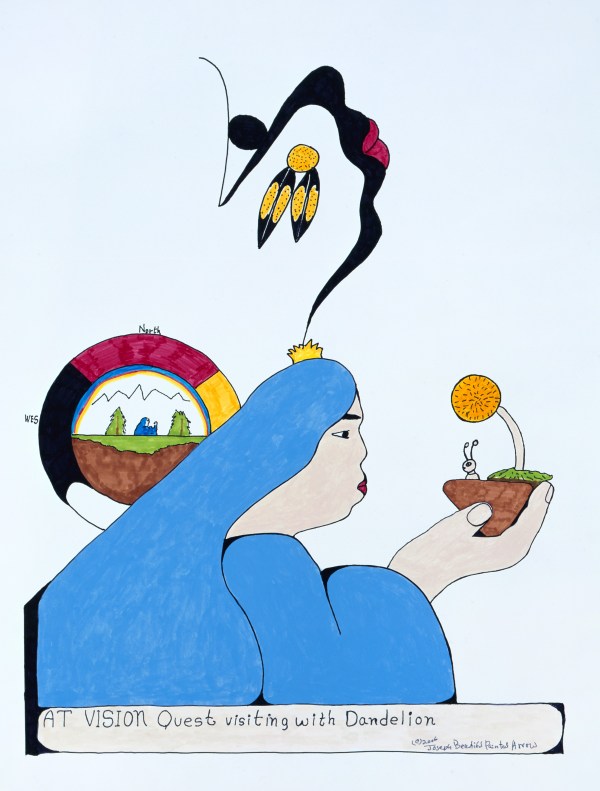
At Vision Quest Visiting with Dandelion, Joseph Rael (2006)
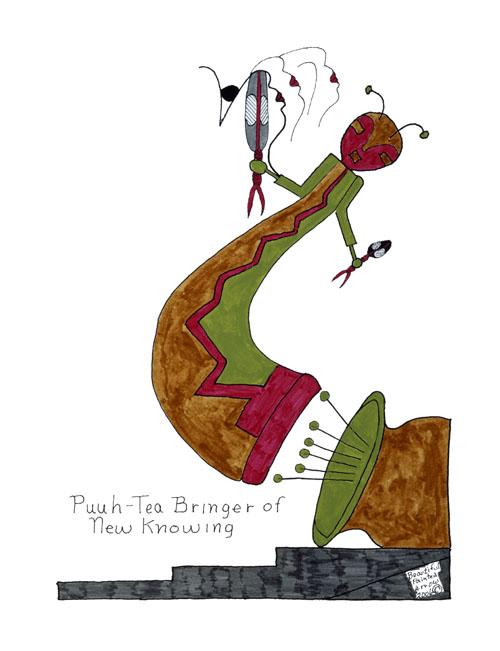
Visions are new knowledge, guiding insights that come in visual form, rich with symbolism and archetypes. Visions are different than intellectual, linear thought – they are in-breakings of the divine into ordinary life.
Puuh-Tea Bringer of New Knowing, Joseph Rael (2006)
“Ceremony is the way to do this. It gives us powers. Ceremony works because there is crying for a vision. By crying for a vision, I mean that the soul is longing for light, so it can drink it in and thus fulfill its nature. If light – vision – is lacking, there is sadness,” (J. Rael, cited, p. 89).
Mike is a friend of mine whom I met through Joseph Rael (Beautiful Painted Arrow) and he gave me a copy of this book and I would like to return the gift by writing this review.
Mike is a sincere and compassionate seeker and this book tells the story of his journey building the Circle of Light Peace Chamber. Mike followed his dreams and visions to bring them into reality and he has many spiritual adventures along the way. I would say that Mike is a gentle soul.
Like many mystics, Mike’s journey takes him from a sense of an isolated ego to the experience of interconnected being – “Being awake and open to All,” (205).
He learns about the meaning and purpose of life and the importance of attending to inner visions and bringing them into material reality, thus becoming a Liminal Being, or, as Joseph Rael might say, an “In-Betweener,” or a “hollow bone.”
“What you need is to let go of all the fear and let go of all the pain in you, and then you are not competing and you know you are on your soul’s journey and living your purpose – when you are that pure love that you are. Just trust in the love that you are, and you’re always living your purpose and on your path,” (166).
I have been to visit Mike, and his wife Marie, several times after meeting him at the book release and 80th birthday party of Joseph Rael (Beautiful Painted Arrow) in 2015. We featured a picture of The Circle of Light Sound Peace Chamber in Walking the Medicine Wheel: Healing Trauma & PTSD, (page 95 – I still feel bad about the typo of your surname in the caption – sorry about that Mike!).
My sister, Karen, and I met with Mike & Marie in October, 2018 and filmed them talking about the construction of the chamber. You can watch the video of that, here. And see other videos of my work with Joseph Rael here, and here.
Mike & Marie Pedroncelli, Circle of Light Sound Peace Chamber, photo K. Kopacz (2018)
Here are the next two paintings from Becoming Medicine: Pathways of Initiation into a Living Spirituality, by David R. Kopacz, MD & Joseph Rael (Beautiful Painted Arrow). The first painting is by Joseph, Where God and Humans Meet. This was one of the first paintings that Joseph gifted me when we first started working together. These paintings are found in chapter 4, Becoming a Visionary. Here is what I wrote about the painting in the book:
ON VISIONS
“Joseph’s artwork comes from his visions. What he sees in his visions he puts in his artwork. I keep a number of Joseph’s paintings around my desk. One of these is “Where God and Humans meet.” This painting is in the shape of a large vase, filled with tiny dots—like stars or molecules of gas. There is a central point, like a sun, which shines two rays downward to the top of two people’s heads and there is a little star where that divine energy enters in through the crown (7th) chakra. Arching upwards from the central sun is a divine being, God or Vast Self. As always in Joseph’s paintings, this divine being is looking upwards and has a large black eye (which is a black hole, Joseph says, and this black hole is about the same size as the light giving central sun). The edge of the vase and the back of this divine being are the same line, the vase grows out of the divine being which creates a container of and for existence. We are the vase that contains the space where God and humans meet, but from a visionary perspective, the material we are made of, the vase, is the material of Wah-Mah-Chi, Breath-Matter-Movement, in other words, God. Visions come from the divine and they reveal to us who we are.Visions are the soul drinking light, Joseph says,” (78).
Where God and Humans Meet, J. Rael 2015
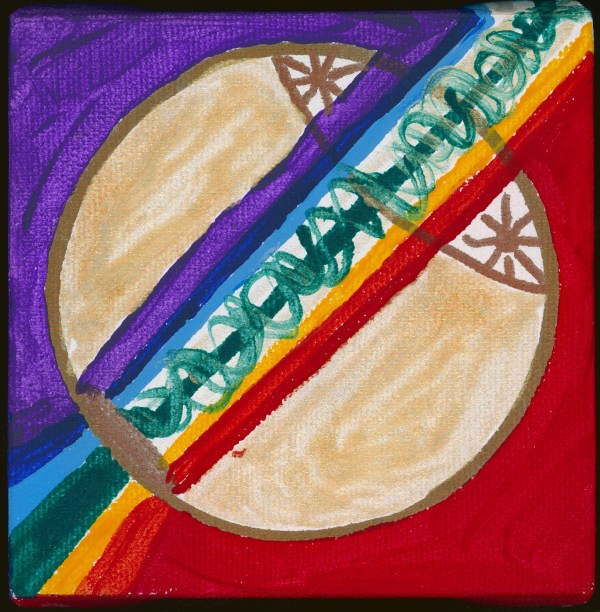
The next painting is one of mine. When I was living in New Zealand I began reading Henry Corbin and was fascinated by his description of the ‘alam al-mithal, the place where “Spirits are corporealized and bodies are spiritualized,” (Corbin, Spiritual Body, Celestial Earth, 177). I would sit and meditate, looking out at the volcano, Rangitoto, and would try to find what this place of ‘alam al-mithal would be like. I painted 10 different paintings, but I’m not sure I could capture my vision.
‘Alam al-mithal, D. Kopacz (2016)
“Visions are at the center of this book, just as the heart is at the center of the medicine wheel and our hearts are the center of our being. A vision is a little bit like a poem, or maybe a dream. It can be of brief, passing interest, or it can be an orienting structure for the rest of your life,” (78).
The first painting, “Dove of Peace,” is by Joseph Rael. He describes how he had a vision after his foster mother, Lucia, died – he saw a white dove in the corner of the room and had a glimpse of paradise. This painting is in Chapter 3, “Separation.” You have to go through separation before you can go through reunion.
Dove of Peace, Joseph Rael (2018)
The next painting is one of mine, “Visionary Perception,” and starts off chapter 4, “Becoming a Visionary.”
Visionary Perception, David Kopacz
“For me, I was in training all the time that I was in Picuris. If everything is considered holy, then you are always in training.
Apparently I was in training for right now—to tell the people in the United States what we are built to do and that we are the Sacred. We are the holy ones. That is why I always speak with eloquence.” (Joseph Rael)
We are into the July 4th Weekend of the Pandemic. Will this weekend be any different than any other weekend of the pandemic? Social Distancing, we keep to ourselves, we turn inwards – and yet the birthday of when this nation was established (recognizing that we invaded other nations that were already here on this land) is usually about going out, barbequeing with friends, watching fireworks in crowds.
We have our independence from Britain – but what are we using it for? What are we doing with this independence? We are not independent of our acts of aggression, genocide, and slavery – those are intertwined with the founding of the United States of America.
Maybe we have taken independence as far as it can safely go. The current political regime in power in the USA gives us pause to consider this. Maybe it is time that we stopped celebrating independence and started celebrating Interdependence.
We would start by acknowleding our interdependence with Mother Earth and her children, this land that we live on which we took from our Native American brothers & sisters. Then it would lead to acknowledging our interdependence with Africa and her children whom our ancestors captured and enslaved, prospering off of their labor. Then it would lead to acknowledging our interdependence with all the people of the Earth.
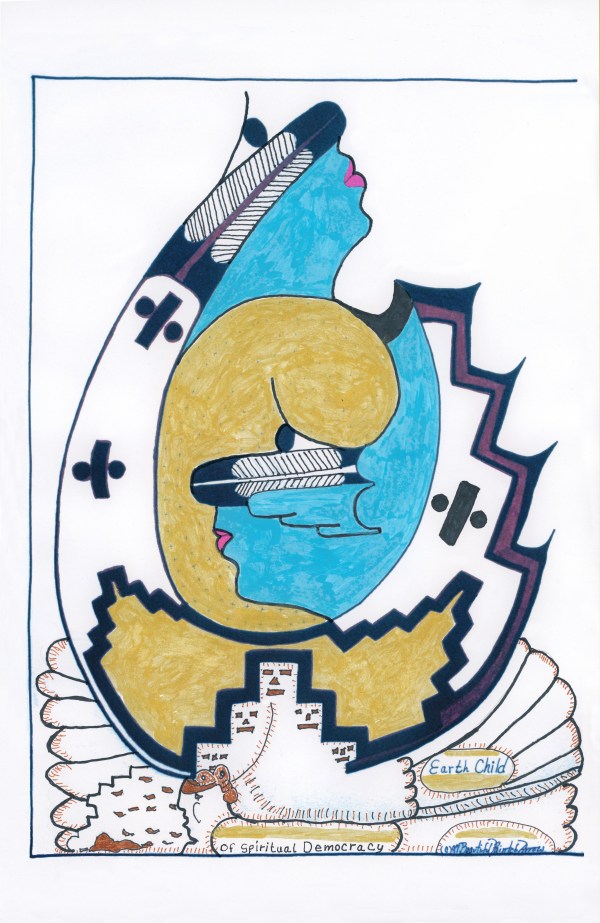
Earth Child of Spiritual Democracy, Joseph Rael (1997)
“Spiritual Democracy is a living connection, allowing the flow of spirituality through our lives, embracing the divinity in all creatures and the divinity of the Earth. Spiritual democracy is the way we treat others when we learn to see the divine in all things and that we, too, are part of divinity. It is a sacred way of being. Periodically, we forget that we are divine as we live in this world of matter and go through its trials and travails. We, as individuals, as well as we as people, need periodic renewal at the font of spiritual democracy.” (p. 381)
We invite you to use this holiday weekend to renew our Spiritual Democracy. Let’s put the “we” back in “We the people…”
If you’d like to read the chapter, just download the pdf below.












 Being Fully Human