Coniunctionis.21: In A Silent Way

Miles-davis-in-a-silent-way[1]

Music has been a bridge for me lately, it always is something that I rely on when I am in a big transition or when I have an inner chaos of turmoil. I think that the energy of music has the ability to connect to inner states, to serve as a mirror back that amplifies the inner state until it can be clarified, transformed or resolved in some sense. In this aspect, music is therapeutic. This is nothing new as music has long been associated with healing rites and rituals and as having the ability to bring together body and soul. While the roots of music and healing are in the sacred, we have lost this association in the modern world. For me, there are at least two levels to the transformative nature of music as it creates correspondences between inner and outer. There is the physical aspect of the music itself, and there are also the emotional and spiritual themes of the lyrics which can sometimes make sense of this often mysterious life we live. What I am going to write about in this column is purely instrumental music, Miles Davis’ “In a Silent Way.”

In a Silent Way was released July 30, 1969 on Columbia Records. It was recorded in one session date on February 18, 1969 at CBS 30th Street Studio B in New York City. It was the first of Davis’ fusion, electric albums. For me, it combines the best aspects of the classic 1959 album, “Kind of Blue” and the dissonant 1970 album, “Bitches Brew.” In 2001, a three-disc box set was released, “The Complete In a Silent Way Sessions,” and this is what I first started listening to as I entered into a stage of transition moving back from New Zealand to the US. (Details about the album are taken from the Wikipedia entry for the album).

The Complete Sessions are 3.5 hours of music, while there are a few songs that I sometimes skip, in general I find that I can get seriously lost in this album – in a good way – the kind of being lost that is pleasant and soothing, and often I come out of it feeling kind of “found,” or at least more at peace. The original 1969 album consists only of two songs, as it appears on CD, “Shhh/Peaceful” (18:16) and “In a Silent Way/It’s About That Time” (19:52). The LP lists the songs as:

51EnfgC3sTL[1]

Side one

  1. “Shhh”/”Peaceful” (Miles Davis) – 18:16
    1. “Shhh” – 6:14
    2. “Peaceful” – 5:42
    3. “Shhh” – 6:20

Side two

  1. “In a Silent Way”/”It’s About That Time” (Joe Zawinul, Miles Davis) – 19:52
    1. “In a Silent Way” (Zawinul) – 4:11
    2. “It’s About That Time” (Davis and Zawinul) – 11:27
    3. “In a Silent Way” (Zawinul) – 4:14

What is apparent from looking at the song titles is the way that there is an introduction, an interlude of another song/theme and then a return to the starting point, transformed though after the journey through. As I write this, I do realize that is one of the reasons that I find this album so orienting and soothing for me. There is a lot of wandering, exploring and creating space, and yet there is this continual return. This is even more pronounced in the Complete Sessions which has 78 minutes of different versions of the core songs from the original album. Even in some of the most unstructured explorations, there is often still a simple, repetitive, bass line or a rhythmic click of a drum stick on the rim of the snare that provides an orienting anchor. It is this rhythmic element of the album that made it so conducive to the more modern remixes found on Bill Laswell’s 1998 album, Panthalassa: The Music of Miles Davis 1969–1974, which is where I first heard these songs, as well as on the 1999 multiple artist Panthalassa: The Remixes.

“In a Silent Way” features many great musicians who went on to have impressive careers themselves:

As I mentioned, I can really get lost in this album, the dissonant elements of the brass, guitar and sometimes electric piano and organ pull me out, like exploring interstellar space, or closer to Earth, like the darting fish of a coral reef. While the bass and drums, and sometimes other instruments, build a solid, repetitive structure, like the hidden pulse of galaxies or the rhythmic waves over a reef. These are the two images that I get when I listen to the music, space and the ocean.

What was interesting, recently, was a conversation that my wife and I had about the album. That is not surprising as I have pretty much left it in the CD player in the car for the past months. That particular day we were juggling a lot of things, working on buying a house being the primary thing, and Mary Pat said “this is the first time I like this album, all the chaotic dissonance is like my own thoughts with all this going on.” I was surprised she found the album primarily dissonant, because I could say it is dissonant just as easily as I could say it has a strong rhythmic foundation; or that is even quite open and simplistic even as it is possible to listen to the silence which structures the notes. It is interesting that we had listened to this album in different ways and even more interesting that she had found the dissonant elements soothing on that particular day, as that is something that I have been thinking about lately, the correspondence of inner and outer states related to music.

In a Silent Way, that is the name of the album. Even the name makes me think about this space between the notes, about what it is that is being communicated silently. This brings to mind what all the mystics end up raving about, the silence, the deep and profound meaning that defies words. For instance, Carlos Castaneda writes of “inner silence…a peculiar state of being in which thoughts were cancelled out and one could function from a level other than that of daily awareness…[and to reach this state practitioners]…devised endless ways to shake themselves…at their foundations in order to reach that state,” (The Active Side of Infinity, 103-104). Paradoxically, to reach this state of quietude may require some form of agitation or surprise, thus we have the surprising dissonant elements of “In a Silent Way,” that are required in order to reach the silence. Juan Mascaro in the introduction to his translation of The Upanishads, writes that the “silent voice of the Eternal is perpetually whispering in us his melodies everlasting,” (12). The way of meditation involves quieting the mind, coming to terms with desires, in order to listen to that silent voice. The way of the shaman, which is the way of many contemporary musicians, is to find the silence through the noise or dissonance, for instance the energized focus that can come after a punk rock concert.

There is something about finding music in the outside, that when it corresponds to the inside, brings about some transformation.

What is it that brings resolution of a state of inner tension? Reaching the inner silence. How is inner silence reached? Not always through a direct quieting of the mind, sometimes it is reached by getting shaken to your foundations. “In a Silent Way” combines a little bit of several paths: the dissonant shaking, the rhythmic repetition and the liberal use of silence. Lately, there is something about all these elements that speak to something within me. I find a sense of calm and purpose in the music, the structured elements help me feel focused, the dissonant elements help me to feel expansive, and the silence – I find myself in the silence, some calm, perhaps even the silent voice of the Eternal.

 

Coniunctionis.20: Connecting Inner and Outer Through Music

I started writing the Coniuctionis column for the on-line magazine, Mental Contagion, back around the turn of the millennium. At that time, it grew out of my re-reading of Jung and Nietzsche, along with a personal journal work I was doing that I called Die Untergang, a term that Nietzsche used for a “down going,” or “going under,” which to me symbolized a review of my life up to that point (through going through my journals and writing a commentary on them). The Coniunctionis column was about exploring ideas that came together from various fields (comparative religions, spirituality, mysticism, science fiction, technology, consciousness, personal growth, transformation, trauma and finally, music) and it was also somewhat personal and informal as well as scholarly. It was a place for me to explore different ideas and topics without having to worry about how to publish them in more academic publications. I have recently picked up the thread of some of the topics of this column and thought it would be good to resurrect it. The term, “Coniunctionis” is Latin and I took it from Carl Jung’s last major work, Mysterium Coniunctionis, which explored transformation, particularly through an integration of the opposites, in alchemy and applying that to psychology and personal growth.

In this column, I would like to re-visit a topic that I have always found interesting: transformation through the correspondence of an inner state when it harmonizes with an outer state (music). I was a fairly introverted kid and teenager and had a fair melancholy streak as well. The image that returns to me when I consider this topic is sitting in the dark in my basement room, on top of the dresser, my back against the wall, and my gaze upward through the window at the moon and the night sky, while listening to music. Music has always been a very important part of my life. I am serious and enthusiastic about music. I would listen to bands like Echo and the Bunnymen, The Psychedelic Furs, and my favorite bands, then, were Joy Division and the band that the 3 surviving members formed, New Order.

What has always interested me is that when I find myself in an intense inner state, one which many people might consider a “negative” state, if I find music that seems to resonate and harmonize with that negative state, this correspondence of inner and outer leads to a transformation of the inner state. I suppose this is a homeopathic treatment of sorts, treating “like with like,” however, unlike homeopathy it is an immersion in high dose external “like,” rather than a miniscule “like” dose. Contemporary, Western medicine is often called allopathy, meaning that symptoms are treated with their opposites rather than with “like.” In regard to music, this would mean that if you were sad, you would listen to happy music. My method was to immerse myself in sad, melancholy music, introspective, or in terms of Joy Division an almost nihilistic despair, but one which has tremendous power and energy behind it. In earlier Coniunctionis columns I have written about the similarities of various forms of punk rock and mystical rituals and experiences (see “What Did You See There? Ian Curtis and the Visionary Quest of the Shaman,” Trauma, Transformation and Punk Rock Part IX, in particular). The allopathic approach to feeling “sad” is to say that something is wrong with me and reality and I will fix that by making myself “happy,” a kind of cognitive behavioral therapy of logic. The extreme homeopathic treatment to feeling “sad” would be to say that I am experiencing a sense of being inwardly troubled, and rather than try to change that, I am going to accept it and not only accept it, but I am going to amplify that, I am going to enter into it and I am going to experience it to the fullest extreme. It is at that point that this becomes like a mystical practice, by following an inner state to its extreme, using external stimuli to amplify and maximize that state. For me, what would often happen is that I would emerge with a sense of peace, possibly you could call that happy, but that doesn’t quite seem to capture it, more a sense of inner expansiveness, a greater sense of self-knowing, as well as an ability to go back into the external world without feeling hampered by an inner state, instead feeling rejuvenated and more adapted to reality.

I suppose this is not without dangers, though. Ian Curtis, the lead singer of Joy Division, committed suicide, and the line between transformative amplification and obsessive self-pity and internalization can be a fine one. This is what Jung cautioned about, particularly in regard to Nietzsche, that in his die untergang, he descended into the unconscious, he encountered the numinousity and power of archetypes which had the power to transform his life, but, in Jungian language, he identified with the archetypes as his own personality, which led to ego inflation, rather than ego transformation to incorporate more of the Self, and thus led to madness. The safe and superficial way leads to adaptation to society. The dangerous, inner way of transformation, holds both the danger of madness as well as the marvelous transformation of the ego to hold more energy of the Self (another way to say this is that the personality is stretched beyond its narrow confines of materialism to include a larger capacity for compassion and spirituality, and in that to find a greater sense of meaning in which the ego and the Self are harmonized, as well as inner and outer being harmonized).

Joy Division’s first album was titled, “Unknown Pleasures.” The title invokes many things, but for our purposes, we can focus on the language of mysticism in which the mystic experiences something that is beyond what can be described and that can be found in things that are often discarded or devalued (e.g. Philip K. Dick’s “God in the gutter”). This album, rather than having a side one and side two, was labeled with an “inside” and an “outside.” I could never tell whether there was a real correspondence between the songs on the inside and those on the outside, but I always took it more as a way of being creatively contrary to convention and it also sets up the template or archetype of correspondence and even movement (New Order’s first album was called “Movement”) between inner and outer, thus an initiation or transformative journey is prefigured.

All of this is leading up to the fact that I recently went and saw Damien Jurado perform here in Seattle. This may seem like an abrupt transition, but I am writing this column because music has had a renewed importance to me lately and I would like to write about it in the format of the Coniunctionis columns.

I have recently gone through a major external change in my life, moving from New Zealand (where I had lived the past three and a half years), back to the US, but to Seattle, a place I had visited many times, but never lived in. This major external shift has corresponded with a major inner turbulence that coincides with my mid-forties, in which I feel many different closing and opening of circles and themes in my life, with a sense of completion but also a sense of bewildering newness and outer uncertainty about the future. This also corresponds with a degree of inner certainty which does not, however, have an outlet in the outer world at this point. I have submitted my book, Re-humanizing Medicine, to go into the final proofs stage, with publication maybe, hopefully, 6 months or so from now. The next major project that I want to work on is called Every Thought Leads to Infinity. It is a study of Carl Jung’s Red Book and Philip K. Dick’s Exegesis, both of which were personal journals that were unpublished during the authors’ lifetimes, but held personal, mystical experiences that informed their later mature work. Anyway, it has been a trying year of transition…

When I was in New Zealand, I got the new Moby album, “Innocents.” My favorite song on it was “Almost Home,” which has guest vocals by Seattle artist, Damien Jurado, whom I had never heard before. The song had a lot of personal meaning for me as I was “between places,” between two homes. The song begins:

I’ll decide,

in a moments time,

to turn away,

leave it all behind,

so we’ll fly,

somewhere I will draw the line,

the ground is hard, the treasure fine,

so let it go,

wake up wake up wake up we’re almost home

(For the line “so we’ll fly,” others on the web have heard that as “so inclined,” or “so we climb,” I can also hear it as “soul will fly”).

The song invokes many images, such as a child asleep in a car after a long trip, in which the parents are confidently driving home; or for myself, literally being about to leave it all behind and move to a new home; but most truly, the song describes the spiritual element of life as a journey in sleep, in which the soul returns to its source, or “home.” In most transitions in my life, I felt a strong connection to what was ahead of me as well as a sense of the current situation being “done,” yet in this move from New Zealand back “home” to the US I didn’t have the inner bridge or connection or sense of the “rightness” of the move, and so it felt in some ways like a death. All change is a form of death, at least symbolically, but this was more than that and I found this spiritual sense to the song comforting. Moby, whose album this song is featured on, is often able to combine this element of spirituality into a chilled dance song which seems transcendent without necessarily being preachy or even denominational. Moby has long been an animal rights activist and vegan and also has a personal Christian spirituality, which is quite humble and does not seem to alienate non-Christians in the way he uses spirituality in his songs (see Wikipedia article).

Damien Jurado has just released his eleventh studio album, “Brothers and Sisters of the Eternal Son,” which has more prominent Christian spiritual themes, intermingled with some Sci Fi-like references as well. He seems a good match up with Moby in that the spiritual themes in his music, while often being clearly Christian, are expressed in such a way that they have universal appeal. (There is a brief discussion of his spirituality in a Pitchfork interview). Although, with this album, these themes are very overt, Jurado also recently put out a gospel chorus album entitled, “Sisters,” which is available as a bonus disk with “Brothers and Sisters.” “Sisters” is mostly alternate versions of Jurado songs, with him on acoustic guitar and singing and backed by the Silver Sisters Choir, but also includes the song “All For You,” which I believe is a Christian spiritual, if I remember correctly what he said when he played the Neptune Theater here in Seattle.

Jurado, Moby, Joy Division, and Bill Laswell (whom I’ll just mention here) combine, in different proportions, electronic technology, rhythmic and hypnotic beats, soaring emotional/spiritual soundscapes and lyrics that explore existential and spiritual themes. I think it is a valid perspective to state that all music is spiritual in nature as it has the ability to create a bridge between inner and outer states. This is one of the definitions of healing, bringing together that which has been separated, like the edges of a wound or an imbalance between the inner person and the outer world.

Music has been a bridge for me lately, it always is something that I rely on when I am in a big transition or when I have an inner chaos of turmoil. I think that the energy of music has the ability to connect to inner states, to serve as a mirror that amplifies the inner state until it can be clarified, transformed or resolved in some sense. In this aspect, music is therapeutic. This is nothing new as music has long been associated with healing rites and rituals and as having the ability to bring together body and soul. While the roots of music and healing are in the sacred, we have lost this association in the modern world. For me, there are at least two levels to the transformative nature of music as it creates correspondences between inner and outer. There is the physical, vibratory aspect of the music itself; and the emotional and spiritual themes of the lyrics which can sometimes make sense of this often mysterious life we live.

A More Funky and Electronic Take on The Sea and Cake

2_gent

A Review of “Two Gentlemen” EP by The Sea and Cake

Contrary to the other reviewer of this album, I have always really liked these 26 minutes of remixes that are definitely more electronic and more like Thrill Jockey bandmates, Tortoise. It is definitely is quite different from a typical, non-remixed Sea and Cake album. There are some nice melodies mixed in with different electronic sounds, O’Rourke’s remix of “Do Now Fairly Well,” titled, “I Took the Opportunity to Antique My End Table,” is the most mellow of the songs and is truly beautiful. “Two Gentlemen” has a more instrumental and sampled feel to it. It came out in 1997, the same year as the original The Sea and Cake album, “The Fawn,” which is a really great album. Stereolab’s “Dots and Loops” also appeared that year, which features John McEntire of The Sea and Cake and Tortoise. This set of remixes makes sense in the context of the links with Tortoise and Stereolab. If you are looking for a down-tempo groove out with some nice melodies thrown in, this EP is a good listen.

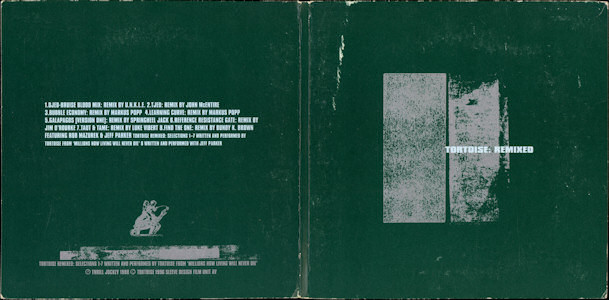
Remixes and Steve Reich sample: A Review of “Tortoise Remixed”

tortoise remixed

A Review of “Tortoise Remixed”

I first bought Tortoise Remixed shortly after it came out in 2001. Somewhere along the way, I lost it and recently re-purchased it. It isn’t available as an MP3 to my knowledge. What I missed about it was the first track, “Djed (Bruise Blood Mix),” Remixed by UNKLE. The song, “Djed,” originally appeared on the 1996 album “Millions Now Living Will Never Die, and is over 20 minutes of meandering beats, rhythms and electronic sounds. It is a really nice song with a lot of space in it, maybe a little jazz-like, a more electronic Miles Davis “In A Silent Way.” “Djed (Bruise Blood Mix)” has the original song buried in it, but the drums are much more punchy and snappy beats, a little like a funkier DJ Shadow’s drums on “The Number Song.” The vibraphone is still there, but there are vocals mixed in from Steve Reich’s “Come Out “from 1966. Reich had performed this at a benefit for the “Harlem Six” when he had recorded the voices of the young black men who had been arrested. Wikipedia has a short entry on this, that it is the voice of Daniel Hamm saying, “I had to, like, open the bruise up, and let some of the bruise blood come out to show them,” “(alluding to how Hamm had punctured a bruise on his own body to convince police that he had been beaten)” “Come Out (Reich),” Wikipedia accessed 3/1/14.

Overall, I find the album a little patchy. Some of the remixes are kind of busy and glitchy. “Reference Resistance Gate,” is a solid track, a remix of “Along the Banks of the River,” by Jim O’Rourke (Chicago musician, producer, collaborator). “Find the One,” remix of “The Taut and the Tame,” by Bundy K. Brown, is also quite nice and spacious. “Djed (Bruise Blood Mix),” alone, is worth getting the album, but these last two mentioned songs are good, too. O’Rourke and Brown also remix The Sea and Cake, released as “Two Gentlemen EP,” from 1997, another Thrill Jockey band like Tortoise, that is worth checking out, too, and stands together as an album more.


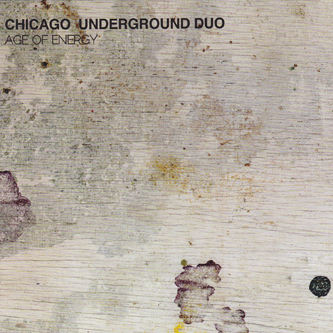
“Age of Energy,” lives up to its name!

age of energy

A Review of “Age of Energy,” by the Chicago Underground Duo (2012)

This sixth album by Rob Mazurek and Chad Taylor as the Chicago Underground Duo lives up to its name and is full of energy. The 19:56 minute “Winds and Sweeping Pines” starts out spooky, other-worldly, but around 16 minutes in finds a coherence and rhythm, which is reprised on the 4:19 minute “Moon Debris,” which closes the album as a nice bookend. The 10:56 minute “It’s Alright,” is also spooky, with echoes and delays. “Castle in Your Heart,” (4:36) is a bright spot with a sweet, music box-like sound, with xylophone or vibes, kind of like falling asleep after the circus in a patch of sunlight. “Age of Energy,” (6:40) is a blast of sound and power.

This is a strong album, with space to really stretch out in the music. I have to be in the mood for it, but it is good for doing something creative with prolonged focus, like painting. I was doing this the other day while listening to the album and the sun came out after a day of rain and illuminated the canvas and the music just fit perfectly. This album deserves a good review.

Continuing Creative Music out of Chicago

cud-locus-web-cover_2    locus back cover

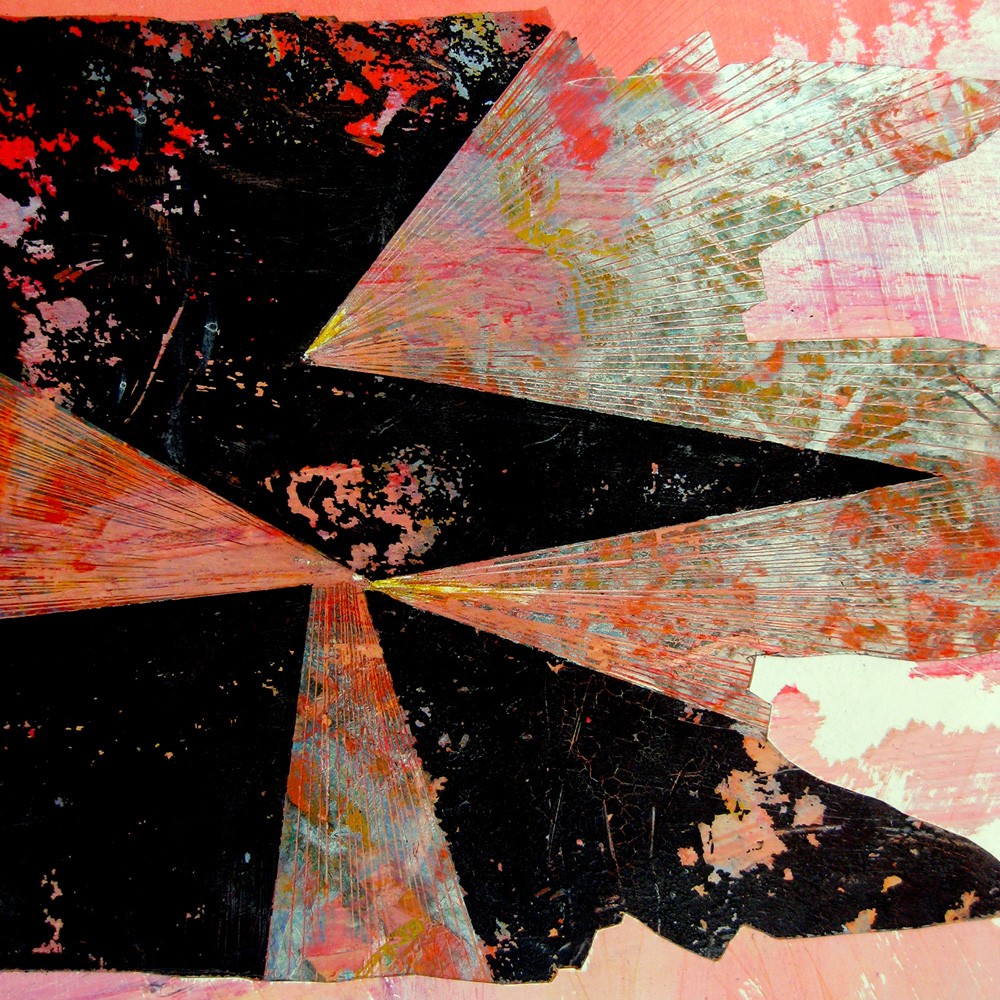
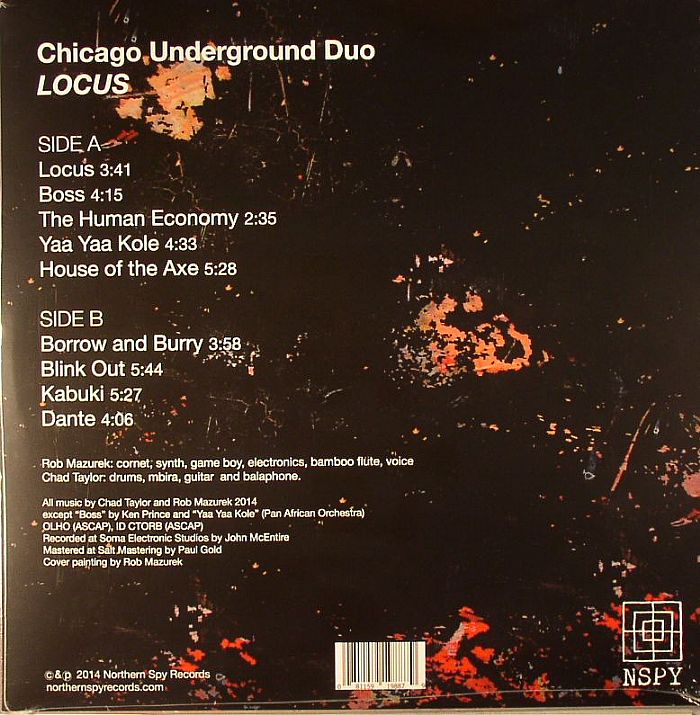
A Review of “Locus,” by the Chicago Underground Duo, (2014)

This is the seventh album by Rob Mazurek and Chad Taylor as the Chicago Underground Duo, although they have collaborated with other musicians on albums as the Chicago Underground Trio, Quartet, and Orchestra. The Duo put on a great live show and I saw them at a small club in Chicago back in the ‘90s. Mazurek and Taylor have also collaborated with other Thrill Jockey bands and musicians, such as Isotope 217, The Sea and Cake, and Tortoise. The Chicago Underground Duo are solidly an experimental, avant-garde jazz group, but at times there are influences of some of these other projects, such as the melodic vibraphone-like sound on “Yaa Yaa Kole,” which also sounds a bit like Isotope 217. Or some of the more electronic-influenced sounds that are reminiscent of Tortoise or Isotope.

This is a diverse album and is not an easy listen, although there are some great songs on the album. Personally I tend to like the more melodic songs like “Yaa Yaa Kole,” or the loopy sound, with poppy drums, and catchy horn of “Boss.” “Kabuki” is interesting, sometimes catchy, sometimes repetitive, sometimes a little irritating, reminding me of The Residents. Missing is the nice, long song or songs that are typically on a Chicago Underground album, like the twelve minute “Blue Sparks From Her and the Scent of Lightning,” from Synesthesia, or the nine minute, “Two Concepts for the Storage of Light,” from Axis and Alignment. The longest song on Locus is “Blink Out,” at 5:44.The album ends with “Dante,” which does have a tense, claustrophobic feel, filled with struggle and plodding, as Dante’s journey through Hell and Purgatory were in The Divine Comedy, and it ends with a brief, beautiful expansiveness, like the sun shining through the clouds, or Dante’s illumination.

It is a beautiful, catchy, challenging and dissonant album. Definitely experimental jazz and experiments are often risky and don’t always pay off, even when creative, but it is great when it all comes together.


Review of God Is A Trauma: Vicarious Religion and Soul-Making (1989), by Greg Mogenson

God is a Trauma

This is a review of an edition of this book that was later re-named and reprinted in 2005: A Most Accursed Religion: When a Trauma Becomes a God.

The thesis of this book is that trauma (as an experience that overwhelms the ego) and God (an experience that overwhelms the ego through unknowability) share something in common, and may perhaps even be different aspects of the same thing/process. Mogenson writes that his aim “is not to reduce theology’s God to a secularized category of psychopathology but rather to raise the secularized term ‘trauma’ to the immensity of the religious categories which, in the form of images, are among its guiding fictions,” (1). Further that just as “God has been described as transcendent and unknowable, a trauma is an event which transcends our capacity to experience it,” (1).

Drawing on Jung, Hillman, Nietzsche, Freud, the Christian mystics and the Christian Bible, Mogenson traces out a very interesting interplay between trauma and God. The book is flawed by, what comes across as, hostility toward religion, and with that spiritual and mystical experience. I would say this is the major reason that I found this book fascinating as well as frustrating and disappointing. There is a certain arrogance in Mogenson’s knowing of religion and a reductionism, not necessarily to materialism, but to imagism. By this I mean the strain of thought and argument from Jung through Hillman which seeks to distance itself from spiritual experience. Jung’s work is bifurcated, sometimes he claims to be a scientist and speak of the “God-image” rather than of God (Mogenson adopts this stance in the first paragraph of his book, saying he is not speaking of God, but of the “God-image”). Jung’s work, particularly now that The Red Book has been published, also clearly values spirituality and religion, and attempts not to reduce those universal aspects of human experience to psychology, but to use psychology to better understand God/spirituality/religion. Hillman (whose work I can’t claim to have studied as extensively as Jung’s) elevates soul over spirit, with soul being associated with energized human experience and the spirit associated more typically with transcending human experience. In a way, this is the old argument between immanence (soul) and transcendence (spirit). In Hillman’s work there is a, usually subtle, antagonism with spirit, partially because he views himself as correcting the imbalance of traditional religion.

Freud was a confirmed atheist. Nietzsche pronounced the “death of God,” however, Nietzsche was very alive and expansive in his writing. Freud used rationalism and modernism to dissect God. Nietzsche used reason and social criticism to diagnose a problem with Christianity. While Freud seemed to bemoan the fact of non-rationality in human beings, Nietzsche glorified irrationality in the form of “the will to power,” the flow of life, particularly Dionysian life, but also Apollonian life.

I apologize for this divergence from Mogenson’s work, but I think the flaws in the work are not specifically his, so much as a problematic current within contemporary human thought and experience, and particularly within scholarly and academic writing. I cannot claim to have “solved” this dilemma, however, I think it can be dealt with in a more subtle and complex way than Mogenson has done in this book.

Mogenson writes that the “soul-destroying consequence of worshipping a God who is identical with our inability to understand Him is that we tend to propitiate, as if they too were completely transcending, events which the soul might easily comprehend and absorb,” (46).  I think Mogenson overstates the point that life events are easily comprehended and absorbed. It is this aspect of Mogenson’s work that seems arrogant and polemical, rather than subtle and exploratory.

I do see that Mogenson revised this book and that revision is published under the title, A Most Accursed Religion: When a Trauma Becomes a God (2005).  This title does fit the topic of the current edition of the book being reviewed, the out of print, 1989 edition. I happened to be reading this book at the same time I was reading C.A. Meier’s Healing Dream and Ritual: Ancient Incubation and Modern Psychotherapy. What I missed in Mogenson’s book was Meier’s conception of Asclepius, the man who transformed over centuries from a man to a god. The healing, or “right attitude was made possible by the cult, which simply consisted in leaving the entire art of healing to the divine physician. He was the sickness and the remedy,” (3). The title of the revised edition of this book more clearly emphasizes that it is about the potential sickness of God and trauma. The edition of the book, entitled God is A Trauma, is an interesting, if at times one-sided, look at the relationship between Judeo-Christian religion and trauma, as well as the common human response of turning an overwhelming trauma into a “god,” that then terrorizes the individual. The one-sidedness comes from seeing god-making as a pathological process, rather than as an ambivalent process which could be positive or negative depending upon how it was handled.


The Spiritual Transformation of Humanity

A Review of Hans Thomas Hakl’s, Eranos: an alternative intellectual history of the twentieth century

51UwChYBClL._SY344_BO1,204,203,200_[1]

This is a marvelously fascinating book documenting the history of Eranos, a yearly, interdisciplinary meeting in Ascona, Switzerland that started in 1933 and continues on in different forms to the present day. Hakl’s book is balanced, while sympathetic to the underlying spirit of Eranos. It is very well-referenced, with almost one hundred pages of 8 point font notes. Eranos was the life work of Olga Fröbe, who brought together an interdisciplinary group of speakers for an exploration of the spirit in history, philosophy, psychology, science and mythology. These speakers included: Carl Jung, Joseph Campbell, James Hillman, Henry Corbin, Mircea Eliade, D. T. Suzuki, Martin Buber, Paul Tillich, Heinrich Zimmer, and innumerable others. Hakl’s work is detailed and exhaustive as well as broadly connected to larger societal themes. While the topic is very different, it is worth comparing it to Lipstick Traces: A Secret History of the Twentieth Century, by Greil Marcus.

After an in-depth exploration of the people who participated in Eranos as well as the controversies surrounding the meetings and the individual lecturers’ lives and works, Hakl gives an interesting summary of subsequent organizations that sought to combine the scholarly and the spiritual, perhaps using Eranos as a prototype. Most notably, for an American audience, Hakl cites a discussion he had with Michael Murphy discussing the role that Eranos played as an inspiration for Esalen, in California, which has played such an important role in the human potential movement and fostering personal growth.

As well as a history of a specific place and organization and specific historical individuals, Hakl also explores broader tensions between science, spirituality, objectivity, subjectivity, modernism, esotericism, individual and the collective. Hakl discusses the tensions between the rational/scientific world view and the esoteric/spiritual world view. His argument is that Eranos was a third view point which sought to integrate both science and inner spiritual experience. Here are a couple quotes that Hakl cites regarding the goal of Eranos as seeking a “rationality that does not reduce or fragment what it sees, but which enriches, synthesizes, and evokes responses,” (Charles Scott, 258). Eranos’ aim was “indeed to bring about more than an understanding but rather a knowing through direct experience,” (Ira Progoff, 258-9). And lastly, Henry Corbin, “we in Eranos never had the intention of adapting ourselves to some given model, we never paid heed to any orthodoxy, and we were concerned with only one thing, namely to press on into the innermost part of ourselves, pursuing that truth until we reach its farthest limits, (261). In summary, “Eranos was thus not exclusively concerned with learned scholarship but equally (although not in the case of all participants) with the spiritual transformation of humanity,” (Hakl, 11).

I highly recommend this book for those who are interested in the “spiritual transformation of humanity,” as well in the history of this organization that brought together such influential thinkers as Carl Jung, James Hillman, Joseph Campbell, Mircea Eliade and Henry Corbin. The book offers glimpses into the lives of these different figures who lectured at Eranos, where they could try out new ideas and find a source for inspiration and companionship in a place whose goal was the synergistic integration of inner and outer knowing.

The Tension Between Outer Religion (and Psychology) and Inner Mysticism: Jung, Buber and Gnosis

A Review of Alfred Ribi’s, The Search for Roots: C. G. Jung and the Tradition of Gnosis

9780615850627[1]

Gnosis is one of those terms that seem to mean many different things to many different people. Ribi defines it as, “Gnosis is not a ready-made system…It is the undeveloped potential of Christian myth…Developing this myth is a task for people of our own time. It is an introverted task, a personal task,” (ix). Through his study of Gnosis, as well as of Jung (even collecting the same books that Jung referenced in his own writings on Gnosis and alchemy), Ribi sees Jung’s goal as an example of the Gnostic introverted quest for divine understanding of self and God. Jung, himself, near the end of his life said that the main “interest of my work is not concerned with the treatment of neurosis, but rather with the approach to the numinous,” (7).

Lance Owens’ foreword to the 2013 English publication of the book, gives a nice summary of Jung’s inner life and writings, taking into account Liber Novus, The Red Book, published in 2009. This foreword is important as Ribi’s book was originally published in German in 1999 and thus did not have access to The Red Book at the time it was written. This personal journal of Jung’s connects the dots between Jung’s professional work in psychotherapy, mythology and alchemy with his own personal journey. The Red Book traces Jung’s inner development and experiences, from ages 38-54, which can be seen as the source material for his later works. The book itself takes the form of an alchemical or Gnostic text, a sourcebook of dreams and visions, illustrated with fantastic images. Ribi further describes Gnosis as “a spontaneous, creative phenomenon…always a fresh creation, a processing of material that to some extent is already known, but now newly organizing in novel ways and contexts,” (39). Thus The Red Book can be viewed as a Gnostic text, arising from Jung’s inner mind and spirit, a new creation, but also a reprocessing of age-old myths and material. There is no doubt that Jung studied the Gnostics and that he was sympathetic to the spiritual process of Gnosticism.

Ribi begins his book by examining the disagreement between Martin Buber and Jung over Gnosticism and ultimately, inner mystical experience. Whereas Buber considers Jung a Gnostic, and that this is a “bad” thing, Jung himself found in Alchemy and Gnosticism a link to a living, spiritual, inner experience that was the very meaning and purpose of life. For instance, Jung writes, “when I began to understand alchemy I realized that it represented a historical link with Gnosticism, and a continuity therefore existed between past and present. Grounded in the natural philosophy of the Middle Ages, alchemy formed the bridge on the one hand to the past, to Gnosticism, and on the other into the future, to the modern psychology of the unconscious,” (133). For Jung, Gnosticism is one example, as is alchemy, of the individual’s inner search for Self, the inner path to God. Ribi does resort to a form of “psychoanalysis” of Martin Buber’s childhood to explain his opposition to Jung, Gnosis, psychology, and inner, mystical experience. This personal analysis is worth considering, even though it does not always come across as balanced, but in the end is not the most important point. Ribi illuminates the rift between Jung and Buber as part of a larger debate between inner and outer experience, which can be cast as an example of the debate between the tradition of organized religion and the experiences of the individual mystic. To someone within a religious tradition, the individual mystic’s journey often appears heretical, as it is by definition, individual, new and creative, rather than being defined in terms of tradition and orthodoxy.

Through the remainder of the book, Ribi traces Jung’s life’s work through different phases and highlights the role that Gnostic beliefs played, for instance in the writing, in 1916, of  The Seven Sermons of the Dead, Septum Sermones ad Mortuos, with its Gnostic imagery and terminology, it is a mythopoetic text, more spiritual than psychological. Ribi’s examination of this text takes up the remaining 120 pages of his book and it closes somewhat abruptly, without a summing up of the overall book. Still, this book is a very interesting and rewarding read of Gnosticism; the personal relationship between Jung and Buber as it mirrors a larger spiritual/philosophical debate; and as an exploration of the role of Gnostic thought in Jung’s work. In the end, it is probably more true that Jung was not simply “a Gnostic,” as it was that he studied Gnosticism as one of the ways to strive after inner Truth. As Jung writes in the Seven Sermons, “At bottom, therefore, there is only one striving, namely the striving after your own being,” (210).

The Imagination at Work: A Review of Henry Corbin’s Avicenna and the Visionary Recital

The Imagination at Work: A Review of Henry Corbin’s Avicenna and the Visionary Recital

41ddpJevBrL._SL500_AA300_[1]

This is the second book by Henry Corbin that I have read, the first being Creative Imagination in the Sufism of Ibn ‘Arabi, with its beautiful cover. I came to Corbin via James Hillman and Carl Jung, and was thus interested in Corbin’s concept of the imagination. Corbin goes to great lengths to distinguish imagination from fantasy, and sees “active imagination” as a creative force, that creates the reality, and even matter of ourselves and our worlds. “Each of us carries in himself the Image of his own world, his Imago mundi, and projects it into a more or less coherent universe, which becomes the stage on which his destiny is played out. He may not be conscious of it, and to that extent he will experience as imposed on himself and others this world that in fact he himself or others impose on themselves,” (8).There is a correspondence between what is within the individual and what the individual experiences in both the external material and spiritual worlds.

Corbin’s thoughts revolve around Avicenna, a Persian philosopher and physician (980-1037). Corbin studies three “visionary recitals,” or as he sometimes calls them, “spiritual romances.” Corbin is a dense writer and I cannot claim to have a full understanding of his writing, nor an in-depth understanding of Persian and Arabic culture and terminology that Corbin explores his ideas through. He seems to be focused on a turn in Western culture with Avicenna being a pivot point. Corbin draws a distinction between rational, objective, materialist Western thought and a form of thinking that includes “active imagination” in which the imaginal is as real as the material, in fact possibly more real as it precedes and gives rise to the material. This leads to an in-depth discussion of Avicennan angelology and the ‘alam al-mithal (world of Images), where “spirits are corporealized and bodies spiritualized,” (35). The loss of this intermediary realm of the ‘alam al-mithal leads to a severing of the connection between spirit and matter and to the dualism inherent in much of Western thought. Corbin argues that we “must cease to separate the history of philosophy from the history of spirituality,” (16). While Corbin is interested in history and scholarship, his underlying drive is to illuminate a spiritual quest.

I’ll just touch on a couple of the themes in the book, as it winds its way through various Gnostic and Islamic mystical visions and encounters. There is the recognition that the individual is a “Stranger” in the world, i.e. comes from somewhere else and that “the soul must find the way of Return. That way is Gnosis, and on that way it needs a Guide. The Guide appears to it at the frontier where it has already emerged from this cosmos, to return-or better, to emerge- to itself,” (19). There is the “quest for the Orient,” or discernment of proper orientation toward the truth, that is the ta’wil, or the return “to restore to one’s origin,” (29).

I find it difficult to summarize the philosophical arguments of this book, but I found it immensely interesting and I read it as much as poetry and as mystical imagery as spiritual philosophy. Jacob Needleman describes Corbin’s work as “visionary scholarship” (foreward to Corbin’s The Voyage and the Messenger: Iran and Philosophy). I like the idea of a visionary scholar and it reminds me of Juan Mascaro’s work translating the Upanishads and the Bhagavad Gita, scholarship that is historical, linguistic, yet motivated by an underlying search for Truth. For one new to Corbin, this would most likely be a difficult book, but if you read it as you would a dream, albeit a dream with complicated technical and foreign terminology, it can be a beautiful and rewarding experience.

For a reader, like myself, coming from a familiarity with the works of Jung and Hillman, Tom Cheetham’s book, All the World an Icon: Henry Corbin and the Angelic Function of Beings is a good introduction to Corbin’s thought and explores the relationships between these three men’s thought as well as their meetings, but reading Corbin’s original works is a must.