Chris Smith and David Kopacz discuss the rewards and pitfalls of practice in yoga, meditation, writing, and life.
Sometimes practice clears a space where imperfections and flaws are seen. We are tempted to try to eliminate those specks of dust and scratches on our window, but accepting our imperfections may actually be the real part of practice. Practice is about reconnecting to our True Humanity, our inner held-back place of goodness, our source of love, compassion, and caring – and we may only reach these through suffering and imperfection.
For instance, we explore the Sanskrit term, samvega, which Stephen Cope describes as “complex state involving disillusionment with mundane life, and a wholehearted longing for a deeper investigation into the inner workings of the mind and self,” (The Wisdom of Yoga, 13).
Or as Karlfried Graf Dürckheim wrote in his book The Way of Transformation: Daily Life as Spiritual Practice, “Thus the aim of practice is not to develop an attitude which allows us to acquire a state of harmony and peace wherein nothing can ever trouble us. On the contrary, practice should teach us to let ourselves be assaulted, perturbed, moved, insulted, broken and battered” (107).
Chris and Dave discuss their own struggles with chronic illness/ongoing medical symptoms and the difficult work of turning personal illness and suffering into fuel for personal growth work.
We talk about:
using suffering as a spiritual practice
cleaning the windshield
“The Garden,” a reading from Chris’ next book, Hope Opens Doors
a workshop Chris is putting on in February, “Chronic Illness & Love”
Sean Mackey’s work on love & pain
finding inner calm and strength, even within chaos & suffering
Makransky & Condon’s Sustainable Compassion Training
making practices creative and fresh
the work of Joseph Rael (Beautiful Painted Arrow)
spanda – the divine creative pulsation
practice does not make perfekt
being capable of suffering may make us more capable of joy
the benefits of practice are not only for us, but are fully realized when we share with others and the Earth
practice is caring for ourselves and others
We close with a couple of practices, one from Dave’s book, Caring for Self & Others and short one from Chris Smith.
We have video links on YouTube and audio links on Spotify, here is the link to all episodes:
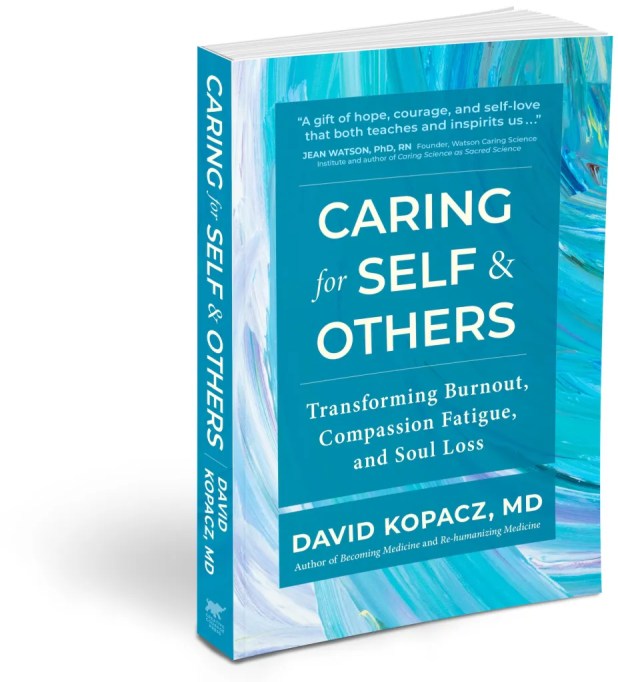
I have been working on this book for ten years – the longest of any book I’ve written. In many ways it is a follow-up of Re-humanizing Medicine (2014) and yet it also is strongly influenced by my work over the past 10 years with Joseph Rael (Beautiful Painted Arrow). It brings together my work on physician and staff wellness in presentations and workshops, from my work Whole Health at the VA, and my work with The Doctor as a Humanist. Re-humanizing Medicine used a 9-dimensional model of the components of being fully human: body, emotions, mind, heart, creativity, intuition, spirituality, context, and time. In Caring for Self & Others, I’ve added the dimension of Becoming Caring: Caring for All, a kind of holistic leadership for self & others. Within each of the ten different dimensions of being fully human I have developed three different domains that end in an -ing (in honor of Joseph Rael’s emphasis on verb-ing in our conversations). I’ll now give a brief review of the journey of how this book has come into being.
After publishing Re-humanizing Medicine, I realized I needed to develop a set of practices to operationalize what I called the counter-curriculum. The counter-curriculum was a humanizing curriculum, a caring for self curriculum, which focused on how we do things, not just what we do in clinical settings. If our medical education and continuing medical education (CME) trains us to be good clinicians, the counter-curriculum trains us to be good human beings – thus I came to call this Continuing Human Education (CHE). In the age-old balance of being healers and technicians, I recognized that we have really given the education of ourselves as healers short shrift, and have almost exclusively focused on becoming technicians at the expense of our humanity. The loss of our role as healers and the loss of our human presence in medicine leads not only to impoverished clinical care (with patients feeling like they are being processed by protocols rather than cared for by human beings), but it also cut us off from the rejuvenating nature of the healing relationship which nourishes our own humanity as well as the humanity of our patients and clients. I realized that to care for others we must first care for ourselves and that in caring for ourselves we were developing the skills and aptitudes necessary to care for others.
In 2015 I was developing the idea of “Becoming a Whole Person to Treat a Whole Person,” which I presented in various forms at the Australasian Doctors’ Health Conference, and conferences of the Alliance of International Aromatherapists, and the Australasian Integrative Medicine Association.
In 2016, Joseph Rael and I published Walking the Medicine Wheel: Healing Trauma & PTSD. That year I deveoped presenations on Healing Circles, Pathways to Healing Moral Injury, and comparing the Medicine Wheel and the Hero’s Journey as pathways of initiation and healing – with presentations at the Mayo Clinic Humanities & Medicine Symposium, and various local settings. I developed a half-day workshop called “Caring for Self: Well-Being in the Workplace” that I gave for HopeWest hospice staff in Grand Junction, CO.
In 2017 I first started using the title of “Caring for Self & Others” in presentations, for instance at Western Sydney University in Australia. I continued developing ideas around Healing Circles and the Hero’s Journey, with presentations at the Australasian Doctors’ Health Conference and the University of the South Pacific in Fiji.
One of the dimensions of being fully human from Re-humanizing Medicine was spirituality and I had a sub-section on mysticism and medicine. My work with Joseph Rael, which has resulted in the publication of four books thus far, has allowed an in-depth exploration of the role of spirituality in healing. Our 2020 publication of Becoming Medicine: Pathways of Initiation into a Living Spirituality was a blending of Joseph Rael’s teachings within a framework of initiation, a review of healing through the lives and writings of visionaries, mystics, and shamans, and a survey of the perrenial philosophy of timeless healing wisdom. My subsequent training as an iRest certified teacher (a Western adaptation of yoga nidra from Kashmiri Shaivism by psychologist Richard Miller) and as a certified yoga teacher (CYT 200), has allowed me to study and explore nondualistic states – which I feel are foundational to breaking down the barriers between self and other – a kind of nondual medicine, as I call it in Caring for Self & Others.
As I have been working with burnout for myself and in staff and clinicians, I started to realize that there were many terms for health care worker suffering, not just burnout, but compassion fatigue, secondary and vicarious traumatization, PTSD, demoralization, moral injury, and even suicide could be an outcome of the burden of caring for others. I have come to use the term the costs of caring to encompass all these different dimensions of staff and clinician suffering. My good friend Greg Serpa and I published a chapter on “Clinician Resilience” in the Integrative Medicine, 5th edition textbook and I started to bring together a number of ideas I had been working on around burnout, moral injury, and the costs of caring, and even the idea of soul loss.
Soul loss is often considered one of the causes of illness in shamanic and indigenous traditions, such as in the work of Joseph Rael. It also has a resonance with the Western traditions that psychiatry and psychotherapy grow out of. The etymology of the word “psychiatry” comes from the Greek words psyche + iatros, soul healer. The Swiss psychiatrist, Carl Jung, frequently wrote of the psyche and also of the soul in his work as a healer and psychotherapist. The more recent, modern tradition of neglects the idea of the a vital essence of a person – yet there is a practical utility in addressing burnout as “soul loss.” In doctors and health care workers, as well as in teachers, and business, burnout is such a serious issue. We talk about burnout, but what is it that burns out? The soul is one answer – not necessarily in a metaphysical or religious sense, although it could be understood that way, but in a metaphorical and evocative way of describing what burnout and compassion fatigue feel like – that one has lost some core aspect of one’s being – a loss of soul. I gave presentations on burnout and soul loss at the Doctor as a Humanist’s on-line international conference, New Realities in the Times of COVID-19 (2020), University of Washington Psychiatry Grand Rounds (2021), and Seattle University’s Giving Voice to Experience Conference (2022).
A key idea in Caring for Self & Others is that suffering can be transformed – this is what healing is all about and this is the primary skill that a healer has, how to transform suffering. Our work as healers, doctors, technicians involves exposure to suffering, therefore we cannot eliminate suffering from our work as the very definition of our work is to engage with suffering. We can minimize the amount of collateral suffering that we experience from working in systems that do not support the full human being of clinicians and staff – that is the moral injury piece that we need to address. However, I think that burnout is inevitable when we are people who work with people, particularly people who work with suffering people. In my conversations during the pandemic, Lucy Houghton and I have been developing the idea of post-burnout growth, which is analogous to post-traumatic growth, in which we use suffering as a stimulus to personal and professional growth. Post-burnout growth captures the idea that burnout is not to be feared, but rather respected as a predictable occupational hazard – just like a firefighter working with fires is sooner or later going to get burned.
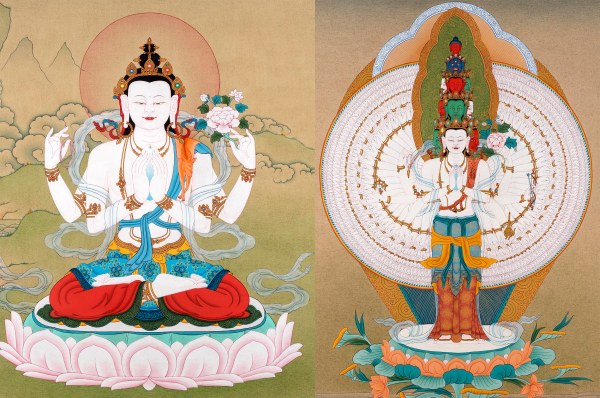
The Many Faces of Chenrezig, Image Credit: Enlightenment
The story of Chenrezig as a wounded healer captures this idea of post-burnout growth perfectly. Chenrezig vowed to alleviate all suffering in the world – which is not dissimilar to our own vows, spoken or unspoken, to heal others. If he was not successful in this vow, he pledged that he would shatter into a thousand pieces – a state akin to burnout, compassion fatigue, and soul loss, where we feel injured as a result of our caring. This is, in fact, is what happened – Chenrezig worked diligently, healing many, yet there was still more suffering than he could address and he shattered into a thousand pieces. This is where the story ends for so many health care workers and educators who become embittered, cynical, and maybe even leave their profession. But in the story of Chenrezig, there is a ritual elder, Avalokiteśvara, who sees Chenrezig’s suffering from addressing others suffering. Avalokiteśvara puts Chenrezig back together – not simply as he was before (this is my problem with the way resilience is often used in health care – as a way of going back to the past, or avoiding suffering), but rather as having a thousand eyes to better see suffering and a thousand arms to better touch suffering. Chenrezig becomes more capable of seeing and touching suffering – through post-burnout growth.
This book, Caring for Self & Others: Transforming Burnout, Compassion Fatigue, and Soul Loss, has grown over the last ten years and I am grateful to all the above mentioned organizations. The book and I have also been shaped by numerous conversations with friends and colleagues and I would particularly like to thank Laura Merrit, Shelly Francis (Creative Courage Press), Joseph Rael (Beautiful Painted Arrow), Steve Hunt, Jonathan McFarland, Usha Akella (The POV), J. Greg Serpa, Tulika Singh, Chris Smith, Lucy Houghton, Transformational Arts Network and their Power of Words conference, Gretchen Miller (and the editorial staff at the CLOSLER blog), and so, so, so many others. There truly is no self without others.
Mental Contagion is publishing online some of its archive. Coniunctionis: Trauma, Transformation & Punk Rock was a column that I wrote from 2000 – 2002. My sister, Karen Kopacz started editing and publishing Mental Contagion and brought together a great group of writers, including Gene Dillon, Wendy Lewis, Dean Pajevic, and Eric Hoffman, as well as many others over the years.
.4 : How Can Ugliness and Disharmony, Which Are the Content of Tragic Myth [and punk rock], Inspire Esthetic Delight?” (Joy Division, Punk Rock, Violence, Despair & Transformation Part I) (February, 2001)
.5 : Why is Revolt Necessary? (Joy Division, Punk Rock, Violence, Despair & Transformation Part II) (March, 2001)
.6 : Is Alienation Necessary for Creativity? (Joy Division, Punk Rock, Violence, Despair & Transformation Part III) (April, 2001)
.7 :Is There an Inside/Outside? (Joy Division, Punk Rock, Violence, Despair & Transformation Part IV) (May, 2001)
.8 : What is the Meaning of Ian Curtis’ Death? Where is the line between the Art Object and the Artist? (Joy Division, Punk Rock, Violence, Despair & Transformation Part V) (June, 2001)
.9 : What is Punk Rock? What is Not Punk Rock? (Joy Division, Punk Rock, Violence, Despair & Transformation Part VI) (July, 2001)
.10: What Does the Shadow Know? (Joy Division, Punk Rock, Violence, Despair & Transformation Part VII) (August, 2001)
.11: What is the Relationship Between Music and Religion? (Joy Division, Punk Rock, Violence, Despair & Transformation Part VIII) (September, 2001)
.12: What Are We to Do? Quotations (October, 2001)
I: Interview: Ouroboros (Houston) by David Kopacz – for Mental Contagion (MC) (November, 2001)
.13: What Does Religion have to do with Rock? A review of Dan Graham’s Rock My Religion(December, 2001)
.14: What Did You See There? Ian Curtis and the Visionary Quest of the Shaman (Joy Division, Punk Rock, Violence, Despair & Transformation Part IX) (January, 2002)
I: Interview: Poster Children by David Kopacz (With Special Guests Doug McCarver and Mike Barry) (February 2002)
.15: Afterwords
CONIUNCTIONIS.0
On stranger waves, the lows and highsOur vision touched the sky. “A Means to an End,” Joy Division, Closer, 1980.
There is a movement within me, a current and flow that lives through me. I have felt the pull to be inside, where everything is happening. I have felt the pull to be outside of it all, where nothing is happening. These essays, written between 2000-2002 for the online journal Mental Contagion, are attempts to understand the inside and the outside and the power that flows from outside to inside and from inside to outside. These essays are investigations into the nature of reality through Joy Division, trauma, transformation, and punk rock.
There is a pull that some people feel, to go deeply inward, sometimes that pull is a push, from alienation or trauma in the outer world. Going into this inner wilderness is a kind of darkness and it can overlap with despair. Maybe despair is the cause of the inwardness or maybe despair is a station along the path of inwardness, like a phase of grief that one goes through, leaving the communal and collective world and entering into the sacred inner cave of consciousness and being. Jung wrote,
“As a child I felt myself to be alone, and I am still, because I know things and must hint at things which others apparently know nothing of, and for the most part do not want to know. Loneliness does not come from having no people about one, but from being unable to communicate the things that seem important to oneself, or from holding certain views which others find inadmissible. The loneliness began with the experiences of my early dreams, and reached its climax at the time I was working on the unconscious. . . .
It is important to have a secret, a premonition of things unknown. If fills life with something impersonal, a numinosum,” (Carl Jung, Memories, Dreams, Reflections, 356).
For Jung, this loneliness was difficult to bear, but it was a source of learning and experience that he would not have traded for fitting in. Ian Curtis, the lead singer of Joy Division, also found a creativity in the darkness and the loneliness and he sent back missives from the depths, as a lone astronaut exploring space might send back scratchy transmissions from another galaxy:
“You’ve been seeking things in darkness, not in learning” (No Love Lost)
“I’ve been waiting for a guide to come and take me by the hand. Could these sensation make me feel the pleasures of a normal man?These sensations barely interest me for another day I’ve got the spirit, lose the feeling, take the shock away” (Disorder)
Depending on how this pull is engaged in, one goes on an inner journey. If one goes deep enough, there is an inner well of transformation, drinking that water of the deep self is like a form of rebirth, but rebirth infers that there has been a death. Without guidance, many are lost on this path and there is untold loss of human potential. Yet, these brave souls, these inner warriors, can serve as heroes as well as cautionary tales. To give one’s self over to this inner secret is like taking the steps of what Joseph Campbell called the “Hero’s Journey,” with steps of 1) separating from the everyday world; 2) entering into a magical world or the underworld and going through an initiation and transformation into a new way of being; and 3) a return and reintegration into society. Jung’s process of individuation would say that the hero brings back energy and ideas from the collective unconscious, and yet the hero bringing this back is alone, because no one else made that journey and no one else yet understands the beauty and value of what the hero or heroine has brought back from the unconscious into the light of day. Joseph Campbell felt that the hero is rejected by society, because he or she has gone places that most people do not know or understand. Herman Hesse, in Steppenwolf, wrote of a similar concept, that creativity is infused into society by the lone wolf, the liminal being, the misfit.
“We are psychiatrists; we are German; we have read Nietzsche; we know that to gaze too long at monsters is to risk becoming one – that is what we get paid for,” (Huelsenbeck, quoted in Greil Marcus, Lipstick Traces, 226).
I was a young psychiatrist when I was writing these columns and I was trying to find my path as an artist, a writer, a professional and a person. I was not German, but I had read Nietzsche, Jung, and a number of other writers you’ll find in these pages. I had listened to Joy Division and punk rock and post-punk. I was gazing at monsters, both inner and outer, as Richard Huelsenbeck, the Dadaist Psychiatrist.
These essays were about me trying to figure some things out, but they are really more explorations than answers. Over the years, the topics in these essays have resurfaced and recurred in my life in various ways. After a period of some years, I found that I had more to write on these topics and began writing additional columns.
For the purpose of this archival collection, I have just collected those essays published in Mental Contagion 2000 – 2002. Post 9/11/2001, I mostly shifted to doing interviews for the column, for this collection I have kept just a few interviews as many of them seem more specific to that time and that place (Champain-Urbana, Illinois). You can read more recent Coniunctionis essays on my blogBeing Fully Human. My website www.davidkopacz.com also has the original Coniunctionis essays, along with artwork, photography, poetry, publications, and other work. The work of Coniunctionis prefigures my current work with Joseph Rael (Beautiful Painted Arrow) and has continued to influence my writing and published work:
How can we transform suffering, fragmentation, and painful inner & outer separation? This is the central question that Joseph Rael (Beautiful Painted Arrow) and I address in our new book, Becoming Medicine: Pathways of Initiation into a Living Spirituality. Suffering is the flip side of initiation and enlightenment. If you are seeking to become enlightened, the door that you often enter through is some form of suffering, separation, and fragmentation.
Initiation is the process of becoming more fully human. It is a common process in indigenous societies and in religious traditions. Anthropologists, such as Victor Turner studied initiation, as well as scholars of world religions, for instance, Mircea Eliade. Joseph Campbell popularized the process of initiation as the Hero’s Journey, comprising three primary stages of separation, initiation, and return. Campbell sought to find a way that we “modern” people, who lack religious and sociocultural ritual frameworks for initiation, could transform suffering into personal and spiritual growth. Psychologists and psychiatrists became interested in the concept, as it applies to the presenting common concerns of those seeking psychotherapy. Carl Jung saw the need for initiation and transformation, as he wrote about throughout his career in books such as Modern Man in Search of a Soul, Memories, Dreams, Reflections, and his posthumous journal, The Red Book.
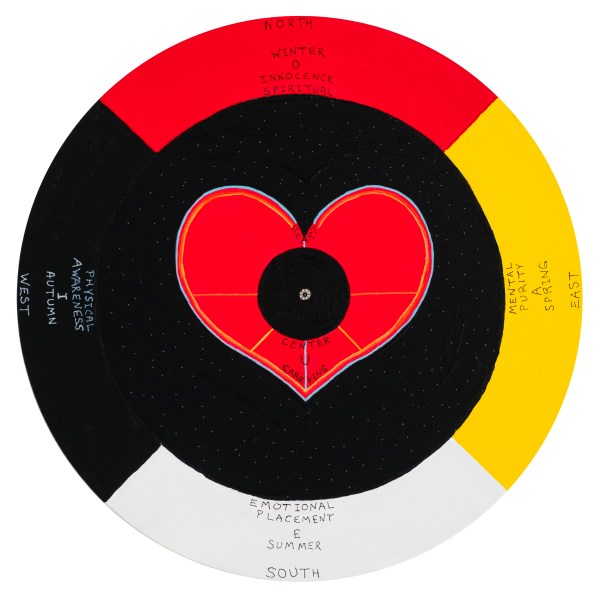
We live in a disorienting time and we seek to get our bearings again. In our first book together, Joseph Rael and I wrote about his practices of using the medicine wheel as a kind of compass for inner and outer orientation. When we find ourselves disoriented, we need some organizing framework to help us re-orient. The outer directions are North, South, East, and West. There are also the inner directions of spirit, emotion, mind, and body. Joseph also teaches that the center of the medicine wheel is the heart and embodies the principle of carrying. When we enter into the center of the medicine wheel, we realize that our hearts are medicine bags and they are filled with sacred objects. The initiation is the process of “finding the held-back place of goodness,” as Joseph called it in our book, Walking the Medicine Wheel: Healing Trauma & PTSD. Initiation is when we go into the center of the medicine wheel to find our medicine, which we come to realize is an ongoing process of becoming medicine – becoming the very thing that we so desperately need.
David Kopacz’s adaptation of Joseph Rael’s Medicine Wheel
We structure the book around the framework of initiation that Joseph Campbell, Victor Turner, Mircea Eliade, and others have described: separation, initiation, return. However, Joseph Rael comes from what he calls a verb language tradition – a language that is full of verbs like breathing, transforming, and becoming. It is a language of connecting, rather than how he describes noun language (English and German, for example) as languages that separate our living and interconnecting world into separate and discrete: people, places, and things. (The process of turning people into things is the topic of dehumanization that I explored in my first book, Re-humanizing Medicine: A Holistic Framework for Transforming Your Self, Your Practice, and the Culture of Medicine). Given Joseph’s predilection for verb language, we adapted separation, initiation, return into: seeking, finding/receiving, and giving. What one seeks with and within one’s heart, one eventually finds and receives, becoming healing medicine, and then as one is fulfilled with this, one overflows with fullness, giving to others what it was that we were seeking. In part III we examine how the personal medicine is also the universal medicine. The medicine that we become is the medicine that the world needs, and we find it through the journey of initiation into our hearts.
We live in a disorienting time and yet maybe instead of trying to go back to the way things were, we can go deeper into transformation, into the way things might be. The idea of initiation is consistent with Jack Mezirow’s model of transformative learning – that one enters into transformation through first becoming disoriented. And we have plenty of disorientation that we find ourselves in the midst of at this present time. Mezirow studied ten stages of transformation and we can break these down into three stages that parallel the stages of separation, initiation, and return. One way to understand transformation is that it is a change of who you are. This can be contrasted with simple change – where you remain the same, but you just change something you do. One can change without being transformed, but transformation is the ultimate change. Disorientation is the first step, according to Mezirow, for transformation. In that sense, maybe we are exactly where we need to be and things are exactly as they should be in order for us, as individuals and collectively, transform.
Adapted from Mezirow, Jack. “Transformational Learning Theory,” in Jack Mezirow, Edward Taylor, and Associates eds., Transformative Learning in Practice. San Francisco: Jossey-Bass, 2009.
Here is the table of contents of Part I of Becoming Medicine:
Part I: Separation (Seeking) 1 / Becoming Medicine 2 / Circle Medicine 3 / Separation 4 / Becoming a Visionary 5 / Becoming a Shaman 6 / Becoming a Mystic
After studying the various forms of separation/seeking, we look at how ancient and modern people have gone through the process of initiation of becoming visionaries, mystics, and shamans. We define visionaries, shamans, and mystics broadly, with the understanding that anyone can develop these human capacities. We examine my experiences learning from Joseph, as well as Joseph’s life experiences. We review a number of different spiritual teachers, musicians, and healers and their processes of initiation and becoming, including Carl Jung, Henry Corbin, Hildegard of Bingen, Miles Davis, Ben Lee, Evelyn Underhill, Dorothee Soelle, Juan Mascaró, Krishnamurti, and Matthew Fox.
In the next blog post, I will give a brief overview of Part II: Initiation (Finding/Receiving).
While most people think of burnout as a bad thing, maybe it is not always that bad. While burnout can lead to apathetic withdrawal and an acceptance of the status quo, it can also be a turning point where one decides that they are no longer going to put their energy into a system that is not functioning and resists change.
synthesis
I suppose you could map out the stages of burnout and I am sure that someone has. I suppose it could start with enthusiasm, idealism, active coping and problem-solving, then frustration, confusion, and then finally a kind of withdrawal from the situation while at the same time plodding along. Complete burnout might not be that great of a thing, but maybe some of the earlier stages can be useful in overall adaptation to a situation and also as a means to achieve a radical reorientation to a situation.
What do I mean by this?
I’ll give an example from clinical psychotherapy. Often times a clinical stalemate or equilibrium can happen, in which not much change happens because both the client and the therapist hit a comfortable way of dealing with or avoiding discomfort. In trying to be “nice, supportive, and understanding,” for example, a therapist could be contributing to and maintaining a pattern of interaction which actually resists change and insight. It is only on that bad, stressful day, when the therapist, often for other personal or professional reasons, can no longer maintain the facade of “niceness” and loses their temper, or in some other way breaks the equilibrium of the therapy, that at this point, something new and interesting and more real, open and honest can emerge. It is in the aftermath of this “failure of empathy” that real gains in understanding may really become possible.
Maybe this can be similar for dealing with a dysfunctional system. Maybe it is only at the point of burnout, where one can no longer handle trying to be polite and helpful and conscientious, that at this point, one can no longer put energy into a situation that is really not working on many levels. Maybe burnout is not all bad, as long as it doesn’t lead to complete withdrawal and nihilism.
journey
journey
An interesting thing happened today. I was feeling really upset and angry and I flicked off the light switch at work, feeling like I just had to get out of there, and “POP” the overhead fluorscent light bulb blew. I thought, man, I must be pretty charged up about this. I flicked the light switch again to see if the light would go back on and “POP” the other bulb blew. Man, it was time to get out of there.
Tomorrow, I will request new light bulbs, and I imagine that when I get them in a few days, that if nothing else, new light will be shed on my situation.









 Being Fully Human