Becoming Medicine Has Arrived!!!

I just received five boxes of books! It is so exciting to see Becoming Medicine in finally in print. Two editions, one color (the Art Medicine Edition) and one in black & white! I keep flipping through the two editions, side by side and comparing how the artwork looks! I’m too excited to read it and I already know what it says, anyway…

It is available directly through Itasca Books (the same price as on Amazon). I ordered a copy through Amazon, myself, and anticipated delivery date is 3/31/20 – 5/30/20, for some reason, although it says it is in stock. At this point I’d recommend getting it directly through Itasca as I know someone has already received it that way. It is also available on Barnes & Noble, but I am just seeing the more expensive Art Medicine Edition there at this point.

Here are the links to Itasca:

Standard Edition

Art Medicine Edition

The foreword is by Lewis Mehl-Madrona, MD, PhD and a number of people have written some lovely endorsements that I’ll include in this post:

Becoming Medicine is a great compilation of contemporary medical science and ancient spiritual wisdom. This book is written from the heart like a prayer, if you are a seeker of a living spirituality and want to magnify your power to heal, read this book. — CARL HAMMERSCHLAG, M.D., author of The Dancing Healers, The Theft of the Spirit, and Healing Ceremonies.

This is a remarkable and deeply engaging account in which a Native American shaman and his psychiatrist apprentice plunge deep into the heart centre of a living wisdom. Replete with questor myths and mystical adventures, this passionate, richly cross-referenced and spiritually inclusive book becomes a vibrant junction of intersecting journeys from diverse wisdom traditions. Circling age-old themes of separation, quest and spiritual homecoming, it is an invitation to trust the non-linear journey of inner transformation — one that turns us, eventually, into our own medicine. Marked by an authenticity that readers will instantly recognize, here is a genuine watering-hole at which seekers of all persuasions can pause and ‘drink the light’. — ARUNDHATHI SUBRAMANIAM, M.A., author of When God is a Traveller, Sadhguru: More Than A Life, and with Sadhguru, Adiyogi: The Source of Yoga, editor of Eating God: A book of Bhakti Poetry.

Behind the words and images of Becoming Medicine is the wisdom of a man fearless enough to break down all the barriers between what he knows and what he is. Joseph Rael is a unique island of beauty and sanity in our crazy, uncultured culture. And that island that he is, is vaster than the whole world. — PETER KINGSLEY, Ph.D., author of Catafalque: Carl Jung and the End of Humanity, A Story Waiting to Pierce You: Mongolia, Tibet and the Destiny of the Western World, and In the Dark Places of Wisdom

In this wonderful book, Picuris/Ute medicine man Joseph Rael reveals that each of us is an embodied human being who is in fact a medicine bag, a container in which we carry sacredness. By walking into the center of ourselves, into the center of our hearts, we cease to be ourselves and are instead becoming medicine. It is something that is done every moment. Becoming Medicine means that we are becoming capable of being a place for the Breath-Matter-Movement of the vast spirit to manifest and reside for a moment. This is a fabulous book for our times. — HANK WESSELMAN Ph.D., anthropologist and author of nine books on shamanism including The Re-Enchantment: A Shamanic Path to a Life of Wonder, The Bowl of Light: Ancestral Wisdom from a Hawaiian Shaman, the award winning Awakening to the Spirit World (with Sandra Ingerman) and the Spiritwalker trilogy.

Tragically the odious divisive social diseases of the 1930s are returning. Nationalistic, racist and fundamentalist movements are rapidly dividing communities. Innocent people feel more and more lost, alienated, powerless, lonely. They yearn for healing. But how can this healing begin? This is why Becoming Medicine by David Kopacz and Joseph Rael (Beautiful Painted Arrow) is so timely. It is a truly remarkable book, so relevant, so grounded in experience. The medicine of healing begins within each one of us. There we discover our true selves, our unified oneness with all humankind and the universe itself. This is not a healing that is confined to one event. On the contrary, it is a call to a transformative, ongoing, lifelong initiation of discovery. Each discovery leads to a deeper personal and social healing. — GERALD A. ARBUCKLE, Ph.D., Refounding and Pastoral Development Unit, Sydney, Australia. Author of Fundamentalism at Home and Abroad: Analysis and Pastoral Responses (2017), Loneliness: Insights for Healing in a Fragmented World (2018), and Humanizing Healthcare Reforms (2012). 

Like the wondrous journeys of the spirit it describes, this book escorts the reader along a path to new understanding and, ultimately, transformation. Along the way, we are reminded of our true nature, our kinship with everything around us, and our power to navigate through our own tumultuous times. The path can be bumpy. It can be circular.  Sometimes it is dark. This book helps light the way, and every page is a step toward something meaningful. Where will your journey take you? — J. ADAM RINDFLEISCH, M.Phil., M.D., Medical Director, Integrative Health, University of Wisconsin School of Medicine and Public Health, Associate Professor, Department of Family Medicine and Community Health.


Becoming Medicine 
will help you think in circles, dream-journey in technicolor, speak your vowels with mystic awareness, listen to music with more heart, and feel your heartbeat with more awe. The wonderful paintings of Joseph Rael (Beautiful Painted Arrow) and David Kopacz are a generous offering to linger over. I am grateful for their creative friendship and commitment to share a depth of spiritual, psychological, quantum physics, and visionary teachings. Becoming Medicine is a call to community, not only so that we seek out companions to slowly explore the insights and stories in this book. But so that we each take an inner journey into our hearts and return as the visionary healers the community of earth is calling for. — SHELLY L. FRANCIS, author of The Courage Way: Leading and Living With Integrity (2018). 

This is a book that can really change your life. David Kopacz and Joseph Rael’s Becoming Medicine is a remarkable collaboration between two brilliant and courageous pioneers. The information they provide opens a doorway to a healing path that unveils the hidden potential of the human spirit. Blending together knowledge that is ancient and sacred within the backdrop of modern day psychiatry, it is deeply illuminating. It is a must read for anyone interested in embarking on a journey of transformation and becoming medicine for the world. — SHILAGH MIRGAIN, Ph.D., Assistant Professor, Distinguished Psychologist, University of Wisconsin – Madison.

Becoming Medicine byDavid R. Kopacz, & Joseph Rael (Beautiful Painted Arrow) is a powerful illustration of the title through the authors’ sharing of their own stories, beautiful art and text, using examples from scientific and humanistic/spiritual literature. Its message is not about becoming a doctor or a healer, but the path to becoming the medicine itself. This is a profound exploration of the journey to Become More — Medicine to self, others and the world, integrating personal examples with multiple cultural traditions present and past. In Becoming Medicine, Kopacz and Rael detail not only the journey for individuals but a path for a disoriented and fragmented world to engage in transformation towards wholeness and unity. Health workers and all seekers alike will benefit from this work.— MICHAEL HOLLIFIELD, M.D., (Long Beach, California & Angel Fire, New Mexico), President and CEO, War Survivors Institute, Clinical Professor of Psychiatry and Behavioral Sciences at the George Washington University School of Medicine and Health Sciences.


Becoming Medicine 
is a bridge between many dualities including: the conscious and the unconscious, the scientific and the spiritual, the ordinary and the non-ordinary, and the Western and the Indigenous. Intricately referenced and yet personal in narrative, David and Joseph weave us through distinct world traditions to reveal the interconnectedness in stories of healing. This bridge is likely to most benefit those of us educated in western contexts, where our minds have been trained to neglect the wisdom of circles and spirit. Whether readers begin as healers or seekers, they will realize the congruence of these paths. Becoming Medicine inspires us into our own shamanic journeys. — NEETA RAMKUMAR, Ph.D., Lecturer, School of Social Sciences, University of the South Pacific, Fiji.

Dr. Kopacz holds the space between the mystery and majesty of shamanic tradition and the study of anthropology and medicine. His writing brings the reader into sublime experiences that Dr. Kopacz holds in his body. He walks the walk between the seen and the unseen, transforming life along the way. Prepare to be fascinated. Prepare to be amazed. You’ll return over and over to the information on the pages and between them. — HENRI ROCA, M.D., Functional Medicine Specialist, Shamanic Journeyer, Clinical Assistant professor, family and community health, Louisiana State University School of Medicine, University of Arkansas for Medical Sciences.
Transformative Language Arts Network Power of Words Conference, Scottsdale, AZ, Sept, 2019

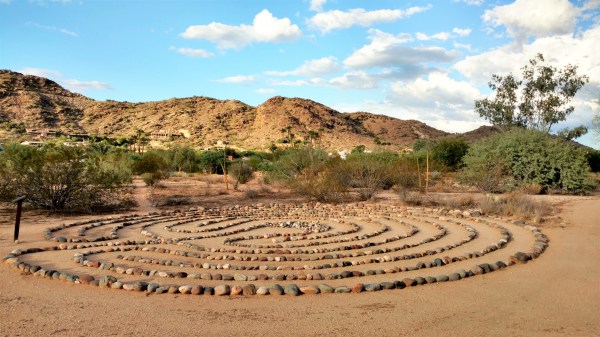
Labyrinth at the Franciscan Renewal Center, Scottsdale, AZ

I attended the Transformative Language Arts Network’s annual Power of Words conference for the first time last week and it was amazing! Caryn Mirriam-Goldberg, former Kansas Poet Laureate, started a MA program through Goddard College in 2000, founded the Power of Words conference in 2003 and the Transformative Language Arts Network was officially founded in 2005.

The 2019 Power of Words conference was a small, intimate group of around 60 people. I found the discussions with fascinating and interesting people outside of the conference as inspiring as the actual conference offerings – which were incredible! I was able to have a nice chat with Caryn and we exchanged books, and I now have her Landed and Following the Curve to continue the conference with now that I am home. I met the new managing director, Hanne Weedon. Actually, I ended up chatting with most of the council at some point during the conference: Liz Burke-Cravens, Caleb Winebrenner, and Chip Cummings.

Right from the start of the conference, I sat down to dinner with author Gregg Levoy (Callings, Vital Signs) and Pediatric Neurologist, Peter Bingham (whose book in progress idea sounds great and I hope to read some day). Gregg Levoy did a few presentations, starting with his pre-conference workshop, Courage & Clarity with Your Right Calling – a great session in which he asked the audience a series of questions leading deeper into passion and calling and then looking through our answers to “search for concentrations of energy” in our answers and common themes. He also gave the keynote that night. Gregg was gracious enough to attend my workshop Heroic & Healing Journeys for Contemporary Times (which I’ll discuss in a future post), and he referenced Camus’ The Rebel, that “to be human is to rebel against tyranny.” It is quite a synchronicity that I had brought along that very book with me to the conference!

Gregg Levoy

The first pre-conference workshop I attended was Noa Baum’s “Stories Old & New: A Path to Healing & Resilience,” a storytelling workshop. This was a very helpful workshop and made me think about how “transformation is contagious,” to tell a personal story of transformation can become a universal story of transformation, and vice versa. Noa also gave a spell-binding performance of her “A Land Twice Promised.” I was speechless for a while after it. Noa is a Jewish woman from Israel and it is the story of her years of friendship with a Palestinian mother, recalling the struggles of growing up in the Middle East, whilst their children played together in the United States. The performance follows the story of their friendship, as well as the stories of their mothers. The name of her performance is the same title as her book, A Land Twice Promised: An Israeli Woman’s Quest for Peace. In speaking of the distinction between the performance and the book, Noa told me, “the show is the story of our friendship and the stories of our mothers. The book is a bit different – it is a memoir telling the story behind the show and how it all came to be. It is also the story of how I discovered the transformative healing power of storytelling and how I use it for peacebuilding.”

Noa Baum

The third pre-conference workshop was given by the wonderful poet, Usha Akella, “Fetch the Fire: Writing the Ghazal.” This was a great history and introduction to the form of the ghazal and we all muddled through writing one ourselves. The generous poet, Steffen Horstmann had donated signed copies of his book, Jalsaghar – thanks for this Steffen! We studied his ghazal, “[Clouds roil as Shango drum echoes in the Nile delta],” with the great line: “Charms rattle in a shaman’s fist as wind along the shore / Thrashes trees (rousing panthers from shadows) in the Nile delta.” Usha’s keynote the next day, “Matwaala: The Birth of a Festival,” described how she worked to found Matwaala, the South Asian Diaspora Poets Collective. This was a riveting presentation that focused not only on poetry, but politics, spirituality, immigration, and on bringing all voices together. It concluded with Usha reading her own poem, “Enough!” which Usha told the TLA Network they could share. This poem is a call and a challenge for “the people” to take care of the children of this Earth. Usha’s newest book of poetry is entitled, The Waiting. The book starts with the Prologue: “The hidden hand gently opens, reveals / the secret script so concealed from us, / And as the hope-less night moves to morning, / The heart’s compass from distrust to trust.” The Waiting is published in India, but you can get a copy directly from Usha by emailing her at: Reachmatwaala@gmail.com. Her other books are worth looking for: A Face That Does Not Bear the Footprints of the World, …Kali Dances. So Do I…, Ek: An English Musical on the Life of Shirdi Sai Baba, and her travel journal and poems, The Rosary of Latitudes. You can find links to Usha Akella’s poems through the Matwaala website and also a few of her poems from The Waiting are available on the Muse Indian website.

Usha Akella

I thoroughly enjoyed several long talks with Peter Bingham of Vermont Children’s Hospital and Suzanne Richmond, who developed the Health Arts & Sciences program at Goddard College. Suzanne introduced me to Dr. Celia Hildebrand, an acupuncturist, who then invited me to drive out to meet Gladys Taylor McGarey, one of the founders of the American Holistic Medical Association. I had a nice chat with Celia and Gladys and we all spoke of our callings and journeys into becoming healers. Gladys is quite impressive, at 98 years old she is still working on developing a Living Medicine program in the community and she shared with us some of her notes for her upcoming talk at the Academy of Integrative Health & Medicine conference later this month.

Dr. Gladys McGarey

The conference was set at the beautiful Franciscan Renewal Center with a desert healing garden that I started every morning in, drinking coffee, journaling, and watching and listening to all the desert birds and animals waking up for the day.

Such great community, inspiring company, and visionary creativity at the Transformative Language Arts Network Power of Words Conference! Check out their website and their work! Photos below of (Middle Right) David Kopacz, Usha Akella, and Chip Cummings and (Lower Left) Peter Bingham, David Kopacz, poet Cindy Rinne, Suzanne Richmond, and Usha Akella.

New Article in The Badger: Words Create Worlds, Part 2 Rebecca Solnit and Calling Things by their True Names

My next article in this series on words creating worlds, fascism, and spirituality is out in The Badger online magazine! It can be found on pages 52 – 60.

This article focuses on Rebecca Solnit’s latest book, Call Them by Their True Names (2019). Here are a few excerpts from the article and accompanying photos from the Olympic Peninsula.

“Words create worlds,” said Rabbi Abraham Joshua Heschel.[i]

What we call things creates not just discourse, but reality. The words that we use and the words that we do not use lead us in certain directions and have different effects. Words are not just words, they are tools that shape, and give expression to, reality.

Words create our reality and our current reality is in crisis.

Across the world, in many different countries, politicians are rising to power using words of separation rather than words of union. This political crisis is a spiritual crisis because using words to create reality is a spiritual act.

One of the Crises of the Moment is Linguistic

Rebecca Solnit’s Call Them by Their True Names (2018) examines the uses and abuses of language in politics, stating that “one of the crises of this moment is linguistic.” The linguistic crisis confuses us about what is real, what is true, about who we are, and about our relationships with each other and the natural world. “Calling things by their true names,” Solnit writes, “cuts through the lies that excuse, buffer, muddle, disguise, avoid, or encourage inaction, indifference, obliviousness. It’s not all there is to changing the world, but it’s a key step.” “Once we call it by name, we can start having a real conversation about our priorities and values. Because the revolt against brutality begins with a revolt against the language that hides brutality.”[ii]


Sun through the Rain Forest, near Sol Duc River, Olympic Peninsula (D. Kopacz, 2019)

The Deregulation of Meaning

"If you begin by denying social and ecological systems, then you end by denying the reality of facts, which are, after all, part of a network of systematic relationships among language, physical reality, and the record, regulated by the rules of evidence, truth, grammar, word meaning, and so forth. You deny the relationship between cause and effect, evidence and conclusion; or, rather, you imagine both as products on the free market that one can produce and consume according to one’s preferences. You deregulate meaning. . . . And this is how the ideology of isolation becomes nihilism, trying to kill the planet and most living things on it with a confidence born of total destruction."[iii] 

A Storytelling Work that Matters

"This work is always, first and last, a storytelling work, or what some of my friends call ‘the battle of the story.’ . . .  To sustain it, people have to believe that the myriad small, incremental actions matter. . . . To believe it matters—well, we can’t see the future, but we have the past. Which gives us patterns, models, parallels, principles, and resources; stories of heroism, brilliance, and persistence; and the deep joy to be found in doing the work that matters. With those in hand, we can seize the possibilities and begin to make hopes into actualities."[iv]

Doing “the work that matters,” this is what we are called to do. Joseph Rael reminds us that “work is worship,” so this work of activism, this work of story, this work of loving our neighbors, is a sacred work that we are called to do and that we are called to put into words so that we can create, instead of a world of hate, separation, and war, we can create a world of love and peace.

Sun through the Trees, Mt. Muller, Olympic Peninsula

Next issue: Rob Riemen’s To Fight Against This Age: On Fascism and Humanism

Throughout 2019, I will continue to write about some of these topics of how our “words create worlds.” In working with Joseph Rael, writing our next book, Becoming Medicine: Pathways of Initiation into a Living Spirituality, I felt compelled to write about the responsibility of mystical, visionary, and shamanic experience—that we must work toward “Spiritual Democracy.” At its deepest point, mystical experience leads to an awareness that we are all one and this comes with a responsibility to challenge words of separation which ultimately lead to fascism. Mystical experience is a pathway that leads us to question who we are and gives us a responsibility to use our words wisely to create worlds where we are becoming the medicine that our world needs. As Rumi says, “We are pain and what cures the pain.”[v]


[i] Life Between the Trees blog. I first came across a shorter instance of this quote in the Omid Safi reference below.

[ii] Rebecca Solnit, Call Them by Their True Names, 4, 1, 4.

[iii] Ibid., 50.

[iv] Solnit, 184-185.

[v] Rumi, “We are the mirror as well as the face in it,” The Essential Rumi, trans. Coleman Barks, (106).

Happy National Book Lovers Day!

August 9th is National Book Lovers Day in the United States. I’ve been wanting to write a piece on books – specifically buying too many books, but then I came across an idea that maybe too many is not too many. Here are some ideas to make you feel better about having stacks of unread or partially read books – or maybe it will just be an excuse to buy more books!

My home office desk

A 2018 article in Big Think entitled, “The value of owning more books than you can read,” by Kevin Dickinson, has some interesting ideas around unread books. Dickinson summarizes a view by statistician Nassim Nicholas Taleb, of unread books as an “antilibrary.” Taleb wrote about the anti-library in his book, The Black Swan: The Impact of the Highly Improbable. Taleb discusses author Umberto Eco’s library of over 30,000 books. Dickinson writes,

“Eco’s library wasn’t voluminous because he had read so much; it was voluminous because he desired to read so much more.”

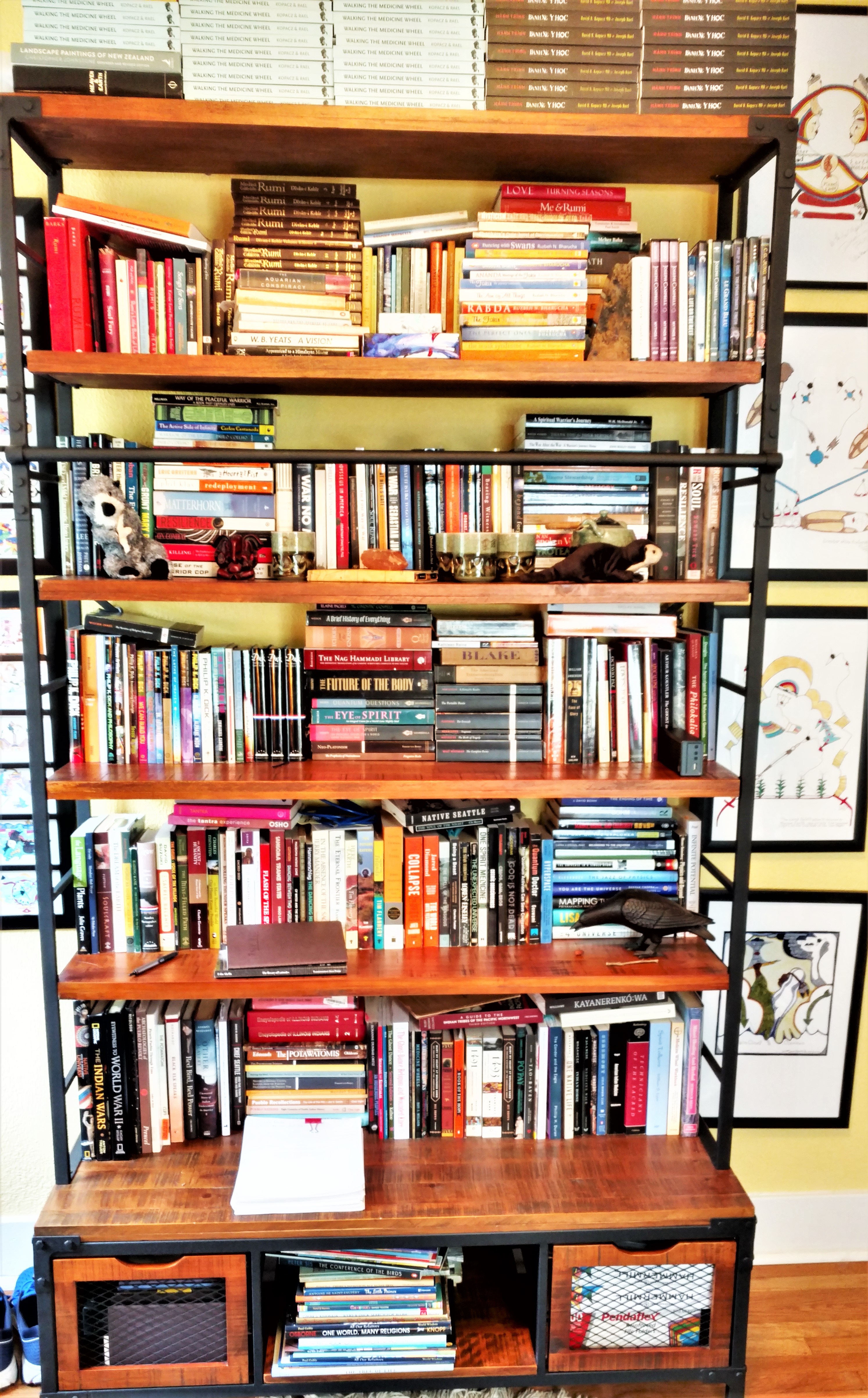
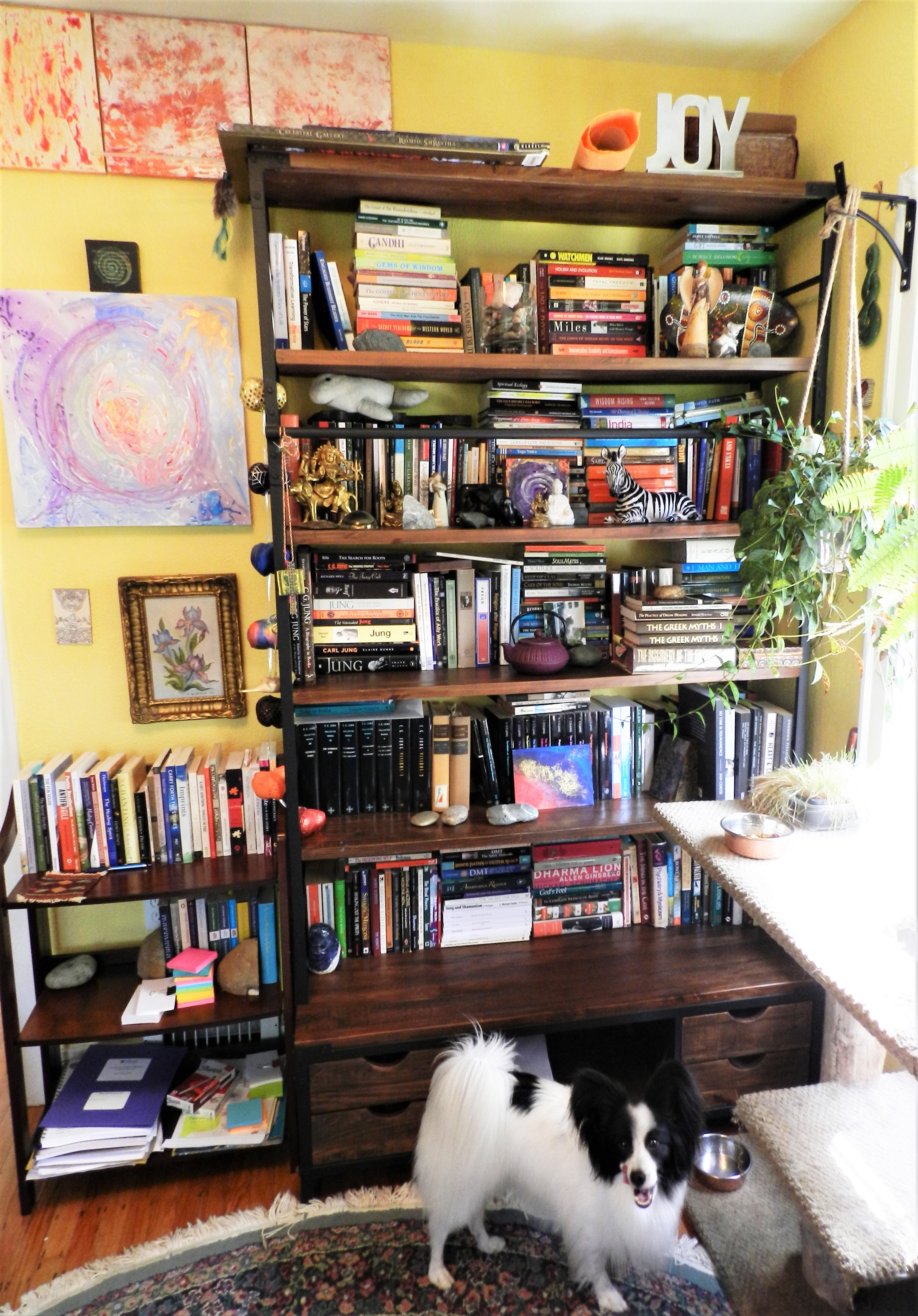
One of my bookshelves in my office

This idea of the benefit of the “anti-library” and unread books shows us something about the benefit not of knowing, but of wanting to know. A small, tidy library may be a sign of an ordered mind and tidy life, or it may be a sign of a lack of curiosity about the world and the world of ideas. Dickinson quotes Taleb:

“Read books are far less valuable than unread ones. [Your] library should contain as much of what you do not know as your financial means, mortgage rates, and the currently tight real-estate market allows you to put there. You will accumulate more knowledge and more books as you grow older, and the growing number of unread books on the shelves will look at you menacingly. Indeed, the more you know, the larger the rows of unread books. Let us call this collection of unread books an antilibrary.”

Another book shelf, with my assistant, Corbin, finishing a snack

Dickinson quotes Taleb, “We tend to treat our knowledge as personal property to be protected and defended.” And further, “It is an ornament that allows us to rise in the pecking order. So this tendency to offend Eco’s library sensibility by focusing on the known is a human bias that extends to our mental operations.” Dickinson cites Jessica Stillman’s concept of “intellectual humility,” as focusing on how much we do not know, instead of how much we do know.

My other assistant, Sofia

Dickinson then writes about the Japanese word and concept, tsundoku, referring to stacks of unread books. He says its etymology comes from “tsunde-oku (letting things pile up) and dukosho(reading books).”

Dickinson’s article, “The value of owning more books than you can read,” is a good read with a number of interesting ideas around the value of books beyond knowing the actual knowledge found in the books. I have not summarized the whole article, I’ll leave you to it if you are interested, or perhaps you would rather just go out and buy Taleb’s book and maybe read it or maybe not!

My writing desk and another book shelf

 I thought today, National Book Lovers Day was a good day to write about this thought-provoking concept of the anti-library of unread books which teaches us about the value of having things we have not mastered, always having the next book (or three, or forty) you want to read, and it says something about the value of focusing on what you desire more than on what you have acquired.

Oh, and one last thing, I must have done this subconsciously, but I just realized I’m wearing the appropriate shirt today for National Book Lovers Day!

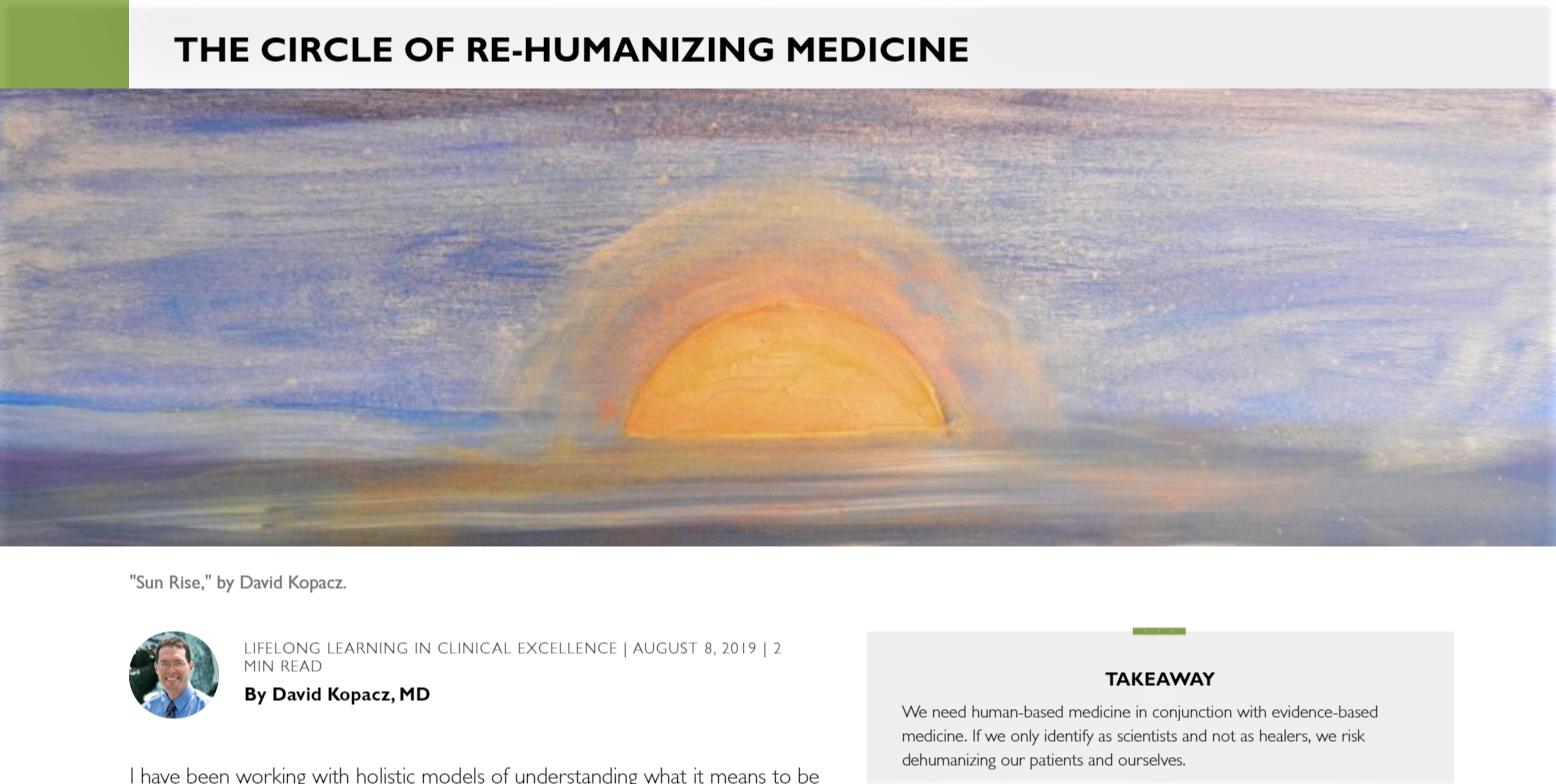
The Circle of Re-humanizing Medicine – new guest post at CLOSLER

Thanks again to the folks at CLOSLER for the next in a series of guest post on various forms of Circle Medicine & Circle Healing. This week’s post is titled, “The Circle of Re-humanizing Medicine.”

Here is the Takeaway summary:

We need human-based medicine in conjunction with evidence-based medicine. If we only identify as scientists and not as healers, we risk dehumanizing our patients and ourselves.

They also included the Circle of Caring for Self & Others that my sister, Karen Kopacz, designed for use with the workbook of that same name that I have been developing with Laura Merritt. It is based on my 2014 book, Re-humanizing Medicine: A Holistic Framework for Transforming Your Self, Your Practice, and the Culture of Medicine.

Caring for Self & Other Circle

Next week is the last in my series of guest posts at CLOSLER, please check it out. It is on the VA Circle of Health, another holistic model of Circle Medicine.

Memorial Day Wishes of Peace for those on all sides of the Vietnam War – Bánh Xe Y Học: Hành Trình

On Memorial Day we remember those whom we have lost. Official reports of loss of US soldiers in the Vietnam War is 58,000+. A 2008 British Medical Journal study estimates 3.8 million total deaths during the Vietnam War (called the Resistance War Against America in Vietnam). The suffering of war continues long after the war ends with PTSD, Moral Injury, Agent Orange exposure, and even suicide. Controversy exists over the number of US Vietnam veterans who have committed suicide since returning home, with estimates from 9,000 (in a 1990 study) to over 50,000 reported in various places. As a psychiatrist who works daily with veterans, I see the long-lasting after effects of war. Brain science has been pushing back the age of full development for the human brain, with 25 years of age being considered brain maturity. Wars typically are fought by the young and after every war we have a generation of veterans whose developing brains have been shaped by war and the imprint of death. The casualties of war are the walking wounded as well as the deceased, and many of the wounds are not visible.

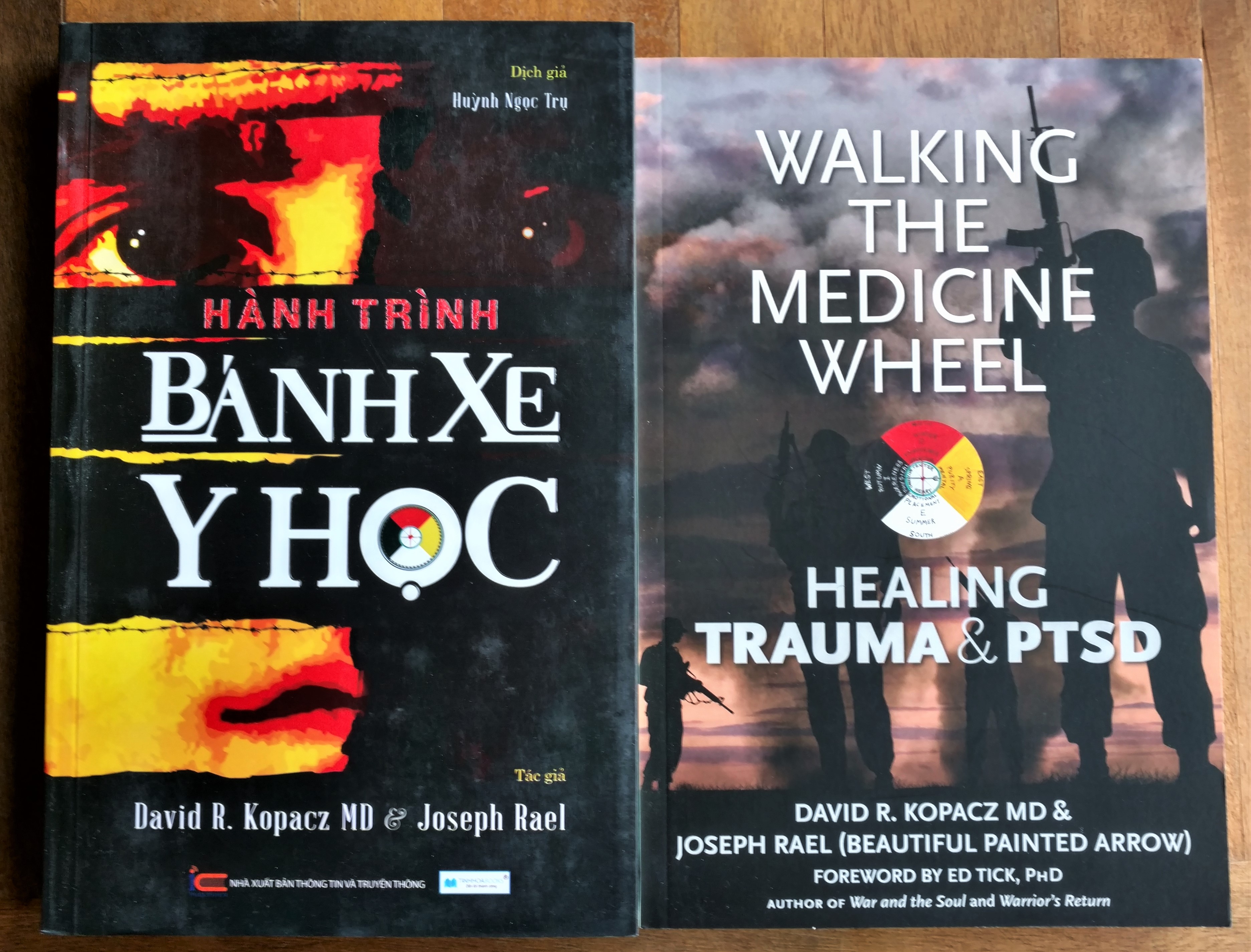
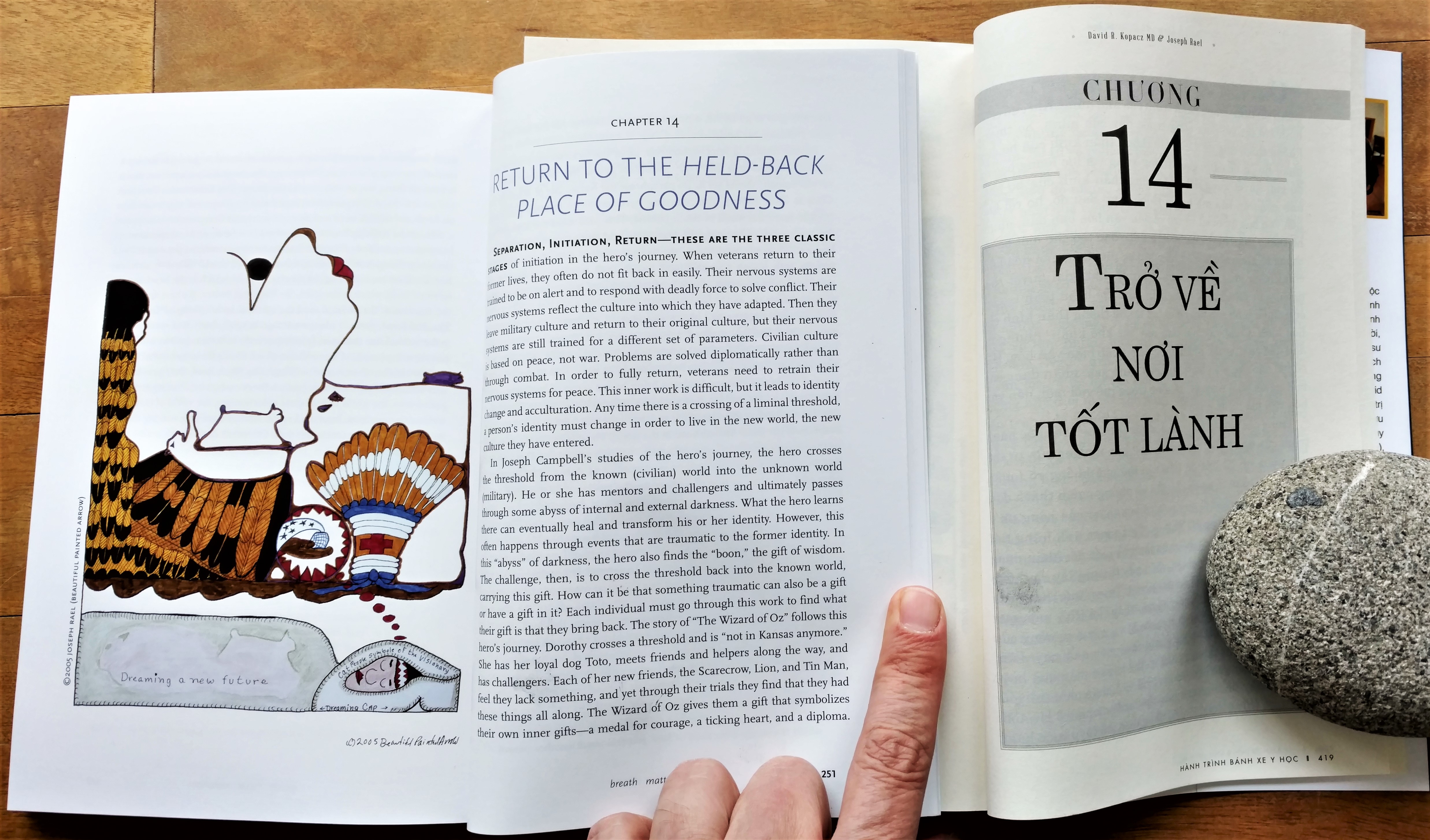
I just received a box of books from Vietnam, the Vietnamese translation of Walking the Medicine Wheel: Healing Trauma & PTSD (Bánh Xe Y Học: Hành Trình). It is really amazing to hold these books from Vietnam in my hands and compare them side by side. I work with so many veterans at the VA who served in Vietnam and to have the words of peace that Joseph Rael (Beautiful Painted Arrow) and I have put together into this book translated into Vietnamese feels very important.

The work of peace is a continual work, like tending a garden. To receive a box of books from Vietnam about bringing peace to veterans is like getting a big packet of seeds to replant what has been injured by war. For Joseph, language is very important, not just in conveying meaning, but in creating spiritual realities. To have the healing properties of the medicine wheel translated into Vietnamese brings our two lands and peoples closer together in peace. Translators Huỳnh ngọc trụ & Lê Thục Uyên Phương have worked to bring American English and Vietnamese into resonance with each other. In his book, House of Shattering Light, Joseph wrote about how the war gods were first created out of the fear that people had, but that later they came home to peace and became peace gods. In Walking the Medicine Wheel: Healing Trauma & PTSD, the title of chapter 14 is “Return to the Held-back Place of Goodness, which translates into Vietnamese as, “Trở Về Nơi Tốt Lành,” Return to Good Place.” Peace is this Good Place and Joseph tells us that we all have it within our hearts, we can forget about it, we can loose touch with it, but is always there. Our jobs as healers – both those working as healers for others, and those of us who are seeking to heal ourselves – is to find our way back home to this place of goodness, this place of peace. We are all wounded in one way or another, and yet we all have a source of goodness and healing within us – we are the medicine that we are seeking!
Zakir Hussain at the Moore Theatre, Seattle, 4/2/19

Zakir Hussain & Niladri Kumar with the image of Ustad Allarakha as a perpetual presence.

The Masters of Percussion 2019 – The Ustad Allarakha Centenary Tour came through Seattle this past week. The tour celebrates the 100th anniversary of the birth of Ustad Allarakha, Zakir Hussain’s father and internationally-renowned tabla player in his own right. Ustad Allarakha influenced Mickey Hart of The Grateful Dead and had collaborated with Ravi Shankar and made an album in 1968 with jazz drummer Buddy Rich, Rich à la Rakha. Zakir Hussain, played with Mickey Hart’s Planet Drum, as well as with Bill Laswell’s Tabla Beat Science. (Which was, incidentally, the first Bill Laswell album I ever heard, sitting in a cafe in Minneapolis).

The show started with Niladri Kumar on sitar, joined by Zakir Hussain, then added Eric Harland on a full drum kit, and the four piece Drummers of Kerala. It was a great show, filled with lots of beats. The musicians all were smiling and having fun and challenging and riffing off each other.

Zakir Hussain ended the show saying, “Rhythm is a unified concept, it is one language.”

Words Create Worlds – new essay in The Badger

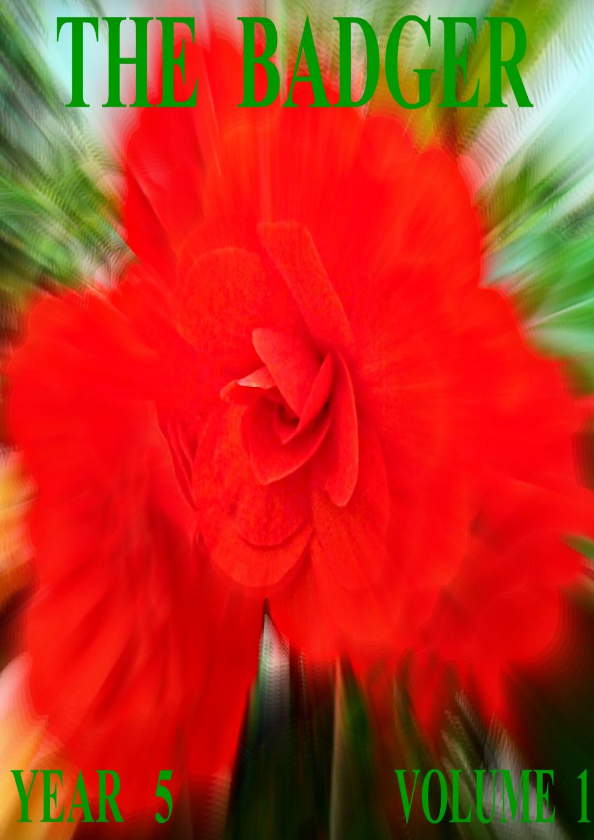
“Words Create Worlds,” my new piece in The Badger, Year 5, Volume 1, is available now through the link, page 47. The title is taken from a quote by Rabbi Abraham Joshua Heschel:

“Words, he often wrote, are themselves sacred, God’s tool for creating the universe, and our tools for bringing holiness — or evil — into the world.  He used to remind us that the Holocaust did not begin with the building of crematoria, and Hitler did not come to power with tanks and guns; it all began with uttering evil words, with defamation, with language and propaganda.  Words create worlds he used to tell me when I was a child.  They must be used very carefully.  Some words, once having been uttered, gain eternity and can never be withdrawn.  The Book of Proverbs reminds us, he wrote, that death and life are in the power of the tongue.”[1]

Heschel points to the power of words to create good or evil in the world. My article is a meditation following the shooting in Christchurch, New Zealand and the increasingly disturbing words of separation and “othering.” I have a special connection with Christchurch, having lived in New Zealand for 3.5 years and having visited Christchurch a few days prior to the second devastating earthquake in 2011. These words that separate us from each other are earthquakes and weapons, in and of themselves, and these words pave the way for future violent actions. You can read the full article in The Badger through this link (scroll to page 47)

In writing Becoming Medicine: Pathways of Initiation into a Living Spirituality with Joseph Rael (Beautiful Painted Arrow), I have felt obligated to write about “spiritual democracy” and the responsibility to act in ways that increase, rather than decrease, our inter-relatedness and oneness. A living spirituality is a call to action. Joseph Rael has been working for world peace for decades now, and working with him, I have taken on this responsibility as well. I plan to write more on the power of words, the ways that they can divide or unite us, and the disturbing trends towards fundamentalism and fascism in our world today. Here is the last paragraph from my essay in The Badger:

Over the next year, I would like to write about some of these topics of how our “words create worlds.” In working with Joseph Rael, writing our next book, Becoming Medicine: Pathways of Initiation into a Living Spirituality, I felt compelled to write about the responsibility of mystical, visionary, and shamanic experience—that we must work toward “Spiritual Democracy.” At its deepest point, mystical experience leads to an awareness that we are all one and this comes with a responsibility to challenge words of separation which ultimately lead to fascism. Mystical experience is a pathway that leads us to question who we are and gives us a responsibility to use our words wisely to create worlds where we are becoming the medicine that our world needs. As Rumi says, “We are pain and what cures the pain.”[2]


[1] Life Between the Trees blog, https://lifebetweenthetrees.com/2012/08/06/words-create-worlds-monday-morning-parable/.

[2] Rumi, “We are the mirror as well as the face in it,” The Essential Rumi, trans. Coleman Barks, 106.

Red Begonias, Christchurch Botanical Gardens, 2011

New Mexico

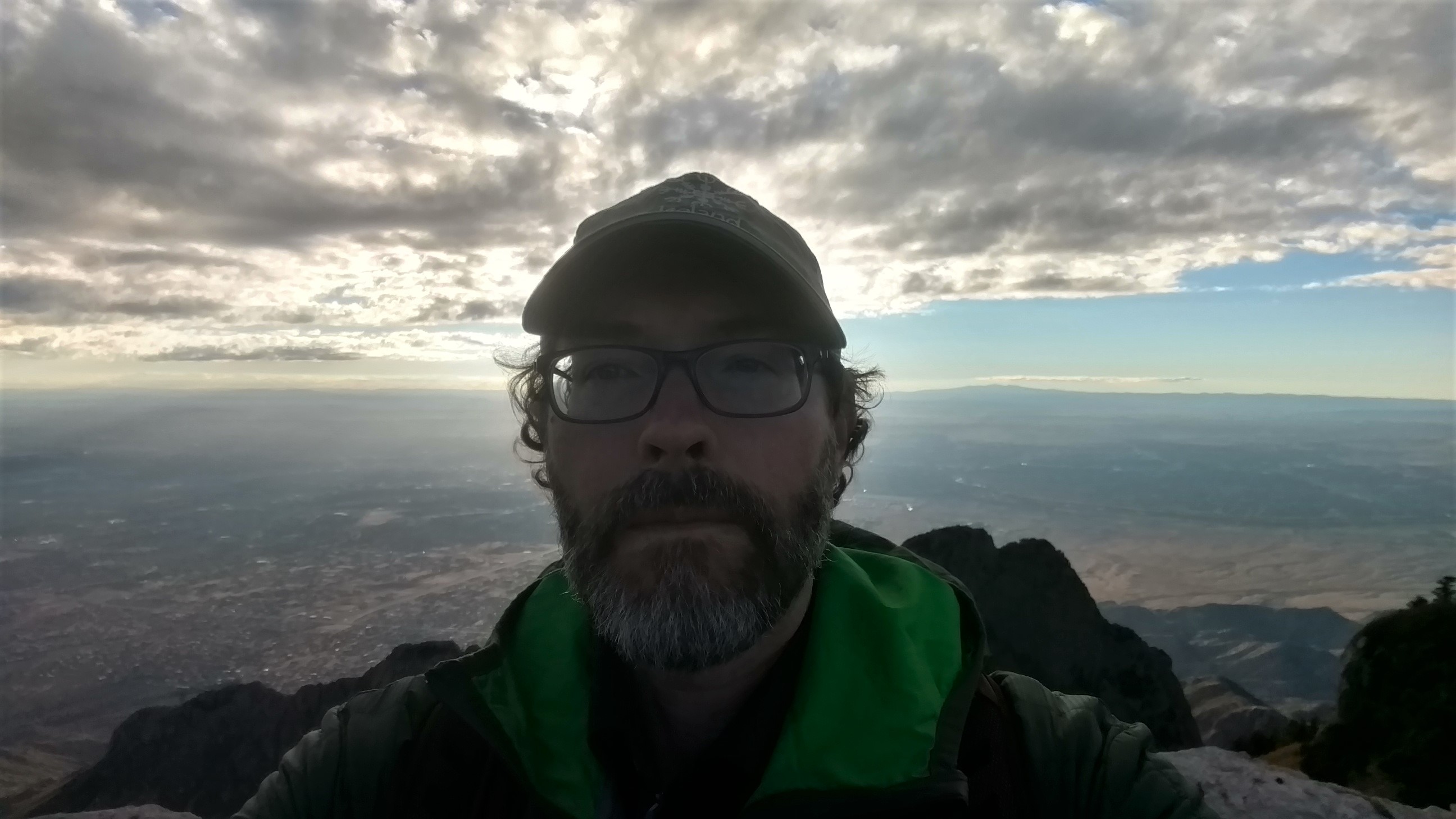
Sandia Selfie

Sunset from the top of Sandia

I took a trip to Albuquerque, New Mexico last month, to do some work with my co-author, Joseph Rael (Beautiful Painted Arrow). My sister met us there and we did some photos and video in preparation for our upcoming book, Becoming Medicine: Pathways of Initiation into A Living Spirituality. I should be getting the final edit back any day now and will be taking one more review of it and then it will start getting formatted – it should be out in the first half of 2019. It is always a lot of fun working with Joseph and I am always learning new things and ancient things.

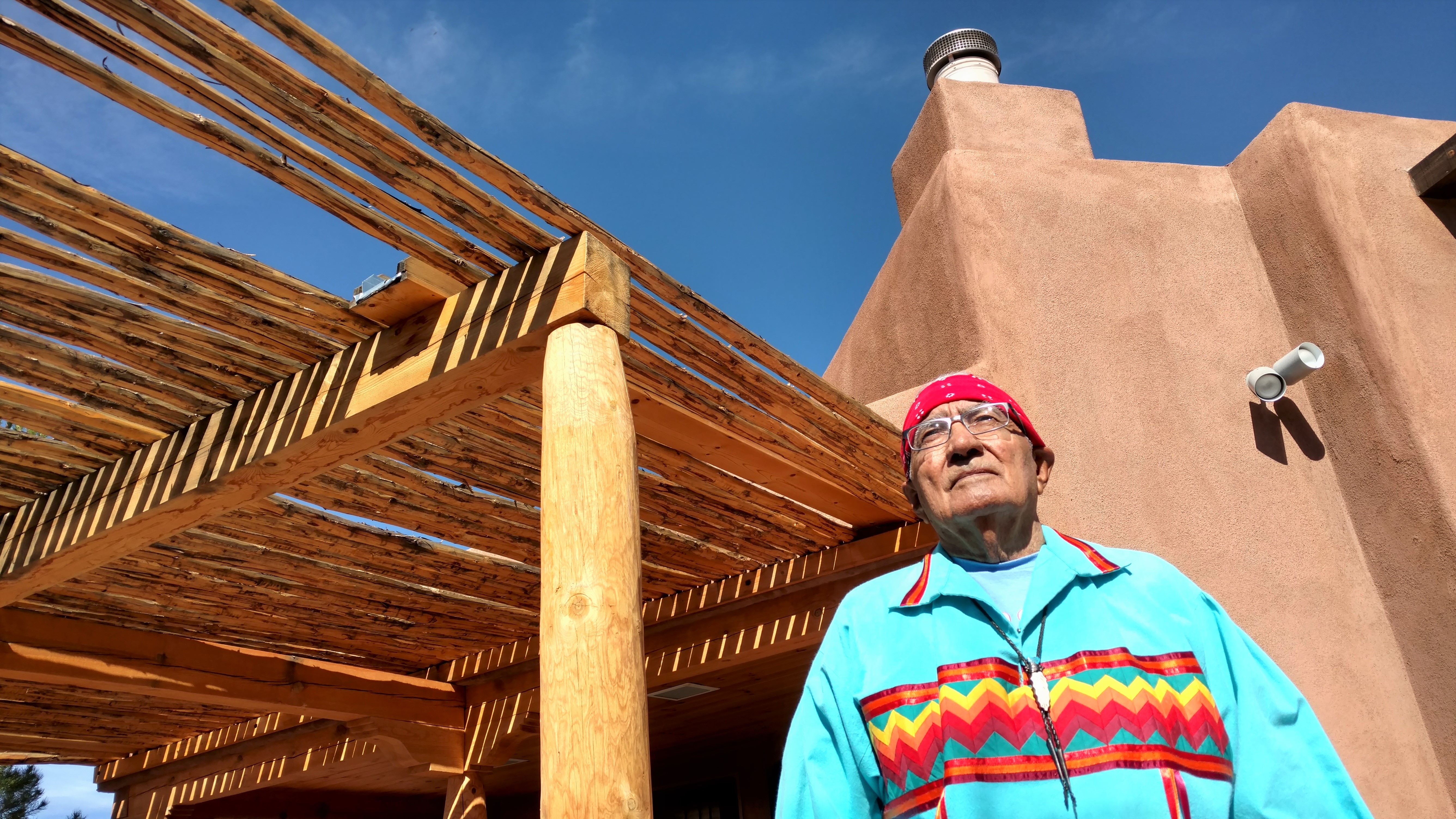
Joseph Rael (Beautiful Painted Arrow)

Joseph Rael (Beautiful Painted Arrow)

The area is very beautiful and my sister, Karen, and I took a couple trips, driving up the back side of Sandia Mountain and to Petroglyph National Monument.

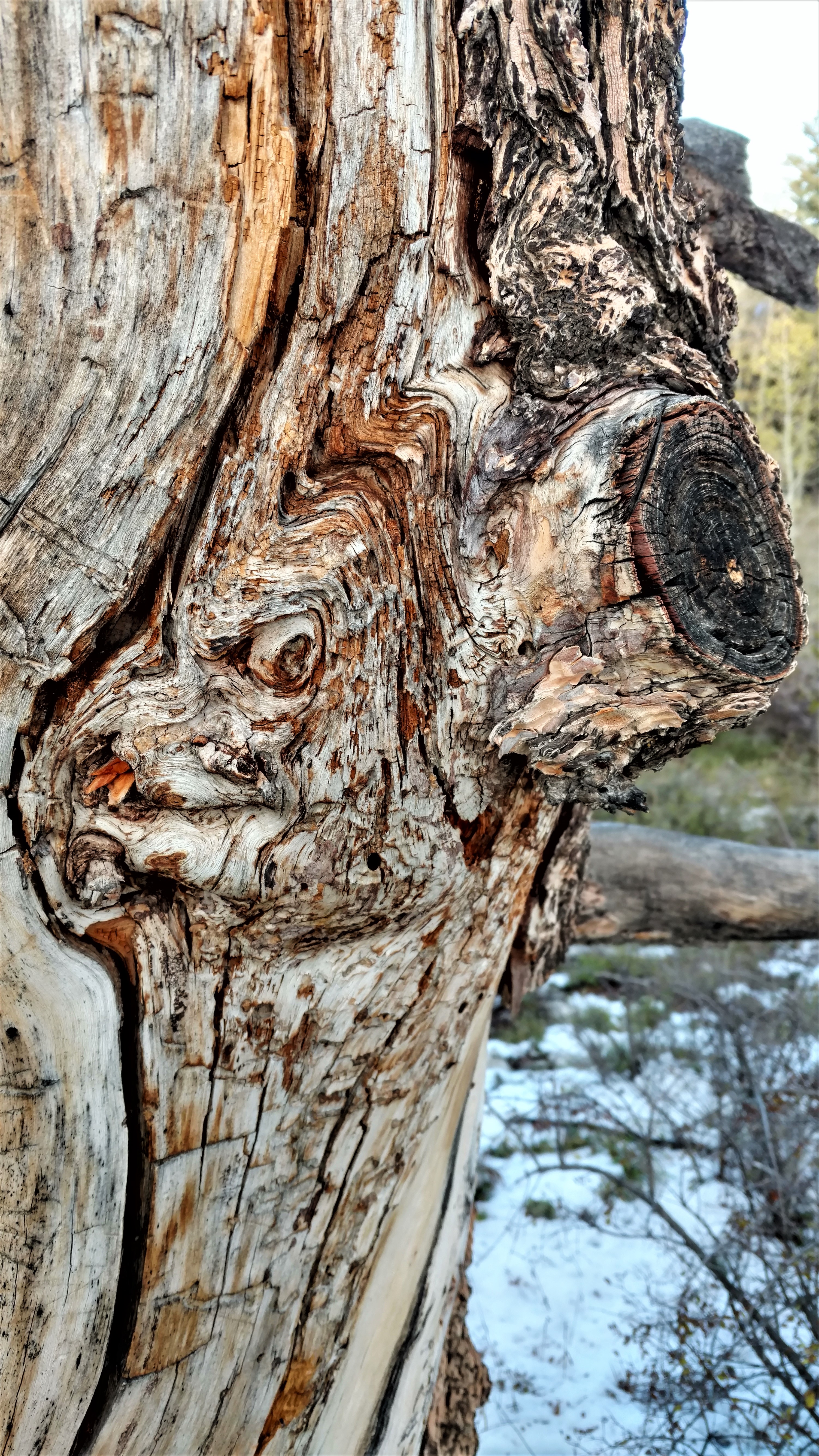
Tree Spirit Sandia

Tree Shape on top of Sandia, a little snow in the background

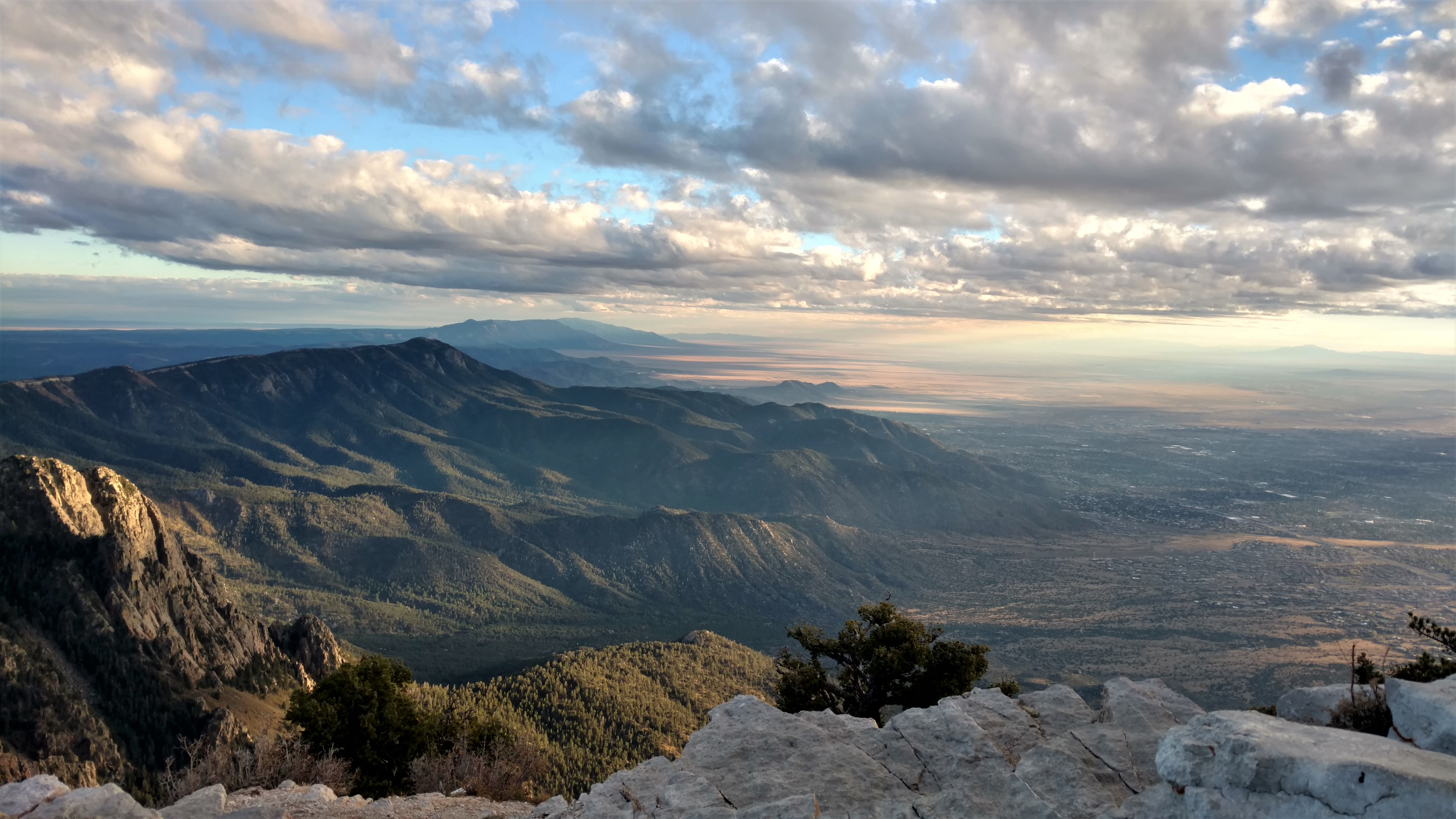
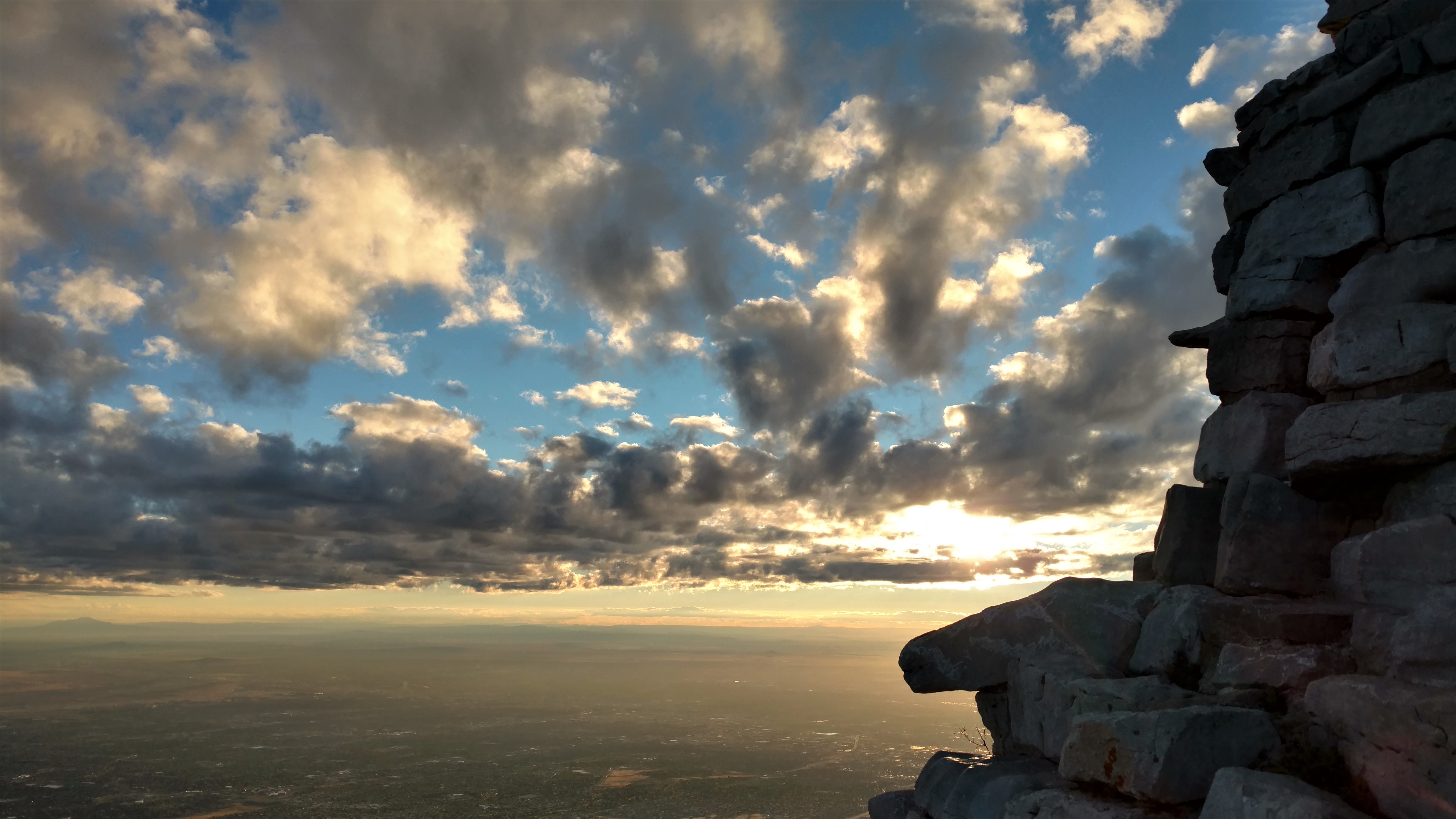
We got up to the top of Sandia with about an hour or so left of daylight and we saw an amazing sunset and beautiful views.

Sandia Southern View.jpg

Looking South from Sandia

Sandia Western View

Kiwanis Rock House, Looking West from Sandia

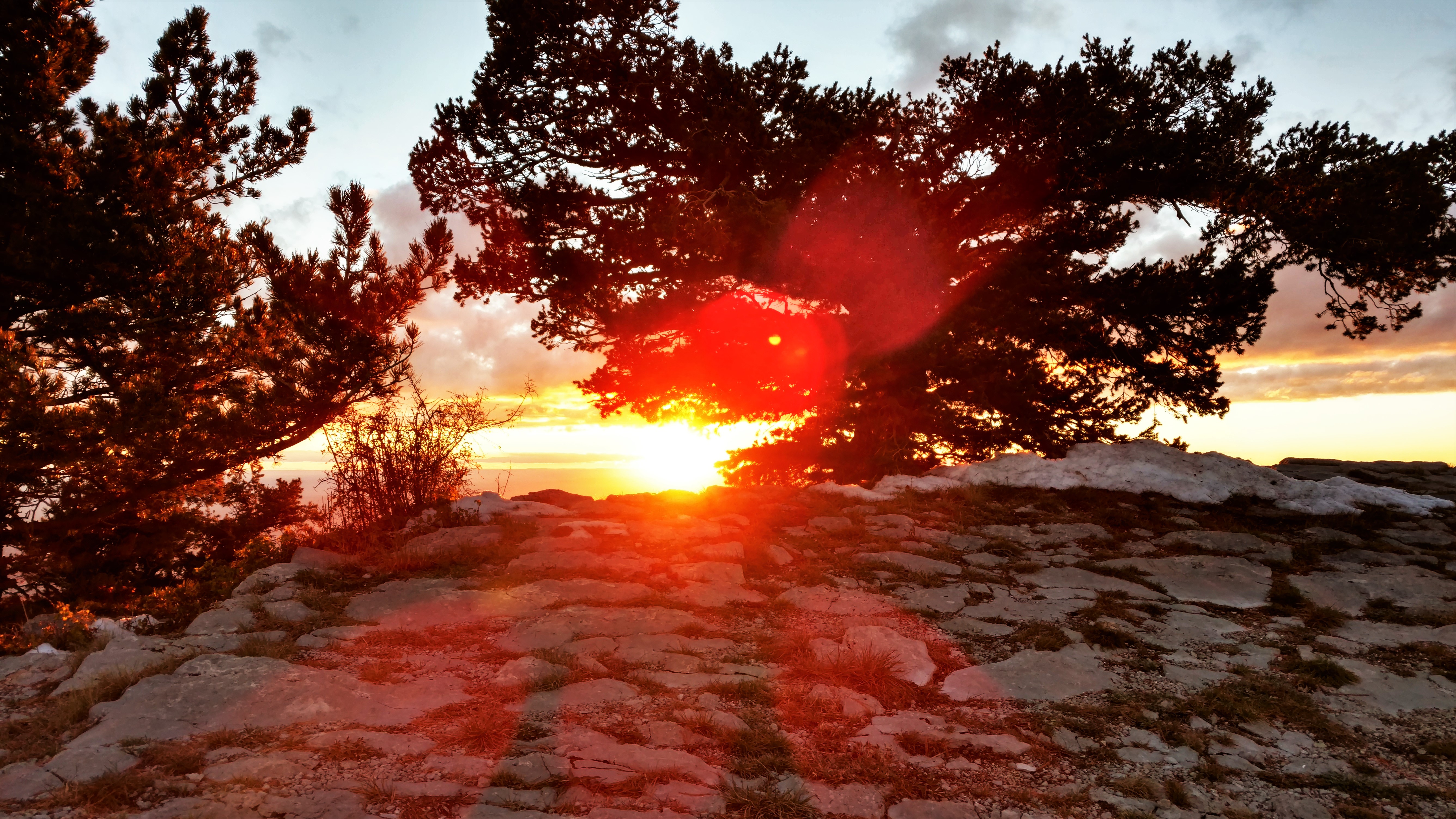
Sandia Sunset through Trees

Sunset through Trees, Sandia

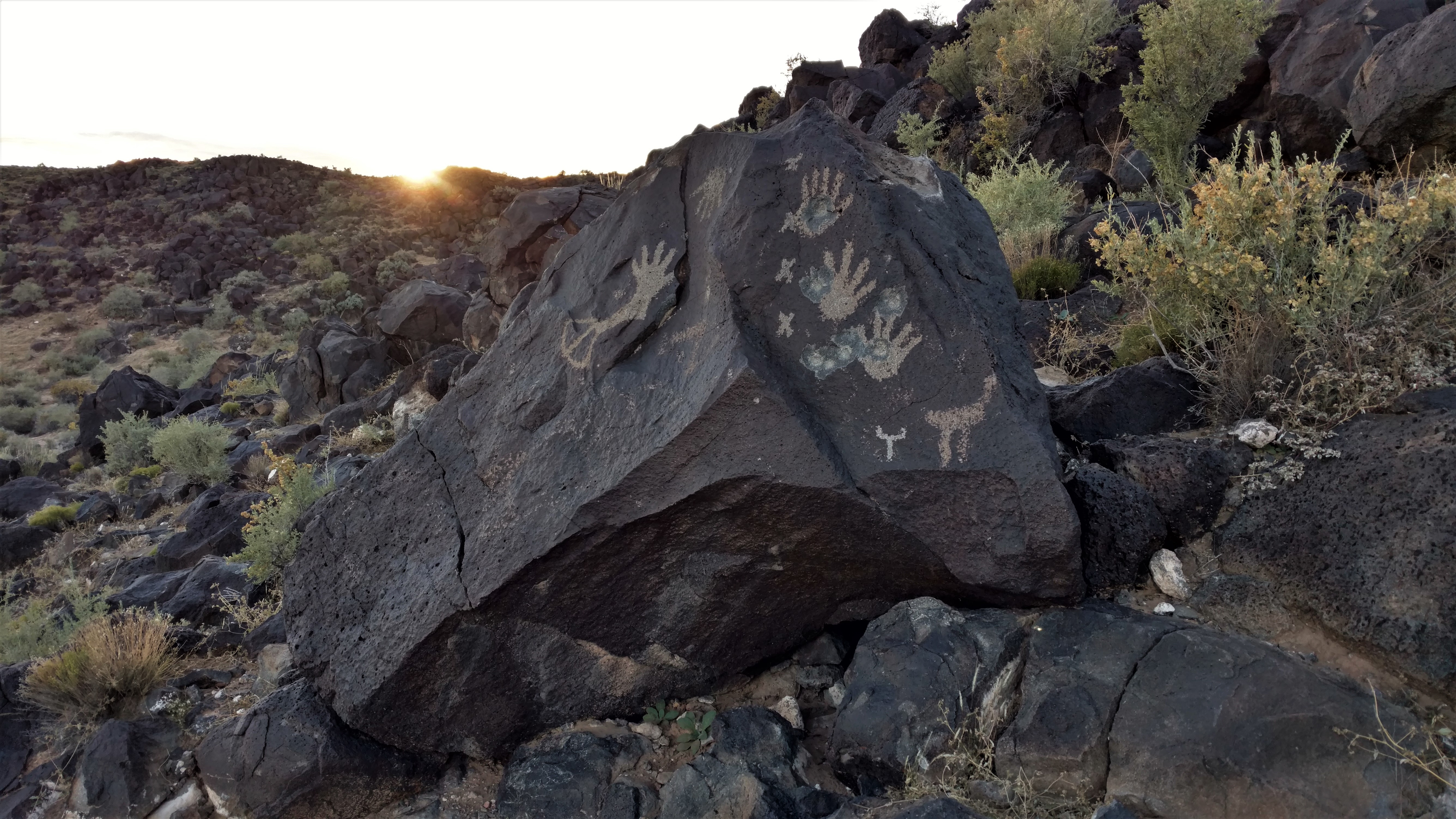
The next night we went to Petroglyph National Monument, again near sunset.

Petroglyphs

Petroglyphs

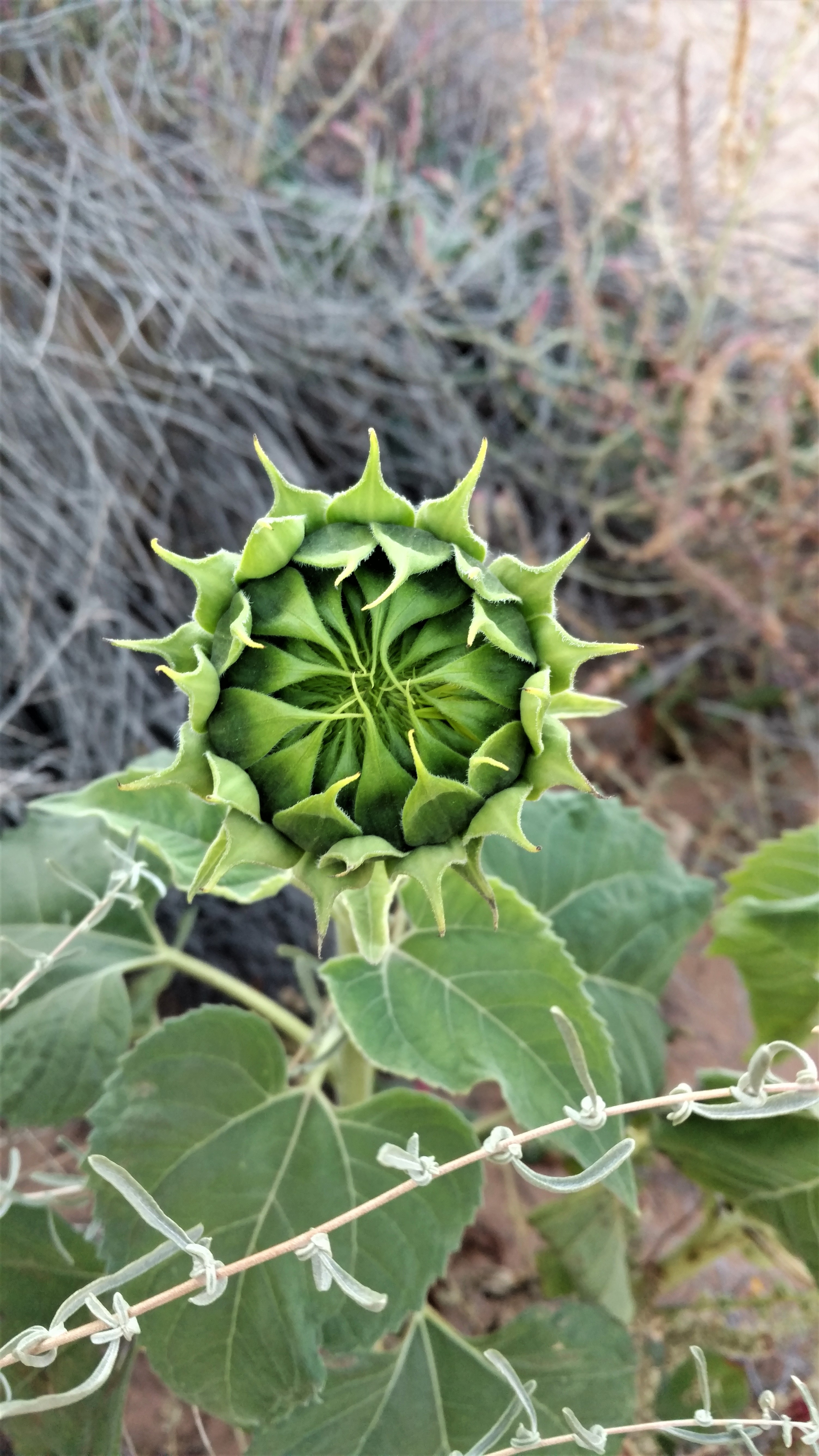
Sunflower

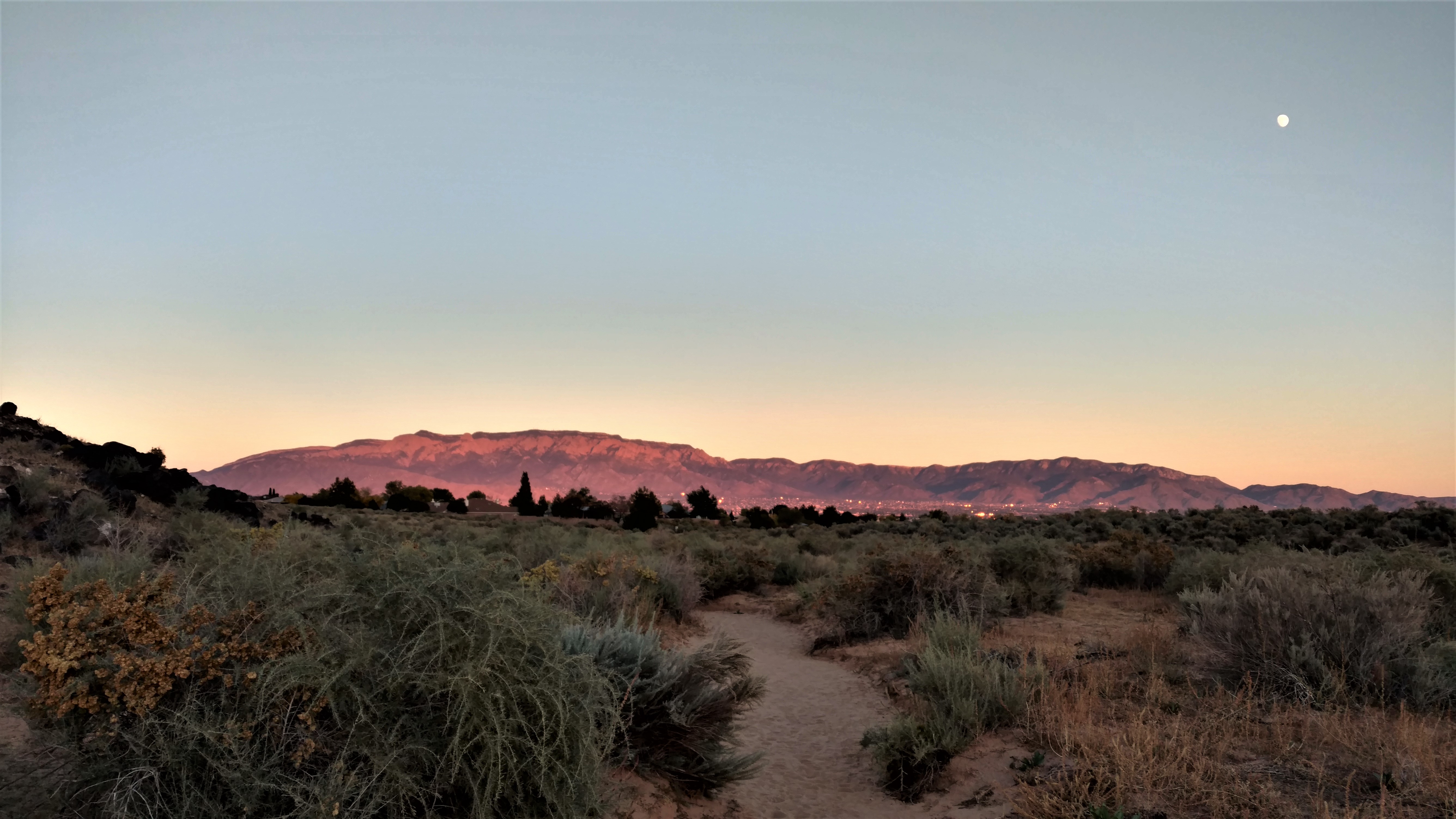
Sandia means “watermelon” in Spanish and you can see how this mountain got its name when you see it at sunset.

Sandia from Petroglyphs Sunset

Sandia Mountain at Sunset from Petroglyph National Monument

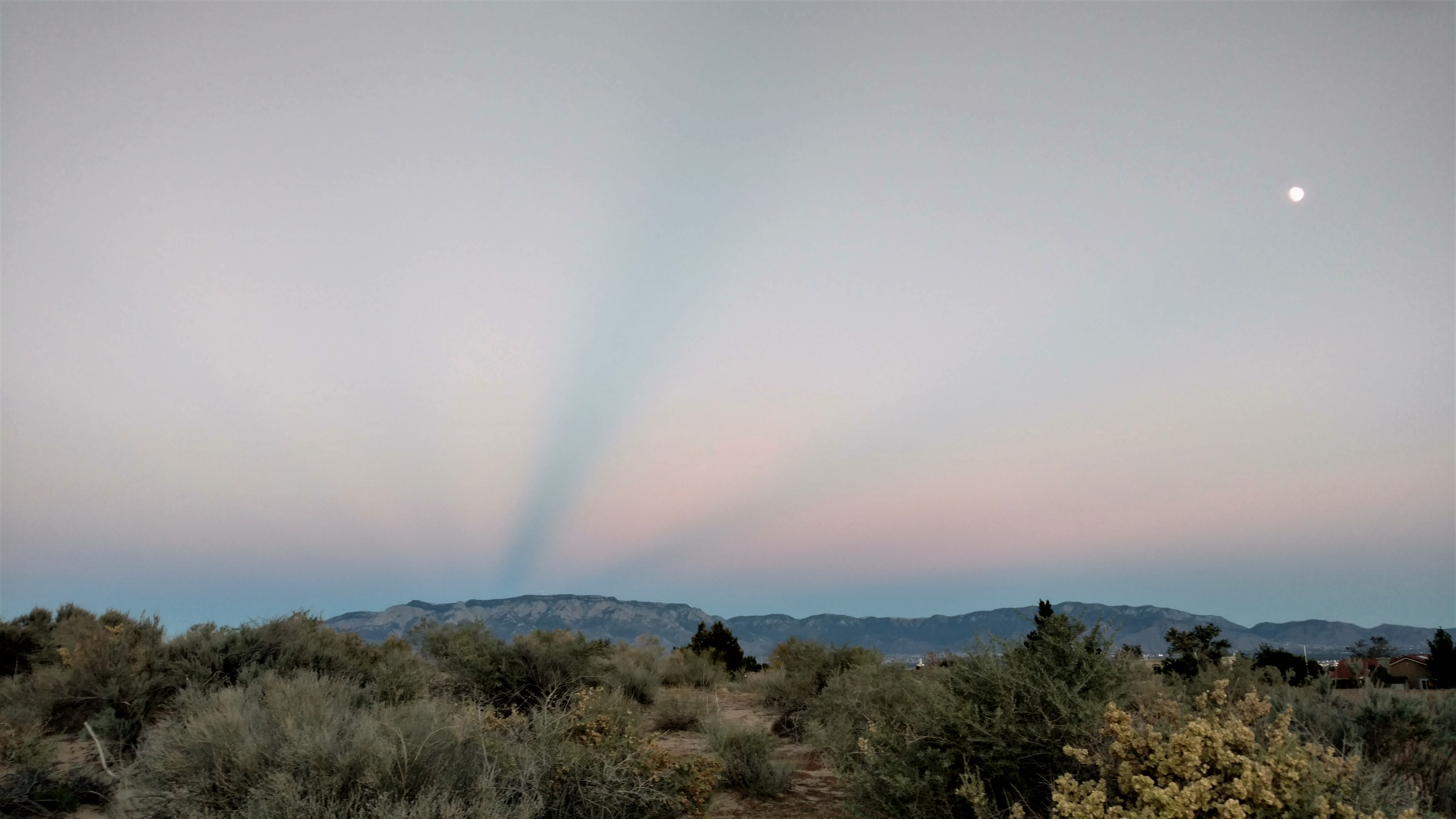
Having visited Sandia and Petroglyph several times, I always feel as if there is some kind of connection of communication between all the petroglyphs facing Sandia. This night there were light streamers visible above the mountain as the sunset behind us.

IMG_20181020_183442482_HDR

Sandia as Sunset Continues

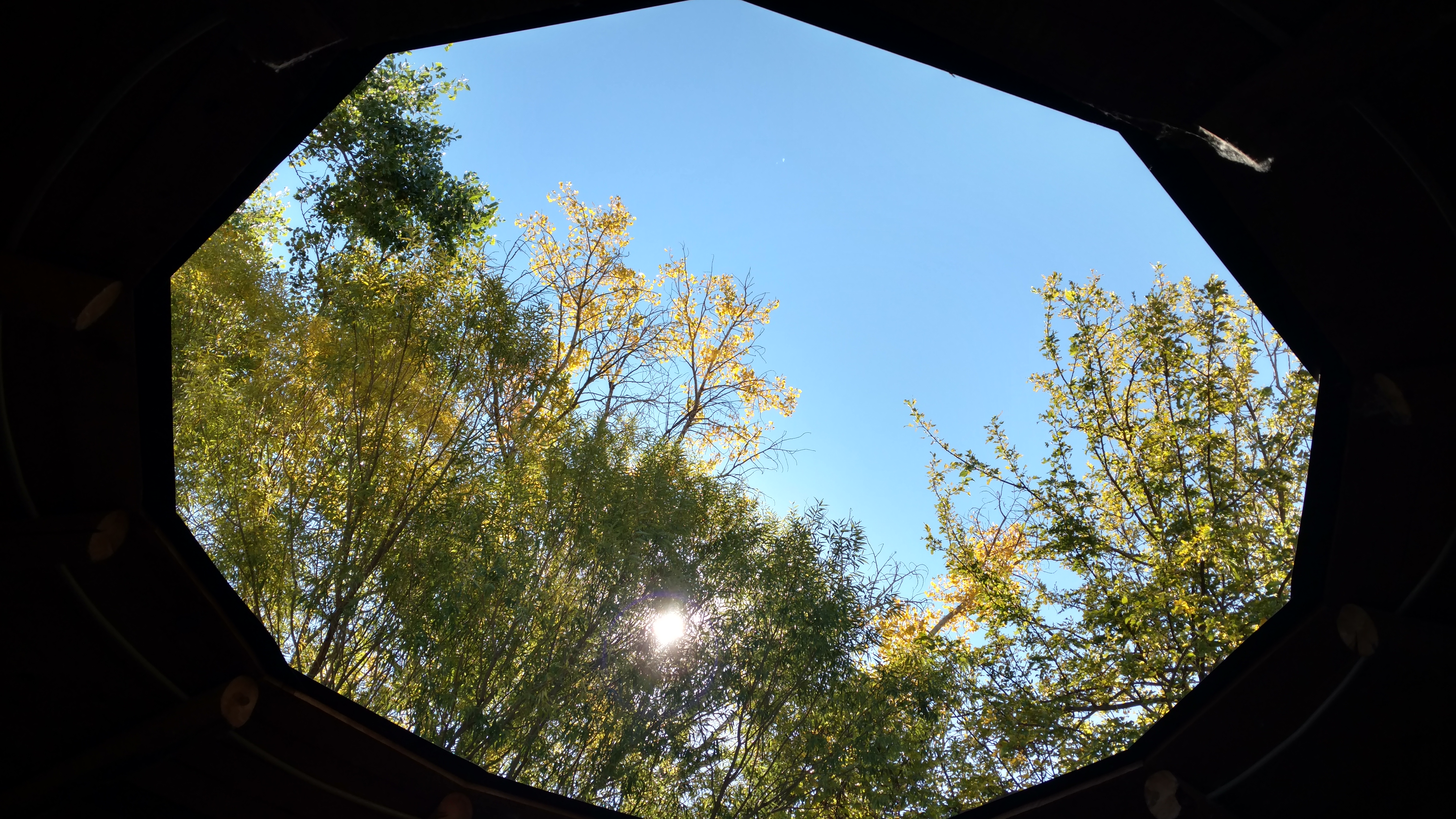
We went to visit our friends, Mike & Marie Pedroncelli and spent some time in their Sound Peace Chamber, built with consultation from Joseph Rael and based on his visions he had in the 1980s of building circular structures, half above ground and half underground where men and women come together to chant for world peace. There are over 50 chambers on four continents that have been built.

IMG_20181021_105501058_HDR

View through top of Sound Peace Chamber


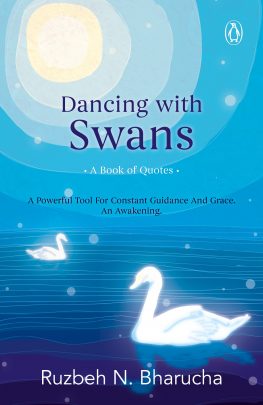
A Review of Ruzbeh N. Bharucha’s Dancing with Swans: A Book of Quotes

cover Dancing with Swans

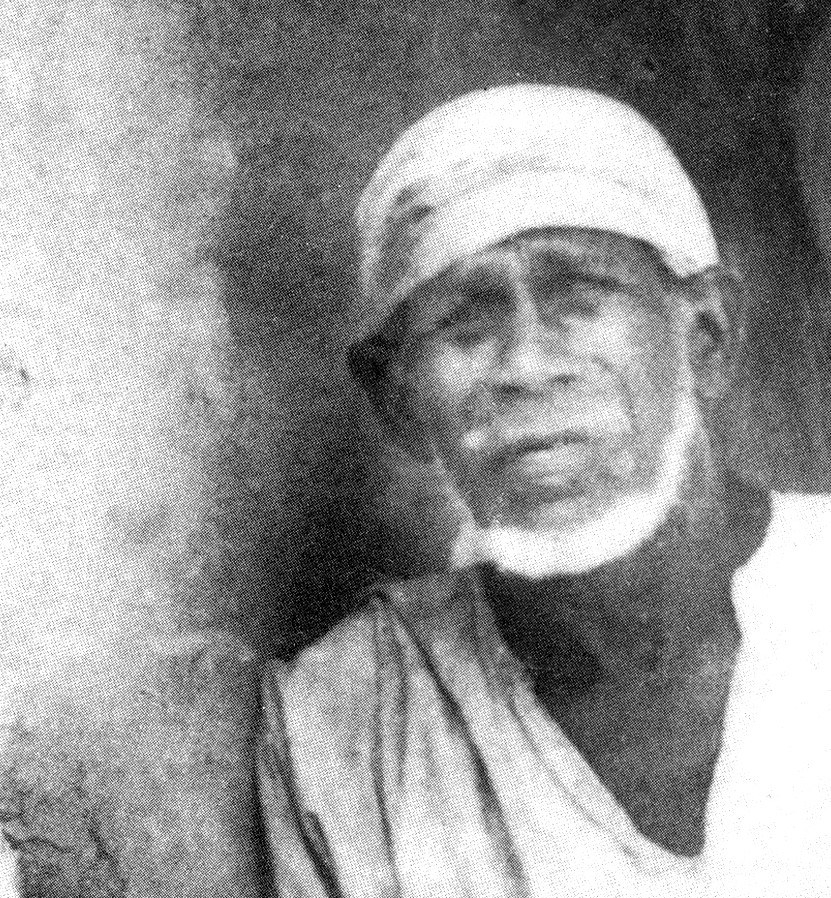
This is a book of short prayers and aphorisms. Ruzbeh Bharucha states in the foreword of the book that 2018 is the 100th year anniversary of Baba Sai of Shirdi’s Maha Samadhi – his enlightened departure from the Earthly realm. Bharucha dedicates the book to “my dear Master, the Fakir of Shirdi; You, The One in whom reside The Goddess and The Lord and the Oneness Family,” (v). Further, Bharucha writes that it is nonsense that Shirdi Sai Baba is gone, “You live in the hearts, minds, breaths and sighs of countless of Your followers and lovers. So how could You ever leave Your body as everything of ours is Yours and if all of ours is Yours, then You reside in millions of us,” (v). The book is thus dedicated to Shirdi Sai Baba as Guru and non-dual Oneness.

shirdi_sai3.jpg

Sai Baba of Shirdi, By Kifayat Hidayat Mawal

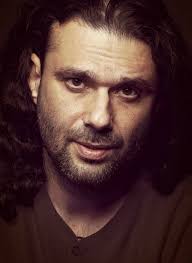
Ruzbeh N. Bharucha is the author of many books in which the protagonist walks and talks and jokes (often irreverently) with God in the form of the Guru, Shirdi Sai Baba: The Fakir series, Rabda, and Ice With Very Unusual Spirits. These books remind me of an Indian Richard Bach, filled with humour and love as they explore the relationship between the wayward devotee and the spiritual teacher. The books are earthy and teach that one does not have to be boring to be spiritual. In fact, it is often the outsider aspect of the protagonist that leads to the spiritual relationship.

Ruzbeh N. Bharucha - Copy

Ruzbeh N. Bharucha

Bharucha has also been writing works that are not spiritual fiction, but more of an autobiographical and non-fiction approach, for instance The Aum of All Things, The Perfect Ones, and The Musk Syndrome. The current book, Dancing with Swans: A Book of Quotes, is in this vein, a book of quotes that came to the author whilst he was in meditation/communion with Shirdi Sai Baba. Bharucha was guided to meditate “after sunset for a certain number of weeks,” (ix). He portrays himself as a slacker, falling asleep, and meditating only a few minutes, but then he would write down the inspired wisdom he received. Bharucha summarizes the book in the following way:

“The theme of this book, in reality, is very simple. Give your best to each moment and leave the rest to The One and after that accept your lot with joyous acceptance. Be kind. Be compassionate. Be a bit crazy. Try not to be an adult. Be childlike but not childish. Be mature, not cynical. Don’t judge. Live and let live. Spend time in work, prayer and play. We are the makers of our own destiny through the use of fee will in our past lives, this one and the future…When life is rubbing our noses in the ground, inhale the fragrance of Mother Earth. When life is tossing us in the air, try and gaze into the sky. All is as well as we want it to be,” (x).

Swan through bushes, St. James

What follows is some 280+ pages of inspired quotes, roughly divided into different topical sections. To me this is solidly a good book, but not great in the way of The Fakir series is. Nevertheless, there are some gems in the book, such as in pointing toward non-duality, “You are the one praying to The One within you. So you are chanting and being prayed to. You are the one chanting and being chanted to. You are The One,” (14). Or, the following:

“Often sadness or emptiness within is a reflection of the yearning of the soul to move towards The One. Those who understand this, move into silence and prayer, or spread joy and compassion. That’s the only antidote to fill the void within,” (16).

Bharucha teaches a path of living spirituality. “Not the path of religion,” he tells us, “but that of spirituality comes from loving God,” (38). Further distinguishing religion and spirituality, he states that, “All that is spiritual leads us to Oneness. Earlier, being religious and spiritual meant the same. Now nothing divides one brother from another as surely as the false interpretation of religion,” (88). Bharucha often illuminates the hypocrisy of religion, ritual, and conservatism, showing that it is those who step outside societal norms and expectations who are the true lovers of God.

“Till one does not make God, Goddess, Guru—the three Gs—as the sole and soul priority, there are innumerable distractions, obstacles, temptations, confusions, to make life a living hell, this and in future lives,” (39).

There are sources of consolation within the book. Particularly in reminding the reader that emptiness and loneliness are steps on the spiritual path.

DSCN3824 (2)

Path to Chapel of Saint Non, Pembrokeshire, Wales, © D. Kopacz 2018

“The emptiness the seeker feels on The Path is a must. One needs to be empty for the Divine Energy to fill us up. The page has to be blank for the Divine Words to be written on,” (23).

In times of darkness, such as our own, Bharucha advises us that the way forward is through, through embracing our fears, just as in the hero’s journey the darkness of the abyss contains the boon that can transform self and world. “The hour before dawn is the darkest but also the most spiritual—the true meditative Kali; you either fear the darkness or go within and become one with Her radiance,” (131). Rather than denying pain or seeking to avoid it, Bharucha writes that the pain is a way to open us up and make us more compassionate and that our choice of how to react to inevitable pain and suffering is what determines our experience.

“I feel sometimes the cosmos has no other way to make us more compassionate than by making us experience hunger, pain, sorrow, loss and anguish. The wise learn from these experiences and become more understanding. Others waste the opportunity and become negative. Karma means going through an experience, while free will decides heaven, hell or in-between,” (195).

Getting back to his main theme of the book, Bharucha reminds us, “The true role of any individual is to allow the unhindered and uncorrupted Divine Energy to flow through him or her. That, in reality, is our only purpose of existence,” (203). Allowing this “unhindered and uncorrupted” flow does not turn us into pious and staid religious people who stand back and above the fray, rather this Divine Energy makes us all individuals, sometimes somewhat quirky and irreverent, engaged in the world, offering compassion and doing good regardless of whether it is an official holy day or not. And yet as the Divine Energy flowing through us makes us into individuals, we are simultaneously in touch with and at one with Oneness, what Bharucha calls the 3 Gs—God, Goddess, and Guru. The Oneness is the energy that flows through the individual, animating diversity, allowing the many in One.

“Don’t waste time on negative stuff. Don’t. In a blink of a moment, we shall be either old, alone or dead, and then realize what we have let slip away from our grasp. All this shit isn’t worth it. Let it go,” (91).

Swan at St James'

Swan, St. James’s Park, London, © D. Kopacz 2018