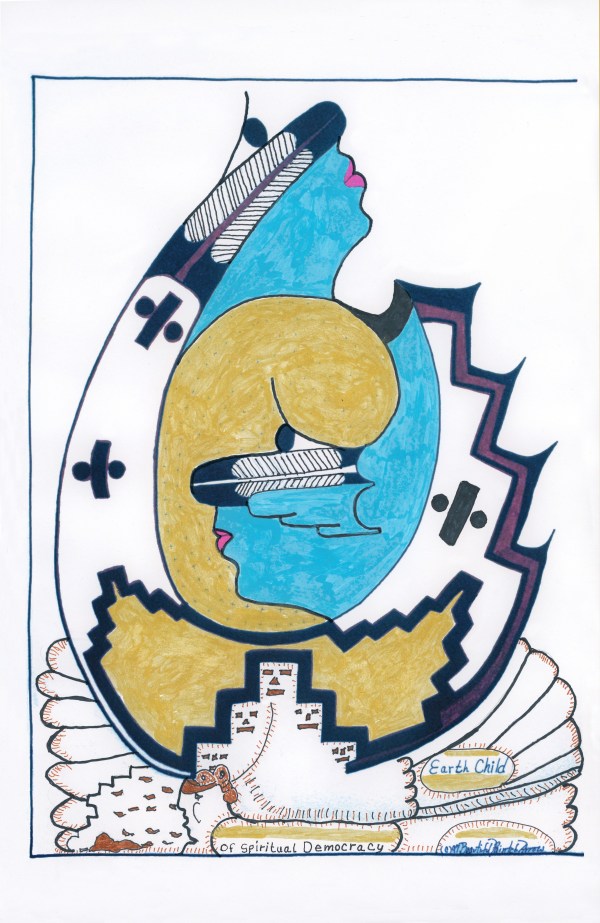
These next two paintings from Becoming Medicine: Pathways of Initiation into A Living Spirituality, are both Joseph Rael’s. The first, Eagle Dancing Feather Becoming Medicine Heals the People was originally Eagle Dancing Feather Medicine Heals. Joseph had me write on the print “Becoming” and “the People” so that we could use this painting as the cover. It, thus, has several different elements, like an acrostic.
Eagle Dancing Feather Medicine Heals The People, Joseph Rael (2016)
The next painting is the first of two paintings of Chimney Rock that we included in the book. Chimney Rock is a historic Pueblo structure on the Southern Ute Reservation. The structures were aligned to be able to tell the seasons based on the progress of the moon in relation to the peaks of Chimney Rock
Lunar Stand-still at Chimney Rock, Joseph Rael (Beautiful Painted Arrow), 2005
I felt drawn to visit Chimney Rock on my second visit to see Joseph in Colorado, but the gates were closed. (The first visit I had gone to Mesa Verde). I made it there in 2016. I happened to get there as there was a sunset flute performance and I had a little friend visit me there.
A little friend, D. Kopacz (2016)Chimney Rock, Southern Ute Reservation, Colorado, D. Kopacz (2016)
“In English, ‘medicine’ is something that still needs to happen, but in Tiwa medicine is already there, it is a power. Every human being is a power. One becomes a medicine person through practicing one’s destiny. The child already has his or her own medicine. Through practicing one’s destiny, the medicine person manifests the medicine that was already there as a child. The child makes medicine all those years and then becomes an adult.” (Joseph Rael – Beautiful Painted Arrow, page 30)
Joseph told me that he uses four colors always in his rainbow paintings: yellow, orange, red, and blue – I follow his convention here.
Night Eyes of Direction Finder, Joseph Rael (Beautiful Painted Arrow) 2006
I love this painting of Joseph’s and it starts of Part I Separation (Seeking). Seeking is the start of everything, the start of the book, the start of life – the start of what we are trying to do at this very moment in history – seeking peace and love to move through these challenging times. The painting comes right before chapter 1, “Becoming Medicine.” Joseph’s quote we start off the chapter with is below:
“The thing I should have said in my books is that everyone already has their medicine. The way you become a medicine person is you practice who you are because you are already medicine. No one gives it to you, you are already it.”
The “Introduction” to Becoming Medicine: Pathways of Initiation into a Living Spirituality is my story and path of how I came to meet and work with Joseph Rael (Beautiful Painted Arrow). Thus, more of the paintings in this chapter are mine. The two that follow are The Hero’s Journey and the Medicine Wheel of the Heart.
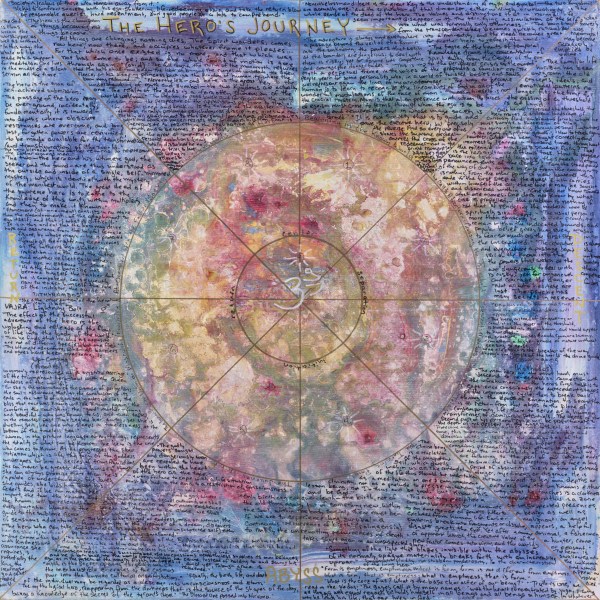
The Hero’s Journey, D. Kopacz, 2014
The Hero’s Journey painting was an example of the Hero’s Journey project that we invite veterans to do at the end of the 12-week Hero’s Journey class. The project invites the veteran to bring together the personal & universal into a creative project. Some veterans have done paintings, drawings, maps of their time in the service, writing and performing a song, and even multimedia art installations. I painted this as an example for the class. It is a 36″ x 36″ square canvas, divided into the stages of the Hero’s Journey and the quoted text around the circle is made up of various quotes by Joseph Campbell that pertain to that step of the journey.
Medicine Wheel of the Heart, D. Kopacz, c. 2016-2017
This was my attempt to bring together, in a visual format, Joseph Rael’s teachings about the medicine wheel. An earlier medicine wheel was published in Walking the Medicine Wheel: Healing Trauma & PTSD. The Medicine Wheel brings together the four outer directions of North, South, East, West, and the four inner directions of Mind, Emotions, Physical, and Spiritual. Each direction also has a corresponding vowel sound: A (ah), E (eh), I (ee), O (oh), U (uu) – pronounced as the vowels are in Spanish. There is also a princple idea associataed with each direction: Purity, Placement, Awareness, Innocence, and in the Center – Carrying.
As I was working on Becoming Medicine, I conceptualized it as a continuation of the journey started in Walking the Medicine Wheel. In Walking the Medicine Wheel, we worked to integrate the four outer and four inner directions and ended with connecting to the “held-back place of goodness” in the heart. In Becoming Medicine, I saw us as entering deeper into the heart center. I found Joseph’s comment about human beings as “medicine bags” to be useful here and that the purpose of the book was two-fold: to find the “sacred objects” which are hidden in our own hearts bringing them back for communal healing, and to go even deeper into a state of non-duality. In Walking the Medicine Wheel, Joseph said, “I am my brother’s keeper.” Joseph wanted to teach veterans that we are all brothers and sisters and we are all related. Becoming Medicine is about going beyond the affiliation of relation into a sense of oneness, non-duality – this is the state that mystics and visionaries know and it is the place of ultimate peace. This insight, or enlightenment about our non-separateness from other living beings and the material world is an initiation into a new relationship with the land and into spiritual democracy. As with many mystical traditions, when you make your secret journey you will find that what you were seeking is already within the medicine bag of your heart.
Detail from In The Many Windows of the Dream Time of Mother Earth, J. Rael, 2005
I just came across Kosmos: Journal of Global Transformation in the past few months and we are so excited and honored to have this essay published in this journal with such a needed and important focus. You need to set up an account to view our article, but it is free of charge and Kosmos does not have any advertising in it – just pure ideas of goodness & transformation! I loved the first article I read, “What if the Virus is the Medicine: Humanity’s Next Initiation,” by Julia Hartsell & Jonathan Hadas Edwards – it seemed so resonant with the work that Joseph & I have been doing in our book, Becoming Medicine: Pathways of Initiation into A Living Spirituality. Then I read Martin Winiecki’s “Searching for the Anti-Virus: Covid-19 as Quantum Phenomenon,” which was also very good and features images from Jung’s Red Book along the margin of the page.
This current issue of Kosmos: Journal of Global Transformation has a beautiful essay by Llewellyn Vaughan-Lee, “The Labyrinth and the Black Madonna: Love and Earth Magic.” Vaughan-Lee, a Sufi mystic, is a wonderful writer, whose work I discovered late in the game of writing our last book, we cite his work a few times. He has written a number of great books, including The Return of the Feminine and the World Soul and Spiritual Ecology: the Cry of the Earth. Take a look at this and some of the other great articles as well in this issue of Kosmos, In the Labyrinth: Pathways to Healing.
“We are living in disruptive times, yet there have been other times as equally disruptive. People lived through pandemics, plagues, pestilence, famines, natural disasters, slavery, genocide, oppression, and wars upon wars. How did they do it? I believe there is a secret well of resilience and wisdom within the human being—located in the heart—where we find our medicine.” (Kopacz & Rael)
Binding Sites of Coronavirus COVID-19, D. Kopacz, 2020Dream of a Bat, D. Kopacz 2020
Mental Contagion is publishing online some of its archive. Coniunctionis: Trauma, Transformation & Punk Rock was a column that I wrote from 2000 – 2002. My sister, Karen Kopacz started editing and publishing Mental Contagion and brought together a great group of writers, including Gene Dillon, Wendy Lewis, Dean Pajevic, and Eric Hoffman, as well as many others over the years.
.4 : How Can Ugliness and Disharmony, Which Are the Content of Tragic Myth [and punk rock], Inspire Esthetic Delight?” (Joy Division, Punk Rock, Violence, Despair & Transformation Part I) (February, 2001)
.5 : Why is Revolt Necessary? (Joy Division, Punk Rock, Violence, Despair & Transformation Part II) (March, 2001)
.6 : Is Alienation Necessary for Creativity? (Joy Division, Punk Rock, Violence, Despair & Transformation Part III) (April, 2001)
.7 :Is There an Inside/Outside? (Joy Division, Punk Rock, Violence, Despair & Transformation Part IV) (May, 2001)
.8 : What is the Meaning of Ian Curtis’ Death? Where is the line between the Art Object and the Artist? (Joy Division, Punk Rock, Violence, Despair & Transformation Part V) (June, 2001)
.9 : What is Punk Rock? What is Not Punk Rock? (Joy Division, Punk Rock, Violence, Despair & Transformation Part VI) (July, 2001)
.10: What Does the Shadow Know? (Joy Division, Punk Rock, Violence, Despair & Transformation Part VII) (August, 2001)
.11: What is the Relationship Between Music and Religion? (Joy Division, Punk Rock, Violence, Despair & Transformation Part VIII) (September, 2001)
.12: What Are We to Do? Quotations (October, 2001)
I: Interview: Ouroboros (Houston) by David Kopacz – for Mental Contagion (MC) (November, 2001)
.13: What Does Religion have to do with Rock? A review of Dan Graham’s Rock My Religion(December, 2001)
.14: What Did You See There? Ian Curtis and the Visionary Quest of the Shaman (Joy Division, Punk Rock, Violence, Despair & Transformation Part IX) (January, 2002)
I: Interview: Poster Children by David Kopacz (With Special Guests Doug McCarver and Mike Barry) (February 2002)
.15: Afterwords
CONIUNCTIONIS.0
On stranger waves, the lows and highsOur vision touched the sky. “A Means to an End,” Joy Division, Closer, 1980.
There is a movement within me, a current and flow that lives through me. I have felt the pull to be inside, where everything is happening. I have felt the pull to be outside of it all, where nothing is happening. These essays, written between 2000-2002 for the online journal Mental Contagion, are attempts to understand the inside and the outside and the power that flows from outside to inside and from inside to outside. These essays are investigations into the nature of reality through Joy Division, trauma, transformation, and punk rock.
There is a pull that some people feel, to go deeply inward, sometimes that pull is a push, from alienation or trauma in the outer world. Going into this inner wilderness is a kind of darkness and it can overlap with despair. Maybe despair is the cause of the inwardness or maybe despair is a station along the path of inwardness, like a phase of grief that one goes through, leaving the communal and collective world and entering into the sacred inner cave of consciousness and being. Jung wrote,
“As a child I felt myself to be alone, and I am still, because I know things and must hint at things which others apparently know nothing of, and for the most part do not want to know. Loneliness does not come from having no people about one, but from being unable to communicate the things that seem important to oneself, or from holding certain views which others find inadmissible. The loneliness began with the experiences of my early dreams, and reached its climax at the time I was working on the unconscious. . . .
It is important to have a secret, a premonition of things unknown. If fills life with something impersonal, a numinosum,” (Carl Jung, Memories, Dreams, Reflections, 356).
For Jung, this loneliness was difficult to bear, but it was a source of learning and experience that he would not have traded for fitting in. Ian Curtis, the lead singer of Joy Division, also found a creativity in the darkness and the loneliness and he sent back missives from the depths, as a lone astronaut exploring space might send back scratchy transmissions from another galaxy:
“You’ve been seeking things in darkness, not in learning” (No Love Lost)
“I’ve been waiting for a guide to come and take me by the hand. Could these sensation make me feel the pleasures of a normal man?These sensations barely interest me for another day I’ve got the spirit, lose the feeling, take the shock away” (Disorder)
Depending on how this pull is engaged in, one goes on an inner journey. If one goes deep enough, there is an inner well of transformation, drinking that water of the deep self is like a form of rebirth, but rebirth infers that there has been a death. Without guidance, many are lost on this path and there is untold loss of human potential. Yet, these brave souls, these inner warriors, can serve as heroes as well as cautionary tales. To give one’s self over to this inner secret is like taking the steps of what Joseph Campbell called the “Hero’s Journey,” with steps of 1) separating from the everyday world; 2) entering into a magical world or the underworld and going through an initiation and transformation into a new way of being; and 3) a return and reintegration into society. Jung’s process of individuation would say that the hero brings back energy and ideas from the collective unconscious, and yet the hero bringing this back is alone, because no one else made that journey and no one else yet understands the beauty and value of what the hero or heroine has brought back from the unconscious into the light of day. Joseph Campbell felt that the hero is rejected by society, because he or she has gone places that most people do not know or understand. Herman Hesse, in Steppenwolf, wrote of a similar concept, that creativity is infused into society by the lone wolf, the liminal being, the misfit.
“We are psychiatrists; we are German; we have read Nietzsche; we know that to gaze too long at monsters is to risk becoming one – that is what we get paid for,” (Huelsenbeck, quoted in Greil Marcus, Lipstick Traces, 226).
I was a young psychiatrist when I was writing these columns and I was trying to find my path as an artist, a writer, a professional and a person. I was not German, but I had read Nietzsche, Jung, and a number of other writers you’ll find in these pages. I had listened to Joy Division and punk rock and post-punk. I was gazing at monsters, both inner and outer, as Richard Huelsenbeck, the Dadaist Psychiatrist.
These essays were about me trying to figure some things out, but they are really more explorations than answers. Over the years, the topics in these essays have resurfaced and recurred in my life in various ways. After a period of some years, I found that I had more to write on these topics and began writing additional columns.
For the purpose of this archival collection, I have just collected those essays published in Mental Contagion 2000 – 2002. Post 9/11/2001, I mostly shifted to doing interviews for the column, for this collection I have kept just a few interviews as many of them seem more specific to that time and that place (Champain-Urbana, Illinois). You can read more recent Coniunctionis essays on my blogBeing Fully Human. My website www.davidkopacz.com also has the original Coniunctionis essays, along with artwork, photography, poetry, publications, and other work. The work of Coniunctionis prefigures my current work with Joseph Rael (Beautiful Painted Arrow) and has continued to influence my writing and published work:
“If American democracy fails, the ultimate cause will not be a foreign invasion or the power of big money or the greed and dishonesty of some elected officials or a military coup or the internal communist/ socialist/fascist takeover that keeps some Americans awake at night. It will happen because we—you and I—became fearful of each other, of our differences and of the future, that we unraveled the civic community on which democracy depends, losing our power to resist all that threatens it and call it back to its highest form.”
Parker Palmer, Healing the Heart of Democracy: The Couraged to Create a Politics Worthy of the Human Spirit, p. 9.
“I am you and you are me. There’s only one being here, and even though you have a different body, I have a different body, and a different moment, but we are in this together, you know, and people don’t understand that.”
Joseph Rael (Beautiful Painted Arrow)
(from Becoming Medicine: Pathways of Initiation into a Living Spirituality, pg. 379)
“My elders are convinced that the West is as endangered as the indigenous cultures it decimated in the name of colonialism. There is no doubt that, at this time in history, Western civilization is suffering from a great sickness of the soul. The West’s progressive turning away from functioning spiritual values; its total disregard for the environment and the protection of natural resources; the violence of inner cities with their problems of poverty, drugs, and crime; spiraling unemployment and economic disarray; and growing intolerance toward people of color and the values of other cultures— all of these trends, if unchecked, will eventually bring about a terrible self-destruction . . . the only possible hope is self-transformation.”
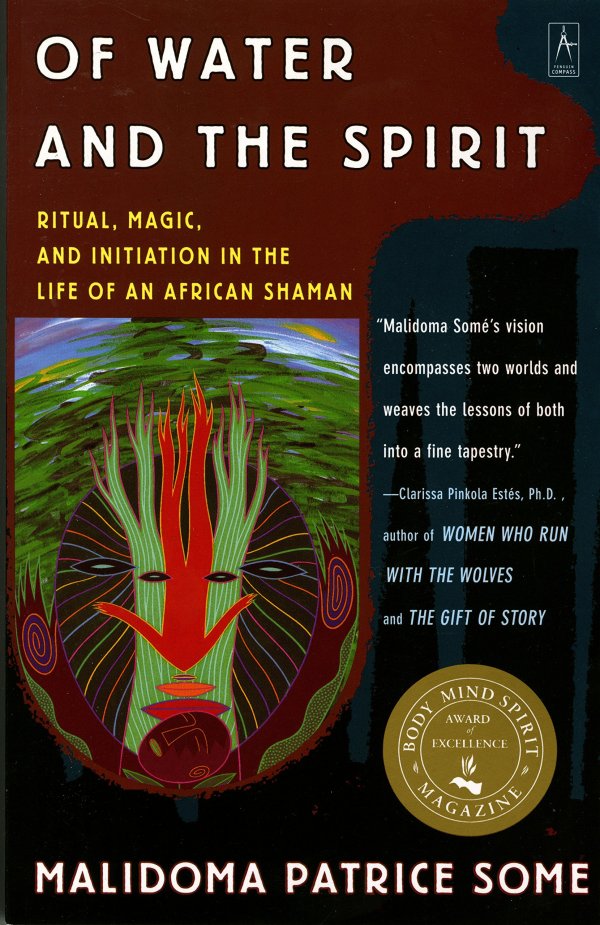
Malidoma Patrice Somé, Of Water and the Spirit: Ritual, Magic, and Initiation in the Life of an African Shaman, 1.
In this week’s episode David Kopacz speaks with Joanna about: encouraging children to plant green living things; dancing with the trees; the dormant seed inside oneself; walking the medicine wheel; becoming a true human being; we are medicine bags; being and vibration; the cycle of rejuvenation; separation is illness, healing is coming back together; the archetypal template of spiritual democracy; the Refounding Mothers of Democracy; coming home to peace.“
Joanna had taken a break for a while and this was her first podcast interview, or gaialogue in a few months, so it was extra special. Thanks to Joanna Harcourt-Smith and co-producer, José Luis Gómez Soler. Here are Joanna’s and José’s bios, take a listen to my interview and check out the many other great podcasts, such as with Steven Herrmann, Charles Eisenstein, Frédérique Apffel-Marglin, Richard Katz, Neela Bhattacharya Saxena, Roshi Joan Halifax, Francoise Bourzat, Lyla June Johnston, and many, many others…
Joanna was born high up in the Swiss mountains on a snowy January evening. She grew up in Paris and speaks 5 languages. School was boring but her curiosity about life was not extinguished by the dullness of the education system. Nature was her teacher, trees, horses, dogs and the ocean gave her a sense of belonging that she did not feel within her birth family.
Joanna turned fourteen in 1960, she was in love with Marlon Brando and Rock and Roll. During her adolescence she was torn between a desire to die and an intense love of life. Because she felt lost between despair and passion she wrote poetry and continues to do so up to this day. During the early 1960s she lived in Spain and wrote “The Little Green Book” an answer to Mao Tse Tong’s “Little Red Book”. The Book was published in 4 languages and widely sold in France, the Netherlands, England and Germany.
In 1968 moved by the music of the times and the spirit of revolution sweeping through her generation she emigrated to the United States. Her exploration of mind liberating substances led her to find Dr. Timothy Leary who was a fugitive from prison in the US. They became in love and were kidnapped by American authorities in Afghanistan and returned to California where Timothy Leary went back to prison to serve a sentence of possession of 0.01 grams of marijuana. During TL’s three and a half years in prison Joanna worked tirelessly to secure his release, she lived in San Francisco where she collaborated, published and distributed the 6 books he wrote in prison. In addition, Joanna traveled to England, Italy and across the United states lecturing about the imprisonment of Dr. Leary.
In 1977 Timothy and Joanna’s love affair came to an end after he was released from prison. She then went down to the Caribbean and bough a magnificent wooden sailboat named Kentra. For several years she lived on her boat and sailed around the islands attempting to heal her broken heart. In 1983 she returned to the United States, surrendered herself into the path of life long sobriety and became a celebrated chef in Philadelphia and Santa Fe.
She practices Buddhism and the elusive way of loving kindness and compassion mainly for herself and for others around her. Joanna’s great question in life is “What is true Kindness?”
In October 2013 Joanna published a memoir about her adventures with Timothy Leary entitled “Tripping the Bardo with Timothy Leary” . Her book been has been optioned by the Oscar winner director Errol Morris. Filming began in December 2019.
She his currently writing another book entitled “Change your beliefs, change your life” Surviving Timothy Leary“.
She is also featured in Gay Dillingham’s movie “Dying to Know”, a documentary about Leary and Ram Dass’ lifelong exploration and friendship.
She is the author of several articles published in the online magazine “Reality Sandwich”.
She likes to remember that “if you don’t like the media, be the media”.
Life is short, but it’s wide!
José Luis Gómez Soler is the co-producer of Future Primitive. Since 2006 he has supported the podcast with research, recording, guest coordination and audio editing of these wonderful episodes.
José Luis studied Audiovisual Media Studies at the University of Sevilla, Spain. Since a young age, he has been deeply interested in mysticism and Nature.
David and Suzanne continue their moving discussion around ‘doing better than rushing to return to normal’ after things shift once again with COVID 19.
This episode dwells in the land of opportunity: What could things look like for us as a people, a world, an environment should we thoughtfully, purposefully move with the new things ushered in despite the chaos vs desperately trying to ‘get back’ to what was once upon a time—back then?
There is such beauty in their words!
I will borrow a saying from David: “Like pinatas of wisdom…”
Suzanne Richman is an education consultant, had founding roles within Goddard College in Vermont, she has expertise and passions within the realms of trauma, grief, social activism. She is a self-confessed recovering academic. You can contact Suzanne at : Suzannehummingbird@gmail.com.











 Being Fully Human