Earth Child of Spiritual Democracy – Joseph Rael (Beautiful Painted Arrow)
Now, more than ever, we need to reconnect to Spiritual Democracy.
War, violence, and aggression directed inward toward a country’s citizens and outward toward other nations and peoples – is not democracy.
In our book, Becoming Medicine: Pathways of Initiation into a Living Spirituality, Joseph Rael (Beautiful Painted Arrow) and I dedicate chapter 14 to the topic of Spiritual Democracy:
“Spiritual Democracy is a living connection, allowing the flow of spirituality through our lives, embracing the divinity in all creatures and the divinity of the Earth. Spiritual democracy is the way we treat others when we learn to see the divine in all things and that we, too, are part of divinity. It is a sacred way of being. Periodically, we forget that we are divine as we live in this world of matter and go through its trials and travails. We, as individuals, as well as we as people, need periodic renewal at the font of spiritual democracy. To seek renewal is to be a Seeker, yet so many “religious” people are becoming fundamentalists.” p.381
Rigdzin is the proprieter of Pema Kharpo, a shop selling imported Tibetan and Asian good, in the Greenwood neighborhood of Seattle. This was my go to place when I was looking for gifts for others, or a mala for myself. The place is good medicine. Rigdzin would often give me something for health or protection if I was feeling under the weather or traveling. We moved away from Seattle to Madison, Wisconsin in 2025 and I miss my conversations with Rigdzin, but I am finally getting this interview we did in 2024 posted! Rigdzin’s life story is so fascinating, born in Tibet, raised in exile in Dharamshala, meeting with the Dalai Lama on his visits to the Tibetan school, traveling to the US, working in restaurants and starting an import business on the side, serving as an interpreter for Tibetan monks on tours of the US, and now running Pema Kharpo and helping people connect to Tibetan spirituality. We will intersperse his calligraphy art throughout the interview.
David R. Kopacz: As I have spoken with you over the years I’ve been in Seattle, it seems you’ve had many roles in your life. Could you start at the beginning and tell me a little about your childhood and your time growing up in Tibet and then in exile in India after the Chinese invasion of Tibet in 1959?
TIBET TO DHARAMSHALA
Rigdzin: I was one of those who were forced from their country and forced to live in another country. This is part of my role and life starting with unfairness—the opposite of peace. My parents went to India when I was two. So, I experienced, for example, living in a tent, as a concentration camp, so to say, but under the great open heart from India, at that time. We didn’t have any other countries’ support. Only India acknowledged that Dalai Lama can come in exile to Dharmshala. My role was like a child who was victimized by war and extreme poverty.
At a very young age, I was exposed to many, many different situations. I speak many languages, that’s one advantage. Another thing, I also really understand others’ pain. And the greatest blessing was the Dalai Lama’s teachings and Buddhism. From the very beginning, Dali Lama has taught about compassion, all the time, compassion. In Tibetan, this is nying-je. The literal word, nying means “heart,” je means “mighty.” Our heart is mighty, because you can understand others’ pain and see that anger and hatred causes so much suffering. The entire philosophy of Dalai Lama is always putting the other as more important than you. That is the philosophy I was brought up with.
DRK: So, you say that even though there were hardships of being in exile, and being a child of war, and being in extreme poverty, there were things that you saw as gifts like learning many languages and being able to see others’ suffering.
Rigdzin: Also, it was because of His Holiness Dalai Lama’s gentleness and love and his unwavering non-violence that actually gave us more strength, because the truth is greater than the force of hatred or bullying.
Rigdzin: Yes. I sometimes jokingly call my parents, “Dalai heads.” You know, you have a “dead head,” right? Who follows around the band the Grateful Dead? So, I remember my parents like that, following around the Dalai Lama wherever he went or wherever he sent them.
My father was a businessman. He had donkeys and ponies and horses and yaks. He would bring things from Tibet, and then he would bring back things from India. See, he already knew the route to India. So, when he escaped the Chinese invasion, sometimes we were one day apart from His Holiness Dalai Lama and sometimes one week apart on the journey to India. So, His Holiness first went to Arunachal Pradesh and we were already there.
I remember, as a child, since I was maybe three years old, I stayed in a tent. So even today, sometimes my wife takes me camping. When the weather is bad, I get nervous. Because for me, it is no fun living in a tent, ha ha! Especially when we had a tent that was Indian military surplus—they don’t have a floor!
Dali Lama left Tibet on March 17, 1959, after sometime he arrived in Dharamshala in April, 1960. My parents were the first ones who built the Dalai Lama’s new residence. And after they built that, our group was sent to different South India locations, because His Holiness’ whole idea was the future of Tibet.
All the kids were given some form of school, hostel school, boarding school, so that parents can go and make a living and the kids can learn Tibetan. My parents followed everywhere His Holiness Dalai Lama went or directed. They were 100% dedicated to His Holiness. They were unwavering, trusting the guidance of His Holiness Dalai Lama, for the good of their kids and themselves, as well as the people still inside Tibet who didn’t have a voice.
DRK: So, His Holiness was thinking of the future of Tibet and your future.
DRK: You’ve told me you were able to have audiences with His Holiness. Could you say more about what those meetings were like?
Rigdzin: See, after we moved to Dharamshala, I look back and think that was one of the most fortunate things that happened, because we got to see His Holiness Dalai Lama every other week. And we were all kids, but sometimes we were fifty, and sometimes we were two hundred. We would go to see His Holiness in his first residence, which was, actually, an old British summer house. I still remember, that his windows were broken, the glass was broken. So, we flattened American aid or Western aid, oil, cooking oil cans. They come in twenty-five gallon cans, the square ones. So, after the oil is done, we cut them, flatten them, and put a color on them. So, we made windows out of the metal cans. And His Holiness, maybe at that time was twenty-seven or twenty-eight years old
We were kids from maybe five to eleven years old. We all lined up and were excited to see His Holiness and he gave us advice. I still remember his advice at the time, according to our age and capacity, he said “I want you guys to be like a flower in the wild, not like in a manmade garden that can easily whither each season.”
At that time we didn’t know much about sanitation. We didn’t have hot water, no towel, very little, maybe one towel for ten kids. So, he said, “If you wash your face nicely, if you wipe your nose good, that also will help for Tibet, because people will say, ‘Look at that clean, smiling face, that kid is a Tibetan.’” I never forgot that was something that I could do. And always he told us we are fortunate and to be proud, because we are the children of compassion, tolerance, and good manners. Those are the things he liked to talk about. Then he always said, “Take care of each other.” Basically, encouraging compassion to everybody, even to the insects. As kids we grew up with those words and ideas which are really the blessings!
DRK: It sounds like he inspired you to think of yourself almost like an ambassador or emissary for Tibet. Anything else about those years and the experience of seeing the Dalai Lama?
Rigdzin: Yes, from the beginning, He saw each one of us having a profound responsibility for the future of Tibet. Nowadays, we are getting a deeper understanding of his vision, basically, perseverance of the message of truth and compassion, and that we are all interdependent. If we inflict harm to others, it has no end, it only gets worse. Our greater responsibility is the understanding that everyone equally wants happiness, but out of their own shortcomings, they inflict bullying and harming on others. But, actually, everyone is also exactly like me—who wants to be happy, who wants to be respected. So, I understand now the bigger and deeper meaning of why he has always taught non-violence. At that time, we were just kids, right? We just wanted to be mad with China, but His Holiness always says peace is the only possibility.
DRK: How did you end up coming to the United States?
COMING TO THE UNITED STATES
Rigdzin: I met a gentleman on an Indian street; I was selling clothes. I called it my Pema Kharpo [shop] on the street! Ha ha ha! I didn’t know in the future I would own an actual shop. Then I met this wonderful, tall, well-built Westerner, but wearing completely, torn clothes—he looked like a hippie. He looked very strong and he had a lot of cameras. He sat next to me, and he talked to me, because I was trying to read the newspaper. This happened to be an English newspaper. I didn’t know how to read very well. It was more like I wanted to have the image of reading, ha ha ha! He said, “Do you read English?” and then we talked and he said, “You are pretty good. Do you want to go to school?” I said, “I have no money.” “So you want to go to college?” “Yeah!” Then he said, “I will pay for your college fee.” So that’s how it happened. And he asked, “How much it will cost.” And I said, “10,000 rupees,” which was a lot of money at that time. $1 was about eleven rupees. Right now, it is 83 rupees for a dollar. So, he really gave me cash, ₹10,000.
So, I went to New Delhi, and I joined vocational college. And then, many years later, I also got a part-time job in a restaurant. And then two women from Olympia, Washington came in the restaurant looking for someone and asked me, “Do you know Rigdizin?” “Yeah,” I say, “I’m Rigdzin! And then they say, “We’re Chris’ friends.” And then I realized that he sent them to me because I could show them around. So, then I helped these two ladies as a guide. Then they asked me if I wanted to come to America and see what America looked like. They were very curious because one of the ladies said that she remembered ten lifetimes of her past life. And she describes scenery and regions in India and so we go—and they are really there! She said her family thinks she’s crazy. But that’s not crazy for me. So, that’s how we become friends. They invited me to come to see America. So, I came first to Olympia, Washington, and I liked it. Then I went back to India, to bring back more goods. I was lucky to get a visa, a business visa, legally. So, within one year, I could come and go. I went back to India and then I came back to the US and then stayed right here in Seattle.
PEMA KHARPO: WHITE LOTUS
DRK: What did you do in the States then? Did you continue your shop, Pema Kharpo?
Rigdzin: Slowly, slowly, I started to bring my children here. For a few years, I asked for political asylum and then I immediately got a work permit. I worked some but mostly I explored America. People asked me to come here, come there, and I just went. And this is when I learned not only the language, but how people eat, right? How people fight. How do you use the bathroom. What is your culture and all of that. Then I picked up English very fast. I went to community college to brush up my English. But mostly I worked in a restaurant early on.
Then, the first time I went back to India to see my brothers and sisters, I had a credit card. Always, in the back of my mind, I wanted to do something for my community. So, when I had the credit card, I bought 100 rugs from our village. The Women’s Association, something like that we called it, through handicraft, made handmade carpets. Then in Olympia, I worked full-time as a cook. But every other weekend, sometimes, I would throw a small party and sell rugs out of my friend’s apartment. That’s how I started Pema Kharpo! Ha ha ha!
DRK: What does Pema Kharpo mean?
Rigdzin: White Lotus.
This is not just a flower. It has a lot to do with the Buddhist philosophy. The lotus grows from muddy water, but it does not carry muddiness, it is pure. So, we are all living beings born out of father and mother’s activity and desire. But each individual mind is uncontaminated and always has the possibility of complete awakening or freedom. Just like the lotus is growing muddy water—it is pure, it doesn’t carry that muddiness. My wife, when we first started the business, asked my brother, “Please give us some the Tibetan names of some flowers for the name of the business.” Then my brother said, “Pema Kharpo” So, yeah that’s perfect, ha ha ha! If you see images of the Buddha, they all sit on moon disc and lotus petal.
DRK: So, the shop started as a way to help people back home by selling their goods?
Rigdzin: Yes! This gives me a real joy and platform to express my art and my culture. Nowadays, I’ve been here 28 years, I have a lot of repeat customers. A lot of times, I get people who will ask me more questions than they buy. But I’m never unhappy about and like you said before, I have a responsibility even though I don’t know that much. But as a Tibetan, His Holiness said, “You are representing Tibet.” So, I try my best. When people have a question about Tibet, the diaspora, and Buddhism, I definitely have a little bit more insight than others who haven’t been through what I have been through. So, it gives me joy!
DRK: So, you’re a businessman. But you’re also—I suppose a businessman is a conduit of bringing something from one place to another place—but you’re also a knowledge man. You bringing knowledge from one place to another?
SERVING AS AN INTERPRETER OF THE DHARMA
Rigdzin: Yes. And also, as I’ve polished my English, somehow I became an interpreter for many, many different visiting monks and a lot of political activists. For example, I translated for six or seven political prisoners, some of them are nuns who spent years in Chinese prison. They’re very, very sad stories.
Foremost, there was a one Tibetan monk, who was the most known in worldwide, Palden Gyatso. He wrote a book called Autobiography of a Tibetan Monk. So, I organized lectures at many places that I’d already been before with other Tibetan monks. So, I knew of sponsors in small, small outlets, so I called them and they’re all happy to receive Palden Gyatso and help him spread his words. He spent 33 years in Chinese prison.
During those times, people would ask what they could do for Tibet. I collected people’s addresses, then I went back to India, in my village, and put all these names in a hat. People would pick a name and then they would get a sponsor.
People would ask me, “Can you find me a sponsor?” One time, this lady came to me, crying, because her parents died, and she’s the oldest one in the family and they have other two kids. She asked if I could find her a sponsor so she could go to college, just a two-year college. I was able to find a sponsor for her. After many years, I got a call from Canada. The lady said, “Hey, Rigdzin do you remember me? You helped me go to college. I worked and I took care of my family. Now I’m in Canada!” This joy, right? Ha ha ha! It’s not me. Like you said, I’m a conduit. I don’t have money to give in my pocket.
DRK: Right, but you know how to connect people. How many time have you gone back and forth between the U.S. and India?
Rigdzin: At least eight times. I wish I could go every other year. I just love to see His Holiness. But I try to go whenever His Holiness gives a major teaching, for like 10-15 days at a time. I’d love to go to Dharamshala again, and maybe one more Tibetan New Year! Ha ha ha!
DRK: What year were you born?
Rigdzin: Two years before we escaped the invasion in 1959, I was born in 1957.
Also, as a child, I remember—you said the role, right. Even when I was young, a lot of people would come to ask me about something they could not find, if they lost a cow. I don’t know why they would. Tibetans have a cultural belief, that kids are innocent and pure and know things adults don’t. So, they ask kids questions. So, in that way, I was a little bit like an adult when I was like six or seven years old. I remember one time in our dormitory some kids lost something. Somebody stole it they thought. So as a kid they were asking me. And I said, “Okay, we have to do three prostrations to the picture of Buddha.” And then I said you have to be honest and if you’re not honest, you are going to shit in front of us. And as we did one kid literally shat, I still remember! He acknowledged he took it. So that things like that, see?
What I’m saying is, it is part of our culture. Then after many years in 2007, 48 years in exile for me, I knew I had a sister who is the oldest. My dad told me, when I was born, my sister was 24-25 years old. So, she would remember everything. I always wanted to go to Tibet and find her. And finally, I found her. I was able to meet my sister and she told me where I was born, and who gave me the name, right. So, so exciting! All this lifetime, I didn’t know. I just wanted to see what kind of place I might have been born. Right. So, when I was in Olympia, the newspaper people asked, “Where were you born?” I’d say, “In Tibet.” They would say, “Where in Tibet?” I’d say, “I don’t know, in a cave!” Ha ha ha!
Anyway, in 2007, my sister said, “When you were a kid, whatever you said would come true.” I said, “What do you mean?” She said, that when the Chinese started coming, you said that our uncle would be killed. She told me that I said my uncle would be killed and we would all go far away to live in a tent and not return. She told me I said that, and it all came true. Maybe that is the reason I became an interpreter because I could know things like that.
DRK: An interpreter is a conduit of languages between people.
Rigdzin: My father, and my ancestors, they were all healers. But also, it’s not just my family, the entire Tibetan people are like Native Americans. Especially like, two, three hundred years ago there were a lot of shamanic rituals, and all mountains are sacred, all rivers are sacred, like that. In my village, when I went in 2007, each household has a spirit. And they pray every morning. That’s very shamanic.
DRK: In Tibet, there was the shamanic culture, and then the Hindu culture, and then the Buddhist culture. And all three came together.
Rigdzin: Yes, yes. For Tibet, our earliest religion was called Bon, Bon was all shamanic. And yes, it has the Hindu, and within the Hindu there are many different Hindus right? With us, we are those who pray to snakes in the rivers, who are Naga. Similar like that, like in Kathmandu, all over the backs of the Himalaya there’s a lot of shamans.
DRK: Like Mount Kailash?
Rigdzin: Yes, Kailash was very close to our village, when I went, I could see in the distance Mount Kailash.
DRK: So, you were able to go to Tibet for the first time in 2007?
Rigdzin: First time and last time. It was just before the Olympics, and it was little bit scary because the Chinese asked lots of questions at each checkpoint. I was an interpreter for political activists and it was the same thing that they asked, each check point, if we were political activists. I was getting scared. But luckily, I was smart. I had a gentleman from Seattle, and he’s a big guy like you, and he was with me. They said, “Who is he?” I said he is my brother-in-law. Ha ha ha! He dressed more like military color and his hair was short. I was more confident because he is right next to me. So, I was not that scared. Otherwise, in Tibet, people disappear overnight.
How many Tibetans, for example, have been put in prison overnight? Recently I saw, they’re building a dam, they build many of them, but now what they’re building is a hydraulic dam in the most sacred and important river, the Yangtze River. And what do the monks do? We don’t believe in killing others. So many Tibetans, like 100, and monks, over 30, they self-immolated.
Dalai Lama’s guidance, you know, is about just expressing our pain without causing pain to other. And now, these monks and nuns, the entire village, great monks, great masters, they’re touching the feet of Chinese officers, begging them, please don’t build the dam. They’re begging them, crying the entire village coming like this, “Please don’t do this. That’s all we have.”
So, sometimes I get really mad about international, powerful countries always talking about peace, peace, but people who are walking the peace and talking the peace are left behind. Until people who can terrorize them, then they get attention. So, it is very, very sad and appalling.
In Tibet, if you are born there, you can’t say you were born in Tibet, you have to say you were born in China. When a paper interviews me, when they ask where I was born, they say they can’t write Tibet. I tell them, “I’d rather you write India than China.” That is how unfair it is, not only by force was Tibet taken, but then international communities still fail even to write the name, “Tibet,” on piece of paper. That’s my right. As a human being where I was born, I was born in Tibet. “No, no,” they say, “you should write China.”
So, this is how we give in to bullies and guns. You know, at the gun point they ask who you are. I say, “I’m human.” But no, no, they say, “Say you are a cat!” That’s how we feel right? When we say I’m born in Tibet, but no, we can’t we have to say “China.” That is sometimes very painful.
As a Buddhist, someday, I think maybe those Chinese people, the lucky ones, may be born into a Tibetan family. I know that sounds completely bizarre. But I’m saying, whenever we harm, it is putting a green light to continuous harming each other on earth. You know, we—each individual—you can say it is government, but the government is built by individuals, right? In order to become peace, individually, we really have to understand at a deep level that we are all the same. Whenever we get into the rigidity of me versus you—I’m better, you’re black, you’re white, you’re Asian, you’re Chinese—you’re my enemy. It’s really sad, right? If we really meditatively become open-minded, friends become enemies, and enemies become friend. Same thing in a bigger picture, if the world is one family, we are just burning ourselves.
There will be no end to the war. Sorry, it’s very depressing. But again, being taught about Buddha nature, and immaculateness of our innate mind, if we all really think deeply, it is possible. Like His Holiness says, “One human, one Earth.” We can live more harmoniously and happier and have more luxury than killing each other. It takes more time, more effort to kill and to destroy, then do live as it is. Just, just be, be patient, be respectful of each other.
Everywhere. We are just blaming each other, even the temples, the school shootings. I’m not just talking about America—everywhere—in some part of the world, blaming each other racially, you’re this party, you’re that party. Both are similar people within the country, but now people focus on division. And now this is scary in America, and the world, right?
DRK: With Tibet, from the exile in 1959, it doesn’t seem like it’s any closer to resolution. It doesn’t seem like we are getting closer to peace in the world, instead it seems like we are getting further from peace. The Dalai Lama has done a lot of good work for peace in the world, but it’s sad that Tibet itself is very, very locked down.
Rigdzin: Yes, yes, very sad. Like I said, in the middle of night, 1 AM, 2 AM, your husband is gone, and nowhere to be found. And many years later, you learn, he was in prison and now he is dead. The dead bodies that’s all you can visit, it is very sad. But also, I’m sometimes more sad for Chinese officers who do that. They also have a family. Eventually, we have to look into our own eyes. We are our best witness. What did you do, right? What do you do wrong? We always say, “You are your best witness.” And, and there are many stories of the Chinese, that they are very sympathetic, that they’re completely lost in pain, coming in the middle of night to the Tibetan masters and asking for guidance.
DRK: Because they lose their humanity.
Rigdzin: Yes, they think they did it to Tibet, but the same thing happens to them. Somehow, human beings need to set a higher standard, like love, forgiving, equality. One person’s power is very dangerous. We have a saying, one person’s smartness is less than three mediocre people’s decision. The collective decision is better than one person’s decision. We always say that doesn’t matter how smart the individual is, the collective decision is better for everybody.
DRK: There’s the idea of engaged Buddhism, of religion or spiritual practice that is also a type of activism in the world. Thich Nhat Hanh, spoke of that, coming out of Vietnam. In what ways do you see Tibetan Buddhism, and your own life, as not a spiritual retreat from the world, but an engagement with the world.
Rigdzi: One hundred percent. Yes, one hundred percent. I think, of course, His Holiness Dalai Lama, and most Tibetan, for example, monks and nuns, begging to the Chinese officers and touching their shoes. They could have punched them. But those are examples of peace. You want peace, you want compassion, you want non-violence? They’re the examples. And it might take a long time. I really think that no, territory lasts forever. If you look, the Roman Empire, Hitler all gone. Soviet Union fell, right? So, change is imminent. A lot of Chinese are actually reclaiming their ancestors’ faith, which is Buddhism. So, China keeping Tibet is actually an asset for China and for the world. I sometimes say that Dalai Lama is begging China, okay, you can take Tibet as a part of China, but give us legitimate rights under your constitution, minority rights, religious rights, cultural practice, right? That’s all he’s asking. And if they give that to the Dalai Lama, and invite him back to Tibet, I think China will not become weaker, they will become more powerful. They will benefit from Tibet. But, Tibet will also contribute to the world as an example of non-violence and peace and harmony.
My dad, at that time, was very poor, in India. He talked a lot about Tibet having gold. I said, “Where is your gold, I am sick and tired of sitting in this tent!” And you know what he said? He said, “Oh, by the way, we don’t believe in digging for gold.” I said, “Why?” He said, “We are nomads, we’re farmers but also not only that, we are human beings. If you disturb mountains and rivers, the animals will suffer, whatever they eat will have a less nutrition.” That’s what he said. And now I think that is a big social ecology. But he didn’t have those fancy words. He was just saying, what do you drink, the vegetables you eat, and the sheep there, the grass they eat. Is it undisturbed? If the minerals are there, it has more nutrition. He said drinking milk in India, or drinking plain water in Tibet—the Tibetan water was more nutritious. That’s what he used to tell me.
Then I asked my father, “What do you miss the most about Tibet?” What they missed the most is the water of Tibet. When I went, I saw it coming right out of the glacier from the rock. It’s like a pain in your teeth—so, so cold—chilling—and oh so sweet. And now what China is doing, in my village, that same water they are bottling, without any blessing, they named it Tibetan Miracle Water. So, if you empty out all the rivers and all the water, then the largest population in the world, all of Asia will suffer. And also, there will be more earthquakes, because when you make dams like that, it changes the balance of the Earth.
TANTRA
DRK: Speaking of balance, what can you say about tantra?
Rigdzin: Tantra, I don’t know a lot, but yes, those are higher Buddhist view. In the ordinary view, we say this world is samsara. But, in tantra samsara is nirvana. Right? Samsara means that the world is contaminated, that it is delusion. Literally it means you are caught doing the same mistake over and over again—chaos, delusion, desire. Nirvana, that is the opposite, it means peace, equanimity. In tantra, one thing and its opposite can be seen as the same.
In tantra, you have to have a pure perception. Pure view means all sounds are mantras, Even if somebody says, “I hate you.” That sound is a mantra. All human beings are enlightened seeing things as pure. It is called Pure perception. So, then it is breaking into nondualism. So, there’s no dirty and clean. So having said that, we don’t teach tantra immediately because it can be misunderstood and someone thinks, okay, then you can kill a person. But as sometimes I say, clean and dirty, is a kind of superstition. It also means you’re stuck, it is a fixation on dualism. Tantra is about non-fixation, right? So, for example, sometimes this is a bad example. But when you make love, you put your mouth everywhere, whatever the sanitation is. But then in a restaurant you complain about a little bit of fingerprint on the glass and say it is a “dirty” glass.
So, tantra is like that, in some sense. I’m not talking about the sexual, but I’m, just reaching for an example, so the Western mind can understand.
Tantra is often not good to talk about because of the complexity. Sometimes we are just like kids, first you have to crawl, and then you start running, and then not only you start running, now you’re jumping in the air, leaping and you don’t get hurt, right? But the infant, if you throw in the air, they will get killed or die, right? So, if the tantra is heard at the right time, by the right person, it can be very profound. It is quick sweeping, like a highway, and makes faster awakening. But, without true understanding, it can be faster disaster. Ha ha ha!
Tantra, when done with the right kind of craziness does not create a mess in life. Actions have to be done with a kind of love, so that even if something is painful, it can still be nirvana.
DRK: In many religions, East and West, there seems like there’s often a focus on transcendence, moving from this world to some transcendent realm. Then there’s imminence, where the Divine comes down and infuses this world. And it seems like tantra focuses on both at the same time. It is not about getting away from this world, or beyond this world. And it’s not that the Divine is only in this world. It seems like there is a focus on imminence and transcendence at the same time—nonduality.
Rigdzin: 100% Yeah.
DRK: And the Native American and Indigenous religions they seem to have a very immanent focus, that the Divine is not separate from everything here—like you said about the Bon religion and the Nagas, it is in the water, the mountains, and all of life.
Rigdzin: So, that’s why most Buddhism has said that samsara is nirvana. In classic Buddhism, we divide into six different realms and some realms are unpleasant, like hell realm, hungry ghost realm. But my own interpretation is like in a chart where hell is equal to anger. When anger consumes, you create hell right now. Lust and greed create the hungry ghost realm, right now in the present. Extreme pride, ego is god realm. We can look at upper realms and lower realms as something out there, but we can experience, here, the whole six realms in one day. That’s why samsara and nirvana are right here, right now.
Do you have any more questions?
DRK: Yes, what about the concept of samvega that I asked you about earlier? That idea of experiencing dissatisfaction coupled with the desire to grow?
Rigdzin: Samvega, in my own interpretation, is, like, energy. You become fed up with the insubstantialness of our modern activities. Sometimes in Buddhism, we call it “wrong view,” wrong view will always lead you to pain and suffering. So, samvega, on other hand, is the conviction to break through this childishness.
Like, you said here, medical workers, they’re burnt out. But not all of them are burnout, right? It depends on how one looks at things. With samvega, you can tap into that energy, so that I at least have an opportunity to help. Sometimes you have to take the Buddha’s way of looking at tonglen or exchanging suffering and compassion. What if you are that sick person? That’s an even worse situation. Like if a sick person was dying. Would you rather die, or would you want to do anything? Like, sometimes, in my own experience, when I’m really sick, I wish I could just wash the dishes—that would be luxurious!
Sometimes you also get sick and you might suffer, but still, you are there voluntarily, and, also, fortunately helping the other. Right now, in this world, there are others who are doing similar service, but in freezing cold weather, and with not enough food to eat. But here, at least in America, you have a heater, you have hot running water, cold water, air conditioning, and a large dining room, and plus you get paid. I’m saying it’s always a matter of perspective. Perspective is a switch on and off our mind.
So yeah, we all need samvega, because now here’s a story. When I was the interpreter for Palden Gyatso, he said he got beaten every day. And sometimes they would hang him from the ceiling, and they put fire underneath him, like almost live barbecuing human being, but they burn enough to peel the skin, but not die, and then they beat him. And he said he used to think at the time, to overcome the pain and madness, of the 18th hell-ish realm, where the person who is punishing you, or burning you, or beating you, they don’t ever get tired in the hell realm. But, here, in this realm, the person beating me will definitely get tired in half an hour, then I will have some break. And then also, when he would get extremely mad at the person, he would think, if he doesn’t beat me, he’ll be beaten by the authority. So, that’s how he survived 33 years of torture, and when he came out, he was still sharp and razor clear in his mind. Not only that, other monks, including himself, when His Holiness gave them an audience and asked, “What was the scariest part?” And Garchen Rinpoche, whose life I know, he said, the scariest part was he was losing his vow of compassion to the enemy. So, these are some things we should cherish as human beings in this world instead of ignoring them and disregarding them. These are the pillars of path to peace.
TEACHING COMPASSION
DRK: How do you teach that kind of perspective? How do you teach compassion like that?
Rigdzin: The biggest issue is you have to always exchange places. Like, in the West, you say you have to put yourself in another’s shoes. In every aspect, not just torture, not just politics, even lust. They’re being taught as a monastic, that you have to think this is someone’s mother, someone’s sister, like that, right. And even that cannot sometimes put a stop to one’s own mind. So, you might have to analyze, if you imagine taking the skin off a person, they will be not desirable, right? If you look into the stomach, it’s not desirable. So of course, it’s very easy to say, but I’m saying, in every respect, we have some sort of exchange, equilibrium, and exchange oneself for the other.
Like if the Chinese person, whoever was beating Palden Gyatso, were to think for a moment, “What if I was that monk?” If even for a moment you have this genuine thought, you will be little bit hesitant to raise your hand. It is completely mad to see just yourself and not the other.
DRK: So, one way of teaching compassion is to exchange positions, to take somebody else’s perspective. You also talked about analytical meditation and meditating on death.
Rigdzin: With tonglen practice, sometimes you have to give all your merit, love, compassion, everything to the adversary and take all their pain and misunderstanding to yourself in visualization.
DRK: I think about what the heart does. For medical people, we know that the heart accepts the used-up blood, the blood that the oxygen has been taken out of, and the heart accepts it, and then the heart gives it away to the lungs. And then the lungs give the heart the richest blood, the most oxygenated blood, and then the heart accepts it, and then gives it away. So, the heart is this organ of giving and receiving and the organ of transformation of accepting both the bad and the good equally and giving them both away
Rigdzin: When you do this, when you exchange and take on other people’s pain, some people are able to but do this will not affect them. But at that time, when you do that, in my own experiences, when you do that, when it is a suffocating situation, disheartening, complete madness, it immediately gives a path, some kind of space. That’s my own experience. That’s why I’m saying our mind is limitless. It has no shape, no color.
When we talked about before tantra, Buddhists call, kha dhak [kadag], primordial perfection. We are all born with that, it never depreciates, it never needs any addition. It’s already there. The only thing is that we love to be deluding ourselves. We have the habit of falling into self-deception of samsara through our self-cherishing.
So how do you get a different vision in life? You have to act like a great meditator, even if you are not a great meditator, because you want to create that habit of exchanging oneself for another, taking everybody’s pain to yourself. Just like acting and then someday you realize that you’ve developed the habit. So, when somebody says, “Hey, I hate you,” you are more prepared to say oh, it’s just a word. He may be mad at someone else, maybe his coworker but he’s shouting at me.
BECOMING AN ARTIST
DRK: Let’s talk about art. When did you first think of yourself as an artist? What is the relationship between art and peace?
Rigdzin: I thought of art, at that time in childhood, as painting and coloring. I was having a hard time learning in school, especially different languages, like Hindi and English. And now I look at it, I actually have dyslexia. I see letters and numbers reversed. So, I always used to draw. Also it helped me with hunger. I get calmed down when I paint. I used to paint a lot of mountains and rivers. Maybe, in the back of my mind, I was missing those mountains and rivers, and tents and yak. That’s how my beginning was in art, but nowadays I do calligraphy.
When I was very young, in Dharamshala, when first at school, we didn’t have paper because we couldn’t afford it. So, we had to go to the jungle and cut wood. But sometimes we couldn’t even find wood properly. So, I remember sometimes we find bamboo bark. It’s very easy to clean. And then, the monks at that time, our teachers are all old monastery professors. But they are homeless. We are homeless—refugees. Yeah, so they’re our kindergarten teachers. So, they taught in old Tibetan monastic style. So, we had to bring any kind of flat slate or wood. Then, we’d go to our kitchen and and make a paste with the ashes and put on a slate. Actually, now I look back, and we made “dry erase,” but it was organic. And then monks will go and cut bamboo and flatten it. Then they teach alphabet, Tibetan alphabet, like a, b, c, d. So, then I learned to be really creative. In Tibetan, I write pretty well, compared to a lot of people. In Tibetan, we have three different styles of writing. One is newspaper writing, another one is big letter, and one is fast writing. So, sometimes I combine three in one in my calligraphy. So, it becomes very interesting. It will take a little while to read, but those who are good high school graduates, they can eventually figure out what that means. My calligraphy teaches about the Dharma in condensed form.
I think the Tibetan alphabet is one of the best languages to explore Buddha, Dharma, and the nature of the mind. Science researches the brain, but what about the mind? Tibetan culture and language has explored the mind and consciousness.
To end, I would like to speak about China. China has called the Dalai Lama a “wolf in monk’s robes.” They want the power and authority to choose the next, the 15th Dalai Lama, but His Holiness the 14th Dalai Lama has said that Dalai Lama will be born outside of China, in the West. He has said that if the Chinese really believe in reincarnation, they should be trying to find Chairman Mao’s reincarnation and leave the Dalai Lama to Tibetans. In his latest book, Voice for the Voiceless: Over Seven Decades of Struggle with China for My Land and My People, Dalai Lama says that the next Dalai Lama will be born outside of China as long as China occupies Tibet. Padmasabhava said in the 8th century that when the iron bird flies and the horses run on wheels, the teachings will leave Tibet and go to other lands and the Dharma will go to the land of the Red Men.
The ultimate teachings of Tibetan Buddhism are for achieving Naked Mind, pure consciousness for experiencing non-dualism. The teachings are that you should see the other as yourself, you should develop compassion for the other, that you should practice Samantabhadra to develop Universal Good for all sentient beings. Chöeying is the meaning of the innate nature of mind to experience dharmakaya, the ultimate body of truth. But really, it is simple, love everyone and every sentient being, exchange places with others to understand their suffering, and have compassion for everyone.
Pema Kharpo is located at 8554 Greenwood Ave N, Seattle, WA 98103
The excerpt is entitled “The Gates of Paradise: Shamanic Memories from an Indian Visionary,” and is availabe online in Parabola Summer 2022 Edition with the theme of Ancestors. It is currently available online, but the whole issue is worth reading, with an articles on P. L. Travers, Vaclav Havel, Nelson Mandela, and many different topics on the theme of Ancestors.
The article also features two of Joseph Rael’s paintings, “Sage Woman becomes visible to – bless “the People,” and “Crystal Chamber,” which I’ll include below.
We are very happy that this book is getting some notice as it is an autobiography of Joseph’s life specifically aimed at passing on wisdom to the next generation, how fitting that it is in the Ancestors issue of Parabola: The Search for Meaning. The book was also recognized as a winner of the Paterson Prize for Books for Young People.
Our next book has released! Becoming Who You Are: Beautiful Painted Arrow’s Life & Lessons for Children ages 10-100 is 130 pages of Joseph’s lessons for the people of the Earth. The book has 43 art works by Joseph and 14 photographs. We decided on the “ages 10-100” because we’ve also thought about writing a book for younger children. Also, this is our first book for children and it was challenging to bridge Joseph’s ideas and create a story that kids of all ages could enjoy.
Joseph Rael (Beautiful Painted Arrow) was born on the Southern Ute Reservation in 1935 and grew up at Picuris Pueblo in New Mexico. Joseph’s life took him across the country and around the world. After a vision in 1983, he built a Sound Peace Chamber, and then worked on building over 60 chambers around the world — leading to recognition by the United Nations for his work for world peace. Through his friend and co-author, David Kopacz MD, Joseph shares his life and lessons for people, young and old, growing through the transition from childhood into adulthood.
Joseph says that when he was sent to the Santa Fe Indian boarding school, they were trying to make American kids out of Indian kids, in this book, Joseph tells us, “I am trying to make Indian kids out of American kids.” Joseph passes on his wisdom and artwork to the next generations who will inherit the many problems that we have created in breaking the medicine wheel. Joseph tells us, “Let’s not leave the next generations in so much mystery about the physical and spiritual worlds. Let’s educate them from the beginning about the way of the shaman.” We are already born with everything we need, we just need to make sure that as we grow up, we don’t forget who we are.
Here are the generous endorsements we’ve received for the book:
In Becoming Who You Are, David Kopacz & Beautiful Painted Arrow (Joseph Rael), a Tiwa elder, have presented a series of marvelous stories for teenagers and young adults about how to become a human being. This is timely wisdom from Native America, and Joseph’s past, for an age in which the guidance is confusing and truth is optional. The stories help readers sort through the possibilities for who they will become, while learning about and valuing culture & diversity. They describe Joseph’s lessons learned from boarding school, World War II, Pueblo Ceremonies, life on the reservation, and the process of creating sound chambers on guidance from spirits. I heartily recommend it for readers of all ages. We all need the wisdom that David & Joseph offer us.
―LEWIS MEHL-MADRONA MD, PhD
Psychiatry Residency Training Director, Northern Light Eastern Maine Medical Center Executive Director, Coyote Institute Associate Professor of Family Medicine, University of New England Author, Coyote Medicine, Coyote Healing, Narrative Medicine, and Healing the Mind through the Power of Story
Becoming Who You Are is a remarkable narrative that does not fall into prescribed categories—sharing Native American insights in an engaging and charming manner, always speaking to never down to kids as the rightful heirs to our planet. Joseph Rael and David Kopacz are healers and carriers of timeless wisdom working tirelessly for the betterment of life. They convey the becoming of being in lucid text combining autobiography, literature, ecology, spirituality, travelogue, history, magic and wisdom illuminated with beautiful art. Grounded, with shining optimism, this book meanders purposefully like a pure river sourced from a perennial spring of wisdom and will surely motivate kids to fall in love with the earth and—their own selves. In our ravaged age, the book reminds us of interconnectedness and that all that we need is—here—sacred and real—listen!
―USHA AKELLA MSt Co-founder of Matwaala: South Asian Diaspora Poets’ Collective, Poet and Author, “I Thought a Thought,” Ek An English Musical on the life of Shirdi Sai Baba, The Way of the Storm: An English Musical on the life of Meera Bai, I Will Not Bear You Sons, The Waiting, and A Face that Does Not Bear the Footprints of the World
This story of two very different men with common visions, may serve as a guide for all who seek to continually learn about themselves through the lenses of their own history and the cultures of those around us.
―SHUYUN DAVID LO MD
Psychiatrist, University of California Santa Cruz Student Health Center
Becoming Who You Are: Beautiful Painted Arrow’s Life and Lessons for Children by Joseph E. Rael (Beautiful Painted Arrow) and David Kopacz MD is a book that shows us there are other important ways to teach that can speak to us all. Through storytelling, Beautiful Painted Arrow lays out many of life’s core values. We learn that the Tiwa word for God is Wah-Mah-Chi, which is also everything, and is the core to the love of learning which is the secret to being human. This lovely book is written for children, but the authors freely admit that it was written for those in the middle between the two worlds of childhood and adulthood, so it really applies to us all.
―BRADFORD FELKER MD
Psychiatrist, Seattle VA, Professor University of Washington, Captain United States Navy Reserve
As I read Becoming Who You Are, I envisioned myself sitting at the feet of an elder, asking him, “Tell me the story of your life―share your wisdom with me so that I may live it and one day share it with others.” Coming from years and years of Joseph’s sage wisdom and insights, this book is a beautiful invitation to not only learn, but also create your own story—through art, music, writing, reading—or however the spirit moves you.
―MAGDALINE DeSOUSA Author, The Forgotten Mourners: Sibling Survivors of Suicide, What’s Real, Mama?, What’s Brave, Mama?, and coming soon, What’s Wrong With My Family? Growing Up in an Alcoholic Home
The inspiring story and wise words of the elder, Beautiful Painted Arrow (Joseph Rael), speak to the heart of the child within all of us. His life’s journey and teachings give us hope for a better world, one where we live in peace and harmony with our fellow humans and the natural world.
—TWIN SISTERS, JANE LISTER REIS & MARGIE LISTER MUENZER co-authors of the children’s books, Si’ahl and the Council of Animals: A Story of Our Changing Climate for Children and Their Parents; Si’ahl & Friends Coloring and Activity Book; and Margie’s Nature’s Gifts: A Poetry Coloring Book.
I have been working with Joseph Rael (Beautiful Painted Arrow) since October of 2014. I’ve written about how I was working on a Hero’s Journey class for veterans, based on the concept of Joseph Campbell. I happened to find a copy of The Visionary: Entering the Mystic Universe of Joseph Rael (Beautiful Painted Arrow)by the late Kurt Wilt. Kurt had mentioned several times in his book that Joseph’s life’s path was like the Hero’s Journey. I wrote to Kurt, told him what I was doing with the veterans’ group and he thought Joseph might want to hear about what I was doing. Kurt gave me Joseph’s email address. We emailed back and forth a couple times and Joseph invited me to visit him at the Southern Ute Reservation in southern Colorado. On the way down there I was thinking maybe I could include a chapter in the Hero’s Journey work on indigenous approaches to healing. As I wrote up my notes that first night, I realized there was more than a chapter – it was a whole book! The next day I mentioned the idea of a book to Joseph, what to me was an epiphany must have already been obvious to Joseph, as he just off-handedly said, “That’s what I was thinking.”
This led to the publication of Walking the Medicine Wheel: Healing Trauma & PTSD. Actually, in working on that book, we turned in our first draft to Paulette Millichap, our publisher with Pointer Oak and Millichap Books. Her reaction was, “This is interesting, but where is the book for veterans?” Oh, no, I realized, Joseph took me down the rabbit hole and I chased his thoughts like birds and we ended up writing a book that went up, down, and all around, but we lost track of what we started writing. So we split the book into two books and I quickly wrote in more veteran specific chapters. The second book also expanded and expanded and became Becoming Medicine: Pathways of Initiation into a Living Spirituality. However, even that book – at 500 pages – still had things we cut out and that could go in other books!
One of the other book ideas that grew out of the other writing was a book on Joseph’s art. I had the idea of a book called Art Medicine (which is actually the sub-title of the Becoming Medicine color edition) that would focus specifically on art and visions.
To this end, with the idea of doing a book on art, vision, healing, and featuring Joseph’s art work, I’ve put out a call to anyone who has an original art work by Joseph. Joseph is very generous with his work and has given away the bulk of it. At some point, he did start getting digital copies of some of his work, for books, or for printing out posters that he would give away. He also gave me a set of 35 mm slide photos of some older work and I’ve had those digitalized to preserve.
If you have an art work by Joseph, please just take a camera photo of it and email it to me at davidkopacz369@gmail.com
I’ve gone through each of Joseph’s books and listed the art work that has been published and we have all or most of these on digital.
For anyone intersted, here is a list of art work by book with the page number in parenthesis.
Sound: Native Teachings & Visionary Art
New Awareness, Old Awareness
An Epiphany
Seekers of Divine Guidance (0)
Blessing for All Life (4)
Mother Earth and the Flowering of Life (8)
Voice of Silence (10)
Song of Singing Bowl (14)
Sky Father covers Mother Earth with SPIRIT Leaves for new trees just planted after the summer fires (18)
The Infinite Vast Self (21)
The Fun Makers (23)
The Grandfathers (26)
Rainbow man and rainbow woman make first Double Rainbow on Turtle Island (29)
Oceanus vents beneath the Earthly crust, circles of epiphanies for the two Leggeds on Mother Earth in July (32)
Untitled (Early Horn of Plenty) (34)
Summer nights with Mother Earth and her children (38)
Morning Prayer for a new dawn (43)
Spirits of Red Rock (44)
CLEAN AIR Sacred Offering for the People of Mother Earth (47)
The moon arrives near the Earth to seed abundance in the Oceans (50)
Dance Chief calling the Sun-Moon People from the Spirit World to come and Dance (54)
Song of the Baskets (61)
Beautiful Painted Arrow song before Painting: “Oh Grandmother help us to see.” (65)
27 Feather Blessings (66)
Ancient Mysteries tell us that the Mother of fires lives inside the roots of grass, the roots of trees or in the brightest star in any night sky (69)
The Cosmos dreaming us in and out of perceptual realities (70)
Biosphere Stratosphere Energy Sphere (75)
Ceremony for severe cyclones with strong winds (76)
Woman of the Mountain Lakes calling for Mountain Rains – in Ceremony for the water moon (79)
Blessing place for school books (84)
Entrance to TREE of Life (87)
The Winter Summer People (90)
From the Clay of Life “the people” became visible (93)
From the hand of Great Spirit comes all Blessings (99)
Galactic Dance (102)
Flowering of new insights (104)
Untitled (eight-lobed inner flower, colored faces, Old Medicine Wheel) (108)
Rainbow Makers (110)
Story Tellers say that Ancient Ancestors traveled through time looking for new places to live and were known as “Those that fly like blowing wind” (113)
Angels of Light (114)
Harvest Belt Dance (117)
Climbing and Crossing Between Worlds Ceremony (121)
Dream Catcher (124)
Four Winds, Elders of the Sacred Blessing Way (128)
Ah-who (131)
Mother Nature of fields and Streams A child of innocence is born in every moment (137)
Watermelon plant people making food for the children of Mother Earth (141)
Creator of Ocean mists always brings new wisdom to learn (147)
Sage Woman becomes visible to bless “the People” (150)
From the Spirit World comes Eagle Wing to heal the people (159)
The Dreams of the Right Hand (168)
A cup of Silence (170-171)
Ocean Places of Oceanus (172-173)
Cradleboard Blessing Great Bear is the Big Dipper and the seven stars (174-175)
A Geological Formation: A Fault Line vision quest site a place to look for something that prevents perfection (176)
Flowering of Divinity (receiving sending) (181)
Weh-mu – 1 (191)
Weh-seh – 2 (196)
Pah-chu – 3 (199)
Wiii – 4 (202)
Pah-nu – 5 (206)
Mah-tschlay – 6 (209)
Cho-oh – 7 (212)
Wheh-leh – 8 (219)
Whiii – 9 (222)
Tehn-ku-teh – 10 (226)
Sun-Moon Dance, for our Galaxy (na-ku-tha-ke) We’re Dancing (229)
Creation Singing for all Artists (232)
Being & Vibration:
Entering the New World
Climbing and Crossing between worlds Ceremony (duplicate)
Untitled (Hands Weaving Mocassins)
Little Rainbows of Light home of a Beaver dam of water…Of Enlightenment (x)
The Land Spirit after it returned to Mother Earth, she drinks the thunder of Light at the new home of the Corn People (xii)
Planet Earth (Mother Earth) for Paulette & Kelly (Angel bringing child) (7)
Lava Rock is connected to time (10)
Born into the being of vibration the prehistoric farmer demonstrates how multi-verses were made with the sound of “Taah-que”…(12)
Broken Pots (20)
Birthing the Corn Mothers (24)
Coil Pottery Stew (28)
Deer Mother Feeds Her People (31)
Breath Matter and Movement, Being and Vibration, Life is the road of Goodness Grandfather walks with us (34)
Medicine (go forth for the people) for the four directions medicine bag, Grandfather, creator Dreaming into Life, all of the universes (Tiwa World) pa-aah-neh (40)
Untitled (Medicine Wheel) (48)
The Red Road (51)
Corn hair woman (64)
Singing for the Little People who bring the autumn light t0 (key-yah-ney) Mother of Planet Earth (67)
Mother of Time (74)
Untitled (corn plant, emotional, physical, spiritual, mental body – left, south, west, north, east on right) (79)
Drum Dance Wa-Chee-Chee-Who at Where God Lives and Walks on Planet Earth (99)
Being and Vibration of the Brother and Sister stars (102)
Creator of the Five Worlds (111)
Holy Water (113)
Untitled (5 worlds) (119)
Rain water droplets, sun flower, drink (124)
The Rain makers at Long beaver tail pond (131)
Ancestors bring rain to the desert (135)
Heart Path Spirit (137)
The Being of the feather Dance (139)
Altar of Mountain lion – mossa-neh (144)
Walking the Medicine Wheel: Healing Trauma & PTSD
Breath Matter and Movement (three feathers pointing to sun) (xxix)
Offering of the Heart (xiv)
Planting the Seed of the Heart (DRK xvii)
People of the West-East be Blessed (xviii)
People of the North-South be Blessed (xxiii)
The Cardinal Directions are created (xxxi)
The Ancient Role of the Sentry of sentient perceptive consciousness for seeing long distances, etc. (15)
A Geologic formation A fault line vision quest site – a place to look for something that prevents perfection (20)
Trapped Warrior (DRK 34)
Untitled (corn plant, emotional, physical, spiritual, mental body – left, south, west, north, east on right) (44)
Grandfathers in the dreamtime traveling into multiple realities on strings of light (47)
Sweat Lodge (55)
Medicine Circle of Mother Earth home of two leggeds (65)
The Medicine in the Medicine Wheel (DRK 70)
Untitled (Medicine Wheel 1995) (71)
Ideas (74)
Father facing sun rise blessing for the people (77)
The Grandfathers (90)
Before the Gourd Dance the spirit of time came to bless the people she was wearing sixteen medicine wheels (124)
Awakening at an AA Meeting (135)
Darkness Seekers of Wisdom (137)
Awaken from sleep to a state of grace (142)
Sacred Heart (DRK 149)
The Sacred Heart of the Madonna (DRK 150)
The Enlightenment of the Horn of Plenty (153)
Medicine Wheel of the Darkened Heart (DRK 157)
Center of the Heart Become Aware Carry Divine Consciousness find and live states of Grace (163)
The Ordinary and the non-ordinary learning how to play or paint, follow the Red Road (169)
Ideas – Reflections (171)
Madonna over Sound Peace Chamber (189)
Cosmic Medicine Wheel (DRK 191)
The Grandfathers (217)
Breath Matter and Movement (Sacred Offering for Humans) (222)
Summer Rains a basket People of the Earth receive It is full of Beauty and delight is dancing (Angels of Divinity) (225)
Fan Spirit Ceremony (Lord of the Winds) (228)
Wind Keeper – Breath of Life Spirit (230)
Three Feathers dancing to the light of Divine Song (232)
The People in Ceremonial Bliss (238)
Dreaming a New Future Cat People symbol of the visionary (250)
Warrior Healing (DRK 264)
Divine Healing (Eagle wing) (268)
Becoming Medicine
Available in Art Medicine Edition (color) and Standard Edition (b&w)
Creator of Worlds (ix)
Breath, Matter, Movement (xxiii)
Enlightenment (DRK xxv)
Conception (DRK xxvi)
The Hero’s Journey (DRK 7)
Medicine Wheel of the Heart (DRK 12)
A Rainbow Medicine Wheel (DRK 19)
Night Eyes of the Direction Finder (22)
Eagle Dancing Feather Medicine (33)
Lunar Stand-still at Chimney Rock (37)
Creation (DRK 46)
Sun and Dancing Moonlight on the People of Mother Earth (61)
Dove of Peace (72)
Where God and Humans Meet (79)
‘Alam al-mithal (DRK 86)
At Vision Questing with Dandelion (90)
Puuh-Tea Bringer of New Knowledge (96)
Vision of the Blessed Virgin (100)
Shamanic Vision (DRK 109)
Blessings for Drinking from Morning Star w/ JR dictation to DRK (117)
Sacred Offering of the five-fingered (130)
Elders Gathering at Winter Solstice (139)
Drinking Universal Spirit Starts Light (156)
Dove of the Holy Spirit (DRK 160)
Crow Flying Through Cosmos (DRK 166)
The Blowing Breath of Dark Energy (171)
The Underside of a Far Larger Ship (184)
Heart Meditation (DRK 206)
Heart at the Center of Dark Matter (DRK 220)
When the People Went into the Cave of Existence and Returned as Made People Ceremony (228)
The Vase of Love and Light (235)
Blue Feather (DRK 238)
Candle of the World #1 – Ordinary and Non-ordinary Realities (249)
Crystal Chamber Taken up into the Sky (256)
Ordinary, and Non-Ordinary Reality Offering Bowl (258)
Spirits of Chimney Rock (263) Crow Flying Through Dark Matter (DRK 281)
Of Many Windows in the Dream Time of Mother Earth (283)
Puma Giver of the Visionary Life to the People of Mother Earth (293)
The Hunter Puts Cornmeal in the Deer (297)
Dark Matter Deer Medicine (300)
Planet Earth (Our Mother) Offering to the Sky and All Our Relations Wa-Ma-Chi (311)
Returning Home for Mending (316)
Grandfather God Creates All the Universes (328)
Drinking from the Flowering Light of Mother Nature (344)
Good Bye Dr. Dave (356)
Out of One, Many (364)
Rain Cloud and Oceanus (371)
Earth Child of Spiritual Democracy (380)
Peace Makers of the Rainbow Light (396)
Candle of the World #2 – People of the Sand Place – Stars Who Live in the Heavens – They Travel to Planet Earth (406)
Holy Woman (412)
Mother Earth Dreaming All the Two Leggeds into Beauty (423)
In the Currents of Time (433)
Breath and Space Time (446)
Rainbow Bird and Blue Star Woman (460)
Up to 2000 Songs per Day of Bird Song Chiuu-cho-cchaa-aah-neh (473)
This is the final installment in the Art of Becoming Medicine. Joseph Rael (Beautiful Painted Arrow) and I have been featuring our artwork from our book, Becoming Medicine: Pathways of Initiation into a Living Spirituality. These are the last two paintings in our book, and fittingly one is by me and one is by Joseph.
This painting is accompanying the text of the “Entering the Heart Ceremony” that we close the book with. This exercise, or ceremony, takes you through a series of doorways through your physical heart, the heart of humanity, the heart of life, the heart of creation, and finally into the heart of the Creator and the heart of the medicine wheel. At this point, the journey that we started in walking around the medicine wheel in our first book together is complete as we progress through initiations into being a shaman, a mystic, and a visionary and end in the center of the heart of the medicine wheel. We’ll offer this ceremony to you here:
Entering the Heart Ceremony
Find a quiet place where you will be able to sit for a while, either inside or outside. Find the center of the space where you will be sitting. Orient yourself to the North and take one step in that direction, honoring the place of innocence. Turn around, facing South, and step back into the Center of your medicine wheel, honoring the place of carrying. Take a step to the South, honoring the place of placement. Turn around, facing North and step back into the Center, again honoring the place of carrying. Turn to the East, and take one step forward, honoring the place of purity. Turn around, facing West, and step back into Center, honoring the place of carrying. Take one step to the West, honoring the place of awareness. Turn around and step back into Center, once again honoring the heart of carrying.
Now you will walk the medicine wheel. Face the East and take one step forward, intone the sound of the letter A_aaahhhhhhhhh, drawing out the sound as long as you can as you step around the perimeter of the circle to the South and then intone the sound of the letter E_eeehhhhhhhhh. Follow the wheel around to the West and intone the letter I_eeeeeeeee. Follow the wheel to the North and intone the sound of O_ooooooooo. Now step to the Center and intone the sound of the letter U_uuuuuuuuu.
Now you can sit comfortably in the center of the medicine wheel, this is the place of carrying and it is the heart of the medicine wheel. As Joseph reminds us, the microcosm is the macrocosm, thus this is the heart of the medicine wheel, it is your heart, it is the heart of the Earth, it is the heart of the Universe, and it is even the Heart of God—Wah Mah Chi—if you can walk deep enough into the heart.
We will now be going through a series of doorways. First we will enter your personal heart and trace the flow of blood through the medicine wheel of the heart. Venous blood, after giving its oxygen to the body, returns to the heart from the Northwest, the place of connecting spirit and body, entering into the right atrium. Next follow the flow of blood into your right ventricle in the Southwest, the place of the connecting body and emotion. From here the blood is pumped to the North, the place of Spirit and Innocence. Here the blood enters into the lungs and is transformed as the inner venous blood connects with the outer oxygen- rich environment coming into the lungs. The venous blood now turns from dark to bright red arterial blood as it carries more oxygen as the physical matter of the body creates a container in which the movement of the blood connects with the movement of the breath—thus we have Breath, Matter, Movement, thus we have Wah-Mah-Chi entering at this point. Next, follow the blood as it comes back into the heart from the Northeast, the place of connecting spirit and the mind, as it enters into the doorway of the left atrium. From here the blood travels to the Southeast, the place of connecting mind and emotion in the left ventricle. From here the arterial blood travels North, to the spirit again, and then travels throughout the body, revitalizing it and carrying the breath into matter through the movement of the blood.
The atria and ventricles of the heart are empty chambers that can fill with blood and then empty, a continual process of accepting what life has to give, allowing transformation, and then giving goodness away to the rest of the body. These empty chambers might remind you of the word that Abhishiktananda used—guhā: the cave of the heart. Now that you have circulated through your own personal heart, the time has come to enter into the center of your heart, for it is here that you will find the doorway into the deepest chambers of the cave of the heart, which we can also call the secret garden. Move into the center of the heart, this is the still point at the center of all the circulating movement of the burning fire of the blood. In this still center-point, look around for a doorway. It is dark here in the center of the heart, despite the burning of the blood, you can look with your eyes, but you need to see with your inner, non-ordinary vision. You must feel into it with your non-ordinary senses. Locate the doorway—it might be on the wall, or the ceiling, but it could possibly be on the floor as it leads deeper into the heart. Open the door of your heart and step through the threshold into this next larger space of your heart, feeling the opening of stillness and space within your center. You are now in the heart of humanity. Feel your way into this heart of humanity where your heart and the heart of humanity are one.
Once you have acclimated to the heart of humanity, begin looking for the next doorway that opens into an even deeper stillness of heart. Using your non-ordinary senses, locate the door, open it, and step through, entering into the heart of life. Open up into the heart of life where the heart of every living thing is one. Even things that don’t have an obvious heart like plants have their center here. Open up into this greater spaciousness, feeling more space open up within your heart and feeling a vastness that you are entering. Take some time getting comfortable in the heart of life.
Start to look around for the next doorway, looking all around with your non-ordinary vision. Find the door, open it, and step through into the heart of creation—this is the heart of every physical thing, all biological beings and rocks, water, soil, and even space. Feel this space open up within the center of your heart as you step forward into this vast space. Spend some time enjoying being one with creation.
There is still another doorway as you begin looking around again with your non-ordinary vision. In this realm, you get used to letting go of your identity—moving from the personal, to humanity, to life, to creation. Find the door, open it, and step through, entering into the Heart of God,
the Heart of Wah-Mah-Chi—the Heart of the Creator. Here you are One with everything, resting peacefully in the light of the Heart of the Creator. You have taken four steps through four caves of the heart. You have been practicing heart medicine as you have been circling deeper into the heart medicine wheel.
Now it is time to go into the heart of the heart medicine wheel, taking a step into the center of the heart of the heart medicine wheel. By now you should be used to using your non-ordinary vision to find the door, open it, and walk through, as you do so. You now are entering into what Joseph calls Vast Self. This is the place of non-duality. There is not even oneness, because it is before the counting even began. Feel the peace of Vast Self, the place before Creation, the place that watches Creation being created out of itself and yet remaining the same. Be still, be still . . . still . . .
The last painting by Joseph is “One Sun and Four Moons” from 2018. It also features black holes. Joseph has told me, in the past, that the black eyes of his spiritual figures in paintings are black holes.
One Sun and Four Moons, J. Rael (2018)
Although this is the ending of our The Art of Becoming Medicine series, working with Joseph is like always opening new doors. We are already nearing the end of a draft of our next book, Becoming Who You Are: Beautiful Painted Arrow’s Life & Lessons – a book for children of all ages, but particularly those in the transition from childhood into the teenage years. We have a rougher draft of a book for younger children called A Bowl Full of Ideas for Inventive Minds: Learning How to Count to Ten in Tiwa. We have also started the talking and idea stage of a book on Art Medicine, which will focus on Joseph’s visual art and the healing properties of artwork. There is always more to do with Joseph! The ending is just the beginning…
The first is “Rainbow Bird and Blue Star Woman,” a vibrant painting from 2009. Joseph’s Tiwa name, Tsluu-teh-koh-ay means Beautiful Painted Arrow, it can also mean Double Rainbow. At the lower left of the painting is “entrance to Oceanus’ cave.” Joseph often describes a vision he had of going to the bottom of the sea to meet Oceanus, the Lord of the Waters. This vision and Joseph’s relation to the ocean, even though he lives in the high desert, is important to him and he has advocated a ceremony on the 7th of each month for the purification of the oceans.
Rainbow Bird and Blue Star Woman, J. Rael (2009)
The next painting is another favorite of mine, “Up to 2000 Songs per Day of Bird Song Chiuu-Cho-Cha-Aah-Neh.” This section of the book these paintings are found in includes chapter 17 Returning to the Garden of Paradise and 18 Secret Journey to the Secret Garden.
Up to 2000 Songs per Day of Birdson, Chiuu-Cho-Cha-Aah-Neh, J. Rael (2005)
We are separated from the Garden by a paper thin space. It is a parallel reality. You are there without going there. We don’t have to walk there or even have to travel there. You travel with thought, not with physical energy and it pulls you there rather than you having to put effort on your part to get there. (Joseph Rael)
The first piece is “In the Currents of Time,” from 2005. We see a medicine wheel of the seasons moving sun-wise (clockwise) and two fish, one swimming upstream and one swimming downstream. Although time flows forward in ordinary reality, Joseph says that time can flow backward in non-ordinary reality. Everything is circular – if you don’t get something right the first time, you will circle back around to it and some point. Similarly, the past of the country and the past of the land continues to exert an influence.
In The Current of Time, J. Rael (2005)
The next piece is “Breath Matter Movement and Space Time,” from 2014. Breath Matter Movement is how Joseph translates the word for God in the Tiwa language, Wah-Mah-Chi.
Breath Matter Movement and Space Time, J. Rael (2014)
We only have four more art works to feature and we will bring this Art of Becoming Medicine series to a close.
Joseph and I have been working on our next book together. He wants it to be for 10-12 year olds and it will include Joseph’s life & lessons from when he was growing up and what he thinks kids today should learn. I think kids of all ages (meaning adults, too) would find this interesting because we are always learning and growing. We started out with a working title of Journey of the Holy Beings, then moved to A Bowl Full of Ideas for Inventive Minds (we might still keep that for a younger kids book), currently the working title is Becoming Who You Are: Beautiful Painted Arrow’s Life & Lessons.
We are starting to look for publishers – young adult books are a whole different category from our past work. Let us know if you have ideas for publishers! Maybe we will get the book out within 2021!
These two pieces of art work by Joseph Rael (Beautiful Painted Arrow) come from Becoming Medicine: Pathways of Initiation into a Living Spirituality, chapter 15, “Refounding.” The concept of refounding comes from Gerald Arbuckle’s work on how individuals periodically help guide institutions back to their founding values while updating the institution to the current situation.
“By refounding I mean the process of returning to the founding experience of an organization or group in order to rediscover and re-own the vision and driving energy of the pioneers. . . . To refound formation is to re-enter the sacred time of the founding of religious life itself. . . . This model of symbolic death and rebirth, which is made up of three stages – separation, transition/liminality and reaggregation – also has a powerful scriptural foundation,” (Gerald Arbuckle, From Chaos to Mission: Refounding Religious Life Formation, 3–5).
These two art pieces are from the section of the chapter entitled “Refounding Mothers of Democracy.” As I was reading background material for this chapter, I kept coming across the phrase, “founding fathers,” and I wondered why there was not more emphasis on founding and refounding Mothers of Democracy and so focused on several women artists and writers whose work has been to refound principles of democracy – musician Anoushka Shankar, writer Rebecca Solnit, and, then of course, the original founder of spiritual democracy, Mother Earth.
Anoushka Shankar wrote about her album, Land of Gold:
“Everyone is, in some way or another, searching for their own “Land of Gold”: a journey to a place of security, connectedness and tranquillity, which they can call home. This journey also represents the interior quest that we all take to find a sense of inner peace, truth and acceptance – a universal desire that unites humanity…Land of Gold is the culmination of my journey to the interior, channelling my distress at the situation in a constructive way, exploring the stories of the voiceless and dispossessed. I believe that art can make a difference – it connects us to our hearts, bringing us back to what really matters. Music has the power to speak to the soul,” (AnoushkaShankar.com).
Rebecca Solnit stands out to me in any of my thinking about the United States, as I felt reading her work, particularly A Field Guide to Becoming Lost, helped me reimagine the best of the United States and to re-become an American after living abroad in New Zealand. In Hope in the Dark, she wrote,
“To hope is to gamble. It’s to bet on the future, on your desires, on the possibility that an open heart and uncertainty are better than gloom and safety…We all have to place a bet, but we have no reassurance of how it will turn out. Solnit writes that the “future is dark, with a darkness as much of the womb as of the grave,” (Solnit, Hope in the Dark, 4, 6).
Solnit also writes about activism – not as something you do once to put things right, but more as a kind of recurrent ceremony that you do to try to correct the coarse of history that is always going off track. I have been thinking a lot about medical activism being a foundational aspect of medical professionalism and Solnit’s writing on activism has been a great influence on me.
“I use the term activist to mean a particular kind of engagement—and a specific politic: one that seeks to democratize the world, to share power, to protect difference and complexity, human and otherwise,” (Solnit, Hope in the Dark, 18).
“The question, then, is not so much how to create a world as how to keep alive that moment of creation, how to realize that Coyote world in which creation never ends and people participate in the power of being creators, a world whose hopefulness lies in its unfinishedness, its openness to improvisation and participation,” (Solnit, Hope in the Dark, 108).
Joseph’s first art work in this series is “Holy Woman” from 1995
“Holy Woman,” Joseph Rael (1995)
His next piece is “Mother Earth Dreaming All the Two Leggeds into Beauty,” from 2006.
“Mother Earth Dreaming all of the two Leggeds into Beauty,” Joseph Rael (2006)
Here is what Joseph wrote about our current time and Mother Earth:
“I believe that it is now time for the elders all over the world to talk to their people and instruct them. As elders we have more responsibility . . . a responsibility to talk about the sacredness of the Earth, and the sacredness of the people on the Earth. One of our journeys is to help the people as they walk on Mother Earth. Mother Earth is our land and she belongs to us because we are her children. She belongs to us and we belong to her. So we can take care of her the way she has been taking care of us,” (Joseph Rael, Sound, 256).
The first is “Rainbow Makers of the (tutah) Rainbow Light,” a colorful burst that reminds us that Beautiful Painted Arrow can also mean Double Rainbow.
“Peace Makers of the (tutah) Rainbow Light, J. Rael (2005)
The next piece is the second in a series, “Candle of the World #2 – People of the Sand Place – Stars Who Live in the Heavens – They Travel to Planet Earth.” This painting reminds us of the Picuris Elders telling young Joseph that there is an equivalency between the stars in the sky and the sand on the ground. There was a movement of peoples from the stars to the sands of Earth and the destiny of the people of Earth is to return to the stars.

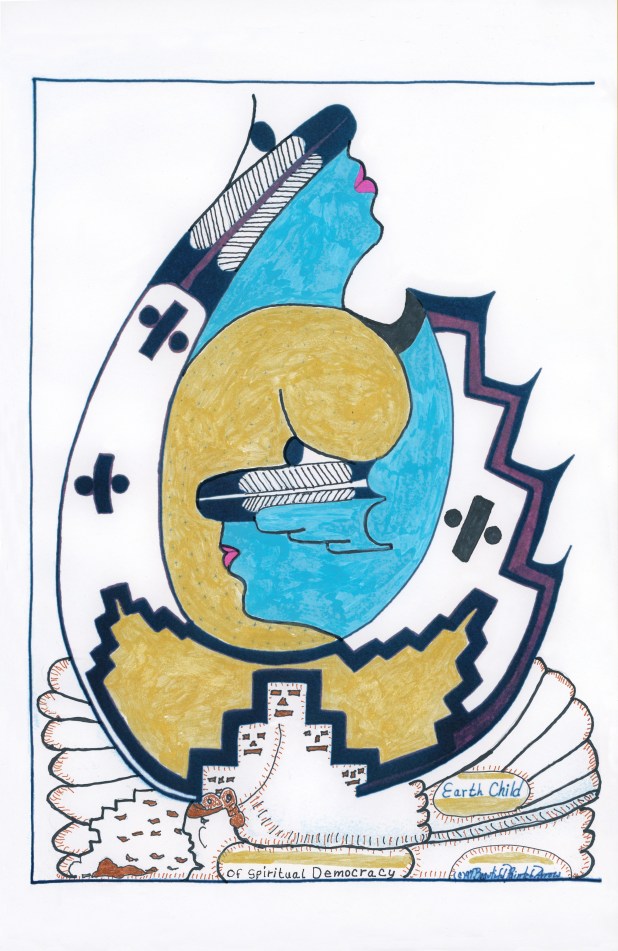

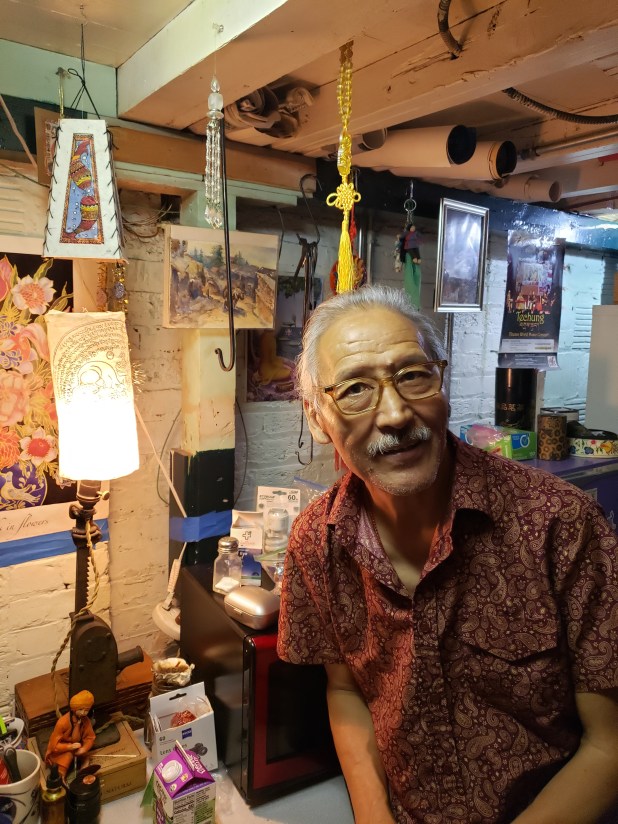
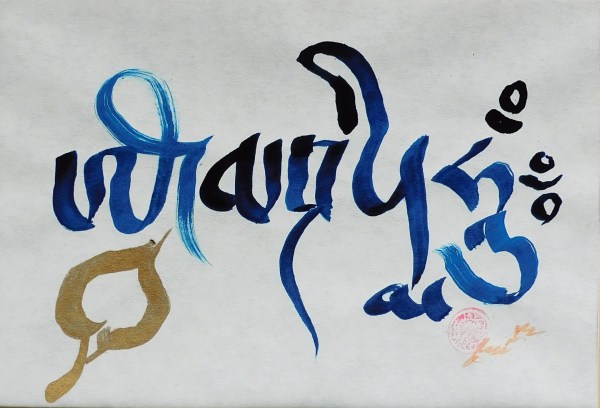
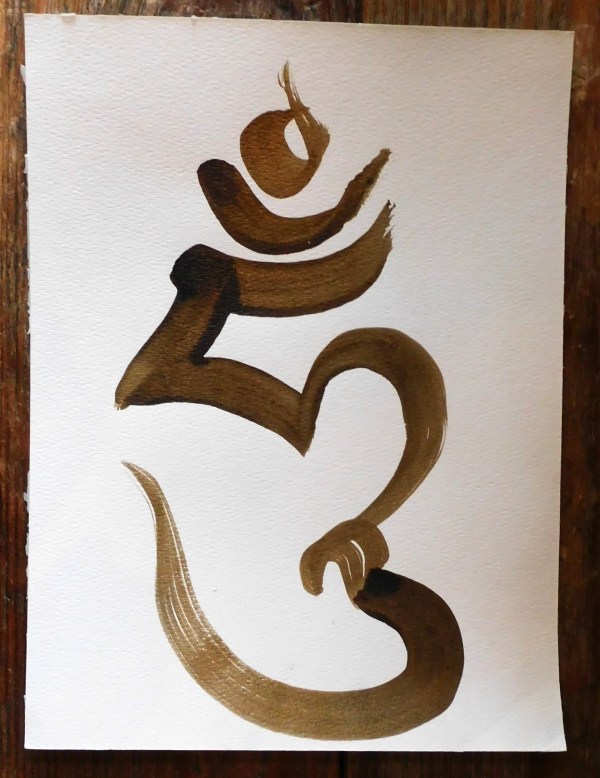
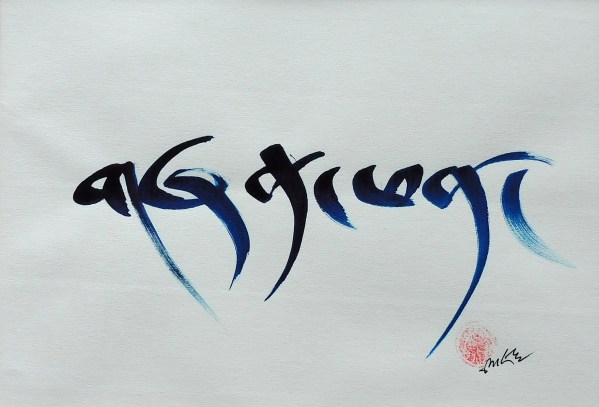
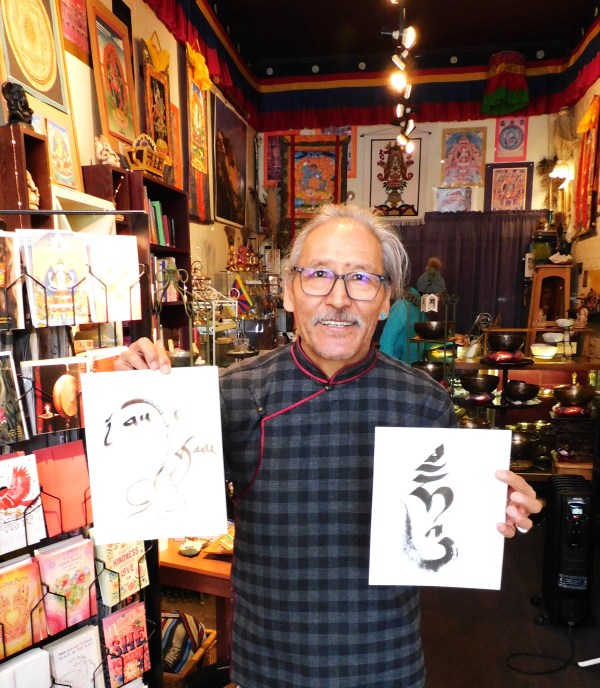
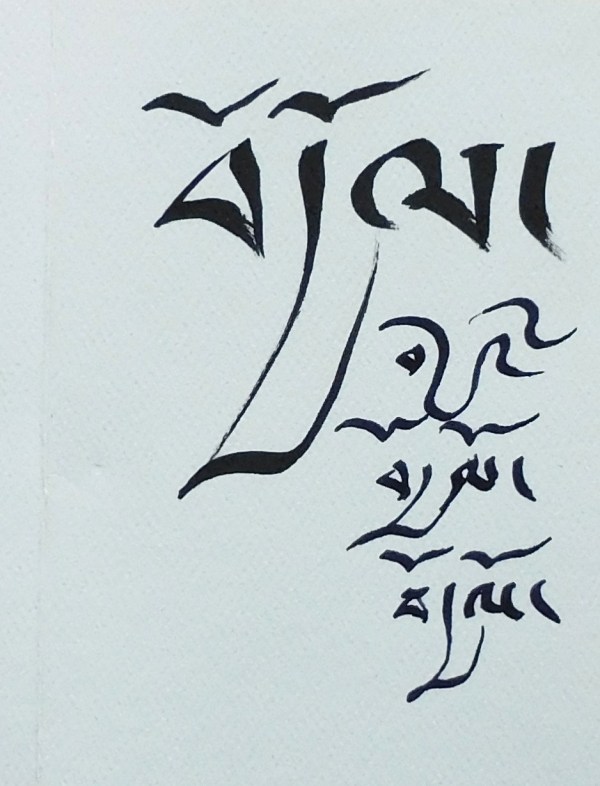
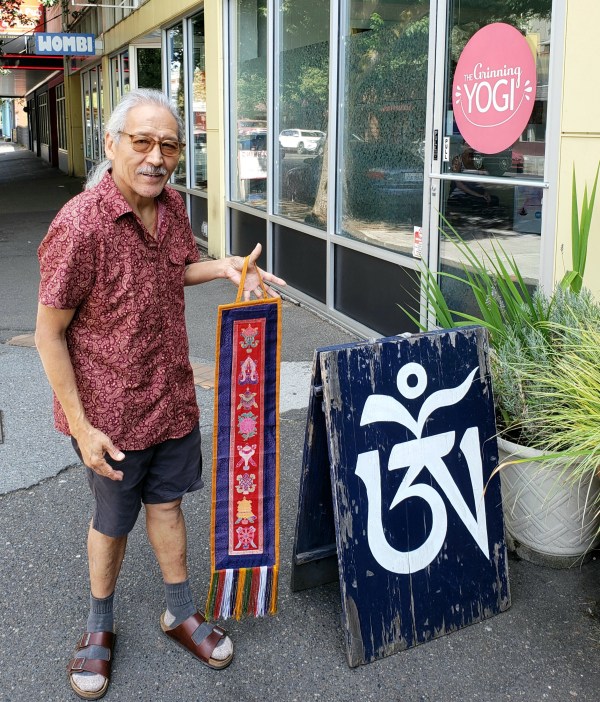
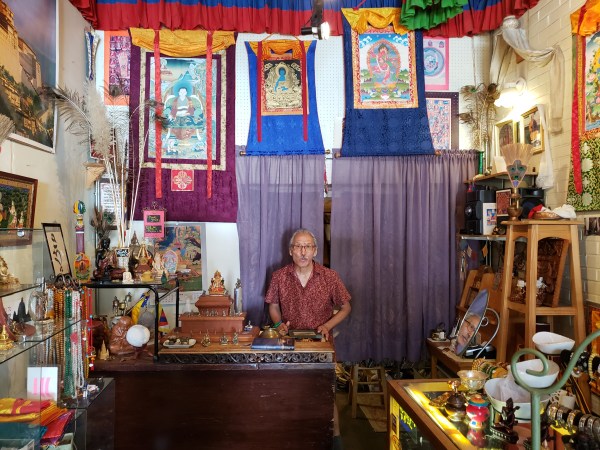
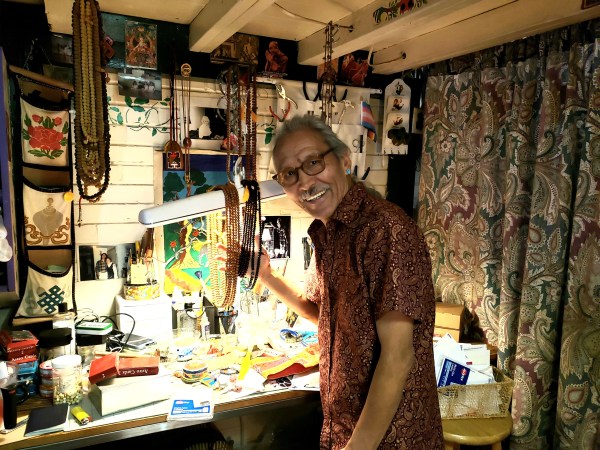
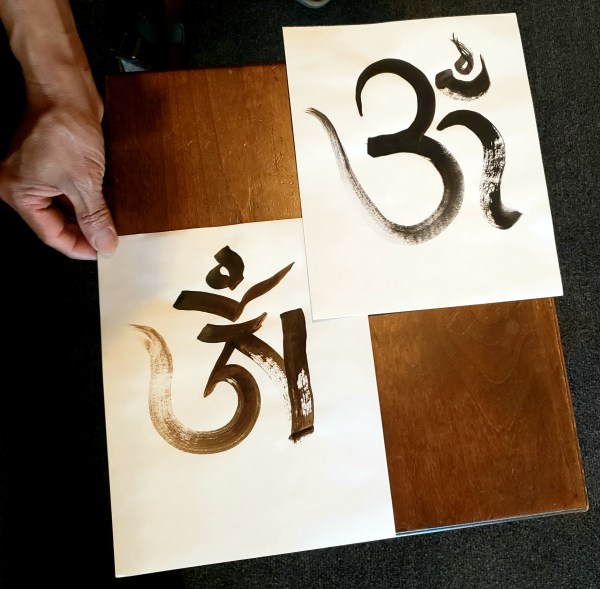
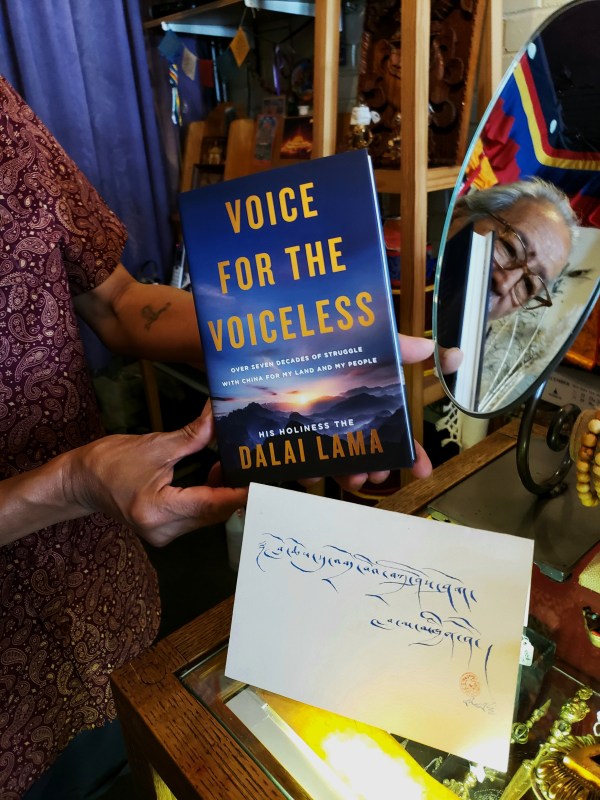
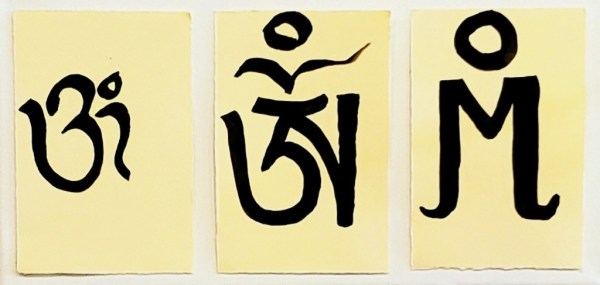
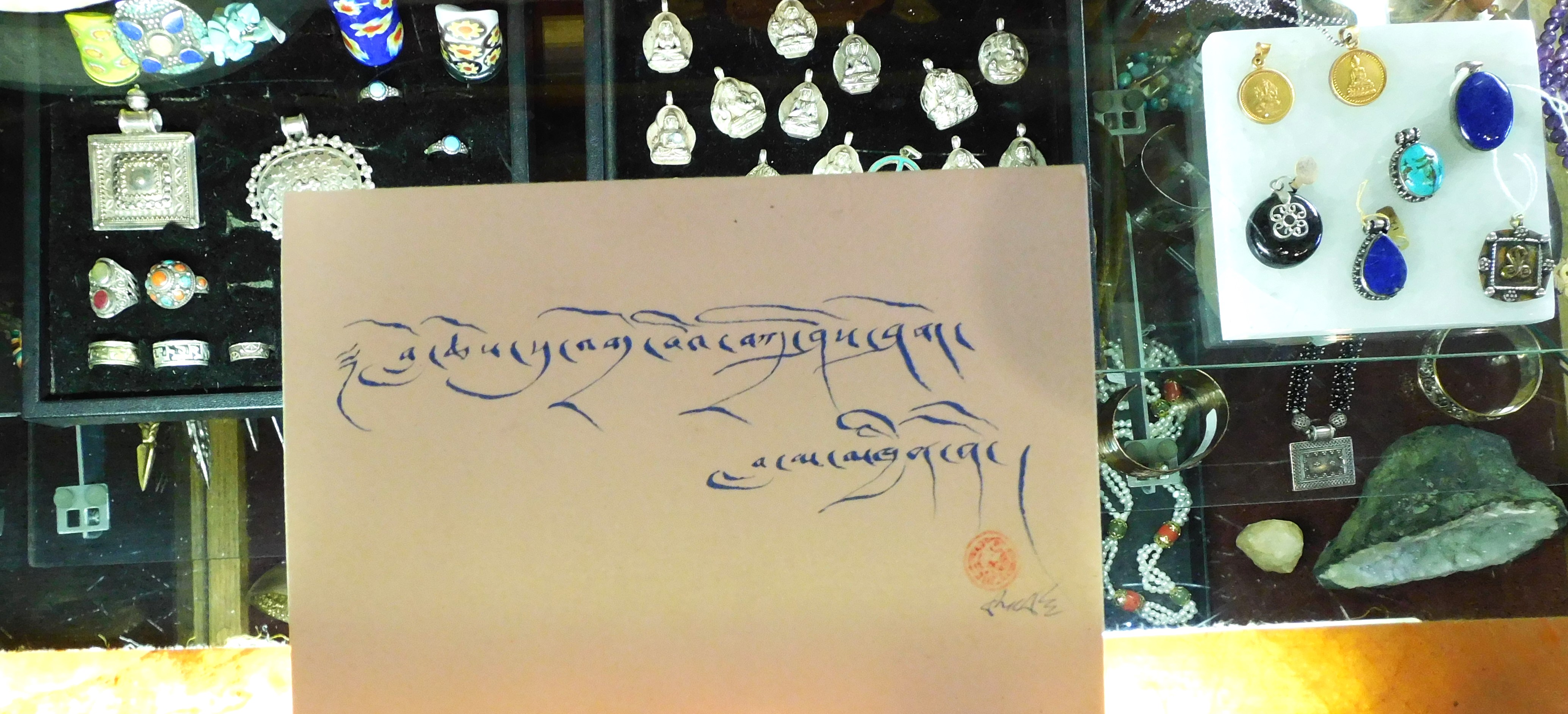
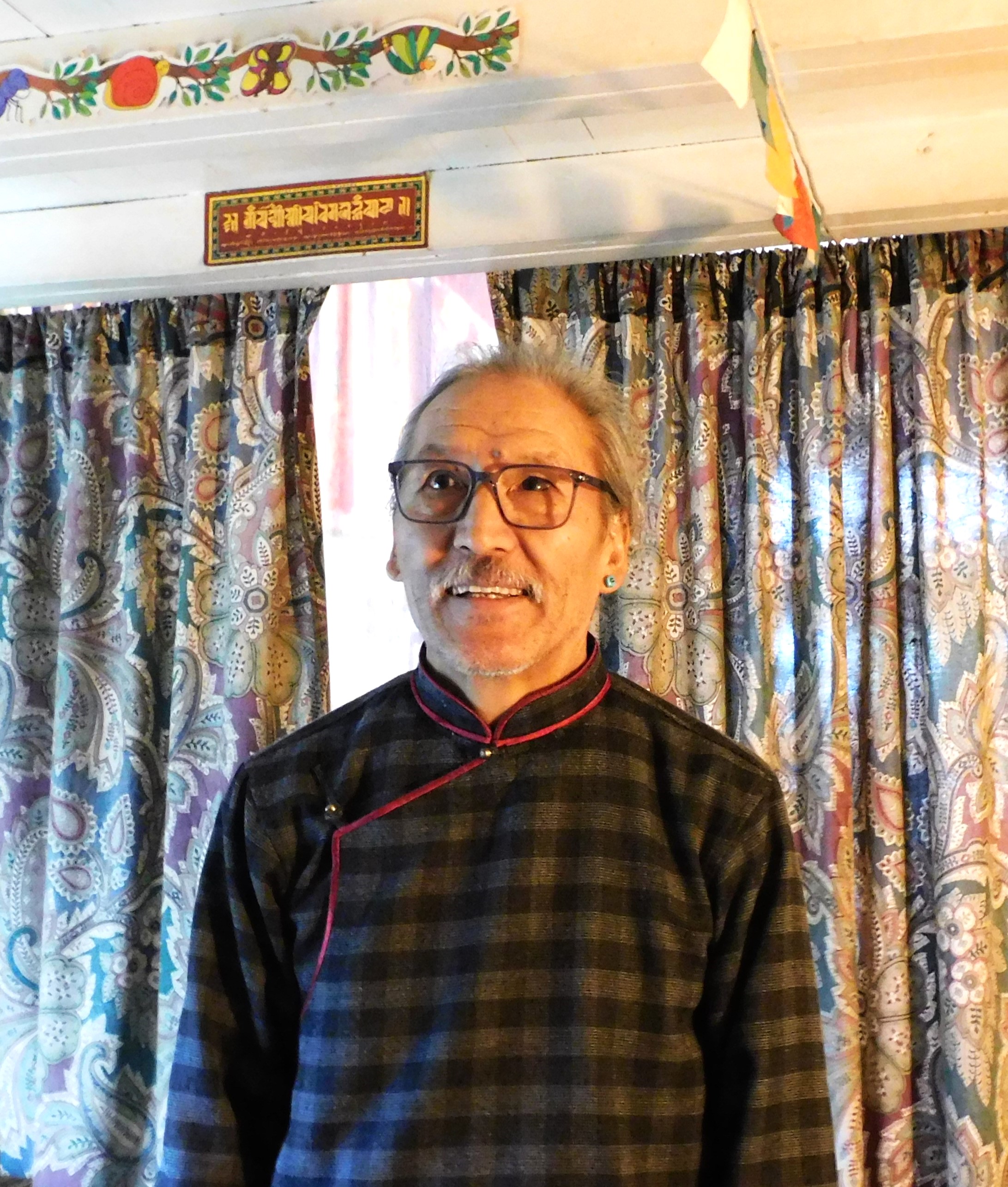
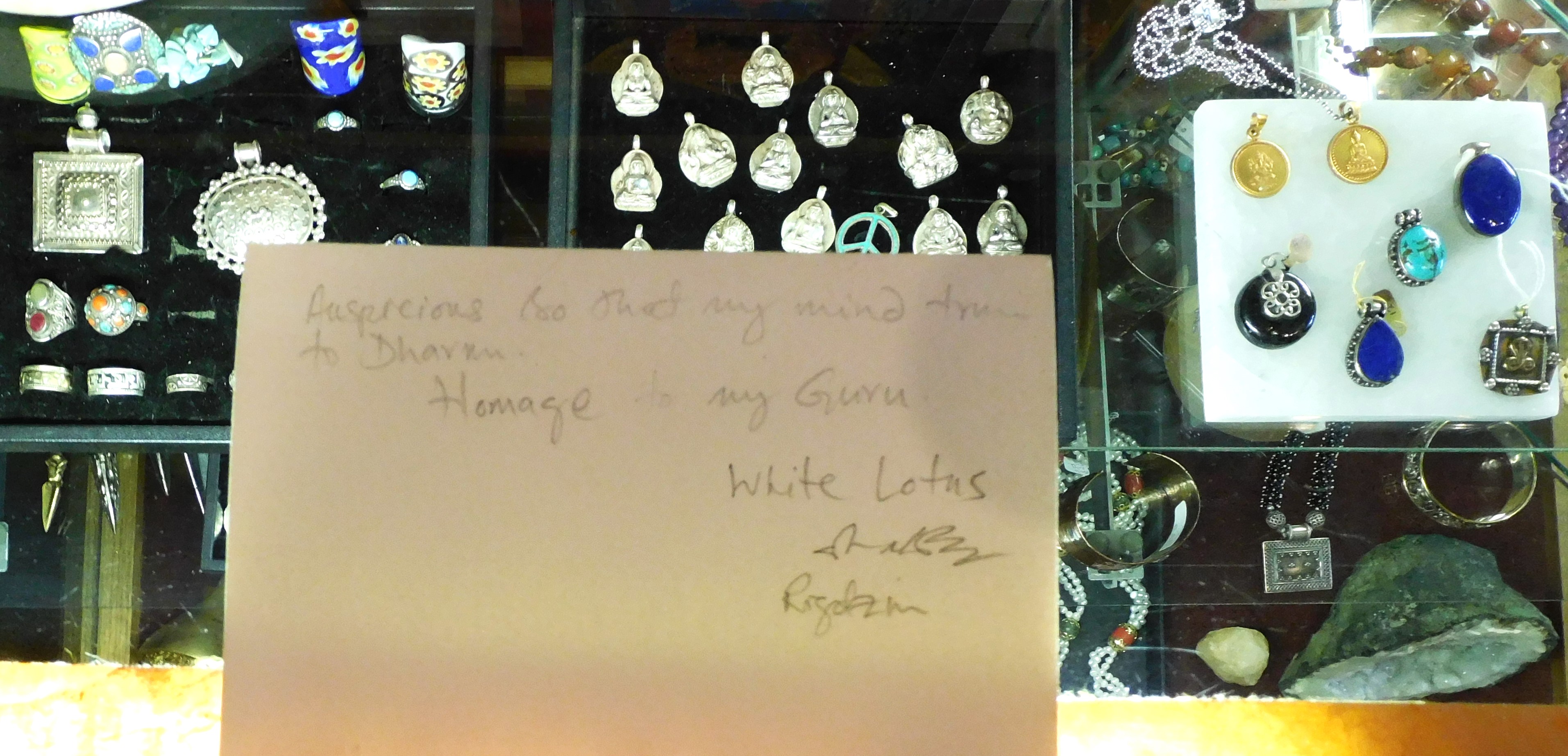
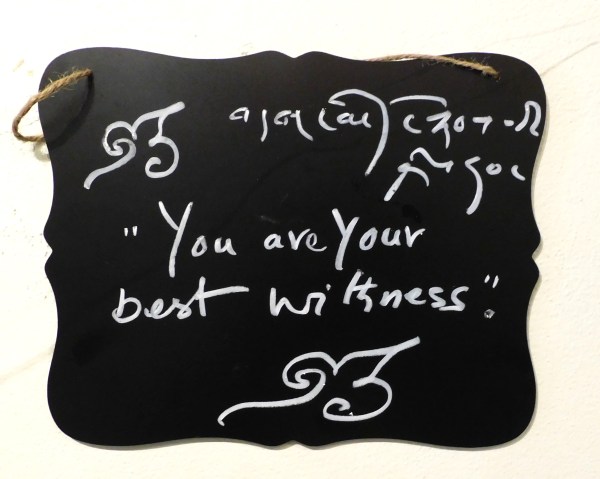
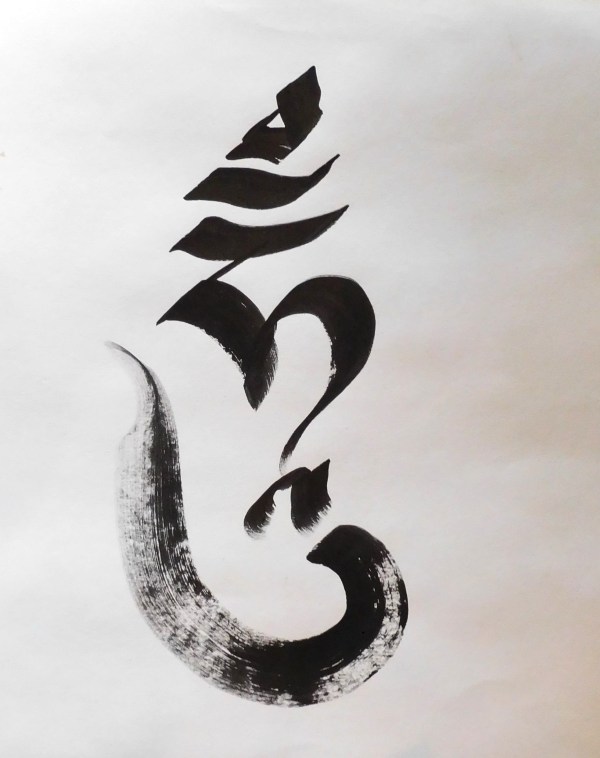
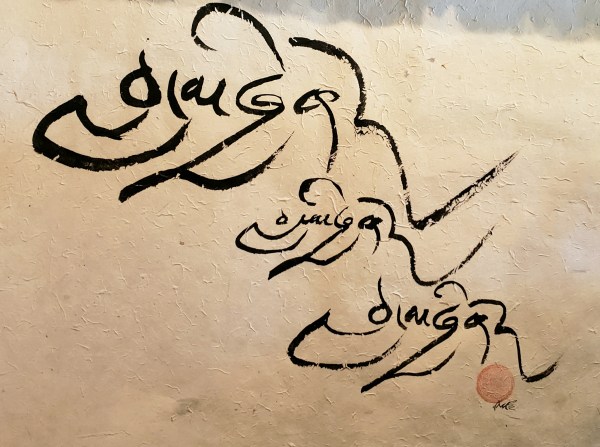
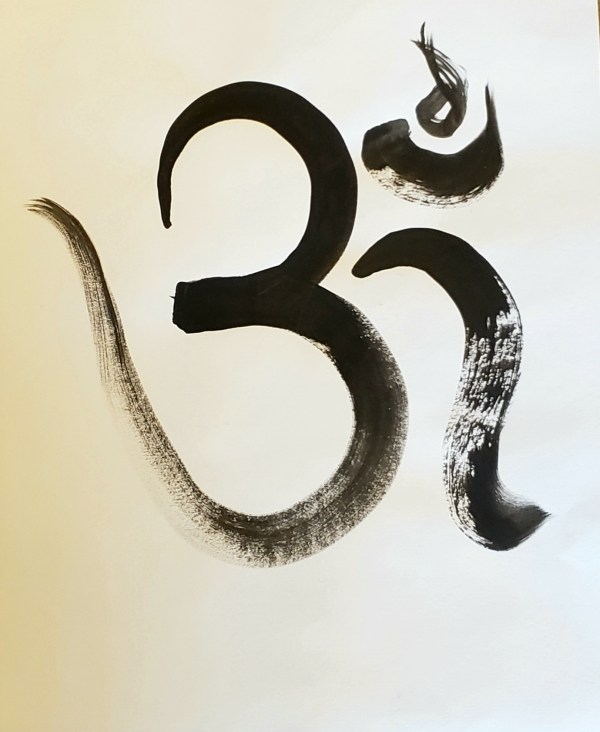
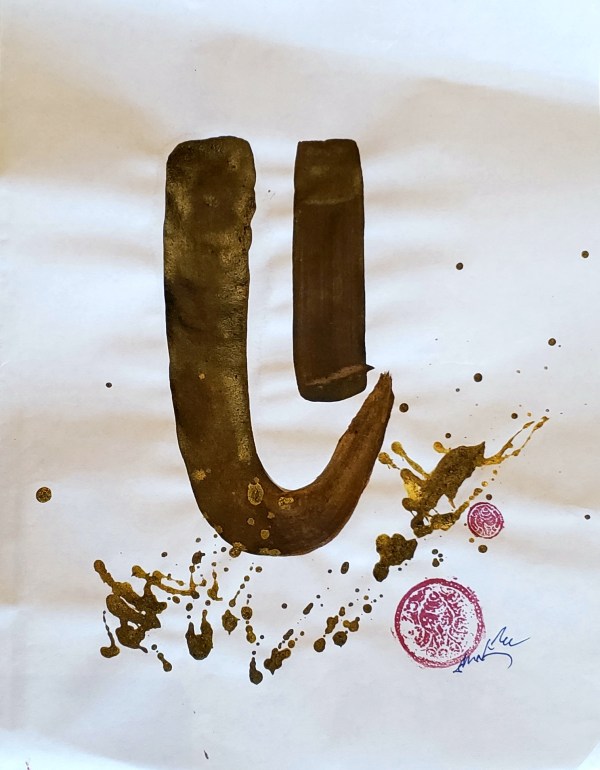
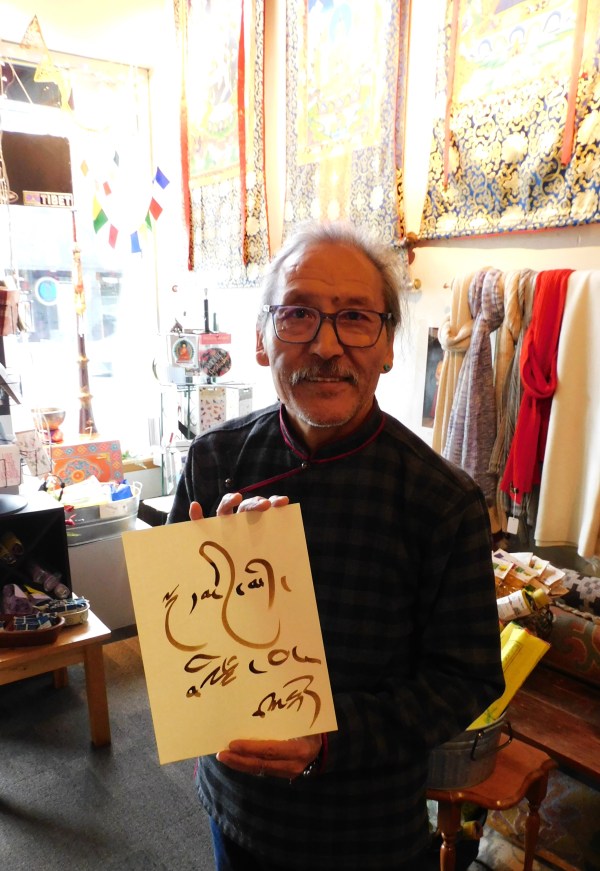
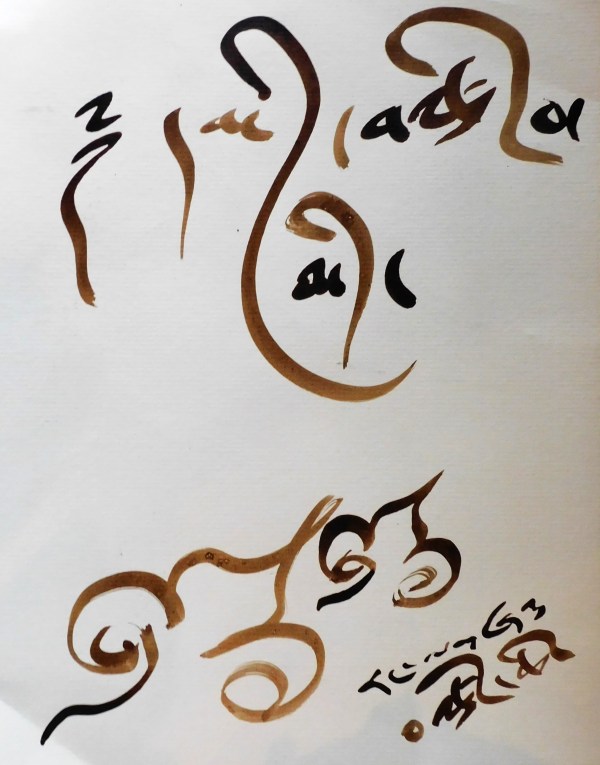
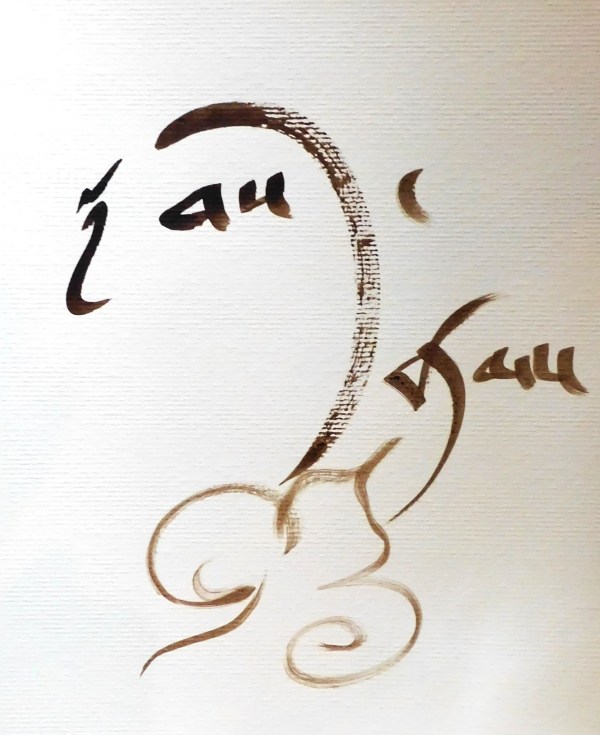
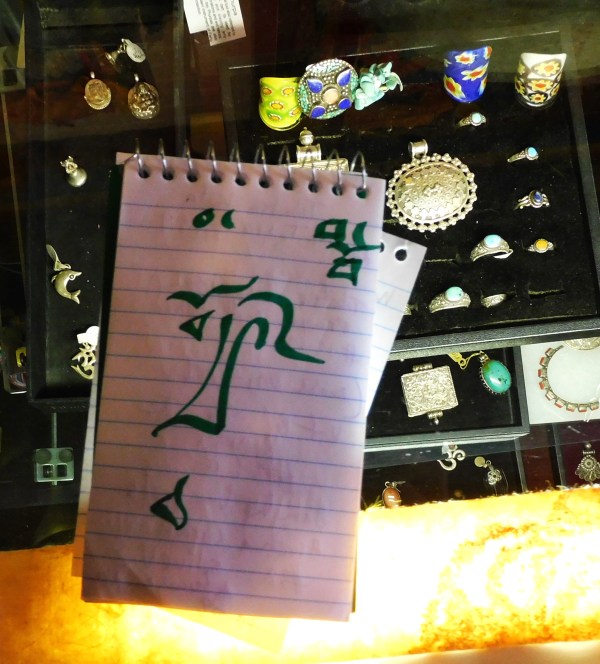
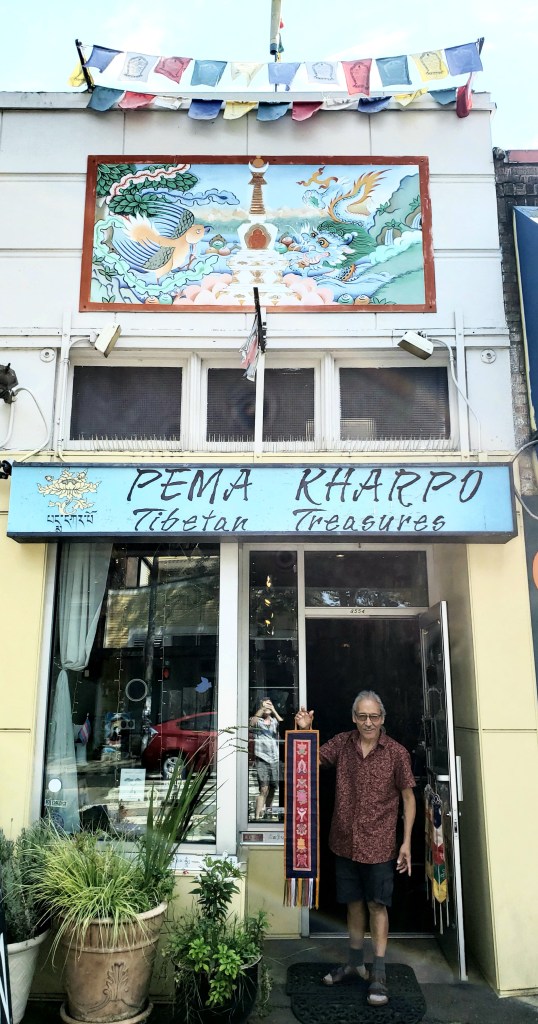
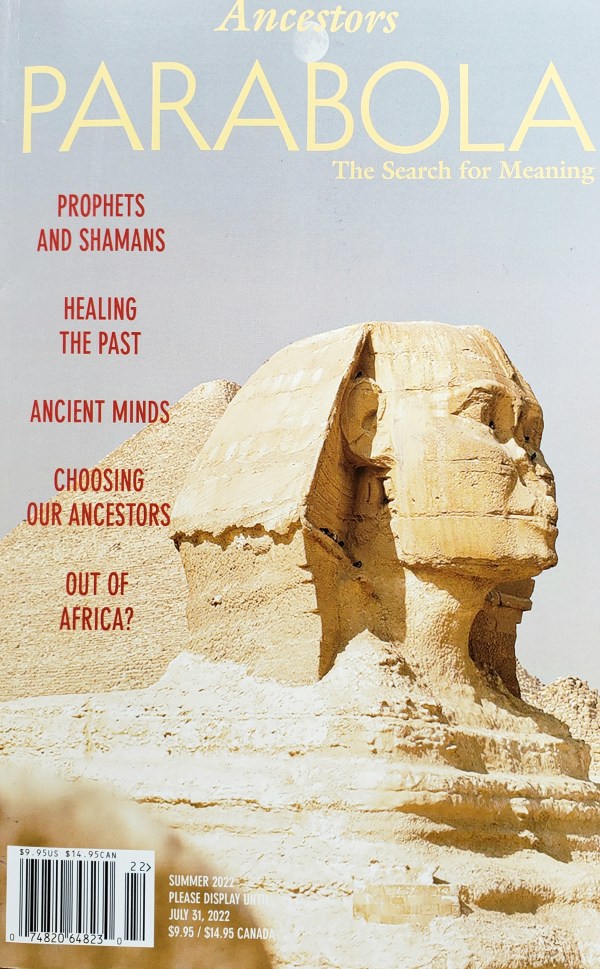
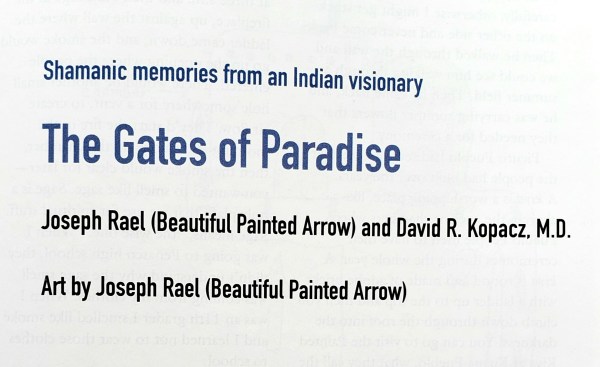


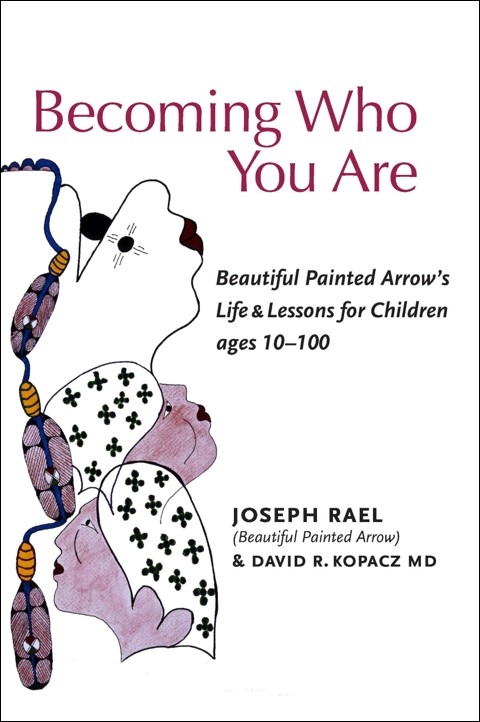

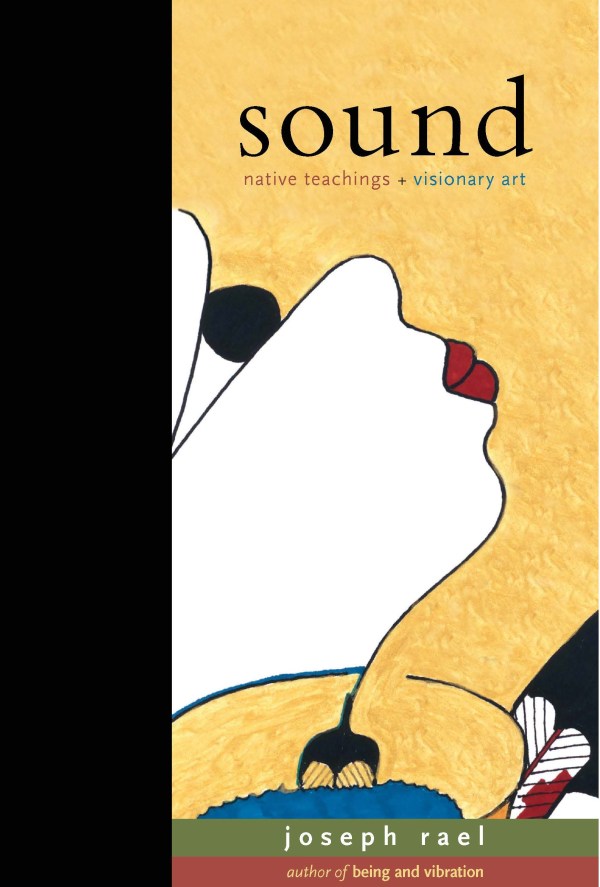


 Being Fully Human