The Art of Becoming Medicine.22

The next two paintings from Becoming Medicine: Pathways of Initiation into a Living Spirituality are both by Joseph Rael (Beautiful Painted Arrow). These two take us into the central chapter of the book, Chapter 0: “Na-Yo Ti-Ay We-Ah (We Don’t Exist).”

Na-yo ti-ay we-ah is a complicated concept. Joseph says it means “I don’t exist.” He teaches that most of the time we don’t exist because we are trying to persist in some kind of state. The times where we really exist are when we are entering into the new and the spontaneous – when non-ordinary reality is perfusing ordinary reality. The first place he explained this to me was when we first met and we were sitting in the rental car prior to Joseph directing me to drive around to different places on the land where key events happened for him. We were talking and then he said – “There, did you see that? We were just sitting here, but then all of a sudden we both started to get really animated – that was the place where we were existing.”

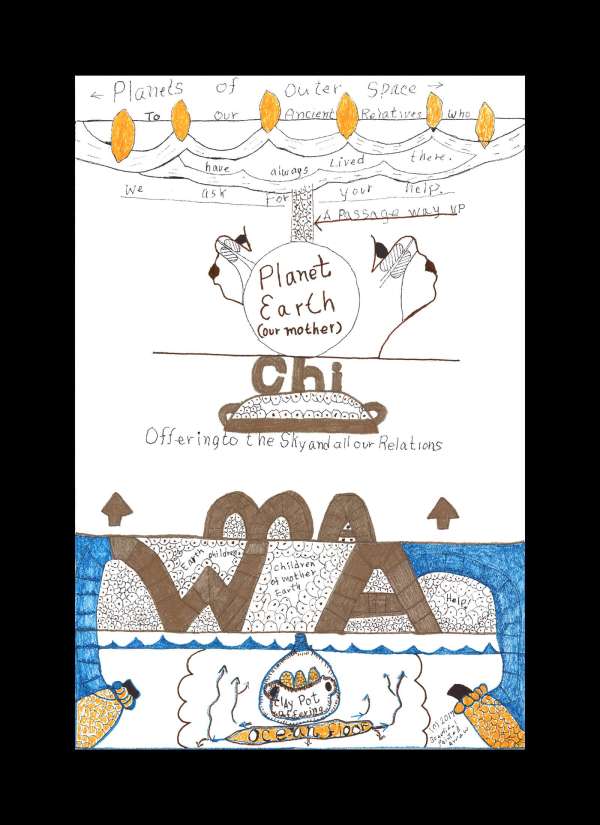
The first painting is titled “Planet Earth (Our Mother),” yet it has a lot of words on it, including Wa-Ma-Chi, the Tiwa word for God. The other text on the painting reads, “Planets of outer space – to our ancient relatives who have always lived there. We ask for your help – a passage way up. Offering to the Sky and All Our Relations. Earth children. Children of Mother Earth. Help!”

Planet Earth (Our Mother), J. Rael (2017)

I’d like to include a section of dialogue with Joseph that led to him telling me about sending the above painting.

I asked Joseph what the Tiwa word for “zero” is. “Y-we-ah” he said, “the flesh does not exist.” And then he said:

“Ok, hold it right there. We are not going to go to the East or the West, we are not going to go to the North of the South. We are not going to go up or down. Write this down, I’m going to say it to you in Spanish. La vida no mas un sueño es. In English that means, ‘Life is but a dream.’ This life is not real. This life is a dream. We have talked ourselves into believing we are our ordinary reality bodies. We use these ordinary bodies to complain, to get in the car, to go around. In this life we are addictable. Use that word, I know I am making things up—we are addictable, we are addicted to this life of ordinary reality. We think we are going from 1 to 10, but we are already at ten (tehn-ku-teh). We were at number eight 10,000 years ago, but we are stuck because we are very addictable, we are stuck hanging on to life, we are hung up on the physical. Enticing as life is, it is a dream. Now, 99% of people are going to disagree with this. They are supposed to disagree because they decided to go with teamwork. All these generations have been stuck because we are very addicted to the idea of being solid, physical ideas—this leads to the idea of property and property leads to conflict. So now we have property problems between the Indians and the United States.

“The point for me—I’m being told, ‘Look you dummy, you are going around in circles, 10,000 years and you are still going around in circles.’ Every now and then, I see ancestors looking down from above—I climb and climb and climb all the way up there. They tell me, look, your ancestors got hooked on the physical. That is why they are still here but they are not supposed to be, they were supposed to have moved on. The trees stayed here with us because they love us. Plants stayed and that is where we got our language from. The mermen were planted in the ocean and now they are stuck here with us, too. It is like that man in the Bible who was stuck inside a whale—that’s us! We got addicted to the sunrise and the sunset, to seeing rainbows, then we got stuck in going to school, going to college, learning things so that we could get rich. We got stuck getting rich, traveling all over the place.

“We better start getting the message, La vida no mas un sueño es. It is dream, dream, dream! We have invested in our landedness, we get money and we buy land. We get a little money and then we buy property and we are stuck with ownership.

“This is what the Story Teller was telling us in the Picuris Children’s stories. I heard these when I was eight or nine years old. [He speaks for a while in Tiwa]. ‘Look up at the stars, they are like little bits of sand. That is where our ancestors are living. We are down here and we are supposed to be up there.’ Then they put you in a square sand box and you play with the sand. Look at people’s attraction to the ocean. They’ll travel across the world to put their feet in the sand and the ocean. They are trying to realize that they are the grains of sand and the grains of sand are the stars and that we do not belong here.

“It’s raining right now—finally I’m saying something worthwhile. This is more rain than I have seen in ten years. They’re saying, ‘Dang, David, you finally got it—you and that crazy Joseph Rael!’

“I was driving this morning and I saw a giant cloud and there was a rainbow up front on the left and then it went over and it was on the right, too. I was driving through it. The last time I saw that was driving back from Madison when I was in graduate school. It was around a place on the border of New Mexico and Texas called Texico. I drove through that rainbow and I thought, ‘It’s time to call David!’

“There’s something going on here that I’m not even going to try to explain.”

I totally resonate with this last statement and momentarily wonder if I can just say that in the book: “There’s something going on here that I’m not even going to try to explain!” But then Joseph continues and he tells me I do need to explain some things.

“We’re supposed to be here, you and I, for some dastardly reason. We need to put something in the book about what all this flooding in the world is about according to the mystic. Schools should be teaching this to kids. We need to understand that in non-ordinary reality we can leave these ordinary bodies behind. We can go out into outer space, to the moon, to other planets.

“We need to start with the premise that everything becomes its opposite. You are a scholar, you can explain this. We started with Pangea, the Indians came across the land bridge, across the straits. You need to orient people to where they come from and then tell them the statistics of what will happen with the flooding and rising oceans on the coasts. You have to look at where there is a lot of land and sooner or later that will turn into its opposite, a lot of water.

“I’m going to send you an art piece. In it I am asking for the people from outer space to come give us some technology. They can do it in our dreams, maybe the dream of a young scientist who will then get that idea to make something.” (Becoming Medicine, 308-310)

Returning Home for Mending, J. Rael (2005)

Words Create Worlds.5 To Fight Against This Age: On Fascism & Humanism

“Words create worlds,” said Rabbi Abraham Joshua Heschel.[1]

To Fight Against this Age: On Fascism and Humanism[2] by Rob Riemen

The Words Create Worlds series of essays was inspired by Rabbi Heschel’s warning of the way certain words led to the Holocaust, Riemen’s To Fight Against this Age, and Rebecca Solnit’s Call Them by Their True Names. I felt compelled as a health professional to speak up about fascism, based on the warning flags of the current US presidency and other world movements. In my youth, I was fascinated with World War II, later as a professional I became interested in trauma and the role of the trauma therapist as a moral agent – not just a neutral technician, but a human being who takes a moral stand against human rights abuses, what Robert Jay Lifton calls a “witnessing professional.”[3] As I have watched this regime unfold over the past four years, my early uneasiness has gradually turned to alarm. As physicians, we need to remember our higher calling to function as witnessing professionals for the health of society.

I think it is time for the Doctor to make the diagnosis: fascism, the prognosis: serious.

Fascism is a sickness, an illness, a disorder. It spreads through false-fixed beliefs (delusions), scapegoating (projection), and its continuous stream of lies creates unreality (impaired reality testing). Fascism infects the individual, but it spreads through the community. As a doctor, I am trained to diagnosis and treat sickness. As a doctor, I am trained to attend to individual health as well as public health. Some would say that doctors need to shut up and “stay in their lanes.”[4],[5] However, as someone who has read Nietzsche,[6] has read Robert Jay Lifton, Jason Stanley, Timothy Snyder, Rebecca Solnit, Madeleine Albright, and Rob Riemen – I have learned from history and I have studied epidemiology – people staying in their lane and just following orders leads down a deadly road. 

It is Time to Call it Fascism

Could it really be happening again? Right here in the USA? The erosion of democracy and the growth of fascism and totalitarianism. I think it is time we started calling it anti-democracy and fascism. Umair Haque thinks so, see his article “What Does it Take to Fight Authoritarianism? The One Thing Americans Still Won’t Do,” in which he writes:

“I don’t blame Americans for not getting why they have to say fascism. It’s a complex and subtle set of thoughts to understand, this responsibility.

And yet if I say ‘not calling racism or sexism racism or sexism is legitimising it,’ you get it instantly. Get exactly that logic for fascism and authoritarianism now. That moral, social, and personal responsibility.”[7]

The Leader spews a continuous stream of “false statements,” otherwise known as lies, propaganda – to confuse and disorient opposition and to mobilize a base of followers into a false-fixed state of loyalty and unreality. There are so many lies that the footnotes start to eclipse the text. During his presidency, the president of the United States had made more than 20,000 “false statements,”[8] which we should just start calling lies and propaganda because there is a method behind the madness – the method of the fascist playbook.

It sounds like a constant stream of gibberish, (just try to read this two hour speech), it makes no logical sense, but it appeals to biases and emotions. It is propaganda: “othering” and demonizing of groups of people: Mexicans, immigrants, Muslims, and women, “Antifa,” “radical leftists,” “anarchists.” Every event is amplified and weaponized to create divisiveness. He casts doubt on the institution of elections and hints that he will not honor the results or submit to a peaceful transfer of power if he loses.

And This Also Has Been One of the Dark Places of the Earth, D. Kopacz

To Fight Against This Age

Let us turn to Rob Riemen’s To Fight Against the Age: On Fascism and Humanism (2018). Riemen is the Founder, President, and CEO of the Nexus Institute, “a leading international center for intellectual reflection to inspire the Western cultural and philosophical debate,” and is the editor of the journal Nexus.

I picked up Riemen’s book, by chance, when I was traveling for work and was in Charleston, West Virginia. I found it at a nice little bookstore, Taylor Books. I bought it on impulse and then was fascinated by it and finished it on the flight home. The book consists of two essays, “The Eternal Return of Fascism,” (originally published in 2010) and “The Return of Europa.” In keeping with the theme of Words Creating Worlds, Riemen writes that “to be able to understand something,” you have to “call it by its proper name,” specifically, “populism…will not provide any meaningful understanding,” (18).  Even more specifically:

“The use of the term populist is only one more way to cultivate the denial that the ghost of fascism is haunting societies again and to deny the fact that liberal democracies have turned into their opposite: mass democracies deprived of the spirit of democracy,” (19).

Fascism Rests on Dehumanizing Others

I have personally been concerned with the objectification and dehumanization that happens in medical education and medical practice (see Kopacz, Re-humanizing Medicine – 2014). The antidote to dehumanization is quite simple in theory: re-humanization. The more difficult questions are: What is a human being? How is the soul of the human being lost? How is the soul of the human being regained? Riemen reaches a conclusion similar to mine about the limitations of numbers and the scientific method and the need for the humanities and a whole person philosophy.

“Science and technology will never be able to provide us with a complete understanding of the human being with his instincts and desires, virtues and values, mind and spirit…The humanities and the arts” provide “the only knowledge that could provide a true understanding of the human heart,” and that “the real requirements of a democratic civilization [are] the wisdom of poetry and literature, philosophy and theology, the arts and history,” (19-20).

How does fascism return to civilized democracies? Germany, itself was a democracy, Hitler was elected and then gradually did away with democratic institutions, consolidating power. Riemen puts it bluntly, “the main reason fascism can return so easily in mass democracies: ignorance,” (21). The ignorance of history. The ignorance of social psychology. The ignorance of power and fascism. If we don’t call it by its true name, as Riemen and Solnit both implore us, we will have no chance of confronting and stopping it.

Riemen takes his title of his book, To Fight Against this Age from Nietzsche, whom he paraphrases, “we should not accept the blind power of the actual and that instead of conforming to the whole noisy sham-culture of our age, we have to be fighters against this age…It is now upon us to fight against a zeitgeist that destroys the spirit of the democratic civilization,” (27).  

You Let Your Magic Tortoise Go, D. Kopacz

The Plague of Fascism

Riemen writes about Camus’ allegory of fascism, The Plague,[9] commenting on the “fascist bacillus,” he tells us that if “we want to put up a good fight, we first have to admit that it has become active in our social body and call it by its name: fascism,” (34). We must diagnose the problem before we can treat it correctly.

Riemen’s book was published in 2018. Now we have the strange juxtaposition of an actual pandemic being used as a fascist tool for promoting divisiveness and effecting the first purge of this regime, 200,000+ dead in the United States as of late September – 25% of the global deaths for 4% of the global population, at least we are “great” at something. Even stranger, now we have a president who is actually infected with a virus he is hell-bent on spreading to others.

Riemen, following Nietzsche’s critique, sees a problem with European and Western culture – that we have lost spiritual values. “With the loss of spiritual values,” he writes, “not only did morals disappear but so did culture in the original meaning of the word: cultura animi, the ‘cultivation of the soul,’” (38). We have become the barbarians. Barbarian originally meant “unintelligible speech,”[10] again, just try reading through this transcript.

This “cultivation of the soul” and the recognition of our common humanity is what humanism is founded upon. Fascism is the opposite of humanism – it is about the degradation of the soul, it is about exaggerating the differences between human beings into a false and superficial sense of sameness rather than seeing “out of many, one,” e pluribus unum.

Writing in the mid-1930s, Menno ter Braak noted that fascist movements were focused on “stimulating aggression and anger.” Riemen summarizes that a fascist movement:

“was not actually interested in finding solutions, had no ideas of its own, and did not want to solve social problems, because injustice was necessary for maintaining an atmosphere of vilification and hatred,” (51).

Lousy at Democracy, Super-Good at Fascism

If we look at the current US presidency, we might be tempted to call it incompetent – and from a perspective of democracy it would be right to do so. However, if we view the current president through the lens of fascism – he is hypercompetent. He is lousy at democracy, but he is super-good at fascist.

Menno ter Braak focused on the use of “social resentment vented on a scapegoat who was blamed for everything: the Jew.” Riemen further summarizes ter Braak’s view:

“At the same time, this movement considered itself to be the eternal victim of the ‘left’ or the ‘elite’ and harbored a deep aversion to intellectuals, cosmopolitans, and anyone who was different…[with a] continuous use of slogans and empty rhetoric…it was reactionary,” (52).

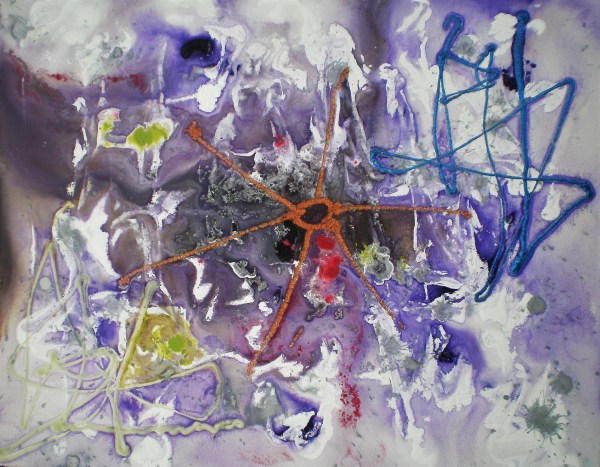
Untitled, D. Kopacz

Fascism is Semi-civilization and Promotes the Cult of Resentment

Fascism is “semi-civilization” and promotes “the cult of resentment.” These are the rules that the current US president is very good at, he consults the fascist playbook at every turn and fascism is winning and democracy is losing.

How did fascism gain hold in European democracies? By using those democracies against themselves. Both Hitler and Mussolini were voted into power. Riemen writes that both the liberals and the conservatives caved in to fascism because they thought they could gain something from it. It is the classic devil’s bargain of “the end justifies the means.” This is based, or maybe we should say de-based, on the idea that getting power or money (the ultimate materialist focus) is more important than human values, civility, decency, or humanity.

“The liberals no longer defended the freedom principle of European humanism but became interested only in the freedom of the markets: that is to say, As long as we can earn money,” (56).

We see this today – somehow the stock market in the US seems to give permission for fascism, as long as we can earn money.

“The conservatives were unprepared to unscrupulously exchange the protection of spiritual values for the preservation of their own power, under the veils of ‘tradition’ and ‘social order,’” (56).

We see this today, the conservatives going along with the president, even when it seems to violate their own principles, as long as they can preserve power and social order. This is the definition of fascism: power and order become more important than principles, ideals, more important than human beings.

After World War II, after Mussolini and Hitler were defeated, some still worried that we had not learned the lessons of history. Riemen reminds of that both Albert Camus and Thomas Mann, both Nobel Prize winners, warned of the return of fascism.

“Camus and Mann…as early as 1947…stated that fascism was a political phenomenon that had not disappeared at the end of the war and that we could now describe as the politicization of the mentality of the rancorous mass-man. It is a form of politics used by demagogues whose only motive is to enforce and extend their own power, to which end they will exploit resentment, designate scapegoats, incite hatred, hide intellectual vacuity beneath raucous slogans and insults, and elevate political opportunism into an art form with their populism,” (60).

Untitled, D. Kopacz

A Realm Where Words are Separated from their Meanings

Riemen warns us, as early as 2010, that “this is a new outbreak of the plague,” (60). But just as you cannot treat a disease you cannot name and diagnose, you cannot appropriately respond to a movement if you cannot call it by its true name – fascism. We, in the US, were sick, even before the Covid-19 pandemic, we were in the throes of a revival of an old illness – the pandemic of fascism. We entered into a realm where “words were separated from their meanings and reduced to slogans,” (61).

Again and again, throughout this essay, Riemen reminds us that the cure to fascism is the medicine of our human unity and spiritual/moral values. This is not about religion – many of the most vocal followers of the president are “religious” people who are more interested in power than in human goodness.

“Our true identity is determined not by nationality, origin, language, belief, income, race, or any way in which people differ from one another, but precisely by what unites us and makes the unity of [hu]mankind possible: universal spiritual values that shape human dignity and that every… [one]…can adopt,” (67).

“Anyone who really wants to be a humanist rejects every form of fanaticism and learns the courtesy of the heart and the art of conversation, dialogue,” (68).

What is needed is not a political solution, but a human solution. We need to remember our original instructions and the principles and tenets of spiritual democracy. While fascism is a political movement based in materialism (money and power), its cure is a spiritual movement based in humanism (soul and spirit).

Continuous Lies as Politics

Riemen describes the Party for Freedom (PVV, Partij voor de Vrijeheid) in his native Netherlands in words that sound like the current US president’s playbook. Fascism is not creative, it is not novel, it is really just the same damn thing, over and over again – the basest aspects of our material nature. It is the propagation of dehumanization through dehumanization. The PPV offers

“the shameless opposite of the Judeo-Christian and humanist traditions: vulgar materialism, oppressive nationalism, xenophobia, ammunition for resentment, a deep aversion to the arts and the exercise of spiritual values, a suffocating spiritual bigotry, a fierce resistance to the European spirit, and continuous lies as politics,” (68-69).

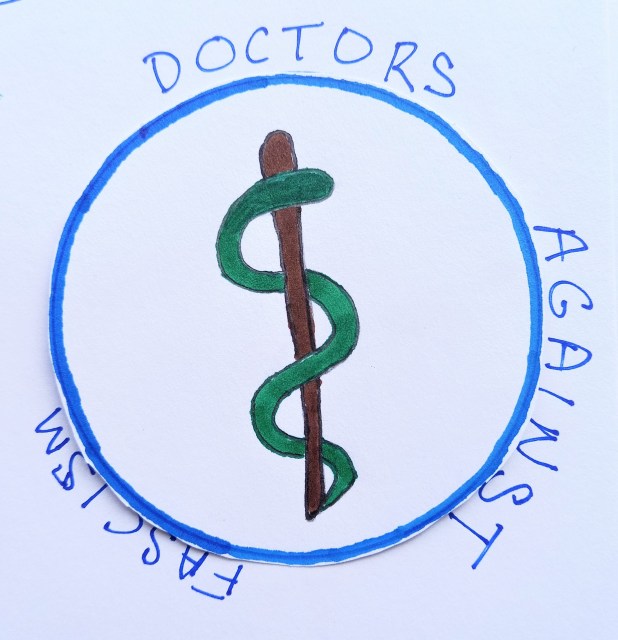
Doctors Against Fascism, D. Kopacz (2020)

Doctors Against Fascism

The way you learn how to diagnose something in medical school is by seeing case after case after case – until it becomes automatic, at the first signs or symptoms, you see the incipient signs of a more serious illness. This is why we need Doctors Against Fascism – witnessing professionals to diagnose and warn us that the fascist bacillus is starting to dehumanize our population and make it vulnerable to fulminant fascism. In the USA, there has been a growing concern about the signs and symptoms of fascism since 2016. Riemen has been seeing it in Europe since at least 2010 and we see it spreading all over the globe – a pandemic of fascism in Poland, Hungary, Turkey, Russia, Philippines, England, Brazil, India, and the United States of America.

The Doctor is in and has bad news for you – the prognosis of our nation’s health is serious. We are infected with fascism – it has taken hold in the minds of many of our citizens and it is spreading through our institutions. Words Create Worlds and we are surrounded by continuous lies as politics.

This essay seems to have found a natural ending-point here. I will pick up with the rest of the review of Rob Riemen’s book, To Fight Against This Age: Fascism and Humanism, in the next installment of Words Create Worlds. Perhaps I will develop this theme of Doctors Against Fascism more.

This series, Words Create Worlds, grows out of my work with Joseph Rael on peace. In Becoming Medicine: Pathways of Initiation into a Living Spirituality, I felt compelled to write about the responsibility that grows out of mystical, visionary, and shamanic experience—that we must work toward “Spiritual Democracy.” At its deepest point, mystical experience leads to an awareness that we are all one and this comes with a responsibility to challenge words of separation which can ultimately lead to fascism. Mystical experience is a pathway that leads us to question who we are and gives us a responsibility to use our words wisely to create worlds where we are becoming the medicine that our world needs. As Rumi says, “We are pain and what cures the pain.”[11]


[1] Life Between the Trees blog.

[2] Rob Riemen, To Fight Against This Age: On Fascism and Humanism, New York: W. W. Norton & Company, 2018.

[3] Robert Jay Lifton, “Foreword to the First Edition: Our Witness to Malignant Normality,” in Bandy Lee (ed) The Dangerous Case of Donald Trump: 37 Psychiatrists and Mental Health Experts Assess a President, New York: Thomas Dunne Books, 2019.

[4] “Doctors Revolt After N.R.A. Tells Them to ‘Stay in Their Lane’ on Gun Policy,” Matthew Haag, The New York Times, Nov. 13, 2018. The original criticism was in a Tweet from the NRA, “Someone should tell self-important  anti-gun doctors to stay in their lane. Half of the articles in Annals of Internal Medicine are pushing for gun control. Most upsetting, however, the medical community seems to have consulted NO ONE but themselves.” https://twitter.com/NRA/status/1060256567914909702.

[5] “Take Two Aspirin and Call Me by My Pronouns: At ‘woke’ medical schools, curricula are increasingly focused on social justice rather than treating illness,” Stanley Goldfarb, Wall Street Journal, 9/12/19.

[6] Richard Huelsenbeck, German-American psychiatrist and Dada-ist who was investigated by the Nazis and forbidden to write, once said, “We are psychiatrists; we are Germans; we have read Nietzsche; we know that to gaze too long at monsters is to risk becoming one―that’s what we get paid for!” (Greil Marcus, Lipstick Traces: A Secret History of the Twentieth Century, p. 211). Marcus’ book traces the spirit of protest from punk rock back to earlier art movements that were cultural and political critiques of the times.

[7] Umair Haque, “What Does it Take to Fight Authoritarianism? The One Thing Americans Still Won’t Do.” Eudamoinia & Co, Sept 25, 2020, https://eand.co/what-does-it-take-to-fight-authoritarianism-the-one-thing-americans-still-wont-do-676dfb86794b

[8] Glenn Kessler, Salvador Rizzo, Meg Kelly, “President Trump has made more than 20,000 false or misleading claims.” The Washington Post, July 13, 2020 at 12:00 a.m. PDT

[9] Albert Camus, The Plague, New York: Vintage International, 1991.

[10] https://www.etymonline.com/word/barbarian

[11] Rumi, “We are the mirror as well as the face in it,” The Essential Rumi, trans. Coleman Barks, 106.

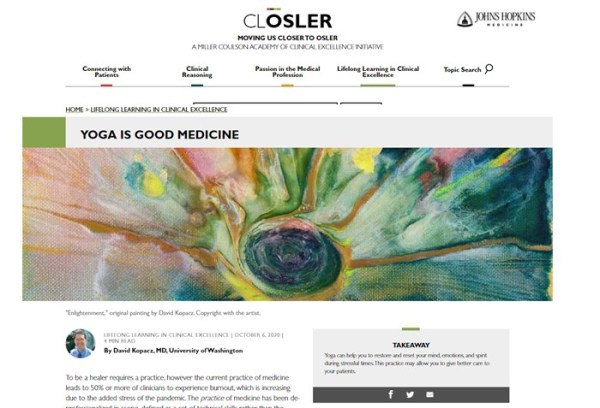
Yoga is Good Medicine – new post @ CLOSLER!

CLOSLER just published a new essay of mine, “Yoga is Good Medicine,” this is an excerpt I re-worked from the section “The Yoga of Burnout” that is part of J. Greg Serpa’s and my chapter on “Clinician Resilience” in the forthcoming 5th Edition of Dave Rakel’s Integrative Medicine text.

“In this way joy isn’t the opposite of burnout, but arises out of connecting (yoking) mind, body, and soul, deeply feeling the experience of being fully human. By rejoining our feeling soul with our functioning body, we can experience joy even in the midst of suffering.”

You can read the whole essay, here, and below is the full painting that the detail in the banner was taken from: 

Enlightenment, D. Kopacz (2015)

Interview with Gerald Arbuckle on Culture, Loneliness, and Fundamentalism @The_POV

This interview from September 13, 2017 with anthropologist and Marist priest, Gerald Arbuckle, is as timely and relevant as ever. This is just a small selection from our talk and focuses on culture, loneliness, and fundamentalism.

The full article can be found at The POV website.

Here are a few quotes from Gerry:

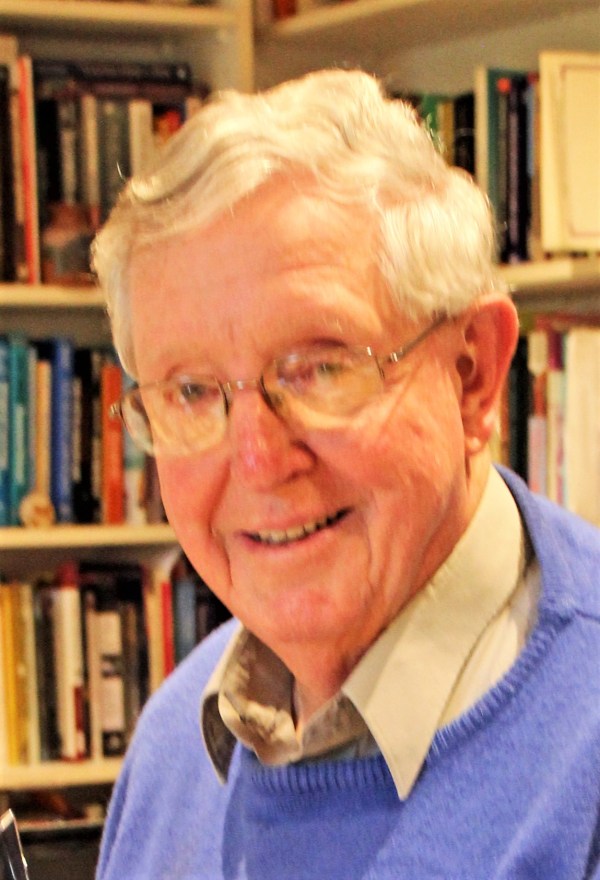
Father Gerald Arbuckle

“the American dream, comes through as a very positive dream, but the danger is that in mythology, amnesia takes place. Mythologies can hide history. What it has hidden is the racist elements in the founding story of the United States”

“The US president is a fragmenter and a polarizer. He aims to fragment by his behavior, alliances, at all levels, international and national. Then that leads to the second stage, polarizer, where not only are they fragmented, but they are polarized. So, this is the tragedy, it is going to be extremely difficult therefore to get a rational debate in that kind of atmosphere.”

“Well, anthropologically, it all makes sense. Once you disturb a culture, even a threat to disturb a culture, and even if intellectually you accept that the culture has to be disturbed, inevitably it leads to chaos levels of intensity. And chaos can only be appeased by returning to what I feel gives me order.”

“Nationalism is a way of giving me a sense of order because it has pre-existed, it is a residual mythology, so the residual mythology comes alive. It never dies, it comes alive so that the United States, with the white rage against African Americans, that is a residual mythology that comes alive, it never died. It just happens to be quietly put aside for the time being, but is there to be used again because it gives me the comfort and sense of security and permanence. And globalization and technology are moving at such speed that our affectivities are not able to catch up with it.”

“There is a real information overload. Put that on to a global scene and the pressure of technology and everything that goes with it increasingly intensifies the chaos, it intensifies the loneliness and the need for a sense of belonging which opens up the opportunity for nationalism, it just makes sense with the intensity that we have probably never experienced before internationally, globally.”

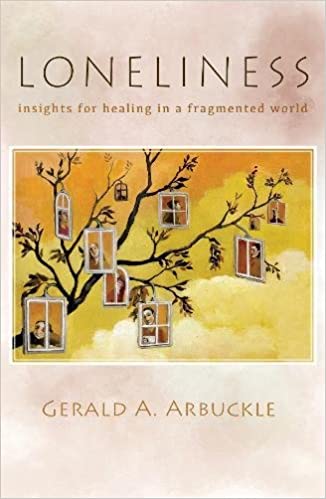
Gerry’s concept of refounding plays prominently in Becoming Medicine: Pathways of Initiation into a Living Spirituality. I also drew from his Humanizing Healthcare Reforms in my book, Re-humanizing Medicine. This 2017 chat I had with Gerry in Sydney, Australia was the basis for what we put in the book on refounding: how organizations and cultures go through the process of reconnecting to their founding visions, while navigating the risk of fundamentalism.

I hope to put out the rest of the interview transcript in the future…but for now you can read this segment:

@ The POV

Anti-Democracy: Changing the Motto of the United States of America from E pluribus unum (“out of many, one”) to “Make America Great Again.”

This essay was originally published in The Badger, Year 4, Vol 2, March 2018. Thanks to The Badger for permission to reprint! It seems as relevant now as ever…

This past year (2018) has been a difficult one in the world. There continues to be a movement of anti-democracy and radical “other-ing,” in which we see our brothers and sisters as “others,” and we break down, rather than strengthen, the bonds of our common humanity. In the United States the freedom of the press is under attack, environmental regulations are being rolled back and hostility toward non-white, non-Christians is being promoted at the highest levels of government. Not only is there an attempt to drive people apart and promote fear, there is even talk of building a physical wall between the United States and Mexico. Walls are the most concrete dividers of people.

While the stated goal is to “make America great again,” in reality it is an anti-democracy movement that has all the hallmarks of totalitarian and fascist regimes of the 20th century.

I do not intend to regularly write on politics in this column (Becoming Medicine in The Badger), but we are in unprecedented times and times such as these spirituality needs to be engaged and to speak up for peace and human rights.

In 2017, I published an essay called “The End of E pluribus Unum? The De-evolution of Out of Many, One, to ME First” in The Badger (Year 3, Volume 2, pgs 57-66). In the essay I describe how the idea of “America First” is thinly veiled selfishness, essentially ME first. It’s history traces back to Charles Lindberg and the America First movement that was sympathetic to the Nazis and encouraged the US to stay out of the war (see M. Albright, Fascism: A Warning and J. Stanley How Fascism Works). This attitude is the pinnacle of self-centered capitalism, and betrays the ideals upon which the United States was founded.

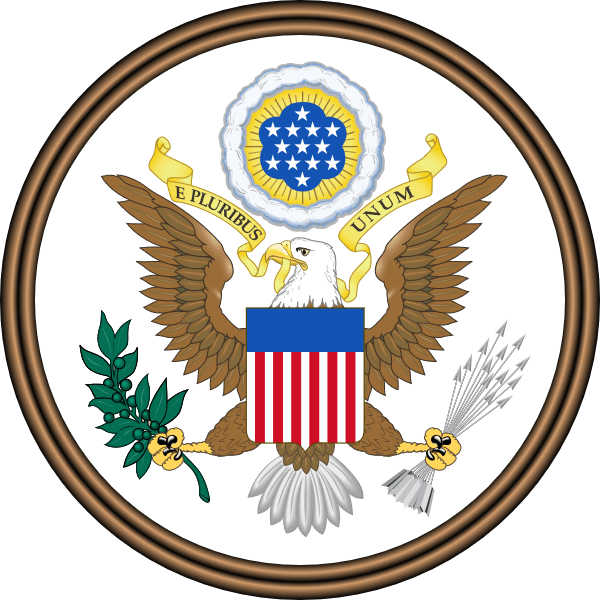
In my work with Native American visionary Joseph Rael, in our book, Walking the Medicine Wheel: Healing Trauma & PTSD, we discuss the motto on the back of the Great Seal of the United States which has the Latin phrase E pluribus unum, “out of many, one.” This motto captures the “united” aspect of the country’s name: the United States, symbolized by the 13 arrows the eagle is clutching. (Glenn Aparicio Parry has written in Original Politics: Making American Sacred Again about Chief Canasatego, of the Onondaga, giving Benjamin Franklin a single arrow that he then snapped easily, then giving him 13 arrows bundled together, which could not be easily broken). The 13 colonies had different cultural, political, religious, and economic foundations, and yet these 13 colonies united and came together with the idea of strength through union, “united we stand, divided we fall.” This phrase was used in the early years of the American Revolution by such figures as John Dickinson, Patrick Henry, and Abraham Lincoln also paraphrased it. I do not mean to gloss over the major failures of living up to the ideals of the United States in regard to its inhuman policies toward Black and Native American people, but ideals provide a vision of a better world to strive for.

The Great Seal of the United States of America, U.S. Government / Public domain. The eagle looks toward the olive branch rather than the arrows – reminding us to focus on peace.

In my essay, I discussed how crucial it is for the idea of democracy to be able to see ourselves as similar and united within our diversity. When Joseph and I wrote our book on helping veterans return from war to peace, we saw this motto, “out of many, one” as crucial. Moving from war to peace means moving from a perspective of human beings as “other” to seeing them as “brother and sister.” As Joseph often says, “I am my brother’s keeper.” This statement shows affiliation and human bonding. In war, military personnel are taught to view human beings as “other” as the enemy. However, after war, this perspective of viewing human beings as “other” does not promote reintegration or democracy. All of us here in the USA (except for Native Americans) come from other lands. Our current First Lady is an immigrant, born in Slovenia.

I was uncertain if I should write a political piece earlier in the year and I am still uncomfortable with speaking out politically for several reasons.

Yet, as a human being, and as a healer, I feel obligated to speak up against totalitarianism and fascism: attacking the press, threatening federal employees, appointing government officials who seek to undermine the mandate of those agencies (e.g. the Environmental Protection Agency, the United Nations Ambassador), lying without any consequences, and consolidating power in fewer and fewer hands.

Another instance of anti-democracy is the censorship of science by banning the words “diversity,” “evidence-based,” and “science-based” in official Center for Disease Control documents. My friend Father Gerald Arbuckle has been writing on topics of bullying and fundamentalism, and he describes how “Trumpism” is a fine example of both (see my review of Gerry’s latest book, Fundamentalism: At Home and Abroad).

Sandia Mountain, looking south, NM (D. Kopacz 2018)

Other healers have felt similarly that they have a moral, ethical, and professional obligation to speak up about the current risks to American democracy. The Dangerous Case of Donald Trump, edited by Bandy Lee, MD, MDiv, includes perspectives of 27 professionals. (Now in a second edition with 37 professionals contributing and also a companion volume The World Mental Health Coalition Documents). While the Goldwater Rule banned mental health professionals from diagnosing mental illness in politicians who had not been formally evaluated, many of these authors take another perspective on our responsibility as mental health professionals to warn others when we see signs of dangerousness.

Two psychiatrists who were very influential in my learning about trauma studies contribute to this volume: Robert Jay Lifton and Judith Herman. Lifton’s work includes the books The Nazi Doctors: Medical Killing and the Psychology of Genocide (which examines how “good” German doctors could gradually become perpetrators of genocide) and Destroying the World to Save It (which examines apocalyptic cults and global terrorism). Judith Herman is the author of the classic book, Trauma and Recovery The Aftermath of Violence—From Domestic Abuse to Political Terror. What I admire about both of these authors, and part of what drew me to working clinically with trauma is that they take a strong human rights stance in their work and do not focus solely on the individual. Their work bears witness to human rights violations as well as seeks to provide a pathway of healing for those who have been traumatized at the hands of fellow human beings.

While I am glad to see that other health professionals are also struggling with the commitment to human rights that is part of being a healer, I do not think that the questions about specific psychiatric diagnoses are important. It does not matter why someone is acting in a totalitarian and fascist manner, danger is danger: fomenting anger and division, whipping up anti-immigrant sentiment, attacking the press, and lying so much that people have come to accept his lying as “normal.” Robert Jay Lifton calls the normalizing of lies, “malignant normality,” through the sheer repetition of lies, people no longer expect the truth.

The Washington Post Fact Checker reported that the current president of the US made “2,140 false or misleading claims” in the first year of office (as of 10/2/20, the total is 20,055 false or misleading claims).

In an interview with Bill Moyers, Robert Jay Lifton describes the concept of health care providers as “witnessing professionals” who have a responsibility to confront malignant normality. Lifton ends the interview with Moyers with the following statement:

“I always feel we have to work both outside and inside of our existing institutions, so we have to…examine carefully our institutions and what they’re meant to do and how they’re being violated. I also think we need movements from below that oppose what this administration and administrations like it are doing to ordinary people. And for those of us who contributed to this book — well, as I said earlier, we have to be ‘witnessing professionals’ and fulfill our duty to warn.” (Robert Jay Lifton)

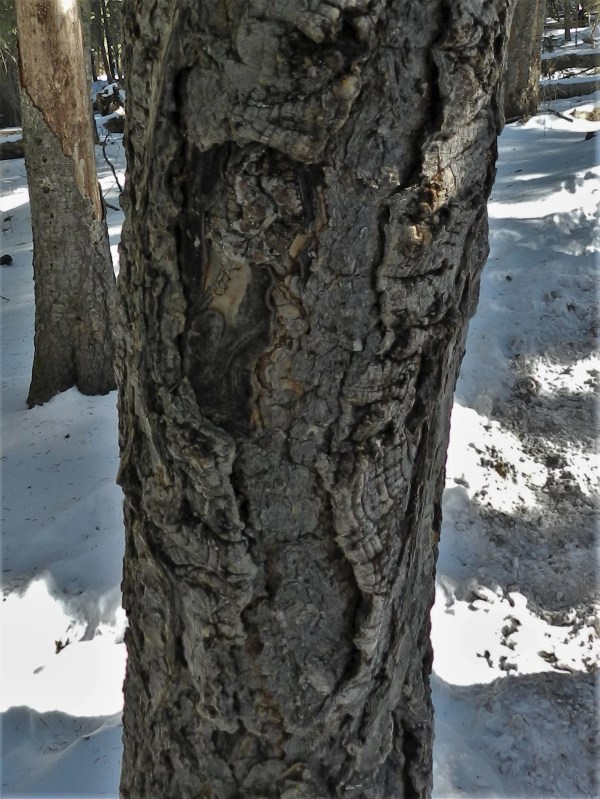
Face in the Tree, Sandia Mountain, NM (D. Kopacz 2018)

I am obligated to provide some follow-up to last year’s essay and to do my part as a witnessing professional. When I spoke of the de-evolution of E pluribus unum to “ME first,” I was speaking on how the current administration’s policies promoted selfishness and self-centeredness over the idea of coming together into union. In many ways my essay predicted that the president would remove E pluribus unum from the official discourse, and in fact he literally did so when he removed it from the new presidential coin and replaced with “Make America Great Again.” The deletion of E pluribus unum promotes anti-democracy. I am very worried about the direction the United States is heading because we are seeing statements and actions that have historically led to the rise of totalitarian and fascist regimes.

Joseph Rael (Beautiful Painted Arrow) and I continue to work together to promote peace. In our latest book, Becoming Medicine: Pathways of Initiation into a Living Spirituality, we seek to illuminate the pathway in the heart that brings us from “other” to “brother and sister.” Mystics, visionaries, and shamans teach us that there is a state of radical union that transcends even the separation implied in our relation as brothers and sisters.

Joseph Rael teaches us that we do not exist as separate beings, but are all part of Divine Oneness. Anti-democracy and radical other-ing are not consistent with spiritual reality. Spiritual Democracy asks us to walk the path of the heart at the center of the medicine wheel.

Many Native American traditions speak of walking the good Red Road, and Joseph tells us that the Red Road is currently off kilter and we must all strive to straighten the path that we are walking upon.

Red Road Off Kilter, Joseph Rael (Beautiful Painted Arrow)

The Art of Becoming Medicine.21

The next two paintings from Becoming Medicine: Pathways of Initiation into a Living Spirituality are both by Joseph Rael (Beautiful Painted Arrow).

The first painting shows a ceremonial tradition of feeding cornmeal to a deer who has given up its life to nourish the people.

The Hunter Puts Cornmeal in the Deer, J. Rael (2017)

The next painting is also of a Deer and one of Joseph’s favorite topics, dark matter.

Dark Matter Deer Medicine, J. Rael (1994)

We quoted some of what Joseph has to say about Deer in The Art of Becoming Medicine.20. Here is the continuation of that passage:

A gathering place for deer is peh mesa, peh mesa. Joseph goes over to a table and brings his hand down flat on it – peh. Then he drags it across the surface of the table – mesa. Peh mesa, peh mesa, he repeats it several times, looking in my eyes to see if I hear it and understand it. Then he goes to the TV console – peh mesa, peh mesa, peh mesa. Then he goes to the bed spread and does it again – peh mesa, peh mesa, peh mesa. Then he says, Put that in the book—Joseph Rael made the sound of the deer on the table, then on the console, then on the bed and it was always the same sound and it means “the power of true perception.” (J. Rael, Becoming Medicine, 298-299)

New Issue of The Badger – Letting Forth the Goodness

Here is what the editor of The Badger put forth to the contributing authors:

Dear Authors,

I world like to remind you that the next deadline for The Badger is August 10 2020.Usually I don’t ask/suggest themes, but this time, considering the extraordinary events of this year, I would like to suggest a theme. I strongly believe the changes ahead require our best skills and knowledge. So I would like the next issue to infuse hope for a good new future for our descendants.While I am writing,  I realize that I am asking you to write something that will be useful for the next 7 generations.This is the time to give our contribution to the evolution of humanity.

Thank you for your effort 

Lots of love and light your way

Antonella Vicini 

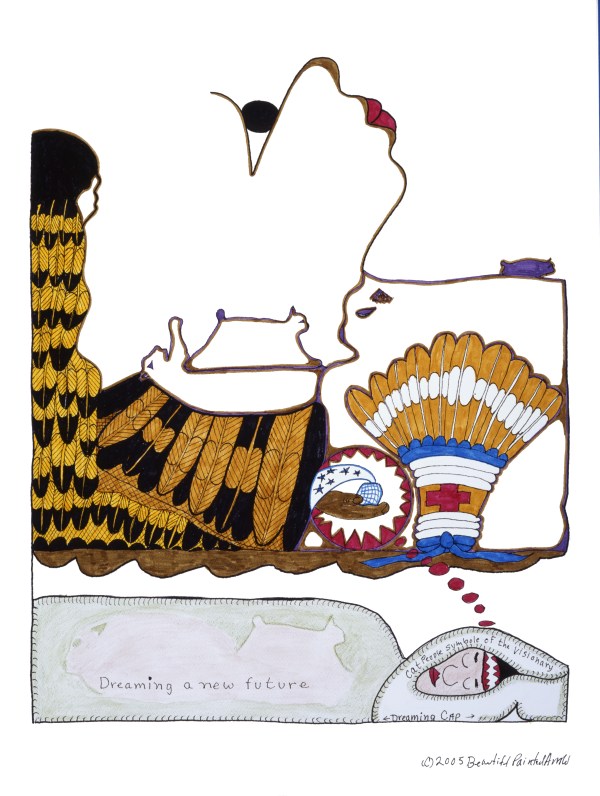
Dreaming a New Future, Joseph Rael (2005)

After thinking it over for a bit, and then talking with Paulette Millichap, of Millichap Press – who published Walking the Medicine Wheel: Healing Trauma & PTSD – we offered chapter 14 from that book, “Return to the Held-back Place of Goodness.” It can be found in The Badger, volume 4, Issue 2, Autumn/Winter 2020, 44 – 67.

Warrior Healing, David Kopacz (20016)

Here is how we introduce the offering of this Goodness:

During this time where so much in the world seems to be going badly, Joseph Rael (Beautiful Painted Arrow) and I offer you Chapter 14: Return to the Place of Held-back Goodness from our book, Walking the Medicine Wheel: Healing Trauma & PTSD (2016 Pointer Oak/Millichap Books). We thank Paulette Millichap for giving permission to reprint this chapter.

While we wrote this book for Veterans, we feel that it is useful for anyone going through stresses and suffering – as so many are during this time of pandemic and political turmoil. Joseph tells us that no matter what you have done, no matter what has happened to you, there is a held-back place of goodness in your heart. The job is to search for it and to reconnect to it. The world could use some more goodness, when you find yours, please share it openly and widely…

Blessings & Goodness

David R. Kopacz MD & Joseph Rael (Beautiful Painted Arrow)

Divine Healing, Joseph Rael (2006)

A Great Pair of Books to Teach Kids about Living in Harmony with the Earth!

Si’ahl and the Council of Animals: A Story of Our Changing Climate for Children and Their Parents

Si’ahl & Friends Activity and Coloring Book

Jane Lister Reis and her sister, Margie Lister Muenzer have created a great book for kids on listening to the environment and caring for it. When the animals of the forest begin to suffer from the changing climate, Si’ahl, a bald eagle, calls a council of the animals. (The authors engaged in dialogue with the Duwamish Tribe about using the name Si’ahl, which is the Duwamish name of Chief Seattle, and honor him with this story). When the animals cry out for help, one family learns to listen to the animals and to work to care for our common home, Mother Earth. The book is illustrated with line drawings by Andrea Hoitis and it could be used as a small coloring book – although there is a larger “Si’ahl & Friends Coloring and Activity Book,” that is a great companion to the story book.

The Activity & Coloring Book has puzzles, mazes, even a grid for backyard birdwatching!

Jane Lister Reis lives in Seattle and is the founder of First Light Farms & Learning Center in Carnation, WA.

Great Book about Healing by Returning to the Land of War to Find Peace

John Wesley Fisher, DC, asked if I would review and write an endorsement for his new book, Dak To Rx: A Travelogue – A Veteran Returns to the Land of His Nightmares. John is a Vietnam veteran and the Founding Director of CORE (Community Reconciliation)Viet Nam. Dak To is the name of a town in Vietnam that John had been in during the Vietnam War. Returning to engage with the land and the people, now from a state of peace, rather than war, leads to healing and the formation of many friendships. One Vietnamese veteran tells John, “Now all survivors are the same…we didn’t kill each other, so now we can be friends and teach the world about peace together.” Here is my endorsement of the book:

Dak To RX is just what the doctor ordered for healing PTSD and coming home from war to peace. John Wesley Fisher is a man of many places and roles: seeker, chiropractor, surfer, traveler, and Vietnam Veteran.

Dak To RX is a journal of his journeys throughout Vietnam in 2011-2012 where he finds compassion, acceptance, peace, and healing from the people he meets and the places where he walks up on the land. His nightmare becomes a dream of peace and healing.

Fisher notes that it is “a sacred time being on the road,” and his journey is a sacred journey of healing. He meets many Veterans (both former allies and enemies) and survivors of the American War in Vietnam along the way. What he learns from one former enemy is, “Now all survivors are the same…we didn’t kill each other, so now we can be friends and teach the world about peace together.”

David R. Kopacz, MD

Psychiatrist, Seattle VA
National VA Education Champion – Office of Patient Centered Care & Cultural Transformation
Assistant Professor, University of Washington

Words Create Worlds.4: The Fight for Humanity – or should we say – Working for Humanity

Words create worlds,” said Rabbi Abraham Joshua Heschel.[1]

Are we in a fight for humanity? You bet your life we are. In 1973 Bob Marley & Peter Tosh wrote the lyrics:

 Get up, stand up, stand up for your rights!

Get up, stand up, stand up for your rights!

Get up, stand up, stand up for your rights!

Get up, stand up, don’t give up the fight![2]

Is fight the right word? Maybe there is a time to fight, even if you are a pacifist, but what does it mean to fight?

Maybe fight is not the right word, as it conjures up opposition and separation – and that is the very thing that we are “fighting” against. There is a quote, often attributed to Mother Teresa, “I was once asked why I don’t participate in anti-war demonstrations. I said that I will never do that, but as soon as you have a pro-peace rally, I’ll be there.”[3] This captures the danger of fighting against something. Nietzsche warns us, “Whoever fights monsters should see to it that in the process he does not become a monster. And when you look long into an abyss, the abyss also looks into you.”[4] And yet, how do we respond to the growing fascism in the world and our history of colonialism and racial oppression and genocide? We have never recovered from racism, we have never fully addressed it. We are in the midst of a pandemic from Coronavirus COVID-19, and yet we are suffering from a re-infection of “the plague bacillus” of fascism.[5] Are not the risks of racism and fascism such that all human beings with a heart must necessarily “Get up, stand up, stand up for your rights?”

Tree, Lime Kiln State Park, WA, D. Kopacz (2015)

Carl Jung’s 1946 essay, “The Fight Against the Shadow,” actually argues not so much for a fight against something outside in the world, but rather an internal struggle to acknowledge, own, and integrate one’s own shadow. While Jung comments on mass psychology and group psychosis following a fascist leader. He wrote that Hitler had an “unadapted, irresponsible, psychopathic personality, full of empty, infantile fantasies, but cursed with the keen intuition of a rat or a guttersnipe.” He also wrote that the reason that Hitler was so successful was because he “represented the shadow, the inferior part of everybody’s personality…and this was another reason why they fell for him.”[6] Jung seems to assume that the fight had to be done in the outside world, but that the cause and the ultimate cure had to do with each individual’s inner fight against their own shadow, to acknowledge, to accept, and to integrate so that one is conscious of this inner darkness within the heart of humanity rather than unconsciously acting it out in the world. He calls this a “moral evaluation,” and an “ethical responsibility.” He notes that the people who are capable of this are often not the political leaders, but the “moral leaders of mankind.” The “maintenance and further development of civilization depends on such individuals” to act in these roles of moral evaluation and ethical responsibility.[7] Jung’s defense against mass movements and collective psychosis resides in the strength of individuals to face their own darkness, for only one who has stood up to one’s own darkness can stand up to another’s darkness. As Jung wrote, “One does not become enlightened by imagining figures of light, but by making darkness conscious. The latter procedure, however, is disagreeable and therefore not popular.”[8]

Jung reorients us to the inner fight as well as the outer fight. From this perspective, we are the barbarians, they are not out there. The word barbarian originally meant “all that are not Greek,” and came from the Proto-Indo-European  root “*barbar- echoic of unintelligible speech of foreigners.”[9] A barbarian was originally just someone “other” than you whose speech you were to ignorant to understand. Somewhere along the way, though, we projected our shadow onto the other and imagined they were the ignorant and dangerous one. Look at the murder and pillage that the colonial empires of Europe let forth upon the world. When Jung met Ochwiay Biano (Mountain Lake) of the Taos Pueblo in Southwestern United States, he was told how the non-European sees the European.

“See…how cruel the whites look. Their lips are thin, their noses sharp, their faces furrowed and distorted by folds. Their eyes have a staring expression; they are always seeking something. What are they seeking? The whites always want something; they are always uneasy and restless. We do not know what they want. We do not understand them. We think they are mad.”[10]

Binding Sites of Coronavirus Covid-19, D. Kopacz (2020)

Perhaps Western civilization is not only barbaric and mad, but also sick. We evaluate the health of countries primarily by their economies. Economies are not people. As we have seen with the Coronavirus COVID-19, our health care systems, educational systems, our systems of justice, even our economic systems – were all in ill health and fractured. A few weeks of interruption of the economic machine and everything was revealed to be so very fragile and weak where we thought it was strong. “Civilized” people look with disdain and horror at earlier civilizations that sacrificed animals or people to the gods, however the Economy demands human sacrifices – homelessness, underfunded health care systems, underfunded education systems, the rape of the environment. If another civilization comes after this one, surely they will see us as mad, primitive, barbaric, worshipping false idols of money and profit at all costs, even the cost of our own humanity and our own home, Mother Earth.

Rebecca Solnit writes “Who Will Win the Fight for a Post-Coronavirus America?” in The New York Times, 3/29/20:

Every disaster shakes loose the old order: The sudden catastrophe changes the rules and demands new and different responses, but what those will be are the subject of a battle. These disruptions shift people’s sense of who they and their society are, what matters and what’s possible, and lead, often, to deeper and more lasting change, sometimes to regime change. Many disasters unfold like revolutions; the past gives us many examples of calamities that led to lasting national change.

How can we fight against this inner and outer madness that is the very structure of our economic civilization? As Charles Eisenstein writes, all the problems that we are facing are all part of one root problem: separation; and the only solution is that we need to move from separation to “interbeing.”

This book is a guide from the old story, through the empty space between stories, and into a new story. It addresses the reader as a subject of this transition personally, and as an agent of transition—for other people, for our society, and for our planet. Like the crisis, the transition we face goes all the way to the bottom. Internally, it is nothing less than a transformation in the experience of being alive. Externally, it is nothing less than a transformation of humanity’s role on planet Earth.[11]

Jung and Eisenstein point out that we do not know who we are and this ignorance is killing us – it leads to fascism, racism, plundering the environment, it leads to us seeing human beings and the environment as “other” as we only focus on this littlest, meanest little part of our larger humanity, our ego. We do not know who we are and this ignorance is killing us and turning our lives and world into a living hell.

Rob Riemen picks up this theme that we have forgotten our humanity. His book, To Fight Against this Age: On Fascism and Humanism takes on the task of a response to the growing rise of fascism and the response being to reinvest in a kind of spiritual humanism. Perhaps, then, our fight is not against fascism so much as it is for every individual to have the right to choose the human, to choose humanism. This is not the kind of humanism that fundamentalists fear – although I am not exactly sure what they have to be afraid of, other than losing control of control.

Our true identity is determined not by nationality, origin, language, belief, income, race, or any way in which people differ from one another, but precisely by what unites us and makes the unity of mankind possible: universal spiritual values that shape human dignity and that every man can adopt.[12]

This kind of humanism recognizes our sacred nature – a sacred humanism, a sacralizing of humanity. Riemen writes that some of the ways we can continue to rehumanize ourselves is through the arts, the humanities, and by learning from history. He also writes that we must have qualitative values, valuing the things that can be felt, but cannot be counted. He critiques a purely business or scientific view of humanity reduced to dollars, numbers, and percentages.

The religions tell us about the sacred, but if a religion leaves out the sacredness of humanity, it literally has no place on Earth. In promoting the idea of a sacred humanity, I am not speaking of one people’s religion, I am speaking of the religion of One people, a religion of humanity that recognizes the sacred in all human beings, in all beings, and in all the Earth.

I am working with Joseph Rael (Beautiful Painted Arrow) over the last six years. The kind of work I do with him is listening, writing, and reading. The work that is most important to him is world peace and he was recognized by the United Nations for this work. Joseph’s grandfather used to say to him, “work is worship,” and that is the kind of work we do together – worship.

When Joseph had his vision of a Sound Peace Chamber in 1983 (a circular structure, half above ground, half below, with men and women sitting in a circle and chanting for world peace), he took a year looking for the best place to build it. After one year, the Spirit Elders came to him and asked why he hadn’t built it yet. Joseph said he was looking for the perfect place. The response was a beam of light that came from the Heavens to Earth and landed in his backyard. It turns out that the work for peace begins at home – in your own backyard!

Joseph learned, in the Tiwa language of Picuris Pueblo, that the name for God is Wah-Mah-Chi, which translates as Breath-Matter-Movement. This tells us that our breath, inspiration and expiration is sacred and holy. This also tells us that our matter, far from being dead or a neutral resource, is alive as well, and full of vital spirit. Movement, too, all of our movements and the way we touch each other is meant to be inspired and full of divinity. In the Tiwa linguistic world, everything is God – just as in the non-dual philosophies such as tantra and Non-dual Shaivism. God is not out there, God is everywhere. The question then is on what do we place value? What do we invest in?

Earth Child of Spiritual Democracy, J. Rael (1997)

Our contemporary civilization invests in money, economic growth, building capital. While the United States of America is often considered by many to be a “Christian” nation, it is actually a nation of heretics if money is placed before God and before humanity, because humanity is one of the homes of God on Earth. In The Heart of Darkness, Joseph Conrad wrote, “This also has been one of the dark places of the earth.” The question is what “this” refers to – is it inner Africa; up river; is it the pagan African people who are physically “dark;” is it King Leopold’s Ghost, the colonial conquest of Africa; or is it simply the darkness in our own hearts when we cease to honor the spiritual humanity of ourselves and others?

Psychoanalyst Robert Stoller describes the motivation behind dehumanization and objectification of others: “we anatomize them … we deprive others of their fullness.”[13] As I wrote in Re-humanizing Medicine,

“Stoller believes that reducing the other to a body part or replacing a relationship with an object is a psychological defense against the anxiety of relationship. The risk is that the process of dehumanization goes both ways. One cannot dehumanize someone and remain human oneself. It is not a human action to treat someone else as an object.”[14]

Stoller writes that the act of dehumanizing another “dehumanizes the dehumanizer.”[15] The colonial project of conquest, plundering resources, slavery, forced conversion to Christianity, the outlaw of indigenous languages and religions, and genocide, both cultural and literal, against indigenous peoples created a vast dead zone on the planet Earth, a vast zone of dehumanization and de-spiritualization, a hell on Earth. What does it matter if one is rich if one lives in hell? The outlaw of indigenous languages and spiritual practices, as in the United States until 1978, was a war against words because it was known on some level that words create worlds. The colonizers took the words right out of the indigenous peoples’ mouths and substituted their own words as they renamed and over-named the landscape in an attempt to make pale copies of the places they came from and from rulers, kings, and queens. Colonizers and colonized were both, thus, dehumanized.  

How do we fight against dehumanization? Is it ever human to fight? Or is the method, rather to get up, stand up, stand up for your rights – your human rights? We must choose the human, not the dehumanized. We must choose to re-invest in humanity by seeing the divinity within Breath-Matter-Movement. Is it possible to get up, stand up, stand up for your rights without turning it into a fight? What does it mean to fight?

fight (v.)

Old English feohtan ”to combat, contend with weapons, strive; attack; gain by fighting, win” … from Proto-Germanic *fe(u)hta … probably from PIE *pek- (2) “to comb, to pluck out” wool or hair (source also of Lithuanian pėšti”to pluck,” Greek pekein ”to comb, shear,” pekos ”fleece, wool;” Persian pashm ”wool, down,” Latin pectere ”to comb,” Sanskrit paksman- ”eyebrows, hair”). Apparently the notion is “pulling roughly,” or “to tear out one another’s hair.”[16]

How do we make sense of the etymology of the word, fight, referring to pulling hair? We can turn to Ayenwathaaa or Aiionwatha, whom we know in English as Hiawatha. While his life and words and legend belong to the Haudenosaunee, the six nations of the Iroquois Confederacy: Mohawk, Onondaga, Oneida, Cayuga, Seneca, and Tuscarora peoples, The Great Law of Peace (Kayanerenkó:wa) is said to be one of the inspirations for the Constitution of the United States of America (See the enlightening new book by Glenn Aparicio Parry, Original Politics: Making America Sacred Again).[17]

War & peace, fighting & working are all tangled up. Hiawatha can be translated as “He Who Combs.” He is called this because he was tasked with helping Great Peacemaker bring the New Mind, the Great Law of Peace, to the minds of humanity – however, he must first comb the snakes out of the greatest opponent to the New Mind, Atotarho.[18] Hiawatha was living a life of dehumanization and depravity prior to meeting Great Peacemaker, in some version of the story he was even a cannibal – a thing that feeds on humanity. When Great Peacemaker explained the Great Law of Peace to him, Hiawatha said, “I take hold, I grasp it. . . . Now what work is there for us to do?”[19] The work he takes on is to bring the New Mind of to those who have become dehumanized, who have lost their connection and memory of their own divinity. There are no enemies to the Great Law of Peace, only opponents, because once a human being makes the choice to be a spiritual human, to grasp a hold of the New Mind and the Great Law of Peace, that person becomes a carrier of Peace. Jacob Needleman, in discussing this story, writes that “man must experience himself as the force that resists the good.”[20] The beauty of this story, and by story I do not mean fiction, I mean medicine,[21] is that no one is forever lost, even the most depraved has the hope of redemption. As Joseph Rael says, Wah-Mah-Chi holds back a place of goodness in our hearts, no matter what we have done, no matter what we have seen.[22] Needleman sees in Hiawatha’s struggle to re-find this goodness within his heart the struggle that we, as citizens of the United States of America, must go through as well for our crimes against humanity.

Here…the legend speaks of a human crime for which no ordinary action can atone. Here the story may well be heard as speaking to our own remorse as we see in a clear light what has been done to an entire people. And here the tale echoes the constitutive legend of our own culture—the crime for which no ordinary action can atone, a level of self-remorse which demands of man an action of an entirely new quality. And for this action the man needs now to turn to the greatness he has seen in himself.[23]

In Joseph Campbell’s hero’s journey model one of the stages before being able to return home is atonement, or as Campbell sometimes wrote, at-one-ment. We must do the work of the heart to atone for our own sins as well as those of our ancestors and culture. To do this means we must become at-one with them, we must bring together both sides of the wound, as was done in the Truth & Reconciliation work in South Africa after apartheid. Perhaps this is a way to look at our culture and society know, the places where we see separation are really two sides of the whole which the wound has cut apart. To pull further from each other only leads to deeper wounding. Also, continuing with this metaphor, we cannot simply force the edges of the wound together, without cleaning and what surgeons call “approximating” the edges of the wound, full-thickness from the base of the wound to the superficial edges – together. We are all wounded and we are all part of the wound and our healing cannot be done individually, it is only through collective healing that we can bring the division of the wound back together into a whole. Needleman and Hiawatha learn that the wound will be healed through the new idea of peace, an idea that is a power.

The New Mind has come to you . . . and you are miserable because the New Mind does not live at ease with old memories . . . Now you will work with me to bring justice and peace to those places where you have done injury to man. We will work together to bring to the earth the new idea of the peace that is power. Such is the work given to man by the Creator of Life.[24]

Needleman sees that we need a re-spiritualization of ourselves as human beings and or our democracy. Joseph Rael and I talk about the idea of Spiritual Democracy, in our book, Becoming Medicine: Pathways of Initiation into a Living Spirituality. I came across this term in Steven Herrmann, Spiritual Democracy: The Wisdom of Early American Visionaries for the Journey Forwardand Herrmann found it in Walt Whitman’s writing.

Adopting the big idea of Spiritual Democracy, the realization of oneness of humanity with the universe and all its forces, can help people feel joy, peace, and interconnectedness on an individual basis. It can also inspire us to undertake sacred activism, the channeling of such forces into callings that are compassionate, just, and of equitable heart and conscience, and give us some tools to start solving some of these grave global problems, while uniting people on the planet.[25]

“The written word, the spoken word,” writes psychiatrist Paul Fleischman, “is like a hand feeling its way into a dark room, looking for a switch.”[26] The switch that we are looking for is the one that turns on and illuminates our shared sacred humanity. We are not alone in this quest, as Fleischman writes in his book, Cultivating Inner Peace: Exploring the Psychology, Wisdom and poetry of Gandhi, Thoreau, the Buddha and Others

Shakers corresponded with Count Leo Tolstoy. Tolstoy’s book was one that transformed Gandhi, and Shaker and Gandhian ideas re-molded Count Tolstoy into a Christian peasant Tolstoy. Whitman and Thoreau met and influenced each other, and Thoreau’s “Civil Disobedience” became the manifesto for Gandhi’s social action. Scott and Helen Nearing read Whitman and Thoreau, as did Rabindranath Tagore. Tagore and Gandhi had a long relationship. John Muir’s favorite author was Thoreau. Thoreau “carried Leaves of Grass around Concord like a red flag.” Seekers of peace read each other, write to each other, influence each other. The quiet life of inner peace isn’t a vacuum.[27]

In Walking the Medicine Wheel: Healing Trauma & PTSD, Joseph told us that we are all brothers and sisters. He says, “I am my brother’s keeper,” thus contradicting the first documented murder in the Biblical tradition. After Cain has killed his brother, Abel, God asks Cain where his brother is. Cain says “Am I my brother’s keeper?” Joseph would say, “Yes, I am my brother’s keeper!” In Becoming Medicine, we move from us being brothers and sisters to us all being One, an identity of non-duality.

Joseph told me, when we were working on Walking the Medicine Wheel for veterans, that every veteran should get their DNA analyzed through National Genographic’s program, so that they would learn that we are all brothers and sisters, we all originally come from Africa. We know this is true through genetic science and the migrations of peoples. We also, literally, all have common human ancestors. We are all the sons and daughters of Mitochondrial Eve, who lived in Africa about two hundred thousand years ago. We also are all the sons and daughters of Y Chromosome Adam who lived between 150,000 and 300,000 years ago. Mitochondrial Eve’s initials are ME – this reminds us that we are all not just one family, but we are all One. Mother Earth’s initials are also ME, thus we are all relatives of the Earth and are One with the Earth. We are made of the Earth and the Earth moves from place to place through our Breath-Matter-Movement.[28]

Mother Earth Dreaming all of the Two Leggeds into Beauty, J. Rael (2006)

We all come from Africa and Joseph says that when he was growing up the Pueblo people would refer to Black people as “our ancestors,” recognizing that we are all related and honoring the Black people and Africa as our common homeland. And where did Africa come from? Africa and all the continents were once all part of One continent, Pangea, which slowly broke apart and is slowly coming back together to reunite in Pangea Ultima.[29]

We have a choice in this life, do we want to be Lumpers and Splitters? This is a concept Charles Darwin described in determining whether two individuals are part of one species or two different species. He noticed that some biologists tended to focus on small difference and others focused on large similarities. Science works, largely, through separation and differences. When you are doing science, it can be good to be a Splitter. However, when you are doing humanity, it is better to be a Lumper, and to see our common spiritual humanity. Another word for “doing humanity” is mysticism. Mysticism is the spiritual practice of being a Lumper, of attaining a sense of peace and unity – what is sometimes called, non-duality. Joseph Rael and I have chapters devoted to becoming a visionary, becoming a shaman, and becoming a mystic and really all of these are about another thing that Joseph often says, becoming a true human.

We must reinvest in our humanity, in our spiritual humanity. To reinvest means we need to take what we consider “mine” and we need to think of it, instead as “ours.” We are out of balance. We have too much energy going into separation, isolation, and hoarding. Our view of the economy and life as always moving toward some imagined future of better profits and no pain is obsolete. Our economy and civilization is based upon expansion. There never was any “empty” land to expand into, it was only other people’s land that we took, stole, signed treaties for and then broke later when convenient. Western civilization has stolen, pilfered, raped, and mutilated the earth and in doing this we have tortured and distorted our own humanity. Who will stand up for humanity? Who will get up, stand up for humanity. We must re-invest in humanity and that begins with you, that begins with me, that begins with us.

But if you know what life is worth

You will look for yours on earth

And now you see the light

You stand up for your rights. Jah![30]

I have been writing on this topic of how our “words create worlds” in relation to our spiritual and political situation. In working with Joseph Rael, writing Becoming Medicine: Pathways of Initiation into a Living Spirituality, I felt compelled to write about the responsibility of mystical, visionary, and shamanic experience—that we must work toward “Spiritual Democracy.” At its deepest point, mystical experience leads to an awareness that we are all one and this comes with a responsibility to challenge words of separation which ultimately lead to fascism. Mystical experience is a pathway that leads us to question who we are and gives us a responsibility to use our words wisely to create worlds where we are becoming the medicine that our world needs. As Rumi says, “We are pain and what cures the pain.”[31]


[1] Life Between the Trees blog. I first came across a shorter instance of this quote in the Omid Safi reference below.

[2] Bob Marley & Peter Tosh, “Get Up, Stand Up,” from the album, Burnin’ (1973).

[3] This quote is popularly attributed to Mother Teresa. The Mother Teresa of Calcutta Center site says that it is falsely attributed to her and that it is “significantly paraphrased versions or personal interpretations of statements Mother Teresa made; they are not her authentic words.” However the page does not say what the original quote or statement was. https://www.motherteresa.org/08_info/Quotesf.html She did speak out for peace, as in this letter to George Bush and Saddam Hussein in January 1991, “Please choose the way of peace… In the short term there may be winners and losers in this war that we all dread. But that never can, nor never will justify the suffering, pain and loss of life your weapons will cause.” “10 inspiring quotes by Mother Teresa,” curated by Jessica Durando, USA Today, published August 26, 2014, https://www.usatoday.com/story/news/nation-now/2014/08/26/mother-teresa-quotes/14364401/

[4] Nietzsche, Beyond Good and Evil, p. 134? What edition? Kaufmann translation?

[5] Camus, The Plague, 308.

[6] Carl G. Jung, “The Fight Against the Shadow,” Civilization in Transition, Second Edition, CW20, page 223.

[7] Ibid., 221.

[8] Carl G. Jung, Alchemical Studies, CW13, pages 265-266.

[9] https://www.etymonline.com/word/barbarian

[10] Ochwiay Biano, quoted in Carl G. Jung, Memories, Dreams, Reflections, 247-248.

[11] Charles Eisenstein, The More Beautiful World Our Hearts Know Is Possible, 6.

[12] Rob Riemen, To Fight Against This Age, 67.

[13] Robert Stoller, Observing the Erotic Imagination (New Haven:Yale University Press, 1992), 32.

[14] David R. Kopacz, Re-humanizing Medicine: A Holistic Framework for Transformation of Your Self, Your Practice, and the Culture of Medicine, 2014, 34-35.

[15] Stoller, 32.

[16] https://www.etymonline.com/word/fight

[17] Glenn Aparicio Parry, Original Politics: Making America Sacred Again. New York: Select Books, 2020.

[18] Needleman, Jacob. The American Soul: Rediscovering the Wisdom of the Founders. New York: Jeremy P. Tarcher/Putnam, 2003., 225

[19] Needleman, 225.

[20] Needleman, 230.

[21] see Kopacz & Rael, chapter “Story Medicine,” in Becoming Medicine: Pathways of a Living Spirituality, 2020.

[22] Kopacz & Rael, Walking the Medicine Wheel: Healing Trauma & PTSD, 254.

[23] Needleman, 223-224.

[24] Needleman, 224.

[25] Steven Herrmann, Spiritual Democracy: The Wisdom of Early American Visionaries for the Journey Forward, xiii.

[26] Fleischman, Cultivating Inner Peace, 101–02.

[27] Ibid., 101–02.

[28] See Kopacz & Rael, Becoming Medicine, 368, 424-425.

[29] See Kopacz & Rael, Becoming Medicine, 361-379.

[30] Bob Marley & Peter Tosh, “Get Up, Stand Up,” from the album, Burnin’ (1973). “‘Get Up, Stand Up’ was also the last song Marley ever performed on stage, on 23 September 1980 at the Stanley Theater, now the Benedum Center in Pittsburgh, Pennsylvania,” (Wikipedia, “Get Up, Stand Up,” https://en.wikipedia.org/wiki/Get_Up,_Stand_Up, accessed 6/6/20.

[31] Rumi, “We are the mirror as well as the face in it,” The Essential Rumi, trans. Coleman Barks, 106.