Becoming A True Human Podcast, Episode 7: Practice

Episode 7: Practice

Life doesn’t have a pause button and neither do we…

Spotify Audio: http://t.ly/HKZGe

YouTube Video: http://t.ly/mluTN

Chris Smith and David Kopacz discuss the rewards and pitfalls of practice in yoga, meditation, writing, and life.

Sometimes practice clears a space where imperfections and flaws are seen. We are tempted to try to eliminate those specks of dust and scratches on our window, but accepting our imperfections may actually be the real part of practice. Practice is about reconnecting to our True Humanity, our inner held-back place of goodness, our source of love, compassion, and caring – and we may only reach these through suffering and imperfection.

For instance, we explore the Sanskrit term, samvega, which Stephen Cope describes as “complex state involving disillusionment with mundane life, and a wholehearted longing for a deeper investigation into the inner workings of the mind and self,” (The Wisdom of Yoga, 13).

Or as Karlfried Graf Dürckheim wrote in his book The Way of Transformation: Daily Life as Spiritual Practice, “Thus the aim of practice is not to develop an attitude which allows us to acquire a state of harmony and peace wherein nothing can ever trouble us. On the contrary, practice should teach us to let ourselves be assaulted, perturbed, moved, insulted, broken and battered” (107).

Chris and Dave discuss their own struggles with chronic illness/ongoing medical symptoms and the difficult work of turning personal illness and suffering into fuel for personal growth work.

We talk about:

  • using suffering as a spiritual practice
  • cleaning the windshield
  • “The Garden,” a reading from Chris’ next book, Hope Opens Doors
  • a workshop Chris is putting on in February, “Chronic Illness & Love”
  • Sean Mackey’s work on love & pain
  • finding inner calm and strength, even within chaos & suffering
  • Makransky & Condon’s Sustainable Compassion Training
  • making practices creative and fresh
  • the work of Joseph Rael (Beautiful Painted Arrow)
  • spanda – the divine creative pulsation
  • practice does not make perfekt
  • being capable of suffering may make us more capable of joy
  • the benefits of practice are not only for us, but are fully realized when we share with others and the Earth
  • practice is caring for ourselves and others

We close with a couple of practices, one from Dave’s book, Caring for Self & Others and short one from Chris Smith.

We have video links on YouTube and audio links on Spotify, here is the link to all episodes:

Spotify Audio: https://open.spotify.com/show/0VB79X56wuCj7jjj5E6oB4

YouTube Video: https://www.youtube.com/channel/UCk7iT73WTnMJdBwWBAc8zIw/videos

Recent Podcasts & Articles

I’ve been doing a few podcasts lately – which is always a fun chance to talk about some of the work I have been doing. I’ll include a few photos from the past year to remind us of the world within which we all live & work.

Yellow Warbler in crab apple tree, Seattle, WA

I spoke with Andrea Nakayama on her 15-Minute Matrix Podcast on “Mapping the Costs of Caring,” looking at burnout, compassion fatigue, moral injury, and soul loss in health care workers. Here is an excerpt speaking about the similarities of burnout and soul loss:

The soul is the thing that makes us alive and vital and engaged and connected around the world. When we lose that, we lose all those kinds of things that connect us to ourselves and to others…How do we bring the soul back? It would be what things make the soul happy, what kinds of things bring you joy? And so how can you build this into your life? I think the distinction is you could start with self-care to support the ego, in the sense of your personality, but I think of the healer, the role of the healers, to be honest with delving into what can be the breakdown of the ego, and then the rebuilding back as a healer.

Yellow-Rumped Warbler in crab apple tree, Seattle, WA

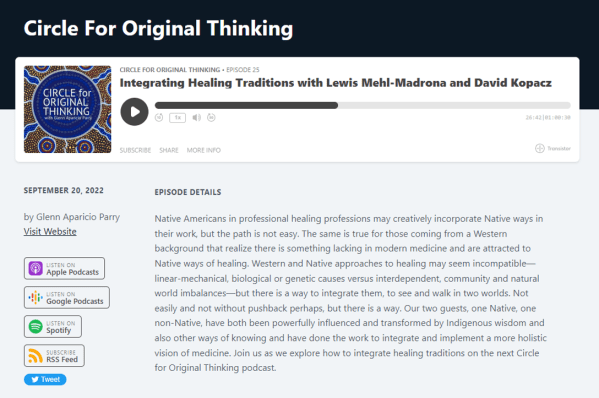
I had a very nice dialogue with Lewis Mehl-Madrona and Glenn Aparicio Parry on his Circle of Original Thinking Podcast, “Integrating Healing Traditions with Lewis Mehl-Madrona and David Kopacz.” Definitely check this out, such an honor to have a generous time to speak with Lewis & Glenn. Check out their great books as well!

The print edition of Parabola Magazine, Fall 2023 featured “This Vibrating Land,” an excerpt from an interview that I did with Glenn Aparicio Parry that we featured on The POV interview website.

I also had a book review “Lessons from A Field Guide to Getting Lost by Rebecca Solnit on CLOSLER as well as an essay “Building Cultures of Caring.” Here’s an excerpt:

Perhaps burnout is a symptom of a larger problem. Perhaps we’ve cut ourselves off from a root of support in our work, we have lost touch with a spiritual and humanistic dimension of who we are and that when one suffers, all suffer. We have lost touch with our interconnection, our non-duality. What did Mother Teresa, Mahatma Gandhi, and Martin Luther King Jr. draw upon when working with the immense suffering in the world? Gandhi spoke of satyagraha as “the Force which is born of Truth and Love,” and Dr. King, spoke of this as “soul force.” Perhaps we should consider developing some kind of non-dual medicine, some kind of practice of non-separation in our healing work.  

Whiskey Creek, Washington

A longer interview and dialogue was an invitation to speak on The Soul Space, entitled “Hero’s Journey & Resilience in the Face of Suffering,” (7/1/22).

Last, but not least – I had a chance to catch up with former Seattle VA Primary Care Mental Health Integration teammate Dr. Nicola De Paul on “Burnout, Moral Injury, and Radical Caring” on her Menders: Love & Leadership in Health Systems Podcast. Check out our dialogue as well Nicola’s discussions with other great thinkers working to bring Love & Leadership into Health Systems!

I also recently had the privilege of interviewing Richard C. Miller, PhD, the developer of iRest, Integrative Restoration, a form of yoga nidra. Here is the link to part I where we talk about his development of iRest and early influences, including J. Krishnamurti. Part II will be published soon on the interview site that Usha Akella and I developed, The POV.

If you have some down time, please check out any of these articles and podcasts that may be of interest to you, as well as look up some of the other great interviews on these podcasts!

Pacific Coast, Washington State