
In this series of essays, in the 250th year of the United States of America, I will develop the idea of Inner Democracy – a democracy of mind and heart and soul – to complement our outer democracy.
We are at a crisis of democracy, there is extreme polarization, accusations of “the other side” being “fascist” or “socialist/communist,” and levels of mistrust in each other and in our democratic institutions that have not been seen in generations.
As Parker Palmer has written, in Healing the Heart of Democracy: The Courage to Create a Politics Worthy of the Human Spirit (2011),
“If American democracy fails, the ultimate cause will not be a foreign invasionor the power of big money or the greed and dishonesty of some elected officials or a military coup or the internal communist/socialist/fascist takeover that keeps some Americans up at night. It will happen because we—you and I—became so fearful of each other, of our differences and of the future, that we unraveled the civic community on which democracy depends, losing our power to resist all that threatens it and calls it back to its highest form,” (8).
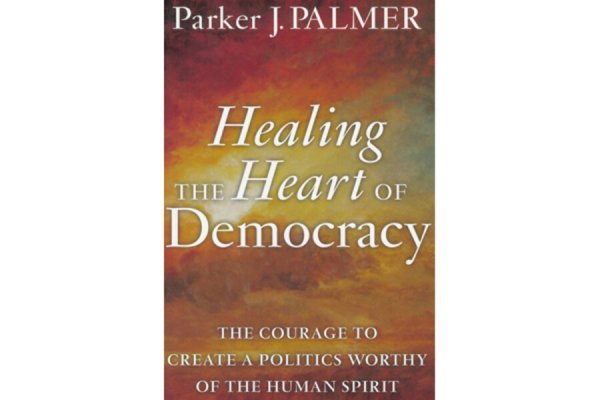
We think of democracy as a form of government, as something outside of the individual person, but Palmer reminds us that democracy is ultimately about “you and I,” and not about something “out there.” Democracy is a “government by the people,”[1] and we are the people. The kind of democracy that Palmer envisions, one that is “worthy of the human spirit,” is the kind of democracy that moves us from Me to We. This Journey from Me to We is a difficult one, and it starts inside each of us.
Jeremy David Engels, in his book, On Mindful Democracy: A Declaration of Interdependence to Mend a Fractured World, defines “true democracy” as “ working together to care for each other and for the life we share,” (4). Democracy, for Engels, is about collaborating and caring, not just for ourselves but for our shared life together on our only ecosystem of the Earth.
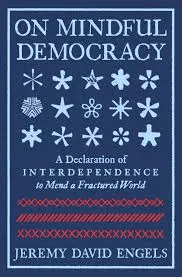
There is a crisis of democracy in what we even mean by “democracy.” Is democracy a libertarian ethos of being able to maximize one’s own life, liberty, and, happiness, regardless of the consequences to others and the environment; or, is democracy a higher, spiritual calling of caring and collaboration?
Engels brings our focus on democracy from the individual to the community through synthesizing the spiritual traditions of yoga, Buddhism, and Christianity. He draws on Vietnamese Zen Buddhist Thich Nhat Hanh’s, “interbeing,” an intellectual/spiritual understanding of the interconnectedness of life, and the Christian community building of Martin Luther King Jr.’s “beloved community,” which then leads to democratic action. Engels re-writes the Declaration of Independence into a Declaration of Interdependence, recognizing the inherent interconnectedness of life.
Mindful democracy is a pathway and practice for developing the experience of inner democracy which can then be practiced in its outer form as building the beloved community and democratic action in the world. Inner democracy is an inner experience within the individual that can then lead to an outer democratic citizenship and government. We can think of inner democracy as a variety of spiritual democracy.
Steven Herrmann has written about the idea of “spiritual democracy:”
“Adopting the big idea of Spiritual Democracy, the realization of oneness of humanity with the universe and all its forces, can help people feel joy, peace, and interconnectedness on an individual basis. It can also inspire us to undertake sacred activism, the channeling of such forces into callings that are compassionate, just, and of equitable heart and conscience, and give us some tools to start solving some of these grave global problems, while uniting people on the planet.”[2]
Spiritual democracy, as defined by Herrmann, is founded upon an experience or realization of “oneness” and “interconnectedness.” He believes that this experience of inner democracy can lead to outer action, “sacred activism.”
Joseph Rael (Beautiful Painted Arrow) and I wrote about Spiritual Democracy in our book, Becoming Medicine: Pathways of Initiation into a Living Spirituality. We drew upon Herrmann’s ideas and combined these with Joseph’s perspectives, we spoke about the “inner journey of the democratic shaman,” and summarized a version of the Hiawatha story about Bringing the New Mind of the Great Peace. We made this chapter available as a free pdf download.
In a Becoming a True Human podcast interview with Jeremy David Engels, Chris Smith and I spoke with him about his book, On Mindful Democracy, and ideas about spiritual democracy, mystical democracy, inner democracy, and he had an idea of putting together a group of writers and thinkers to talk about The Varieties of Democratic Experience, with a nod to William James’ Varieties of Religious Experience.
I would like to further develop some ideas around inner democracy, drawing upon the work of other writers and some of my past writing. Joseph Rael (Beautiful Painted Arrow) and I wrote a chapter on “Spiritual Democracy” in our book, Becoming Medicine: Pathways of Initiation into a Living Spirituality. This draws heavily on Steven Herrmann’s work as well as Joseph’s teachings on peace and the idea that we are cosmic citizens. As Engels did, I drew upon Thich Nhat Hanh’s concept of interbeing and Martin Luther King Jr.’s beloved community in my book, Caring for Self & Others: Transforming Burnout, Compassion Fatigue, and Soul Loss, particularly in chapter ten, “Becoming Caring: Caring for All.” I am indebted to Jeremy David Engels for his book and for such an inspiring discussion in our podcast interview.
The perspective on democracy I would like to develop is the idea that the greater sense of “oneness” (or interbeing, interdependence, nondualism) that an individual experiences, the more fully they will be able to embrace the idea of democracy, which will lead to more vigorous outer expressions of democracy. A practice of inner democracy would, thus, be a contemplative path of the development of a conscious experience of oneness. This leads to a tripartite structure:
- Inner Experience of Oneness
- Idea of Democracy
- Outer Expression of Democracy
This tripartite structure follows the paths of the hero or heroine’s journey (as developed by Joseph Campbell), and the structure of initiation (separation/initiation/return) that Joseph Rael and I followed in Becoming Medicine. It also follows the structure of Jeremy David Engels’ book, On Mindful Democracy (xi-xii):
- Stand on Common Ground (Interbeing)
- Walk the Path of Interdependence in Community (Beloved Community)
- Practice Democracy with Hands and Heart
The idea of mindful or inner democracy can be grasped with the mind, but a mental concept may not be as resilient as an inner experience of democracy – of interbeing, oneness, interdependence – which then leads to outer expression. In this sense, mindful democracy can be a pathway to creating a foundation of inner democracy that then supports the idea and what Engels calls the “hands and heart” of outer democracy.
Inner Democracy could be taught through practices of reflection, contemplation, deliberation, dialogue, meditation, experiences in nature, or any experience in which the individual developed an expanded sense of self beyond the limitations of the ego and the flesh.
The movement of the individual from an identity of “me” to an identity of “we” underlies the inner practice of democracy.
Interestingly, there are many names for an experience of Oneness: nondualism, interbeing, unity, transpersonal, and nondifference, to name a few. There are also many names for interrelationship and interdependence: I/Thou, Me/We, beloved community, and others.
One of the reasons I am excited about following this thread of Inner Democracy is that it provides a positive focus and practices that can be done irrespective of outer events in the world. In my Words Create Worlds series, I have focused more on resistance and opposition to words – uncaring words, words of Me-First, and words of fascism. Through Inner Democracy I am seeking to focus on building inner strength during difficult times. Perhaps chaotic and painful experiences in the outer world could even lead one to fall back upon practices of inner democracy. Inner democracy builds hope, resilience, post-burnout growth, post-traumatic growth. I agree with Jeremy David Engels’ view of democracy as caring and collaboration.
Ultimately, democracy isn’t something done “out there;” democracy is also, perhaps even originally, about doing something “in here,” in the inner space of the psyche, the work of cultivating inner democracy.
[1] democracy(n.)
“government by the people, system of government in which the sovereign power is vested in the people as a whole exercising power directly or by elected officials; a state so governed,” 1570s, from French démocratie (14c.), from Medieval Latin democratia (13c.), from Greek dēmokratia “popular government,” from dēmos “common people,” originally “district” … + kratos “rule, strength.”
https://www.etymonline.com/word/democracy accessed 3/8/26.
[2] Steven Herrmann, Spiritual Democracy: The Wisdom of Early American Visionaries for the Journey Forward, xiii.
 Being Fully Human