
Struggle is inherent to any practice, and so it is inherent in the practice of inner democracy.
At the individual level, struggle is part of every practice, whether meditation on the cushion, yoga on the mat, or a workout at the gym. It is human nature to have inertia and entropy causing us to all away from practice. We all know that we feel better after meditating, doing yoga, or working out, and yet it is human nature to want to put it off, not do it, or fall off the practice even though this may be logically self-defeating. We know that these practices lead to a feeling of well-being after completing them, but other priorities pop up between us and well-being.
The practice of inner democracy also yields a form of well-being, a state of oneness or nonduality which is similar to experiences we can have in meditation and yoga. Inner democracy is a practice because it is not completed once and for all, but requires a continual, regular input of energy in order to maintain nondual well-being and nondual interdependence. This is the practice of moving from Me to We. Democracy is about caring for self and other, about caring for all. As Jeremy David Engels, in On Mindful Democracy, describes true democracy, “working together to care for each other and the life we share,” (4).
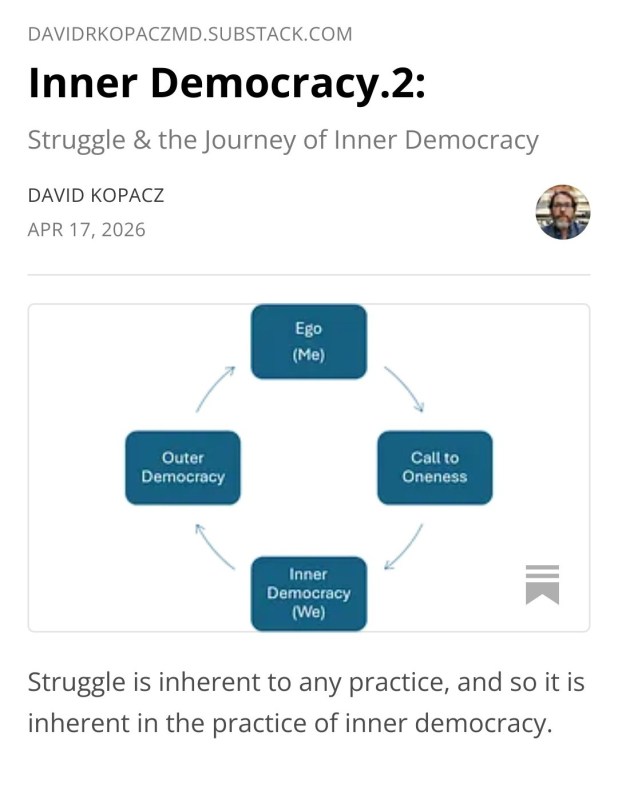
How does the journey of inner democracy start? Something happens in life, a calling, a disorientation, an experience in nature, a tragedy (in one’s life or in the world), a stirring of the heart. Something happens that helps the individual shift from an identity of Me to We. Once this transition or transformation from ego to inner democracy occurs, outer democracy follows.
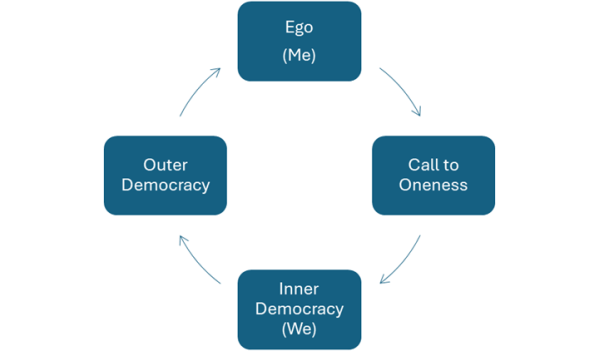
Even once a state of inner democracy is achieved, it can be lost.
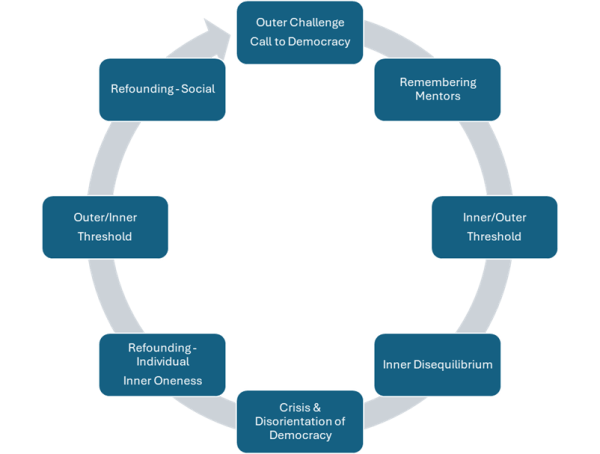
This loss can happen internally, for example falling off the practice, or it can happen from external events which disturb outer democracy. This inner or outer disturbance or disorientation can spark the individual to a deeper personal calling to further develop inner democracy to meet the outer challenge. Inner democracy is a practice as there are so many daily experiences in society that pull us from We to Me.
Joseph Campbell’s description of the hero’s journey and subsequent descriptions of the heroine’s journey by Maureen Murdock and Valerie Estelle Frankel describe struggle as inherent in the journey. Whether it is overcoming outer opposition or overcoming some inner obstacle, the hero or heroine passes through a time of struggle and doubt on the journey of transformation.
Jack Mezirow describes transformational learning as requiring a “disorienting dilemma” that sets the learner on a path of transformation in who they are, not just in learning objective data or facts. The journey of transformation requires some form of inner or outer struggle.
Gerald Arbuckle has described how social and spiritual movements can drift from the founder’s initial vision. The institutionalization of a human movement can lose touch with its original mission. Arbuckle sees the necessity for periodic “refounding” of social movements. Refounding is often led by a “refounding person,” who goes through something like the hero’s or heroine’s journey – personally – and then returns back to the group to reinvigorate it with a renewal of the original founding vision.
Simply voting once a year or every four years is not enough to maintain a healthy inner democracy. It is a practice and practice is a struggle.
Currently, we are in a crisis of democracy – it can feel like everything is not only falling apart, but that democracy is actively being torn apart. The struggle can feel like it is too much. To remember that struggle is inherent in inner and outer democracy can reframe the issue, from one of a problem to one of an opportunity. The current crisis is a call to refound inner democracy within ourselves and then to work to restore outer democracy. The practice of moving from Me to We is never finished.
In Rebecca Solnit’s latest book, The Beginning Comes After the End: Notes on a World of Change, she draws on the science of the transformation of a caterpillar into a butterfly as a metaphor for the transformation of society – it requires a lot of struggle and pain to change the old into the new:
“this metamorphosis has become a metaphor for the transformation of society, often with the sense that we are at the stage of dissolution…A butterfly is the end of a caterpillar. The beginning—the next era—comes after the end of the last one, and in between comes a lot of falling apart,” (4).
Democracy is an ongoing struggle, both inwardly and outwardly. We struggle to become better heart people (as Joseph Rael says) and we struggle to build a society based on We rather than Me. Struggle isn’t bad, it just is. Rejecting struggle obscures the path forward. If the caterpillar breaks out of the chrysalis too soon, there will be no butterfly.
Also on Substack
References and Further Reading:
Arbuckle, Gerald. Interview with David Kopacz, 2017, https://substack.com/home/post/p-188666086
Campbell, Joseph. The Hero with a Thousand Faces, Third Edition. Novato: New World Library, 2008.
Campbell, Joseph with Bill Moyers. The Power of Myth. New York: Anchor Books, 1991.
Engels, Jeremy David. On Mindful Democracy: A Declaration of Interdependence to Mend a Fractured World. Berkeley: Parallax Press, 2026.
Frankel, Valerie Estelle. From Girl to Goddess: The Heroine’s Journey through Myth and Legend. Jefferson: McFarland & Company, 2010.
Kopacz, David R and Joseph Rael (Beautiful Painted Arrow). Walking the Medicine Wheel: Healing Trauma & PTSD. Pointer Oak/Tri S Foundation, distributed byMillichap Books, 2016.
Kopacz, David R and Joseph Rael (Beautiful Painted Arrow). Becoming Medicine: Pathways of Initiation into a Living Spirituality. Seattle & Marvel: Condor & Eagle Press, 2020.
Kopacz, David R. Caring for Self & Others: Transforming Burnout, Compassion Fatigue, and Soul Loss. Palisade: Creative Courage Press, 2024.
Mezirow, Jack. “Transformational Learning Theory,” in Jack Mezirow, Edward Taylor, and Associates (eds.), Transformative Learning in Practice. San Francisco: Jossey- Bass, 2009.
Murdock, Maureen. The Heroine’s Journey: Woman’s Quest for Wholeness. Boston: Shambhala, 1990.
Solnit, Rebecca. The Beginning Comes After the End: Notes on a World of Change. Chicago: Haymarket Books, 2026.

