“The Blessing of Stillness and Silence.”

An Interview with George Kirazian about his literary friendship with Juan Mascaró.

“The memories…are golden memories and I am reliving them,” (George Kirazian).

George Kirazian
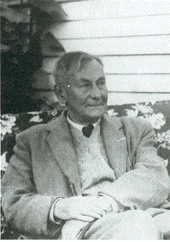
George Kirazian

Juan Mascaro

Juan Mascaró

Author, composer and poet, George Kirazian and his family visited translator Juan Mascaró in Comberton, Cambridge in the UK in 1972. Perhaps at some future point George and I will speak again about his own creative work (he is currently working on a ballet and his rendition of the “Divine Liturgy of the Armenian Apostolic Church” is available on-line, however in our discussion on 8/28/15, we primarily focused on the Kirazian family visit to Comberton, Cambridge. I decided to publish this all as one piece, even though it is a bit lengthy for a blog post, but I’d like to present the full experience of George’s memories as a whole.

Divine Liturgy of the Armenian Apostolic Church

Divine Liturgy of the Armenian Apostolic Church

Juan Mascaró (December 8, 1897 – March 19, 1987) was born in Majorca, Spain, lived in Sri Lanka (then Ceylon) for a time, and spent most of his adult life as a professor at Cambridge. His first name was originally spelled “Joan,” in Catalan, but he changed the spelling to “Juan” to avoid confusion with the female name “Joan.” He retained the Catalonian pronunciation, however, which is more like “jew-an,” rather than the Spanish pronunciation “wan.”

George tells that Juan only ever taught two classes at Cambridge during his entire time there. One class was on the Romantic Poets and the other was “Literary and Spiritual Values in the Authorized Version of the Bible” (which means the King James Version in the UK). There is very little written about Juan Mascaró on the internet, which is perhaps fitting for a man who dedicated his life to translating ancient words spiritual texts – his English translations of The Bhagavad Gita, The Upanishads, and The Dhammapada are still available in the Penguin Classics series. He also self-published a small anthology of his favourite Keats poems (of which George has a copy), Lamps of Light (a compilation of spiritual wisdom from world religions), and the posthumous The Creation of Faith (a collection of his own thoughts and aphorisms). Mascaró had correspondence with another George, George Harrison and this resulted in the Beatles song, “The Inner Light.” 

inner light sheet music

Mascaró wrote in The Creation of Faith, “I have two lives: my inner life with God, and my outer life with nature and men. How mysterious these two worlds are,” (169). He left footprints and notes, detailed in his writings about his inner life with God, however, we know remarkably little about the man in his outer life, and our conversation with George will serve to flesh out the words a bit.

DK: Why don’t you start with how you came to have inscribed copy of Juan Mascaró’s book, Lamps of Fire, as well as his other books?
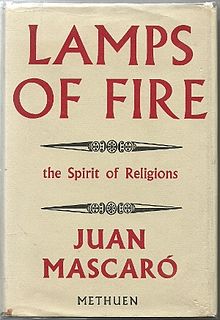
220px-LampsofFire

GK: I had been studying the Penguin Bhagavad Gita in the late 60s, ‘68-69, and was deeply impressed. I then purchased the Upanishads, Juan’s translation, and I was so moved when I completed the introduction, that I just simply–it was at midnight–picked up the phone and trusting to luck and good fortune, called Cambridge, yes, at midnight, San Diego time. I guess it was what, 8 or 9 am there, and she was kind enough, the operator, to trace Juan’s number for me. I called him and he was having breakfast. We chatted for a while and I said “Professor Mascaró, I am so deeply moved by the introduction to the Upanishads that it was like an Upanishad for me,” and he said “Oh, George, where are you calling from?”

You know, he had such a sharp mind that could leap into transitions effortlessly. I said, “I am calling you from San Diego,” and in a moment he simply said “Father Junípero Serra was born a mile away from my father’s farm.”

So you see how he leaped from San Diego, and if you know the whole history of the California missions, established by Father Junípero Serra [recently canonized by Pope Francis], no other comment, he just moved right into the reference, and we chatted. He was very gracious and he said, “Look, I know this is a costly call, can you give me your address.” So I took down his number and I gave him my address and we continued chatting for a while, I don’t know, by this time it was  1 am or so, and a week later I received a Penguin Bhagavad Gita inscribed to me with a very lovely note. And then there began, in Winter, 1971 a lengthy correspondence that carried over into the spring of ’72.

“In theory, an Upanishad could even be composed in the present day: a spiritual Upanishad that would draw its life from the One source of religions and humanism and apply to the modern world,” (Juan Mascaró, Introduction to the Penguin Classics, The Upanishads, 8).

[George then recounted how the friendship developed, with letters back and forth. Juan then invited George and his family to stay at a cottage he owned near his own home, “The Retreat,” and George recounts the discussion with Juan about the cottage.]

GK: Juan said, “I have a lovely cottage,” within walking distance of The Retreat” [his home], and I said, “That’s fine.”  “You’ll like it George.” He said, “I’ve just renovated the bathroom and in addition to that, I have just had the roof re-thatched!”

So, Dave, my wife and I, let me jump ahead a month or so, when we approached the cottage I expected either Ronald Colman or Greer Garson to walk out and greet us, like in “Random Harvest.” I don’t know if you are at all an old movie fan. It was incredible, lovely, with an entrance archway of many miniature roses.

I said “That would be fine.” He asked, “How long are you planning to stay?”  “Oh, about  5-6 weeks.” … Hmmm, it’s amazing how one can recall these conversations almost per syllable, after more than 40 years….. He said, “Well George, would $250 for the month be acceptable?” My wife and I nearly fell off our chairs. I said, “It is so generous, Juan!” Of course, I immediately sent payment to him.

I once made the mistake of calling him Juan [the Spanish pronunciation, like “wan”]. “No,” he said, “I am Catalonian, it is Juan,” [the Catalonian pronunciation sounds more like “jew-an”]. “Well, I am comfortable with Juan” [“wan”], I said. And he answered firmly, “No, George, it is Juan [“Jew-an”]. I only needed that one lesson, I didn’t need it to be repeated.

When we entered his home, Juan amazed us: he came in from a dining room and he just stared at us. It was as if time stopped, he just stared at me, my wife and our children, in a very warm way, you know, this wasn’t anything done icily. And after that he just stayed and looked, as if taking a kind of physical/cerebral inventory of us, if that is possible, and he welcomed us and we sat. It was just a wonderful welcome. And we sat there and then later in the evening, he and Kathleen [Juan’s wife] walked us to our home. And he was right, it was a newly refurbished bathroom, small but very convenient, and the roof was indeed recently thatched. My memory just leaped backwards in time. I imagined that Keats on a walking trip from Cambridge to Comberton, or William Blake, perhaps, and stopping at this cottage for a refreshing drink. I think the building date was 1732. I just said to my wife, “Who knows if Byron or Keats walked by here, and perhaps stopped to rest” – Keats was a walker, certainly, Wordsworth and Coleridge were also…so I just kind of pondered that.

There began our 5 or 6 week sharing time…

We discussed The Dhammapada [Mascaró was just finishing this translation from Pali of the Buddha’s teachings]…and there began a number of delightful, I mean, Dave, golden memories, sitting in his backyard and Kathleen fixing tea and our chatting. And my wife Dee and our girls there, sharing with Juan and Kathleen, and I underneath an absolutely massive walnut tree. Juan said I was sitting in C.S. Lewis’ favorite chair and I was gratified to hear that. He told me that another chair was a favorite of W. H. D. Rouse, who had translated the Iliad and Odyssey of Homer, prose translations, in the ‘50s and ‘60s. They were very popular in America, published by Signet American Library, I used them myself in a number of my classes. He said that Rouse’s chair had been carved out of a nearby walnut tree and it was a beautiful comfortable, gnarly chair, but I preferred CS Lewis’ chair.

Dhammapada

I asked him about Lamps of Fire, oh and a beautiful – he had done a marvelous anthology of Keats’ poetry. Published in Majorca, in a very nice, very artistic, rough-cut, parchment cover, an edition by a friend of his, published on the Island.

And we were talking about Keats, and I don’t know if you want to get into any literary or musical things, but that is what we focused on in those early weeks. He told me, he said that Keats for him was the perfect emblem of the Hellenic experience, while Wordsworth, to his great satisfaction, was the perfect embodiment of the Hindu. And if you read his notes, he took a month or 5 weeks, he told me, to do [translate] the Isa Upanishad at Tintern Abbey, one of Wordsworth’s most renowned poems and he just stayed there…he said it was a labor of love and he didn’t leave. I guess the Wordsworthian spirit and consciousness were present.  He said it was a beautiful time for him.

          …

          And I have felt

          A presence that disturbs me with the joy

          Of elevated thoughts; a sense sublime

          Of something far more deeply interfused,

          Whose dwelling is the light of setting suns,

          And the round ocean and the living air,

          And the blue sky, and in the mind of man;

          A motion and a spirit, that impels                           

          All thinking things, all objects of all thought,

          And rolls through all things…

(Wordsworth, “Lines Composed a Few Miles above Tintern Abbey, on Revisiting the Banks of the Wye during a  Tour, July 13, 1798”)

Tintern_Abbey-inside-2004

From Wikipedia, “Tintern Abbey,” released to public domain by Martin Biely at English Wikipedia

One of the most beautiful gifts he gave me was the gift of Gitanjali by Rabindranath Tagore and – there have been one or two other translations, but he, as I did, following his lead, felt that Tagore’s rendering of his own poems was perhaps definitive.

Gitanjali

“Thou hast made me endless, such is thy pleasure,” (Tagore, Gitanjali, opening line).

He gave me a number of books during our stay and then we started on our walks.

[George tells of their walks down country lanes, speaking of Lope De Vega, Ezra Pound, Bernard Shaw, “Citizen Kane,” Fortunio Bonanova (Catalonian singer and actor who moved to Hollywood, whom Juan grew up with), Tomas Vittoria’s masses. At one point, Juan and George were walking on a meadow lane near a group of cows. Juan asks George about the college the locations he taught at, in California].

GK: I told him, the city is called “El Cajon.”

“El Cajon!” He burst out laughing and the cow got so scared it just turned and ran into the meadow. He said “You have a city called ‘the box!?!’” And apparently that’s what it means. “I can’t believe that a city would be called ‘the box.’ He howled and just kept walking and slapping his knee. He couldn’t believe that a city would be given such a name.

We talked about Tagore, a dear, dear favorite. And we talked about Vivekananda and Ramakrishna and also about Paramahansa Yogananda, who came to the center in LA. He didn’t follow them too, too often, but he had heard that Yogananda had a broad following in the United States and California especially.

Then he went on to talk a little bit about Ceylon (now Sri Lanka) and this was before he returned to Cambridge. He told me, “George, you know I have taught only two courses, I taught the Romantic Poets and ‘Literary and Spiritual Values in the Authorized Version of the Bible,’ that is to say the King James. “That is all I taught, my entire career.” Apparently he got his degree and then went back to Barcelona where he lost a number of his friends, I think Unamuno and others who had been shot. I guess this was Hemingway’s “For Whom the Bell Tolls” time, Francisco Franco ‘39, ‘40, ‘41 and he apparently had lost some dear friends, so he didn’t stay there. He went back to the school that had granted him his degrees, to teach, but he repeated, “I only taught two classes….”

And it was that day, when we returned from the walk, that he gave me the private, 200 copies only, privately printed anthology of selected poems by John Keats. Very artistic looking, a rough-cut, parchment cover edition, it showed Keats’ poems that matter most deeply to him.

A thing of beauty is a joy for ever:

Its loveliness increases; it will never

Pass into nothingness;

Nor do we merely feel these essences

For one short hour; no, even as the trees

That whisper round a temple become soon

Dear as the temple’s self, so does the moon,

The passion poesy, glories infinite,

Haunt us till they become a cheering light

Unto our souls, and bound to us so fast,

That, whether there be shine, or gloom o’ercast;

They always must be with us, or we die.

(From Endymion, John Keats)

And when we talked about Ceylon, Sri Lanka, where he was, he used the term “Governor” of the school, I guess the magistrate of the school. He said that he would walk to the school every morning and I said “That must have been pleasant.” “Yes, it was pleasant but it was rather unique. My rooms were not that far…” And I said “What was unique about it?”  “Well, every morning when the sun rose I would walk to work, I purposefully took a cane and as I walked I would take the cane and knock the cobras out of my path.” He would just strike the snakes out and knock them onto the dirt or the meadows that flanked the walk way. I said, “Did you ever get hurt?” He said, “No, no.” Apparently every morning they were awakening from their torpor, and as the heat warmed them they were stretching and arching, and he just knocked them out, or knocked them out of his path.

[George and his wife, Dee, recount memorable evenings with Juan and his wife, where Juan would pour them all sherry and listen to Catalonian folk songs, and a different facet of his personality would emerge].

GK: He enjoyed and poured us sherry and played Catalonian folk songs on 78 rpms.  And you saw a side of him that I never saw in our walks or in our conversations in his library. What a splendid library, Dave, oh Good Lord, I think he had begun building it the day he returned to England after the Spanish madness. It was just beautiful.

[I had read his] Upanishads and I was deeply moved. The introduction to it was a revelation to me, it still is.

“Our spiritual life must be a work of creation. Whether we are within a religion, or outside a religion, or against religion, we can only live by faith, a burning faith in the deep spiritual values of man. This faith can only come from life, from the deep fountain of life within us, the Atman of the Upanishads, Nirvana, the Kingdom of Heaven,” (Mascaró, Introduction to The Upanishads, 23).
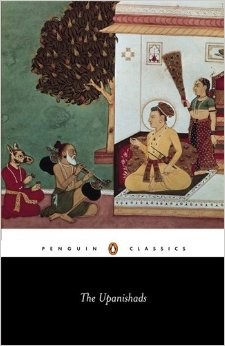
Upanishads

And The Dhammapada, he was working on it [when we visited]. I sat once, and I was honored, he was walking around the room – I sat at the desk and he read several chapters. We looked over the introduction, and briefly discussed Lamps of Fire. He is very careful, as in San Juan Del La Cruz, St. John of the Cross, he will say “translated by E. Alison Peers or “Sister Teresa” and he’ll say “translated by so and so.” Or he’ll say “translated by Juan Mascaró,” but unless I’m mistaken, for all of the Tao Te Ching, he uses the verb “rendered by Juan Mascaró,” he doesn’t say translated. He said he would study the translations he respected the most, absorb them, as many translators do today. We see a number of Americans rendering the Tao or Dhammapada; they are hardly versed in the original language, so what they do is surround themselves in a half-moon of other paperback translations, absorb them, and then render their own translation.

So we talked about Tagore, Yeats – my favorite poet of the 20th century who had written a lovely, lovely introduction to the Gitanjali – it still reads beautifully, do you have that introduction, Dave?”

DK: I don’t think I do, I just have a collected works of Tagore.

GK: If you can get a single volume, with Yeats’ Intro, 1912 or 1907, I may be mistaken, or 1912, it is just a lovely introduction to Tagore’s poems. There are some paragraphs there, you know “I have kept these poems in my hands on trolleys and omnibuses and so forth…” just a beautiful, beautiful tribute….

“I have carried the manuscript of these translations about with me for days, reading it in railway trains, or on top of omnibuses and in restaurants…

Lovers, while they await one another shall find, in murmuring them, this love of a God a magic gulf wherein their own more bitter passion may bathe and renew its youth. At every moment the heart of this poet flows outward…for it has known…images of the heart’s turning to God,” (W. B. Yeats, “Introduction” to the Gitanjali, 1912).

Then he had shown me a letter that Tagore had written to him and said that Juan  had “captured the spirit of the Upanishads,” a very complimentary letter that Tagore had written, and then when we left, he gave me a number of books and inscribed them all, including Lamps of Fire and also Final Poems of Tagore. I think the title is “Whispers of Eternity,” unless I am mistaken, and he said these were very lovely, and indeed, I think the final poem in that volume was written on the morning or night before Tagore’s passing.

“22 December, 1938.

Dear Professor,

I have too often seen the Upanishads rendered into English by scholars who are philologists and who miss the delight of the immediate realisation of truth expressed in the original texts.

And these are the reasons why I feel grateful to you for your translation which fortunately is not strictly literal and therefore nearer to the truth, and which is done in a right spirit and in a sensitive language that has caught from those great words the inner voice that goes beyond the boundaries of words.

Yours sincerely,

Rabindranath Tagore”

(Letter reproduced in The Creation of Faith, Juan Mascaró, 20).

It was a lovely summer, “How was the weather, Dee?”

[Dee, in background, answered] “Not very good. I think we saw the sun twice in one month, grey and overcast…”

[Dee, incidently, is the author of an Armenian Vegan cookbook]

ArmenianVegan

I just love my memories, in the carven walnut tree chair behind the cottage….

Oh, and his eating habits – he said, “I eat one meal a day,” echoing the Buddha. He said “I have a chop, a bit of potato and some greens.” I myself couldn’t exist on so Spartan a diet, so I made it a point to eat rather well before I went for my midday visit there. But he would sit in a kind of mini greenhouse, and he was right: I saw a very thin lamb chop, a modest sized potato, and some green peas, and he ate very slowly, very delicately….

A beautiful summer it was, my family loved it, especially the girls – it looked like Snow White’s cottage or Ronald Colman’s cottage.

GK: Catalonian Dance night, the girls would read the classics…and we would have great times, and I asked, “What about W.H.D. Rouse?” He said, “Rouse was remarkable!” I said, “In what way?” (It was quite an accomplishment to translate the Iliad and the Odyssey, although they are rather prosy). He said, “Well, he impressed me deeply one day when he came here and sat in that chair George, and said, ‘I have begun the study of Chinese’ – and he was 89! ‘I am launching a study of Chinese,’” I think he died several years after.

DK: George, you had mentioned Catalonian music nights, where Juan showed a different side of his story, could you say more about that?

GK: The side was not a very Cambridge manner (laughs), I mean he was relaxed and very cordial, he sipped the sherry and he would fill it again and then translate the songs and he even would sit and get up and then change the record and then stand up and offer us a snack, and smile and laugh. He was like a young boy again, nibbling straw on his father’s farm, long before the whole Cambridge/Barcelona experience began. And we saw that – and I am not saying he was a frowning Cambridge Don, even on his non-Catalonian nights, he was very gracious, very friendly, he would laugh. He would always say, “George the power and beauty of” – and almost every meeting, and I learned from him (I get excited now because the memories as I mentioned are golden memories and I am reliving them, but I was that way myself) and he would always say, “The beauty and the blessing of stillness and silence.” And as Dee just mentioned, he spoke very softly, but you never had to lean toward him to hear what he said, everything was clearly stated and that evening was a merry, merry evening and he would sit and you would know he was in a kind of Proustian remembrance of things past…. He must have been an adolescent again, maybe stealing apples with Fortunato on his father’s farm. Dee says from background, “They were happy songs.” Yes, they were lovely songs, very lilting and happy songs. He loved his Catalonian culture. I mentioned Franco once, but he didn’t even bother to respond. He just didn’t want to discuss that time, that topic… He just wasn’t concerned with it. He was totally Catalonian….
“George, the power and the beauty…the beauty and the blessing of stillness and silence,” (Juan Mascaró, to George Kirazian, 1972).

He could crack a walnut and take a sip of sherry with the best of them, don’t get the impression that he had high, stiff starched collars – that was not the case. Very humble, in that respect he was still a simple son of a Majorcan farmer, I don’t mean that in a bad way, he was very earthy, down to earth.

We never saw him again…

DK: It is so great to hear about [your visit with him]. You know, I had read the Upanishads and the Gita when I was in college and then a few years ago I had gone back and I think I had lost the books, so I had bought them again and had, kind of similar to you, just this real appreciation for the introductions, I read the introduction and then read the book and then went back and read the introduction again, which is kind of a rare thing for me to do. I’ll often when I appreciate somebody, I will start to find everything that they had written and that is when I found The Creation of Faith [a posthumous collection of aphorisms that Mascaró had been working on at his death] and I think that is kind of how you – how did you stumble across that the blog that I did on that book?

Creation of Faith cover

GK: I don’t think it was a blog, was it an Amazon?

DK: Oh, it might have been an Amazon review because I would do both, an Amazon review and then expand that into a blog.

GK: And I responded to that, I don’t know what the review was, but I was struck by that and that initiated my email to you and so forth. You are right, what I did for one semester and a half was, I went through The Upanishads [Juan’s introduction] with a pen and underlined every reference to writers, such as Ramon Lull, a great poet/mystic of the 14th century.  And San Juan De La Cruz, who’s Spanish even I can understand, even though it is around the time of Elizabeth, Shakespeare. But you are right, those have to be revisited often as a holy tribute.

DK: I feel like the tremendous amount of work that he did and how passionate he was, and how much he seemed to love the work that he was doing and the writing that he was translating or rendering. If you look on-line there is very, very little about him, the translations of the books and the introductions come up, but I just pulled up the Wikipedia page [on Juan Mascaró] there are only 303 words in the description of his life.
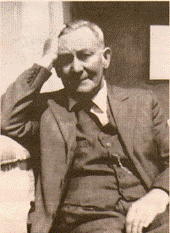
Juan Mascaró

Juan Mascaró

GK: Oh, my Lord!

DK: Just even what I am hoping with you is to put a little bit more about this man’s own life – maybe he is the type of person who would not want a lot of his own details out there, but for somebody who did so much important work and introduced so many generations of people to Eastern wisdom it seems…

GK: Oh, you are absolutely right, it was Juan’s, it was his translations of Penguin which for years were adopted by the UC system here. I mean from Northern California right down to my own city, San Diego, if you took a course and you walked into the bookstore, those were the translations that were on the shelf, his….

DK: And I think they are still very well respected and available.

GK: Yes, they are, and you know, a few of the comments…

Gita

GK: Let me close with this, because not too many people have touched on it in the appreciations on Amazon and elsewhere. What was a revelation to me with the Gita and then later the Upanishads the subsequent, following year, was his ability to (and a number of people now I think are referencing it), his ability when he happens on a kind of eternal spiritual truth he, instead of rendering it the way the original would have him do, he will go into the Old Testament or the New, based on his authorized version…and he will take that phrase from the Bible instead of strictly translating the original because he feels, that quote captured perfectly the Spirit, and would be luminous to kindred readers–and yet he would not dilute, he did not feel that he would dilute the effect and the power of the original by using that Biblical phrase. He worked very carefully… I was amazed at that and I told him that first night. I have never, of all the translations, I have never encountered anything like that. It showed such a total mastery of the two traditions and when I learned later that he taught only two courses,” when he said the Authorized Version, I said to myself “Well, George, there it is!” Just beautiful, just lovely…

And there began, that Summer, the literary romance of my life.

George Kirazian

Facebook: https://www.facebook.com/george.kirazian

Twitter: @georgekirazian

July trip up to San Juan Islands

It has been a busy summer with trips and visits and taking every opportunity to present on my book. I’ll work on an update on my current writing projects, but for now I’ll just share some of the photographs I’ve taken lately.

DSCN1407

We had family visit in July and we went up to San Juan island and spent some time at Lime Kiln State Park, which is supposedly one of the best land-based sites to whale watch. Sure enough, we saw (what some of the more seasoned whale watchers – the ones with big cameras identified as) a Minke Whale. It cruised back and forth a few times and I was able to get a photo of its dorsal fin.

DSCN1371 (2)

There was also a seal or sea lion cruising around for a while.

DSCN1355

And here is a nice crow who was hanging around when we first arrived.

DSCN1345 - Copy

As I was walking around, I saw this great face in an old tree, I took it to be the spirit of this place and was grateful to have seen it.

DSCN1446

Lastly, we also made a trip out to Sun Lakes in Central Washington, which is quite near some of the wild fires that are currently burning out there. This is a photo of Dry Falls, which was once a huge waterfall, but now is quite barren.

DSCN1526

The fires in Washington are very serious the past couple weeks. Three fire fighters died this past week. Two hundred soldiers have been called up from Joint Base Lewis-McCord. Calls have gone out to Canada, Australia and New Zealand for assistance in fighting the fires. The state even made an unusual request for volunteers. From Seattle we can’t see the Cascades today as the visibility is hazy. No rain in the forecast for this week so far…

It has definitely been a very dry and hot summer here.

We just made a trip down to LA and New Mexico and saw a wild fire start in LA while we were visiting friends. It was small and helicopters responded quickly, dropping water on the fire. After that trip down to the Southwest, you really get an appreciation for the ongoing drought and water issues in large parts of the country.

Visit to Mt. Rainier

20150502_163831

I recently visited Mt. Rainier for the first time. It was both exciting, but also a little bit disappointing.

I had heard that the poet, Denise Levertov had compared the mountain to God, a vast and massive presence that is often obscured from view from Seattle due to clouds and fog. She apparently wrote a number of poems about the mountain, but chose to never visit it, as she said she had come here “to live, not to visit,” in the poem “Settling,” the ending of which is below:

…having come here to live, not to visit.

Grey is the price

of neighboring with eagles, of knowing

a mountain’s vast presence, seen or unseen.

She felt that there was something to keeping the mountain at a distance, and I appreciated that as, as beautiful as it was being at the park, I couldn’t get the whole view of the mountain once I had gotten so close to it. Like the quantum physics concept of knowing something only as a particle or wave, but not both, I could approach the mountain and see its details, but I could no longer see its imposing presence.

20150502_170415

Here is the whole of her poem, “Open Secret.”

Perhaps one day I shall let myself

approach the mountain—

hear the streams which must flow down it,

lie in a flowering meadow, even

touch my hand to the snow.

Perhaps not. I have no longing to do so.

I have visited other mountain heights.

This one is not, I think, to be known

by close scrutiny, by touch of foot or hand

or entire outstretched body; not by any

familiarity of behavior, any acquaintance

with its geology or the scarring roads

humans have carved in its flanks.

This mountain’s power

lies in the open secret of its remote

apparition, silvery low-relief

coming and going moonlike at the horizon,

always loftier, lonelier, than I ever remember.

20150502_163524

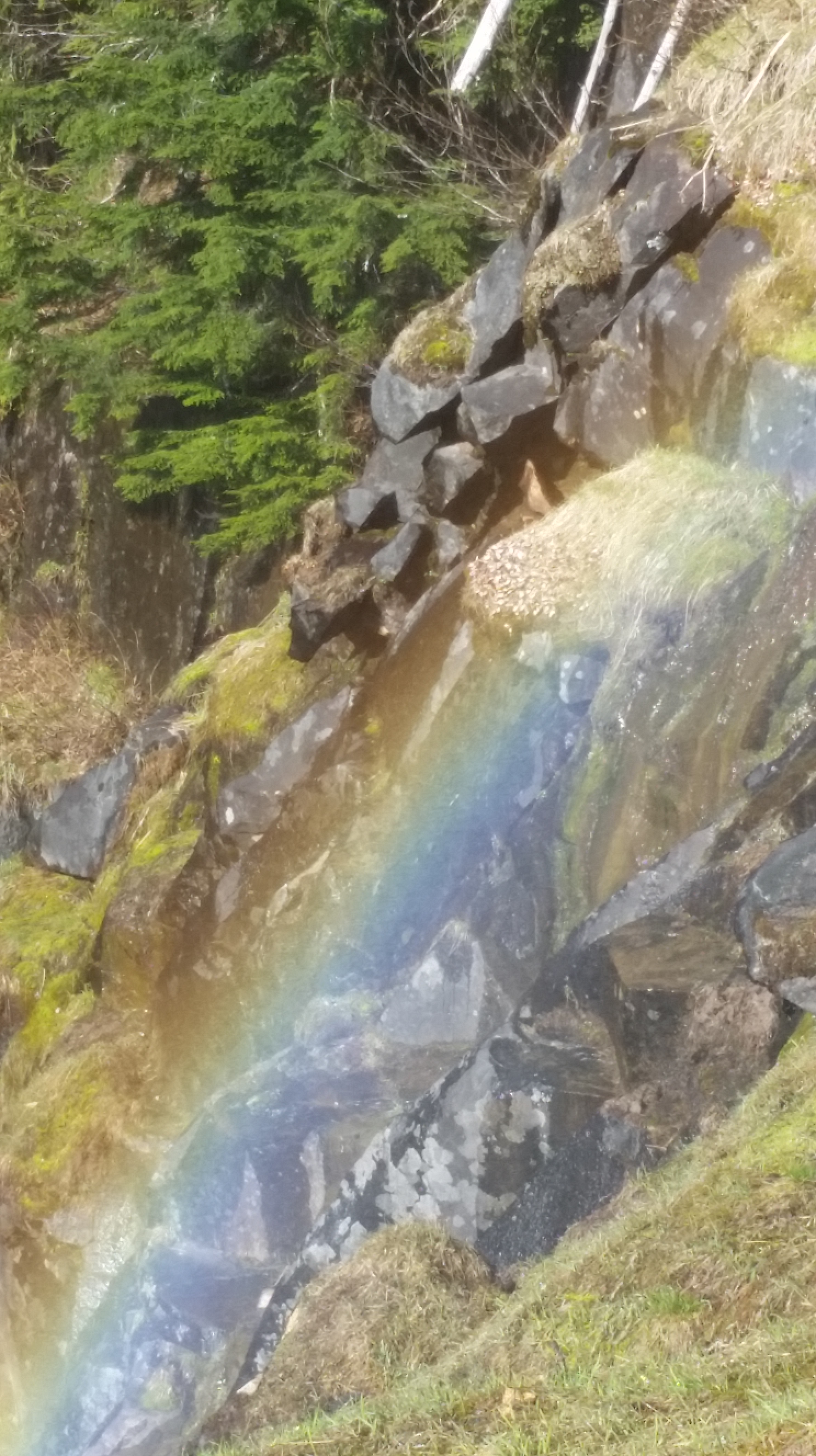
Levertov calls this power viewed at a distance of Rainier, its “open secret.” I don’t actually have a photo to show what I was missing of this open secret, which I guess is fitting, as I went to the mountain, I forfeited that view of it. Still I am glad I went, to get up to the snow line and to take a hike in the woods, and to get some beautiful views of Narada Falls emitting rainbows…

20150502_165802 20150502_165819  20150502_165851

I hiked along the river as it made its way down the mountain. I climbed out and did some rock hopping and saw a number of smaller falls.

20150502_174755

While I did forfeit the vast open secret of the mountain’s power, I did get to see the wonderful play of light with the clouds of mist rising from its waters in this amazing photo I took from a little bridge.

20150502_171851

Review of The Aum of All Things, by Ruzbeh N. Bharucha

51mspDxRDuL._SY344_BO1,204,203,200_[1]

Ruzbeh N. Bharucha is the author of a number of books, foremost among them the Fakir series, in which Rudra, a drifter/seeker in despair of life meets the Fakir: Shirdi Sai Baba. Shirdi Sai Baba was a Muslim holy man and ascetic who combined the wisdom of Hinduism, Islam and Sufism and was revered by both Hindus and Muslims alike. In the Fakir books, Rudra goes through an experience of despair of life to become a disciple of Shirdi Sai Baba and it demonstrates the principles of bhakti (devotion to God) and the Guru (surrender to a Master and spiritual teacher). The books are narrative stories filled with wisdom sayings and Rudra’s irreverent humour. These books have been very popular and have been translated into many languages.

The Aum of All Things was published in 2013. Instead of Rudra (who one guesses bears some similarity to Ruzbeh, at least as an alter-ego), Ruzbeh, himself, is the protagonist. So, presumably this is a work of non-fiction, whereas the Fakir series was a spiritual and inspirational fiction which is also true (much like Richard Bach’s Illusion series, in which Richard meets the reluctant messiah, Donald Shimoda). The majority of the book is taken up by Ruzbeh’s interviews with Bapuji, along with input by Mataji and a few others at Bapuji’s ashram.

dna02[1]

I started out loving Mataji, who first welcomes Ruzbeh to the ashram and first tells of her spiritual search for God:

“When the heart aches, that is when the search begins. If the heart is pleased and satisfied, why will one venture out or set out on a search? When the heart is sad that’s when it seeks,” (Aum, 18).

Mataji starts her quest as a householder and mother, searches out various teachers and philosophies, eventually she meets Bapuji and settles in as his disciple, leaves her family and renounces the world. She describes coming to a state of “Vairāgya, which means disenchantment from worldly matters,” and she quotes a saying, “destroyed all attachments to discover spiritual progress; divine knowledge thy sole quest,” (Aum, 20).

However, Mataji isn’t developed much after the initial pages. Bapuji gives many detailed teachings, but we don’t get much of a sense of him as a person and the teachings are very technical. Ruzbeh gives some good lightening of the mood during all the heavy enlightenment, constantly thinking to himself, in the midst of these profound teachings, how much he needs a cigarette. However, unfortunately, there is not as much of a narrative story in Aum, even though there are brief asides in which Ruzbeh gets peppered by questions (including spiritual ones) and also fields requests for toys, by his daughter, Meher. These are brief vignettes and while they humanize Ruzbeh, they don’t really advance a plot or illustrate the teachings of the book.

What is helpful are Ruzbeh’s asides in which he disagrees with or clarifies aspects of Bapuji’s teachings. Thus there are two teachings going on simultaneously, those of Bapuji and those of Ruzbeh, who is quite spiritually developed, although his comments and jokes about women seem sexist and don’t seem to humanize him as much as his need for nicotine or his tendency to refer to God as “the Great Rock Star.”

Now, to the teachings of Bapuji Dashrathbhai Patel.

They are very technical. Ruzbeh says that this is a book about jñān, spiritual knowledge or wisdom. He says that this takes him out of his comfort zone which lies in “love, faith and surrender to your Master,” (7). Bapuji’s detailed teachings at times seem like some kind of spiritual accounting exercise. Consider the following:

hqdefault[1]

“Now the 8th Celestial Degree was almost 38,400 Arab light years from the earth, with 80 to 99 per cent of Paam Taŧvas and one to 20 percent of Gross or General Taŧvas or elements. The per cent of the gross Taŧva means composition of three elements, Ether, Air and Fire. In this also, as we gradually fall due to the increasing Sañkalps, the percentage of the other wo elements, which gradually increase in percentage thus bringing about heaviness, and leaving us getting more and more occupied in thoughts and creation,” (173), (there is, thankfully, a glossary at the end of the book).

There are a number of Bapuji’s teachings on YouTube, but not all have English translations. This one does have translations and also shows the cosmic diagram of creation, which is essentially what the teachings expound upon.

Here is a kind of guided imagery of a teaching without all the percentages and terminologies:

“Now listen carefully: whenever you close your eyes, imagine your inner body and external body to be made of light, and believe yourself to be made of light and one day you will actually see yourself filled with light, that’s when you will have a body of light. Keep increasing the light; keep imagining yourself glowing more and more with this light. This is the way you go about becoming light. Everything is in the Sañkalp or thought, intention. The world was made out of thoughts. It’s all about the power of thought. Believe something and you will slowly become that thing,” (39).

I found myself considering several other systems of cosmogony while I was reading this. The Śiva Sūtras and the Vijñānabhairava translated by Jaideva Singh provide similar lists of the states or levels of creation (yet here, Śakti, the feminine principle is Śiva’s power to manifest and create – which seems more neutral than Bapuji’s explanation about what happens after the split of masculine and feminine). Suhrawardi’s The Shape of Light also follows the various forms of light following the emanation of sacred Light from the spiritual to the material realms. There are many different cosmogonies that describe Creation – but the real question, the real bit of jñana or gnosis is not about the spiritual accounting of percentages and various states and levels, but why was creation created in the first place? The science cosmogony is that there was a state before time and space and matter, then there was a “big bang,” at first there existed only the light weight atoms of hydrogen and helium, and those stars lived out their lives. With progressive lives and deaths of stars, gradually the heavier elements were created in nuclear supernovas, until present day when we have a wide array of dense atoms that make up our physical world. This narrative is similar to that of Bapuji, that there is at first a formless “Almighty Authority” created a “Supreme Creation” (Paam Rachnā) which he named the “Supreme Father of the Infinite” (Paam Pitā) and then various levels of formless creation assuming greater form, then a split into masculine and feminine, and then ever greater more dense, less spiritual forms were created. Two questions arise at this point: what is the purpose of creation; and is matter inherently less spiritual?

I found myself hearing Joseph Campbell’s words regarding religious cosmogonies, or “myths” as he called them – he said that they are metaphors, not literal truth, but metaphorical truth. Campbell studied many, many religious systems and teachings and searched for the underlying truth of them all, but the way he did this was to move away from the religious to a more secular view – that these are stories that tell us important things about being human, being in the world, and being oriented to the spiritual – they tell us how to live in this world. Psychiatrist Carl Jung also studied numerous world religions and systems of transformation. He maintained a somewhat conservative stance saying that if someone could stay within the religious tradition in which they were brought up, their psychological and spiritual work would be much easier (which he, Jung, definitely did not do). In some ways, Campbell takes the standpoint of immanence – don’t worry about God “out there” worry about how you can bring the stories of God into your life in a meaningful way in the secular world. Jung was more of a mystic and had a strong transcendence perspective, in which the goal of the individual was to move toward the spiritual (although Jung also believed in the principle of wholeness, not rejecting human essences, but harmonizing them). We can look at these two viewpoints of immanence (God/Spirit descending into matter and humanity for a Divine purpose on earth – Jesus’ saying, “the Kingdom of God is all around [or ‘within you’]”) and transcendence (matter is either defiled, or de-spiritualized and the soul must forsake worldly pleasures/desires and move ever more toward God/Spirit). Materialism is pure immanence (there is no divine or spiritual). Bapuji’s (from my very limited understanding) teaching is very much a spiritualism (matter is “bad,” dense, limited in the pure light of God) and his teaching is that we need to move away from the physical desires/pleasures toward ever higher levels of Light. Christianity has both elements of this-worldliness and other-worldliness, the expansion of the West through colonialism and economics into the rest of the world has been very material, and yet Christian teachings often view matter and the body as inherently sinful and tainted.

While spiritual teachings often focus on how we can become more spiritual and more enlightened, the question of why we find ourselves in physical form is often not satisfactorily answered. The Christian answer is that God created Adam and Eve and then they sinned and ate from the tree of the knowledge of good and evil – this is called “the fall” where sinful humanity was banished and exiled from the Garden of Eden and from a closer relationship with God. There is a logical inconsistency in many of these “fall” stories (and Bapuji’s story is very much one of the evilness of matter falling away from the lighter, more spiritual Light – in fact, there is a logic that the reason that matter becomes more dense and less full of Light is that the percentage of Light gradually diminishes through more and more creation being done by the createds, thus it seems in this narrative that God’s Light is not strong enough to maintain Creation and it kind of starts to run down in the outer limits from the Source). How can an omniscient, all-powerful, infinite being have so much trouble with the createds? Matthew Fox takes the concept of “original sin” of humans and the concept of “the fall” to task in his book, Original Blessing. He argues for a Creator whose Creation is a Blessing and not a curse. Fox calls for a Creation Spirituality, one that is consistent with indigenous views, in which the role of the feminine is divine (as in the divine Sophia, or Gaia, Mother Earth, rather than sinful Eve or in Bapuji’s cosmology the idea that the creation of the feminine led to more competition amongst the masculine and led to a creation arms race of sorts that depleted the available Light in creation). The orientation of a people, culture and religion toward women is very much the same as the orientation toward the natural world and Matthew Fox follows this association in his book. Many of the more transcendent spiritual teachings are in the context of a masculine patriarchy in which women and matter are evil or tempting. In Hinduism, this reality, itself, is said to be Maya, and Maya is characterized as feminine, thus leading to the sense that the spiritual is Truth and is masculine. In contrast, more Creation-based spiritual teachings have a more feminine divine energy in which the feminine and the natural world are a source of divine expression rather than divine absence.

51UPFBVJYNL._SY344_BO1,204,203,200_[1]

Thus we can ask, are we sacred and divine or are we defiled, bad, evil, sinful? Is the earth and physical form a blessing or a curse? In the religious cosmogonies, we ask: why did God Create and what are we to do with that Creation? To me, the saving grace of Bharucha’s book, The Aum of All Things, lies in his open-minded and open-hearted seeking of God. After pages and pages of stages, levels, percentages, and permutations of more and more creation leading to denser and denser (and thus less and less light) beings and essences, Ruzbeh says the following:

“According to me the more you get into the technicalities of spirituality the more you realize that heaven and hell are within each of us; the blossoming of one’s true self and the destruction of all that is true; all within oneself. The power to discriminate between right and wrong and the power to choose between the Light or the chaos within, all in our own within. For me liberation means being free from one’s own clutches of darkness and desires and shedding the false self and letting one’s true self shine through. And it is not easy…But you just keep at it. Fall. Rise. Fall. Rise…The Light within is elusive; it’s playful; it’s a lover who wants to be possessed but won’t ever surrender till you are worthy, so keep at it and someday, may be lifetimes later, you and I…will be worthy of Her and be filled with Her and radiate Her essence and then become One with Her…keep trying and trying. That is the only true purpose of life,” (212-213).

Ruzbeh seems far more accepting of our humanity and yet still asks us to strive toward something. He also uses the feminine pronoun and thus brings in a softness to the masculine striving of spirit to free itself from matter. A few pages later he continues:

“What is most important is that you believe that you are loved and your Master [in his case, his guru is Shirdi Sai Baba] is with you…Life is fair and God is within…If we are the Spirit in the body, then that Spirit has come through the Creator and the Spirit is the Creator. If nothing can be created or destroyed in the cosmos and it only changes form, so believe, you and I have just changed forms, but our essence truly comes from the Source and thus we too are the Source,” (220-221).

“Life is about exhaling,” Ruzbeh says, “Not about holding one’s breath,” (221). Maybe that is a simple way of making sense of creation, of being created, of having a Source (whether Creator or Big Bang) – all of this is one big exhalation (again from either Creator or Big Bang) and soon enough, the big inhalation will take place and we will all go back from where we came. From a religious or spiritual perspective, matter and humanity are created out of Love and Joy, true matter is far from the etheric Light of Pure Spirit, yet it is not evil, it is just dense and moves slowly – we can still feel the “Divine Creative Pulsation” (Spanda-Kārikās) within us as within all of Creation and even in the background of Creation. Suhrawardi explains the reason for Creation in this hadith of Allah:

“I was a hidden treasure;

I loved to be known,

so I created creation.”

(Suhrawardi, The Shape of Light, 57)


This little saying is more profound than an explication of layer upon layer of spiritual accounting – Creation is made out of Love, and out of a desire to be known. This leads us to aspire to Love, and to aspire to seek out what is our True Source, our own True Inner Light, to know our Creator. This can be taken in a religious sense as worship of God, or in a secular sense of self-discovery, or in a Jungian psychological sense of individuation (unfolding into Self), or a Campbellian sense of ananda, “follow your bliss” to find out who you are. Maybe creation is all just one big exhalation and inhalation, Ruzbeh would probably approve of this spiritual summation, particularly if he was having a cigarette at the time.

Re-humanizing Imagination and Humanity

DSCN0955

Reflections and a Review of Tom Cheetham’s Imaginal Love: The Meaning of Imagination in Henry Corbin and James Hillman

In the year that I moved back to the United States from New Zealand, I turned to a study of Henry Corbin. I read through his available books in English translation and I found myself drawn to his work and concepts. I knew it was important in some way to my current passage and path in life, but whenever I would try and explain why I would end up spinning in circles around the Arabic word, ‘alam al-mithal, and would keep repeating, it is the place where “matter is spiritualized and spirit is materialized.” The earth-shaking importance of this did not seem to be as immediately obvious to others as it seemed to be for me.

In my course of reading Corbin (who I had come to through reading Carl Jung and later James Hillman) I came across Tom Cheetham’s books: The World Turned Inside Out: Henry Corbin and Islamic Mysticism; All the World an Icon: Henry Corbin and the Angelic Function of Beings; After Prophecy: Imagination, Incarnation, and the Unity of the Prophetic Tradition; and Green Man, Earth Angel: The Prophetic Tradition and the Battle for the Soul of the World. In his most recent book, Imaginal Love: The Meaning of Imagination in Henry Corbin and James Hillman, Cheetham says he has spent over 20 years working to understand Corbin and his book are a wonderful resource, not just on Corbin, Hillman and Jung, but also in documenting an individual’s quest and spiritual path.

In reading Cheetham’s Imaginal Love, I found myself being able to clarify why Corbin is so important to me, why I had to take a year-long study of his work, and how I will use his concepts going forward in my own life, work and writing. Below you will find the text of the Amazon review I wrote of his book, but I will add some additional, more personal reflections first.

Corbin, Cheetham, Hillman and Jung all have worked toward a reorientation of our consciousness. The problems and solutions that they grapple with are similar to the problems that I grapple with: dehumanization through objectification and excessive focus on materialism and re-humanization through the quest to get back in touch with the Source. Corbin’s intermediate realm of the ‘alam al-mithal, where matter is spiritualized and spirit materialized, provides a conceptual understanding of a state of being that is necessary to understand visions and dreams in spiritual and psychological context. When we open ourselves up to this imaginal realm, it transforms us. Not just peak experiences of visions, dreams and spiritual experiences, but our everyday lives and our very state of being can become instances of Creation and living as spirit infused matter and matter incased spirit.

On the surface, my reading of Corbin and Cheetham are about my working toward being able to write on a project comparing the visions of Carl G. Jung and Philip K. Dick, with a study toward their personal journals that were published posthumously (The Red Book and The Exegesis) and the necessity of understanding their personal visions (quasi-psychotic experiences depending on your frame of reference) in their lives and their later, mature works. Their visions laid the groundwork for their later lives, in essence they were a kind of gift or compulsive vocation that they then strove to fulfill, revolving around central themes that their visions illuminate. This is the practical need I have for better understanding visions.

Both CGJ and PKD had their visions around mid-life and they served an orienting function for their later work, as well as had a clarifying effect in understanding their earlier work. I am also in the mid-life passage and I find these two men’s visions and subsequent exegeses of these visions helpful in my own life. And I find Corbin and Cheetham’s work helpful as well. The mid-life passage moves between youth and old age and it, perhaps, is symbolic of the work of the mundus imaginalis or the ‘alam al-mithal in connecting matter and spirit. It fits Jung’s conception that the work of human beings is more externally and materially oriented in the first half of life and more internally and spiritually oriented in the second half of life. The work of the Corbin, Cheetham, Jung, Hillman, and PKD thus can help in understanding a third realm that connects the first half of life with the second half of life in a way that is similar to connecting matter and spirit.

Another reason that I find the work of Corbin and Cheetham invaluable at this time in my life is that I have undertaken a friendship and book project with the Native American visionary, Joseph Rael – Beautiful Painted Arrow. This work with Joseph (or Joseph-ing, as he says we should consider ourselves as verbs, not as object nouns) challenges me to move my writing and understanding in a more spiritual way. He is teaching me how to be in an interpretative and experiential state of being in which vision and visions are routine ways of being.

This year, 2015, I have been doing many speaking engagements on my first book, Re-humanizing Medicine: A Holistic Framework for Transforming Your Self, Your Practice, and the Culture of Medicine. This book spans 9 different dimensions of human experience: body, emotions, mind, heart, creativity, intuition, spirit, context and time. It seeks to provide a framework or pathway that clinicians can use to re-humanize, or stay human, in clinical work and in our lives. It does this by placing equal emphasis on each of these dimensions. It is a book of balance and practicality.

As I was finishing my book, I found myself wondering whether one dimension is more important or a source of the others or if each one is a source in its own right. My motivation in writing it was to try to counter-balance the current primacy of the body and materialism in health care. I had to struggle not to fall into a dualism of over-emphasizing another dimension in an effort to counter-balance medical materialism. Dimensions which are tempting to use to counter-balance medical materialism are the dimension of the heart (basing all health care on compassion and love) or the dimension of spirit (the typical dualism to matter). Obviously, health care today requires a great deal of technical knowledge, yet I also argue that we need to attend to these other dimensions, otherwise we end up with good technical health care that is also dehumanizing, which is a wound in and of itself. But can it be said that, along with the Beatles, that “all you need is love?” Contemporary health care seems to require good technical skills and love & compassion.

Reading Cheetham’s book, I appreciated how he worked with Corbin and Hillman’s root orientations. Corbin views spirit and Light as primary, this is the view of reality and being having its source in the transcendent. Hillman continually is uncomfortable with Jung and Corbin’s focus on wholeness and unity, and instead developed a form of psychospiritual polytheism, in which all the component parts are of equal importance and that we need to resist the temptation of valuing matter over spirit or spirit over matter, but he tends more toward the view of immanence, of spirit being enshrined in matter. Personally, I appreciate Hillman’s work at maintaining the equality of dimensions and experiences, yet I also see him as potentially throwing the baby out with the bath water as his polytheism sometimes seems to me like a post-modernist view in which all things are equal. It is beyond me to be able to say if one or the other of these views is “more correct.” I know that by temperament, I tend to have the unifying tendency of Jung and Corbin.

Is there one Reality or are there many realities? As human beings, should we be oriented toward matter, toward spirit, toward a middle realm, or toward all things equally? Is the imaginal, the ‘alam al-mithal important because it points beyond matter to the Divine, or is it important because it orients us toward the continually renewing Divine within the matter of ourselves? These are theological and metaphysical questions which could be endlessly debated. I think for the purpose of re-humanizing ourselves, it is enough to recognize that we must have some relationship with the realm of imagination, the imaginal place where spirit is materialized and matter is spiritualized, and that there is a value to opening our eyes to the visions that arise both without and within.

91R9gJerz5L[1]

Review of Tom Cheetham’s Imaginal Love: The Meaning of Imagination in Henry Corbin and James Hillman (Kindle version)

This is an important little book. It is Cheetham’s 5th book on Henry Corbin, as well as on his influences on and similarities and differences from James Hillman and Carl Jung. This current book provides an easy entry into Corbin’s work and why he was so influential in the fields of spirituality, psychology and poetry. The book is informative, providing summaries of Corbin, Hillman and Jung’s work, while also being a work of beauty, poetry, and I dare say, even theophany and gnosis – as it helps us understand to see and understand the role of the imagination in Creation and how we are creators and participators as well as createds.

The book also achieves a good balance of a conversational tone in which Cheetham is present and works alongside Corbin and Hillman and shares of himself as well as engaging in scholarly work. Perhaps it is no coincidence as Cheetham is releasing his first book of poetry, Boundary Violations, this year.

The primary focus of Imaginal Love is on the central or at least integral role of imagination in spirituality, poetry, and humanity. Corbin wrote of a tripartite model of reality, with the typical dualism of matter and spirit being linked by a third realm, which he referred to with various concepts, such as the mundus imaginalis, the Imaginal, or the ‘alam al-mithal. Those familiar with Hillman and Jung’s work will see the influence of these concepts in the methods of Active Imagination and the emphasis on the imaginal and mythopoetic. Regardless of what he called this realm, its importance was that it was here that matter was spiritualized and spirit materialized. This third realm connects and orients matter toward spirit. Corbin traced the loss of this realm to the 12th century with the beginning of philosophical systems that separated spirit from matter.

Awareness of or connection to this intermediate realm creates a different state of being, it engenders a different mode of seeing, being and experiencing the world. This state, the Sufis called ta’wil, is a state of interpretation of texts, world and being with continuous reference to the Divine or the secular could say the numinous. This state of being is crucial to understand visions and dreams, whether they are from indigenous traditions (which did not develop the matter-spirit division) or of modern experiencers of visions, such as Carl Jung or Philip K. Dick. The Imaginal is thus not only crucial to understanding mysticism, poetry and visionary consciousness, but it is also a way of life or a path in which an individual can strive to be open to states of being that come from the imaginative connections between spirit and matter.

Orientation toward the Imaginal, Love of it, or connection to the Love that it is a source of, re-spiritualizes and re-humanizes. Corbin writes that one is human only in relation to God, or God’s intermediary, the angel of one’s being (the ‘alam al-mithal is also the angelic realm, the intermediaries between Spirit and matter). His work is thus a therapeutic endeavour in which an individual moves from a state of disconnected matter (an object) toward a state of spirit and matter in constant back and forth creation, in which the object can move toward becoming a subject, or a Person. Thus we are fully human only when we let go of our views of ourselves as egos and material, physical objects. We become human or re-humanized through letting go of our insistence on ourselves as separate matter and egos and open our hearts to Relationship.

This is a wonderful and beautiful book, important for establishing Cheetham as a Person as well as in illuminating the importance of the imaginal and the works of Corbin and Hillman.

We Need a New Holistic Paradigm – “Re-humanizing Medicine” Review

Please check out the Courage & Renewal Blog post, “We Need a New Holistic Paradigm – Re-humanizing Medicine Review,” by Sandra Carter, of the Center for Physician Leadership Coaching.

Here is a quote from the review:

“If ever a path was needed, the time is now! Ralph Waldo Emerson once said: ‘Our chief want is someone who will inspire us to be what we know we could be.’ In this case, a must read for physicians is Re-humanizing Medicine by David Kopacz, M.D., who shines a ray of light on a positive path forward.”

logo-cr[1]

Thanks Sandra for your kind words and thanks Courage & Renewal for your support!

jhp53db8b682bd57[1]


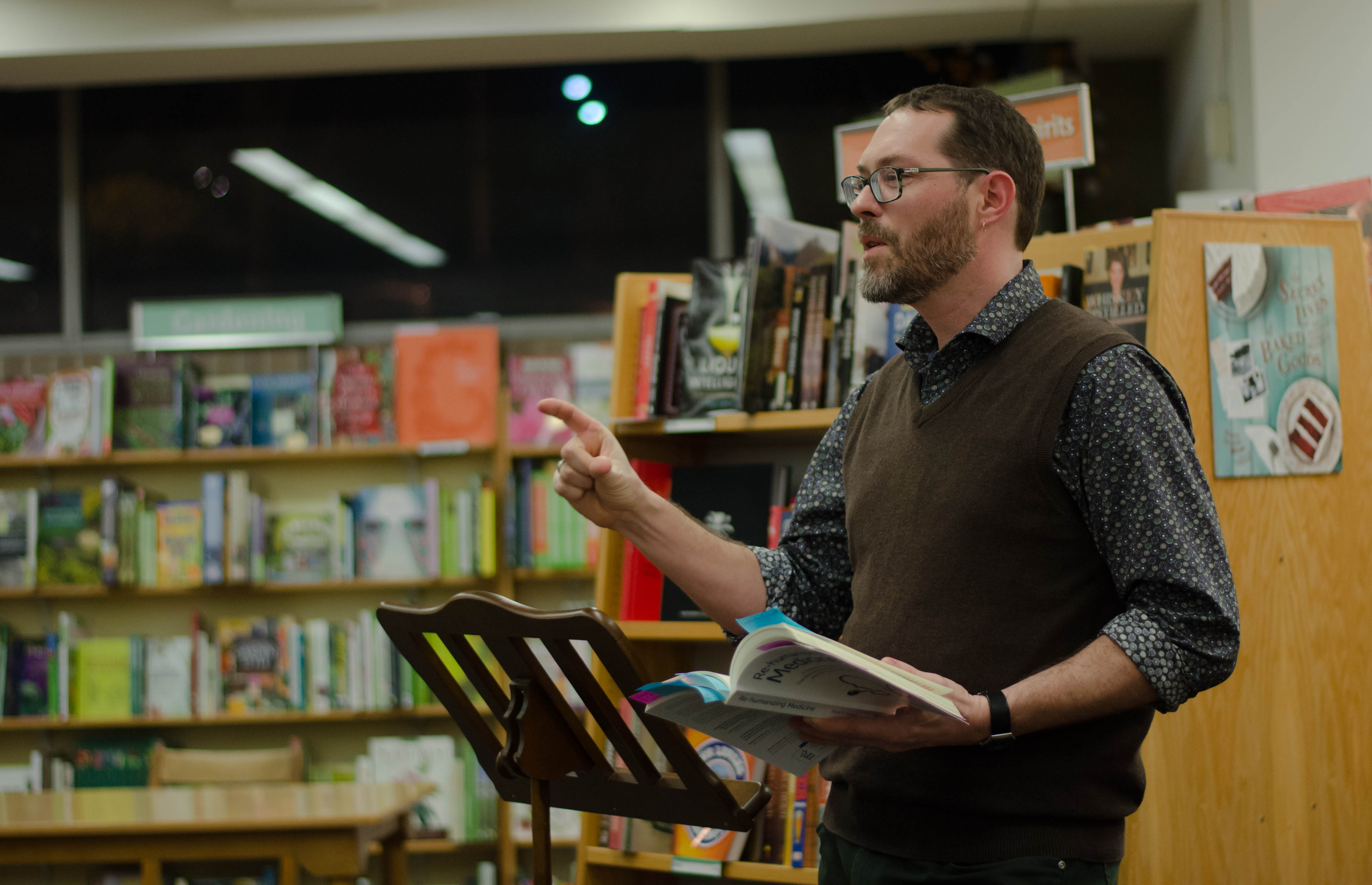
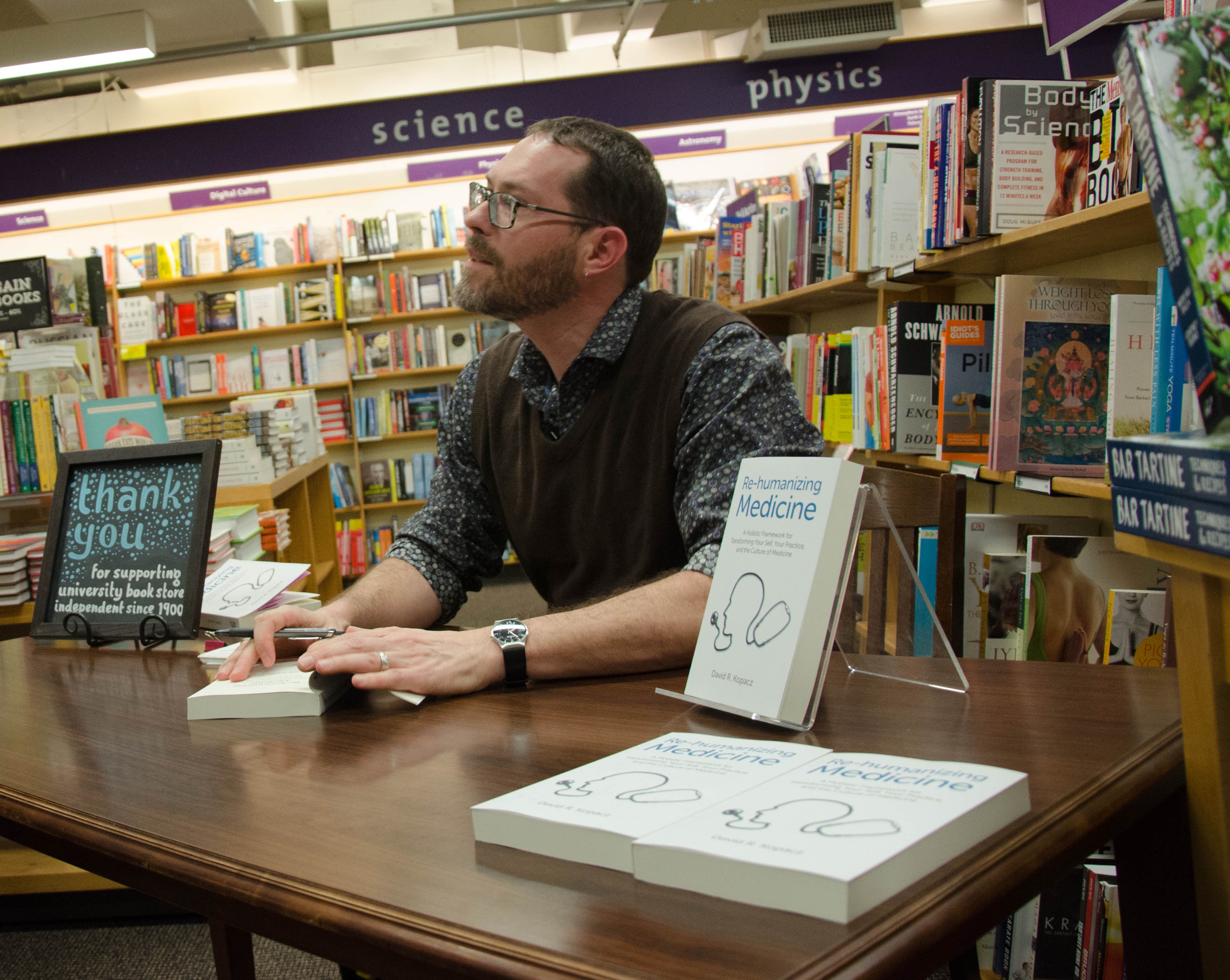
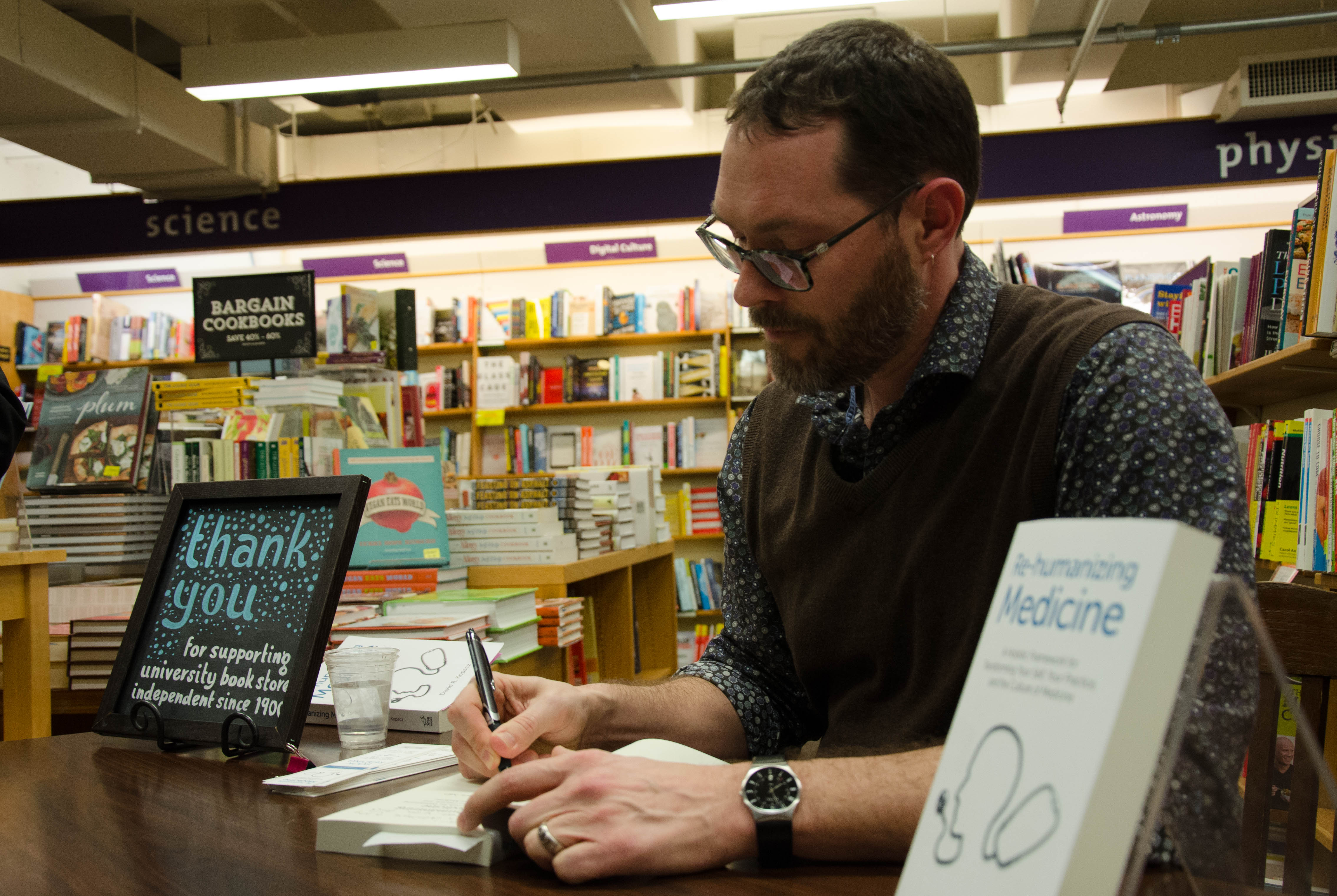
Some Photos from the Book Talk at University of Washington Bookstore, January 8, 2015

Photos courtesy of Salin Sriudomporn

Photo courtesy of Salin Sriudomporn

Photo courtesy of Salin Sriudomporn

Photo courtesy of Salin Sriudomporn

Photo courtesy of Salin Sriudomporn

Photo courtesy of Salin Sriudomporn

Photo courtesy of Salin Sriudomporn

Photo courtesy of Salin Sriudomporn

Photo courtesy of Salin Sriudomporn

Photo courtesy of Salin Sriudomporn

Photo courtesy of Salin Sriudomporn

Photo courtesy of Salin Sriudomporn

Photo courtesy of Salin Sriudomporn

Photo courtesy of Salin Sriudomporn

Photo courtesy of Salin Sriudomporn

Photo courtesy of Salin Sriudomporn

Photo courtesy of Salin Sriudomporn

Photo courtesy of Salin Sriudomporn

Photo courtesy of Salin Sriudomporn

Photo courtesy of Salin Sriudomporn

Photo courtesy of Salin Sriudomporn

Photo courtesy of Salin Sriudomporn

Photo courtesy of Salin Sriudomporn


Doctor appeals to colleagues: Do more than problem-solve

Kopacz-read[1]

Dave Kopacz at book reading at University of Washington Bookstore

HSNewsBeat article on Re-humanizing Medicine: A Holistic Framework for Transforming Your Self, Your Practice, and the Culture of Medicine.

http://hsnewsbeat.uw.edu/story/doctor-appeals-colleagues-do-more-problem-solve

“The push toward evidence-based medicine can blind physicians to other aspects of human interaction, Kopacz suggests.”


Kopacz-robot_1[1]

Re-humanizing Medicine: On the Radio and Book Reading!


Rehumanizing Medicine Book on Exam Table

Follow this link for an 8:30 minute interview with Dave Kopacz on KUOW public radio: “Doctor’s Push To Get People Talking About Health”

Join me for a book reading and signing

Thursday, 1/8/15 at 7 PM

University of Washington Book Store on the main campus

Address & Phone

4326 University Way NE
Seattle, WA 98105

Phone: 206.634.3400