The Royal Australian & New Zealand College of Psychiatrist, Part II

The Royal Australian & New Zealand College of Psychiatrists, part I

Here is the second presentation:

A Chart Review Comparison of Rates of Abnormal Vitamin D Results in a New Zealand and US Mental Health Population

Author: David R. KOPACZ, M.D., Mary Pat Traxler, Ph.D.

Affiliation

Kopacz: Buchanan Rehabilitation Centre, Auckland District Health Board, New Zealand
Traxler: Private Practice, Auckland

RANZCP guidelines for maintaining certification in Psychiatry recommend yearly clinical practice audits. This is to assure that individual practice is consistent with evidence-based guidelines. A dilemma arises when there are no clear guidelines for specific practices. In these cases, the findings of the audits of individual clinicians can identify areas that require future research. These audit results raise the question of whether there should be routine testing of Vitamin D levels, given that the majority of clients tested had abnormal Vitamin D levels.

The current study compares retrospective clinical audits of two different mental health populations: a community mental health sample in New Zealand and a private practice sample in the United States. In the New Zealand sample of 88 clients, 32 were tested for Vitamin D, with 66% having abnormalities in Vitamin D. In the US sample of 114 clients, 32 were tested for Vitamin D, and 53% of clients had abnormal levels. These high levels of Vitamin D abnormalities could have clinical implications.

The findings of these audits raise a number of questions that require future research: do these findings differ from general population data; should Vitamin D be tested on a routine basis in mental health populations; are there subgroups who are at greater risk of Vitamin D abnormalities; what is the implication of abnormal Vitamin D levels for the physical and mental health in these populations; does correcting Vitamin D abnormalities have a positive effect on the acute and long-term physical and mental health of clients?

This presentation was really challenging to put together. There is a lot of controversy surrounding testing for Vitamin D as well as treating insufficiency/deficiency. There was another presentation in our same section by another American psychiatrist who has been in New Zealand for a number of years and has also been studying Vitamin D!

The End of an Era: Freddino’s Closing

The End of an Era: Freddino's Closing

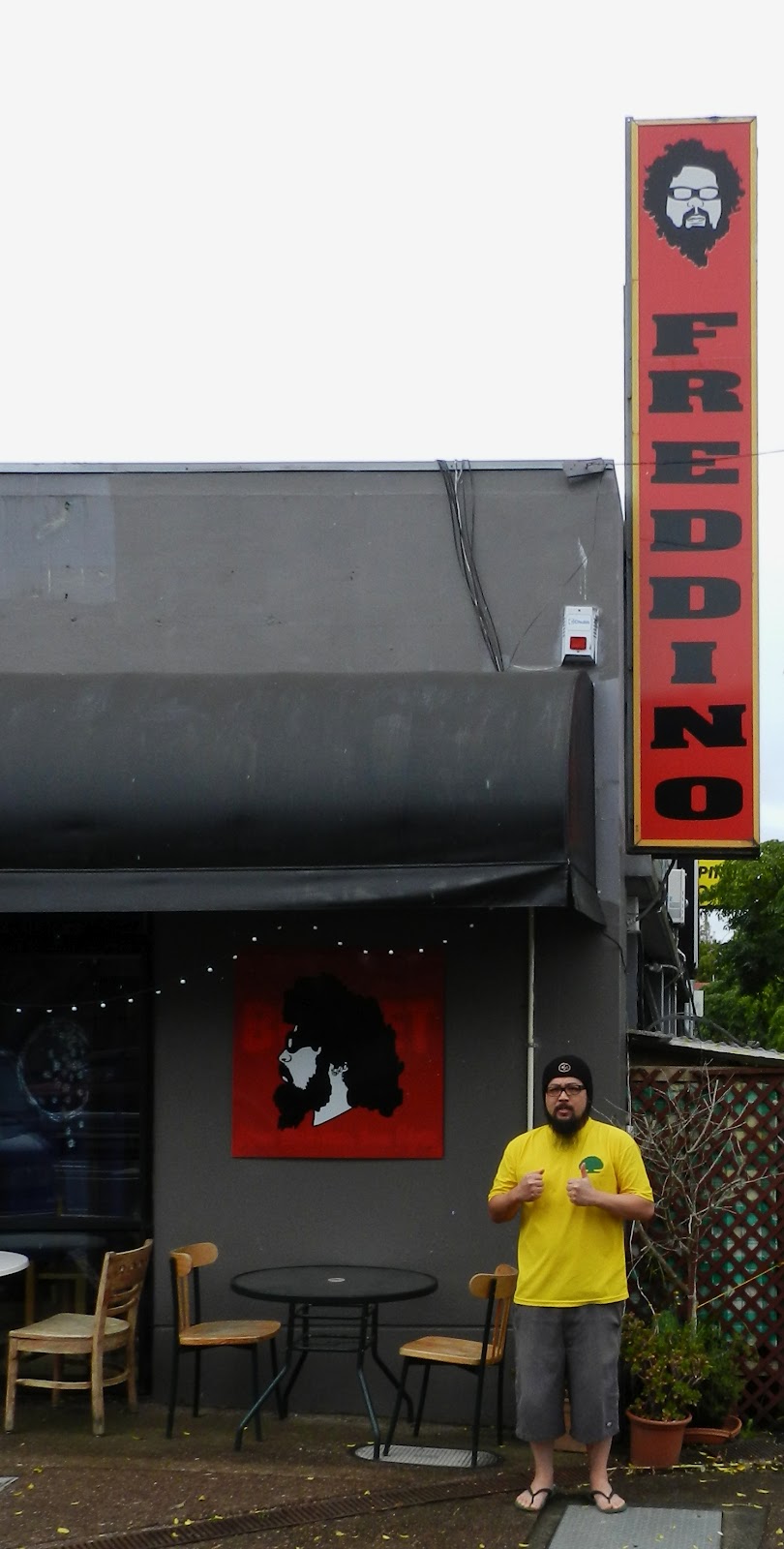
It is the end of the month and also the end of the fiscal year in New Zealand – and Freddino’s cafe and Yakitori is closing.

The End of an Era: Freddino's Closing

This has been my favourite cafe to write in and I am really sad about it closing. Freddino has created a great atmosphere, that in some odd ways reminds me of home, the kind of feel that someplace in Champaign-Urbana – there is something about the relaxed, open atmosphere and the Freddino’s artwork that he has about the place. On the surface, you wouldn’t notice it, it is a deeper sense of creativity and comfort.

The End of an Era: Freddino's Closing

There aren’t many cafes in New Zealand that are “laptop friendly,” but I never felt like I was a nuisance taking up a table at Freddino’s. I have really enjoyed writing at Freddino’s and it will leave a gap in the cafe writing culture in Auckland.

The End of an Era: Freddino's Closing

Freddino isn’t afraid to put himself out there, as you’ll see from his artwork and his iconic self-portrait that festoons the outside of the building.

The End of an Era: Freddino's Closing

The coffee is always great, they serve lattes in bowls, which I love. The vegetarian breakfast is superb! We didn’t make it out to Freddino’s for dinner much, I was mostly there on my Tuesday writing mornings, but the Yakitori was great.

The End of an Era: Freddino's Closing

One And a Half Years and Counting

We recently just passed the one and half year mark of living in New Zealand. It is definitely a different phase now, more settled, but that raises questions and dilemmas, too. Every year here is a year not there. I have a very good career opportunity that has come up here, so I am committed to that, but we definitely have been having some discussions about what our plans for the future are.
I think this is actually a challenging point in the move. The excitement of moving to a new country is not as great. I have a realization that even though I have worked very hard to grow roots here, they are fairly shallow and they feel vulnerable yet. I have definitely grown and learned so many things and met so many people from around the world, here in New Zealand, that it has changed me. This is really a kind of between time. Not a period of intense adjustment, but a period of questioning, and with that questioning, I have also felt mourning. So many of the things I have gained and grown in here are intangible and I wonder how they would translate back to the US. That creates a kind of double mourning: what I left in the US, what I missed out on for the past year and a half, but also about what I will at some point leave here. 
It is a time of being pulled in two directions, it is as if I feel that at some point in the future, I will have reached the half-way point in my journey here and the focus of energy away from the US and toward NZ will begin to shift back. I think because it has been such an intense emotional experience here that any change, anything that stirs up emotions gets compounded.
I have found myself thinking a lot about things that I have let go of over the years, not necessarily things that we sold or gave away before we moved to NZ, but things that I have let go of at other points, books, music – things mostly, but I imagine the things are more than just things, but really parts of myself, eras of my life, things that I once cared a great deal about and then let go of, for various reasons. I have been picking up a lot of music on Amazon, old songs or albums that have been on my mind that I no longer have.  It is amazing what can be replaced digitally now – most of the music, really, is still available. Digitally, it takes up less space, as I amass a digital library that reminds me of my old stacks of vinyl records and cassette tapes – although it is different still, less tangible, and also it is a re-visitation of the past, rather than an exploration of the new on the edge of the present and the future. 
I also bought a Kindle. Have I spoken about it on the blog? I’m not sure, I know I haven’t been blogging as much lately. I like that I can play music on it while I read.  I feel better about downloading books on the kindle than paying for shipping from the US (and the environmental impact of shipping a box of books all the way from the US). Books here in NZ are really expensive, it is much cheaper to import them yourself through Amazon. I have been getting a few books that I miss from the past, like Octavio Paz’s Conjunctions and Disjunctions and Ken Wilbur’s A Brief History of Everything. I am really missing my Jung books that I collected over the years and then decided I didn’t want to lug them about everywhere and let go of them. I seem to go through phases of reading and re-reading Jung and I am in one of those now. The first phase was at University, then we moved back to Champaign after 10 years away, and now about 12 years after that.
It is interesting – I have been thinking about the role that earlier interests play in a person’s life.  I’ve been working on a conference proposal looking at Jung’s Red Book and Philip K. Dick’s Exegesis. Both of these are massive works that were personal, rather than written for an audience, and both contain intense, spiritual experiences that served as a framework for each author’s later works. The strange thing is that the experiences they had are not so unusual given each authors’ interests. For Jung, he had already been writing about archetypes of the collective unconscious and then he experienced a flood of unconscious material that he managed to ground and work with very creatively for the rest of his life. PKD also wrote about how his life had become like one of his novels, filled with spiritual revelation on the edge of psychosis and paranoia. While PKD doesn’t seem like he was as functional in the “real” world as Jung was, still, he made great use of his experiences in his later work. Back to the interesting thing, though, both Jung and PKD seemed to presage their spontaneous spiritual experiences in their prolific work at writing prior to the experiences. 
This is particularly of interest to me at this juncture in my life in which I am looking at some of the things that I thought I had let go of in my life, and I am finding that rather these are recurrent threads – I may have thought I left something behind me, but I find that my interests at a younger age are often my interests at an older age. I guess that is not surprising, I am the same person – and yet I am surprised! Like a painting or a song, there are certain prominent, recurring themes, new elements are incorporated, but they are incorporated into a framework that relates the new elements to the enduring themes. Even coming to New Zealand was an idea I had when was going through my psychiatric training and I became aware that NZ needed psychiatrists. Coming here ties together some of the themes of my interests in culture, anthropology, exploration, travel, nature and then oddly enough, I ended up working in a rehabilitation/recovery model and this reignited some of my earlier interests in trauma, psychotherapy, Jung, and also some of my old punk rock idealism. I never would have guessed what I would be doing at this point, but it is not surprising, given who I am/have been in the past.

Project from writing group: influential author

I have worked with some other people to start a monthly writing group and this was one of our exercises, to write about an author whose writing you find influential. I’ll include my piece on this below:

Rebecca Solnit is an American author that I only discovered upon moving to New Zealand. The first book of hers that I read was A Field Guide to Getting Lost, it seemed appropriate for me, as I was feeling adrift in my life, having just moved around the world and I was trying to get my bearings. This book examines many different kinds of getting lost, from getting lost in the woods, lost in sex, drugs, and rock and roll, lost in mental illness, losing one’s cultural heritage, getting lost in art, and losing one’s thread in life. Solnit explores these themes in a loose, and rambling manner, sometimes seeming to get lost herself, so that the reader asks, “where is all this leading, if anywhere?”
                She quotes the pre-Socratic philosopher, Meno, “How will you go about finding that thing the nature of which is totally unknown to you?” She goes on to say that this seems to her the “basic tactical question in life.” “The things we want are transformative, and we don’t know or only think we know what is on the other side of that transformation. Love, wisdom, grace, inspiration – how do you go about finding these things that are in some ways about extending the boundaries of the self into unknown territory, about becoming someone else (4-5)?” Through studying the various different ways of getting lost, Solnit is secretly exploring the different ways of growing, changing, and transforming one’s self through the engagement in the painful and darker things in life. She often quotes Henry David Thoreau (another reason I like her books), for instance, “Not till we are lost, in other words, not till we have lost the world, do we begin to find ourselves, and realize where we are and the infinite extent of our relations,” (15).
                This permission to be lost in order to find oneself, came at a great time for me, as I struggled with my own issues of identity, place, and belonging.  I have long felt an outsider, and yet there are other times that I am very much an insider in certain situations. I have worked to make sense of my life by following a thread that leads sometimes internally, sometimes externally, sometimes through the “inside” of a system, organization, or profession, and sometimes on the “outside.” It was comforting to me to feel that there is a point in getting lost, and that point is growth and transformation.
                Another thing that I like about Solnit’s writing is that she is an idealist, a social activist, a realist, and a naturalist. She has a poetic sense and uses her own subjective experiences along with pursuing and developing ideas that don’t just sit on the shelf, but that engage with the world to create something positive. The next book of hers that I read was Hope In The Dark:  Untold Histories, Wild Possibilities. In this book, she outlines a definition of hope, how to keep hope alive, and how to stay positively engaged in life, even when it so often seems like all hope is lost. 
What I like about Solnit’s writing is her embrace of idealism and realism, that when held together comprise paradox. Hope comes from despair, human connection asserts itself in the face of repression and disconnection, and one finds oneself through losing oneself. Other paradoxes that Solnit describes are that the word emergency contains within it the word emerge (12); and that darkness can represent both the creative darkness of the womb and or the terminal darkness of the grave (6). These paradoxes allow for both reality and idealism. Paradox allows for one to act in the world without having to be perfect, it allows for complexity, such as success and defeat both being present in the same action. Solnit argues that the very reasons for despair can also be the justification for engaging in the world.  She defines the word, activist “to mean a particular kind of engagement – and a specific politic:  one that seeks to democratize the world, to share power, to protect difference and complexity, human and otherwise,” (18). 
                Solnit argues 3 points in favour of hope: 1) when looked at historically, many positive changes have occurred already in terms of human rights; 2) change “takes place in more protracted, circuitous, surprising ways than is often acknowledged;” and 3) despair is often a result of misunderstanding change, thinking that only success validates hope, and thinking that activism is the exception rather than the rule of continual engagement in life (pgs. 151-152). 
                I came across Rebecca Solnit’s writing at a very good time for me. Personally, my decisions to move from the US to New Zealand were due to both a pulltowards New Zealand and a push away from the economic and political problems in the US. Moving to another country brought up issues of identity and belonging for me, as well as the familiar question of to what extent am I an insider and to what extent am I an outsider. In addition to the Solnit’s positive messages about the benefits of getting lost and the necessity and reality of hope, she is American in the best sense of the word.  She frequently draws on the best American principles, such as Thoreau’s civil disobedience, love of nature, and opposition to slavery. She also draws on the struggles and victories of many Americans who are unknown to the larger world and history. 
                Solnit also draws on voices of freedom from around the world, such as an unknown person who goes by the name Subcommandante Marcos, a leader of the Zapatista movement in Mexico. Marcos has issued a series of proclamations. An excerpt from the Fourth Declaration of the Lacondon Jungle reads, “A new lie is being sold to us as history. The lie of the defeat of hope, the lie of the defeat of dignity, the lie of the defeat of humanity…In place of humanity, they offer us the stock market index. In place of dignity, they offer us the globalization of misery.  In place of hope, they offer us emptiness. In place of life, they offer us an International of Terror. Against the International of Terror…we must raise an International of Hope. Unity beyond borders, languages, colors, cultures, sexes, strategies and thoughts, of all those who prefer a living humanity. The International of Hope. Not the bureaucracy of hope, not an image inverse to, and thus similar to, what is annihilating us. Not power with a new sign or new clothes. A flower, yes, that flower of hope,” (39-40). To me, Solnit’s writing stands for these universal human rights:  the International of Hope and the flower of hope; the engagement with a “living humanity;” and also the best of American ideals and pragmatism.  Last of all, Solnit argues that the act of writing, itself is an act of hope. She states that writing “is a model for how indirect effect can be, how delayed, how invisible; no one is more hopeful than a writer, no  one is a bigger gambler,” (65).

Václav Havel: 5 October 1936 – 18 December 2011

“I should probably say first that the kind of hope I often think about (especially in situations that are particularly hopeless, such as prison) I understand above all as a state of mind, not a state of the world. Either we have hope within us or we don’t; it is a dimension of the soul, and it’s not essentially dependent on some particular observation of the world or estimate of the situation. Hope is not a prognostication. It is an orientation of the spirit, an orientation of the heart; it transcends the world that is immediately experienced, and is anchored somewhere beyond its horizons. I don’t think you can explain it as a mere derivative of something here, of some movement, or of some favorable signs in the world. I feel that its deepest roots are in the transcendental, just as the roots of human responsibility are, though of course I can’t – unlike Christians, for instance – say anything concrete about the transcendental. An individual may affirm or deny that his hope is so rooted, but this does nothing to change my conviction (which is more than just a conviction; it’s an inner experience). The most convinced materialist and atheist may have more of this genuine, transcendentally rooted inner hope (this is my view, not his) than ten metaphysicians together.

Hope, in this deep and powerful sense, is not the same as joy that things are going well, or willingness to invest in enterprises that are obviously headed for early success, but, rather, an ability to work for something because it is good, not just because it stands a chance to succeed. The more unpropitious the situation in which we demonstrate hope, the deeper that hope is. Hope is definitely not the same thing as optimism. It is not the conviction that something will turn out well, but the certainty that something makes sense, regardless of how it turns out. In short, I think that the deepest and most important form of hope, the only one that can keep us above water and urge us to good works, and the only true source of the breathtaking dimensions of the human spirit and its efforts, is something we get, as it were, from ‘elsewhere.’  It is also this hope, above all, which gives us the strength to live and continually to try new things, even in conditions that seem as hopeless as ours do, here and now,”
(Václav Havel, Disturbing the Peace, p. 181-182).

Australia!

AUSTRALIA!
AUSTRALIA!

About two weeks ago, I went to Australia for the first time. The trip was for the World Congress for Psychotherapy. I was in Sydney the whole time and I really enjoyed seeing another major city in this region. It was a 3.5 hour flight from Auckland and is the closest city larger than Auckland. Sydney has a population of about 4.5 million (which is around the population for the whole country of New Zealand) and it is in the Australian state of New South Wales. The whole population of Australia is around 22.5 million (roughly equal to the populations of the four US states of Illinois, Wisconsin, Iowa, and Nebraska).

AUSTRALIA!

It is hard to draw too many conclusions from one week in the largest city of a country. Sydney was very ethnically diverse. It definitely had a larger city feel than Auckland as well as having a different culture. Again, these are just first impressions, but Sydney felt more relaxed (in the sense of not seeming to have as many social rules about colour and loudness of voice), people were louder and more open, but not as friendly. Businesses were more business-like, but with the down-side of being less friendly, more rushed. The food was good, but the quality of the food didn’t seem as spectacular as in New Zealand. 
AUSTRALIA!
I went to the Chinese Friendship Garden and walked around Darling Harbour, where the convention centre was located. Mary Pat and I took a water taxi (which was a great idea) from Darling Harbour to the Opera House and walked around in the Botanical Gardens, which had a huge number of Flying Foxes in the trees. It was definitely a great trip and we’ll go back for a little longer look at some point.
AUSTRALIA!
AUSTRALIA!
The conference was wonderful and had daily themes on indigenous culture, spirituality, and also ethics & philosophy. I met some great people and learned and experienced a lot. The overall theme of the conference was World Dreaming, based on the Australian Aboriginal practice of studying dreams and Dream Time. I did have a lot of dreams at the conference and made it to two of the morning dream sharing sessions that were really interesting group processes stemming from the dreams that people brought in. One of my favourite lectures was by Helen Milroy who presented on Aboriginal experience from pre-colonial era, through colonization and genocide, and then a kind of trauma and healing model. What was really amazing is that she had paintings she had made that illustrated each step along the presentation and the paintings seemed to embody the complexity of the step in a non-verbal way, plus they were amazing paintings! Here is a link to a newsletter I found that has an image of one of her paintings: 
AUSTRALIA!
AUSTRALIA!

The Great American Dissatisfaction/Dream

On returning from a trip back to the US, I have several observations about the country and myself. I was struck by the sheer material abundance of the place and the feeling of dissatisfaction and lack in the people and myself. The solutions for this problem of dissatisfaction are generally material. Yet these material solutions do not fulfill the need or satisfy the dissatisfaction.

What is the American dream? Maybe that gives a clue to the dissatisfaction. It seems that that dream is of acquisition and/or improvement. The desire to “make things better” seems to be very American, and yet I am beginning to wonder if the impulse to make things better comes from an inability or difficulty in accepting what is. One often hears of “American ingenuity” as a source of innovation. At what point does change become a trap rather than an ongoing adaptation to the environment? I used to be perfectly happy with a razor that had two blades, but then it became harder to get refills for it, so I moved up to the new triple blade, and then it became more difficult to get refills for that, so I tried the quadruple blade, it seemed absurd, but I could no longer find refills for the triple blade. Now I just bought a quintuple blade razor and I feel manipulated by the razor blade companies.

It is instructive to look at the dissatisfaction as the flip side of the dream. This is one principle I feel that I have gained from living abroad for a year, that every culture creates itself according to its values and that the drawbacks or blind-spots of a culture are the shadow of its strengths. In this way it is not so unusual to examine strengths and weaknesses in relation to each other. The United States values efficiency, innovation, and the pursuit of happiness. These facets have made the US a very productive, powerful, and creative force in the world, but is there a point where these strengths are over-developed and we have an impersonal society in which people are processed in a quick and efficient manner (I am writing this after having just got through the check-in and security at O’Hare airport where I had to take off anything metal, take everything out of my pockets and go through a “backscatter x-ray” machine for my “safety”). We have bewildering choices for everything from razors, to toothpaste, to blue jeans, and yet are we, as a people, happy or fulfilled?

The dream is for more; the dissatisfaction is that what we have is never enough and that things could always be “better.” On my last day in the US, Borders bookstore was closing. It was very sad to step inside and see the giant signs, “EVERYTHING 40% OFF,” the long lines, and the sense of good deals to be had. We left almost immediately. To me, this felt like the end of an era. While it is true that Borders was a business and it was about acquisition, it was also a place that created a social place that people could meet, that you could check out new books and ideas. Borders wasn’t my favorite place to go for coffee, community, and new ideas, but when I lived in Champaign, I did go there fairly regularly, maybe every few weeks. It was a place to go before or after a movie to talk and browse, or a place to go and read a book, but to also be in a public space that contained the possibility for socialization if I ran into a friend.

The space shuttle also landed for the last time on my last day in the US. This also seems like an end of an era of creativity, dreams, exploration, and innovation. This collective work led to many new scientific discoveries and a common purpose and focus for the country and the world. As the movie, “In The Shadow of the Moon,” showed, it also led to a change in the way that we, as human beings, see and experience the Earth. It was a chance to have an awareness that we are all part of something larger than ourselves and that what happens to one person has the potential to affect everyone.

In the development of ideas, there is often a point where the fullness of the idea is reached and nothing much new is discovered or created (although there can be endless variations on this, like the many new psychiatric medications that are not significantly different than the medications already in use). The idea becomes sterile, the work technical and tedious, and the benefits and results more meager and less gratifying. It seems possible that the United States is at that point. Are we using our creativity, our ingenuity, and our ability to design efficient systems in such a way that the pursuit of our dreams only leads to dissatisfaction? If that is the case, the more energy we put into the pursuit of our dreams, the more unfulfilled and dissatisfied we become. We buy food that does not nourish or gratify, but it is efficiently made, conveniently packaged, and it looks good. We buy bigger and bigger TVs and home theater systems, to give us a more convenient and efficient way to watch movies in isolation from other people. We can download anything we can imagine, and yet our imaginations are unfulfilled.

I have had a couple of recent conversations with people about the Buddhist concept of “the hungry ghost.” What I can remember about these creatures is that they have tiny throats and insatiable appetites; they eat and eat, but are never satisfied or fulfilled. The restless consumption of US society does seem reminiscent of these creatures who only dream of consumption, yet they are never nourished.

Much of the efficiency of American culture seems to neglect nurturance, which is an aspect of fulfillment. For all their conspicuous consumption and discharge of the acquisitive drive, there is an emptiness, dissatisfaction, and persistent hunger in American society. Coming from abroad, the US seems filled with busy people, impatient, in a hurry, irritable, restless, self-absorbed and a little bit like locusts consuming mass quantities of goods and food in a way that is not only not fulfilling, but is also not sustainable.

New Zealand: One year on

It is hard to believe that it has been one year since we moved to New Zealand! So many ups and downs and sideways…  

We arrived back in the US for our first visit back to the Midwest, so we were actually in the US on our one year anniversary of our arrival in New Zealand. It seems fitting that I reflect on the last year at this point.
New Zealand: One year on

The predominant feeling I have about the move is one of gratitude and happiness for having made the leap. It has been an incredibly exciting year, as well as being very challenging, and a year of intense growth and reflection. My life feels so amazingly and irrevocably different from the experience of moving to another country and working there. Even my first job, which in the end, wasn’t the best fit for me, was an incredible learning experience that taught me a lot about the culture and about the public health care system in New Zealand, plus I met a lot of great people. My current job at a psychiatric rehabilitation centre is one of the best jobs I have had in my career and is a place that I can see continuing opportunities for growth.

I feel like I should be able to provide some general statements about my year in New Zealand. I would say that I have a greater appreciation of any culture (US, NZ, and in general) has both strengths and weaknesses. Every culture has different inherent values and once those are understood, the culture makes more sense. US culture values efficiency and consumption, thus banking, shopping, commuting, and work systems run very well, yet the downside is that they can be cold, callous, and impersonal. NZ culture seems to value connection and quality of life, thus relationships, even casual ones, can be more open, nurturing, and personal, however, organizational systems can be disorganized, “unnecessarily” complicated, and inefficient. These are broad generalizations. I can’t say that I have an in-depth understanding of NZ culture(s), but I can say that this appreciation of cultural differences in reference to an organizing value or principle seems true.

I do feel that what I wanted to get out of a move abroad, I have gotten and more so. The process has been uncomfortable and painful at times, but it has also been exciting and rewarding. I feel that I have broadened my view and experience of myself, my practice, and the world, and this is incredibly gratifying. A good decision is one that seems to make more sense as time goes on, and as you live it, and this is how it has been for this move. I do feel that the particular cultural adaptations that New Zealand requires are good challenges for me personally. As my wife and I talk about the future, we really aren’t sure that we know what we will do in 2 years’ time (which is our point of decision for whether we stay in NZ longer, go back to the US, or look at other options), but we both feel that we are where we need to be right now.

A Corrective Emotional Experience

I took a recent trip to Hawaii for the American Psychiatric Conference. I hadn’t been to that particular conference in awhile, but I was really glad I went to this one. I met up with some old friends, caught up, and had a generally great time. It was also the first time I had been back in the US since moving to NZ. Hawaii was actually a good entry point back into the US, since it also has somewhat of a Polynesian culture blended with typical US culture and that made the transition from NZ, which also is influenced by Maori and Polynesian culture, back to the States smoother.

A CORRECTIVE EMOTIONAL EXPERIENCE

A CORRECTIVE EMOTIONAL EXPERIENCE

I met up with a friend who I told about my experience of “swimming with the dolphins” in NZ. I had anticipated doing this even before we arrived in NZ, but the experience here wasn’t all mystical communing with nature, but more akin to struggling to keep afloat in cold, choppy water while the crew of the boat alternatively yelled, “swim, swim,” of “dive, dive,” or “come back, come back.” The experience started by being told the water wasn’t that cold, so we didn’t need wetsuits. We then strapped on this strange snorkel gear that I had never worn before. Then we jumped into a big net in the water and the boat took off, plastering my flippers against the net as if I was some strange bug smashed on a windscreen. Then came the yelling and the swimming and the swallowing salt water and trying to figure out how to work the snorkel gear. I never even saw a dolphin while I was in the water, although an English couple I had been talking to earlier, told me that there was a dolphin right by me several times. I joked it probably sensed I was in distress and was trying to figure out if it should rescue me!

So, 6 months or so later, I went to Hawaii. My friend there said that I definintely needed to have a “corrective emotional experience” with the dolphins and said that she routinely swims with dolphins in several bays not far from her home. So, on a bright, sunny day, with smooth clear water, and a chance to figure out how to work the snorkel gear without some yelling, “swim, die, come back,” at me, I did have a corrective emotional experience. Plus, I got to try out my underwater camera that I had bought in the States, anticipating that I would be spending a lot of time underwater.

A CORRECTIVE EMOTIONAL EXPERIENCE

A CORRECTIVE EMOTIONAL EXPERIENCE

A CORRECTIVE EMOTIONAL EXPERIENCE

A CORRECTIVE EMOTIONAL EXPERIENCE

We went swimming in two different bays and saw dolphins in both of them. The second bay, a dolphin came right up and looked at me, my friend said as if it was posing for a picture. Well, I didn’t quite get the picture (as you’ll see), but the image of the dolphin coming right up to me and looking at me was really something else and tell you what, seeing all the beautiful fish while snorkelling was a bonus! Hope you enjoy the photos….Oh, and I got a new camera with a higher power zoom, so I won’t have to say, “see that thing that looks like a tall rock in the rocks?  That is a penguin.” I’ll post those photos soon, once I upload them, but no penguin photos yet, maybe next time we’re out on a cruise in the gulf….

A CORRECTIVE EMOTIONAL EXPERIENCE

A CORRECTIVE EMOTIONAL EXPERIENCE

Full Circle

FULL CIRCLE

I had a really great day today. I am currently at the American Psychiatric Association meeting in Hawaii. I feel like a lot of my professional life has been a critique of the mainstream of psychiatry, whether it has been studying psychotherapy (which according to a lecture today has “always been subversive,” because it challenges people’s understanding of themselves, their relationships, and it challenges the status quo), learning about trauma and bearing witness, or moving outside the confines of psychiatry into holistic medicine. The thing about living a critique is that it can start to get lonely, because I seem to continually question the fitness of the different treatment/personal growth philosophical systems that I put myself in. It is kind of like the dilemma of trying to find a group of people who don’t fit in and who form a community of “misfits.” Looking around at the conference today, I felt that old desire to be part of the group while also finding fault in the limitations of the dominant, evidence-based paradigm. I was slightly envious of the people who seemed to have built something in their lives over time as I compared myself to them. The thing with continually being open to new ideas and practices is that there is a risk of ending up intellectually homeless and unrecognized, another way of saying that I felt outside of the circle. With my recent move to New Zealand, I have faced this dilemma of wanting to fit in, but also wanting to follow my own passion and my own ethics and idealism.

FULL CIRCLE

Yesterday, I had this realization. I won’t bother putting it into words, it would sound incredibly simplistic, anyway, but it was just this felt sense of connection and meaning, even if I wasn’t feeling a clear sense of purpose. That is when I thought about blogging on the topic of coming full circle, which can mean so many things at so many different levels. On this trip, I brought along Maugham’s, The Razor’s Edge, a book I read a lot when I was in college and medical school. In some ways, the book is important and in some ways it is not, what is more important is re-connecting to things that I was interested in the past, and more important than intellectual things I was interested in, it was about connecting to the feeling of who I was when I was younger and what was important to me, including questioning, searching, and idealism. I had this sense of meeting an old friend, only the old friend was my younger self.

Part of what I was going to write about was a critique (or maybe just another chapter) of my article for PrivatePractice.MD, “Say Yes to Private Practice,” that I wrote as I was leaving private practice. I referenced the movie, “Yes Man,” which I just re-watched again when it was on TV. In the movie, Jim Carey’s character turns his life around by saying “yes” to every opportunity that came along. His life opened up and changed and became more rewarding when he said “yes,” and it closed down, became painful, or problematic when he refused to say “yes” to a new opportunity. In the movie, he hits a peak, though, in how useful this way of living is, everything starts to fall apart as he realizes that he can’t build a relationship if he is constantly saying yes to other things. He comes to learn a more sophisticated way of using this attitude, he learns to say yes only to things that he really, in his heart, wants to do. It isn’t about saying yes to everything, although that was a useful stage that helped him get unstuck in his life, but he learns discernment in choosing to say yes to what he is really passionate about. So that is where I have been feeling like I am lately, that I am at that point where I need to be more discriminating in what I say “yes” to, particularly after my first job in New Zealand where I feel like I burned out after about 2 months in the job and I took on a lot of challenges that were bigger than my own interests.

So, that is what I was going to write about, how I had so much growth in my life through saying “yes,” but that it was time to start reining all that in a bit and to start being more discerning in what I put my energy into and making sure that I am not just doing what needs doing, or jumping into an opportunity, but really practicing discernment and making sure my heart was in whatever I take on in the future. That said, today I had two really cool synchronicities that happened only because I said a few chance words. It was like the old accidental networking (which is what I used to call it) kicked in again. Things started to make sense, I felt more connection, more trust in myself and the universe. I think I won’t write about the actual events, the process is more important anyway. I will talk some about coming full circle, though.

FULL CIRCLE

I imagine that as a person goes through life, they have various circles that they go through. For one thing there is the grand circle of birth and death, that is really the foundation of life, I suppose, it is the most basic and incontrovertible fact. There are other circles, too, though.  For me, I just went through a training so that I can supervise psychiatry trainees in New Zealand (registrars, or what we would call residents in the US). In looking over the supervision pathways, I mentioned that I had done a lot of psychotherapy training, enough so as to be considered to have done a sub-specialty in it in New Zealand. So I mentioned it, and now I am also a psychotherapy supervisor and I already have been assigned my first registrar. Being at this conference also helped me to get excited about the role of psychotherapy in psychiatry. It is tending to get less and less attention and some training programs are even questioning whether it should be taught, but to me, it provides the humanitarian and ethical counter-point to guideline-driven medication management. I have also started doing some psychotherapy at my new job, whereas at the community mental health centre, it really wasn’t part of the work (at least not in a formal and in-depth way) and there were always so many patients that needed to be seen.

Here is what I have to say about this whole full circle thing, it can sometimes feel like you are going backwards when you are really just circling back to some important point in your life, from which you will venture off into another circle. I think of my colleague, Patte Randal’s, diagrams she uses in her work, making the distinction between “vicious cycles” and “victorious cycles.” I guess it is hard to know which kind of circle you are in sometimes. Looking at myself and my life, lately, I am amazed at how intensely I have felt that I am in the depth of either a vicious or a victorious cycle. That struggle and self-analysis, and self-critique, and continual striving to try to get from one kind of circle to the other has really been wearing me out lately. I guess that one way I can describe my realization, from yesterday, is that I am in both circles at the same time. Maybe anytime that I am feeling like I am just in one isolated circle, I will always feel lost and desperate and like the energy I am putting into my life is not going anywhere, building anything, or connecting to anything larger than myself. All circles are parts of other circles. I remember a painting I did called, “There is No Perfect Circle.” It had a bunch of lopsided circles on it that I kept trying to redraw to make “perfect,” finally, in exasperation, I wrote, “there is no perfect circle” on it and that seemed to complete something at the time.  ut, I suppose it might be true to say that every circle is perfect, that every circle is an interpretation of what it means to be a circle and all circles are manifestations of some kind of circle energy or circle template, and in this way, there is an inherent connection between all circles. And, then, I suppose, maybe life is all about continually drawing and re-drawing these circles and seeing how they interconnect and repeat and create things that seem entirely new, even as they might also seem totally commonplace. 

Getting back to Hawaii, the little bit I have seen so far is beautiful. I have met some really friendly birds and I’ll post a few pictures of them. I am trying to go swimming in the ocean every day, so I better circle back to hotel and the beach and go for a swim.

FULL CIRCLE