Walking the Medicine Wheel selected as one of Courage & Renewal’s Favorite Courageous Books of 2016!

It has been a busy couple of months with the book launch, with the biggest news being that Walking the Medicine Wheel was selected as one of Courage & Renewal’s Favorite Courageous Books of 2016!

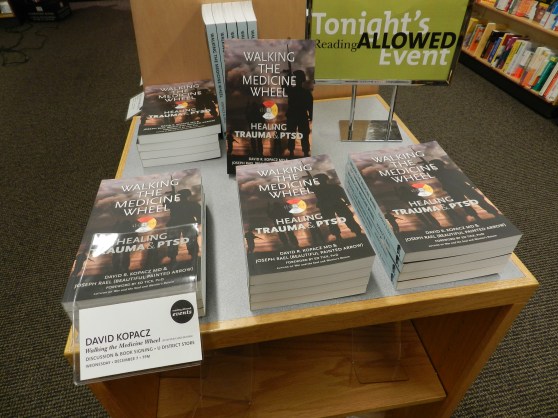
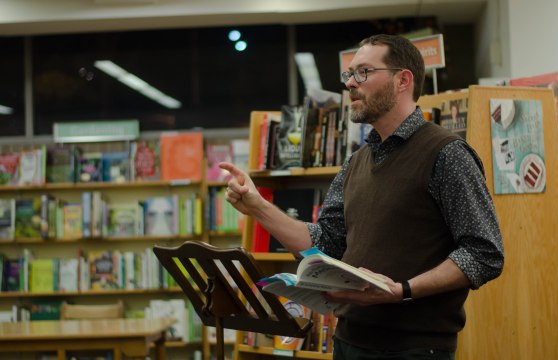
I did a book event at University of Washington Bookstore on 12/7/16.

dscn2602

Joseph and I did a book reading at BookWorks in Albuquerque, New Mexico  11/10/16 and that was great fun presenting together!

I presented at the 3rd annual Mayo Clinic Humanities in Medicine Symposium with the title, “Walking the Medicine Wheel & the Hero’s Journey: Models of Initiation for Veterans’ Homecoming.” This was on 11/4/16 and I really enjoyed it and I met some great people with good hearts. For instance, I met artist Richard Retter who led us in some creative painting exercises.

I also found a statue outside in the desert garden called, “Transformations of the Shaman.”

In Albuquerque I met a Dine (Navajo) Code talker and visited the small Chapel of Our Lady of Guadalupe that had a stained glass moon phase calendar.

20161113_120855

The last big news is that I have a new addition to my job. I have a one day a week appointment at the VA as a Whole Health Education Champion, which will mean I will be conducting training in the larger VA with the Office of Patient Centered Care & Cultural Transformation. I am very excited about this opportunity!

Becoming Medicine in The Badger

The Badger is an on-line magazine on spirituality and the arts out of Italy published by Antonella Vicini. Antonella has worked with Joseph Rael in the past and I will be writing a quarterly column in the magazine under the title, “Becoming Medicine.”

year-2-vol-4-cover

Click on the Badger link to check out the column which talks about how Joseph and I met and came to write our first book together, Walking the Medicine Wheel: Healing Trauma & PTSD.

The Book is Here!!!

20161007_161012-1

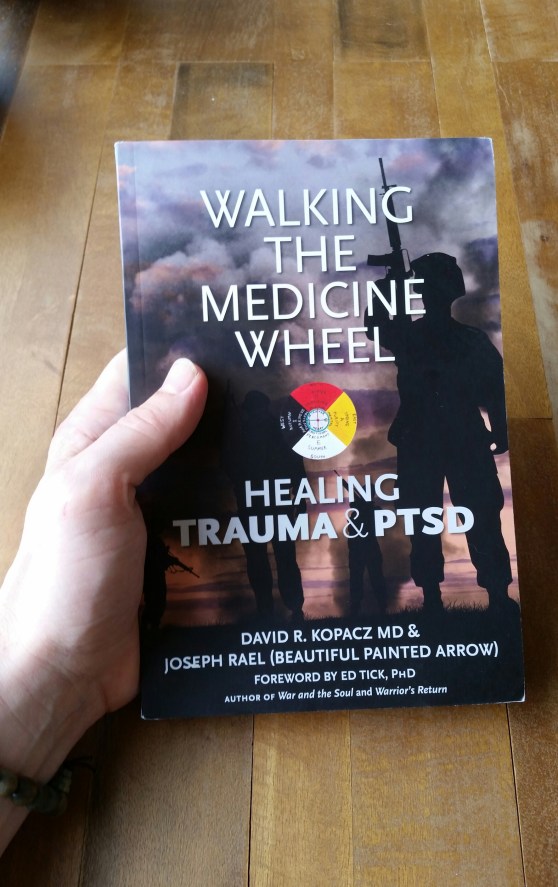
The book that I have been working on with Joseph Rael (Beautiful Painted Arrow) over the past 2 years just arrived in the mail! It looks like it is still not shipping from Amazon yet, but should be soon as it has shipped from the printer.

Judith Gadd has been working with the publisher, Paulette Millichap of Millichap books and has put up a nice website with 4 videos that my sister, Karen Kopacz, filmed earlier in the year.

walkingthemedicinewheel.com

My sister, Karen , at Design for the Arts, is in the process of updating my webpage:

davidkopacz.com 

DSC_9344_color_corrected

I will be setting up some book talks as the next step. In general Joseph will not be traveling much, but we will kick it off together in Albuquerque and will also look at setting something up in Durango. Here is the schedule so far:

November 4, 2016: Mayo Clinic Humanities in Medicine Symposium, Phoenix, AZ

November 10, 2016: Bookworks, Albuquerque, NM (with Joseph)

December 7, 2016: University of Washington Bookstore, Seattle, WA

March 9th, 2017: Minneapolis VA

More news as it is available…

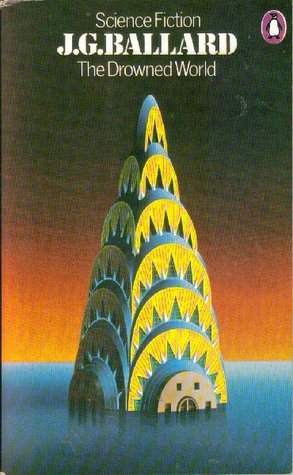
Interview with J. G. Ballard, 1997

ballard

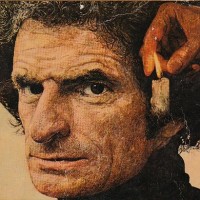
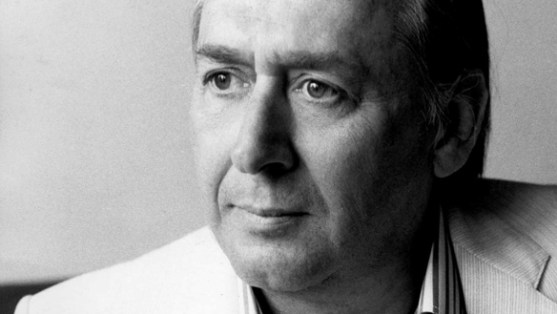
J G Ballard, (image from Alchetron)

In September of 1997, I had just started my first job out of psychiatric residency at Omaha VA and University of Nebraska. I was keen to continue my scholarly work on creativity, trauma, and healing that I had started with my studies of Jerzy Kosinski and Louis Ferdinand Céline – writers who had lived through war. I envisioned a book examining the lives and writing of a series of authors and I contacted J. G. Ballard for an interview via the post. Life happened and other things came up and I did not get much further on that book idea. (Some of my writing of this era can be found on my webpage in the Coniunctionis column I had written for the on-line journal Mental Contagion). Somewhere along the way, I lost the original handwritten letters of my correspondence with J. G. Ballard, but my sister, Karen, recently gave me back a stack of my writings that I had sent her over the years and these contained a photocopy of the transcribed manuscripts. (Thanks to Shelby Stuart for transcribing from hard copy).

I am belatedly publishing this interview with J. G. Ballard from 1997. My initial questions appear immediately below and following this Ballard’s reply.

9/25/97

Dear Mr. Ballard,

Thank you for your response to my letter concerning an interview on the topic of trauma, literature, and autobiography. I appreciate your suggestion of a postal interview.

In trying to draft a few preliminary questions, I have been struggling to avoid simplistic and potentially leading questions. Rather than an isolated question, I have embedded the question in a context including my own musings and various references. I hope this does not prove too distracting.

What has fascinated me in your writings is your past experience as a child of war and the reappearance of images like the empty swimming pool and the young, male protagonist enthusiastically exploring physical and psychological landscapes in transition. How do you see the relation of these childhood experiences to your later writing? I have also wondered the unanswerable question: would you have been a writer without those experiences during the Japanese occupation?

The later traumatic incident that stands out is the death of your wife as described in The Kindness of Women. I became interested in your works during my clinical years of medical school when I had just finished reading a number of William S. Burroughs’ novels. I was struck by the loss of your wives’ deaths preceding (if my memory serves me) both of your careers as writers. Burroughs commented,

“I am forced to the appalling conclusion that I would never have become a writer but for Joan’s death, and to a realization of the extent to which this event has motivated and formulated my writing. I live with the constant threat of possession, from Control. So the death of Joan brought me in contact with the invader, the Ugly Spirit and maneuvered me into a lifelong struggle, in which I have had no choice except to write my way out,” (Miles, William Burroughs: El Hombre Invisible, 1993, pg. 53).


Could you comment on the early loss of your wife and your career as a writer?

Could you comment on how close to objective reality your books Empire of the Sun and The Kindness of Women are? Stated another way, where do you consider these books on the spectrum of objective history-symbolic representation? Spence, a psychoanalyst, has used the distinction between ‘historical truth’ and ‘narrative truth.’ These two realms of truth describe external and internal realities which are equally valid, although not necessarily identical. I notice that both of my copies of these two books of yours are classified as ‘fiction.’ I spent quite a bit of time on this question in relation to my work on Kosinski. There are great discrepancies between Kosinki’s documented biography and his fictional portrayals of his life which he encouraged to be taken as autobiography. While expressing some form of symbolic truth in his ‘auto-fiction,’ as he called it, he both revealed, disguised, and concealed certain elements of his self.

An observation that has struck me is that many of your books seem quite hopeful in contrast to those of Konsinski and Céline’s which I have been studying. You generally do not portray the despair and disappointment in human nature that they do. Kosinski’s books are filled with existential aloneness, sadism, and brutality, ultimately, he committed suicide. His life and writing could be viewed as being tainted and continually influenced by the events of his childhood, a Nazi victory almost 50 years after the fact. In your books and stories you seem to draw on childhood experiences and images, yet there is more of a sense of hope. Other related questions I have relate to a clinical phenomenon observed in survivors of trauma which Freud called the “repetition compulsion.” His view was that traumatized individuals recreate traumatic interactions in their later relationships in an attempt to have a better outcome. I have not seen this to hold true in many of the individuals with whom I have worked, instead they just seem to add new trauma to old. However, in writing, it does seem possible that some form of reworking and mastering of past experiences could take place. Writing can also be a form of witnessing, which in many theories of recovery from trauma is a necessary step for the individual objectified and isolated by trauma to reconnect with the community. Could you comment on this possible relation between trauma, repetition, and writing as witnessing?

Do you have any thoughts or comments on these interactions in the lives and writings of any of the other authors I am in the process of examining: Céline, Kosinski, Burroughs, Beckett, Woolf?

atrocity-exhibition

I have been curious about your portrayals of sexuality in some of your earlier works, such as The Atrocity Exhibition and Crash. These books examine a mode of sexual interaction which is objectified rather than focusing on the subjective or shared emotional experience. These two works seem to explore the potentialities of interaction and to develop modes of relating based on architecture or mechanics (perversions of geometry). To what extent were these personal struggles for you in your life, compared to philosophical explorations? I guess this gets back to the question of historical and narrative truth.

Also of interest is your writing yourself into your own novel in your own automobile accident. (Did you know that Stephen Crane also wrote of fictional situations which he later experienced in his life, such as a boat accident?) Could you comment on this reversal of life imitating art, rather than art imitating life?

Back to the issue of sexuality. Much clinical work has focused on survivors of trauma who have been treated in an objectified manner and who then relate to others in an objectified way, again, a form of repetition or re-enactment of the past. Flipping through The Atrocity Exhibition, I find Dr. Nathan’s comment, “However, you must understand that for Traven science is the ultimate pornography, analytic activity whose aim is to isolate objects or events from their contexts in time and space,” (Re/Search publication, 1990, p. 36). Some of the more enlightened psychiatrists have realized this insight about objectivity and the scientific method, as Stoller has stated, the “false self of psychoanalysis is our jargonized theory,” (Stoller, Observing the Erotic Imagination, 1985, p. 175). The jargon thus become the fetish which is used to objectify the other. This reminds me, in what way did your medical studies influence your writing?

9780312156831

Could you comment on your commitment to Science Fiction? I just finished your book of essays, A User’s Guide to the Millennium, (which is a great title, by the way) and I was struck by the extent that you consider yourself a S-F writer. In the States, Burroughs, Vonnegut, and Ballard are found in the general fiction section. I think that here S-F tends to be looked down on by the “serious” writers. Although, amongst many of my friends, reading S-F was a kind of rite of passage which led up to the journey away from planet “home.”

One last question, what did you think of the film adaptation of Crash? The movie and the novel have been the topic of a number of conversations that I have had with friends.

Well, I guess I did end up asking a few questions. I would like to go through your books in an orderly fashion and perhaps formulate a few more questions if you are willing to tolerate them. I appreciate your willingness to review these pages.

Sincerely,

David Kopacz

Omaha, NE

J. G. Ballard’s Reply

ballard-jg-1

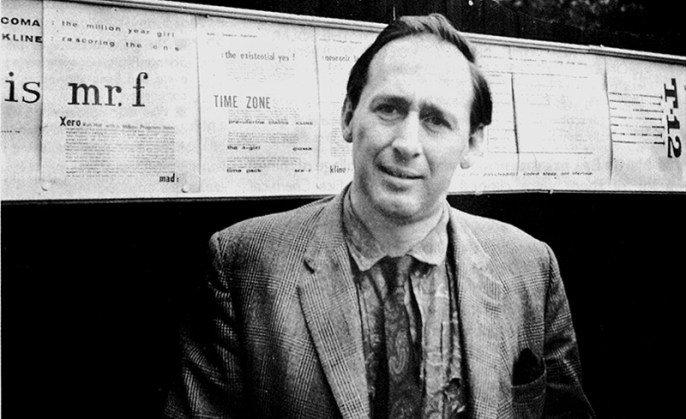
http://www.jgballard.ca/criticism/experimental_fiction.html 


2/10/97


Dear Mr. Kopacz,

Happy to answer your questions, and I hope you can read my handwriting [transcribed from original] – I ought to say first that there seems to be an underlying assumption by both you and the received wisdom of the day that all disturbing or violent experience is inherently damaging – that is that experiences such as the death of a spouse or child, death of a parent, the stress of being uprooted from one’s home, the hunger and privations of war, will all leave indelible fracture lines that run through the wounded psyche like a crack through a glass pane, and that even the lightest tap is capable of inflicting irreparable damage – I very much doubt this, although I seem to be opposed to the entire apparatus of 20th century psychotherapy – the fact is that throughout most of their evolution, human beings have been exposed to constant threats and ordeals, both physical and mental, of every kind, and the majority of people recuperate and in due course make a full recovery – when Empire of the Sun was published many people remarked on the appalling hardships I described, as if they were wholly untypical of the lives led by most people of the time – but as I always retort, the experiences I described in Empire of the Sun are far closer to the way in which most people on this planet have always lived, even today – it is we in the suburbanized, welfare-state western democracies who lead untypical lives – if the death of a spouse, child, parent, if hunger, disease, and privation were unusual and deeply damaging, human beings would never have survived. In fact they have enormous powers of recuperation, and when a devastating blow like a child’s loss of a mother, an utterly irreparable disaster according to psychologists such as Bowlby, can be recovered from if the wider family supports and loves the child, and sometimes, I suspect, if it doesn’t – this is not to say that genuinely horrific experiences of a sustained kind – like Nazi death camps and so on – do not inflict lasting damage – of course they do, just as some people will never recover from the wounds of a serious car crash.

empire-of-the-sun

I think this preamble probably answers many of your questions, but I will deal with them one at a time –

Childhood experiences and my later writing, and would I have become a writer but for WWII?

I think those experiences were a remarkable education, introducing me to an immensely wider contact with the real world than I would have had if my father had been running a textile company in Manchester – I also saw adults under pressure – an education in itself – in fact I didn’t write Empire of the Sun until I was in my mid-50’s and I think that I had long since come to terms with my experience of the war and risen above it.

imagination_intro

http://www.jgballard.ca/media/1974_imagination_on_trial.html

Would I have been a writer but for WWII?

               Probably, since I was a tremendous day-dreamer and fantasist from an early age (five or six) – however, I think the first-hand experience of the war made me very suspicious of the ‘solidarity’ of everyday life (house and home, the securities of bourgeois life, etc.) and pointed me toward the surrealists – I think I relished the surrealists’ dislocations of the war-time landscape as I experienced them, possibly because I realized that the abandoned hotels and drained swimming pools addressed a deeper truth about the nature of so-called civilized settled life – in part I probably turned to science fiction because it allowed me to inflict just those corrective dislocations on the suffocating docility of English life and all its gentrified ordinariness.

cifali_erithpool

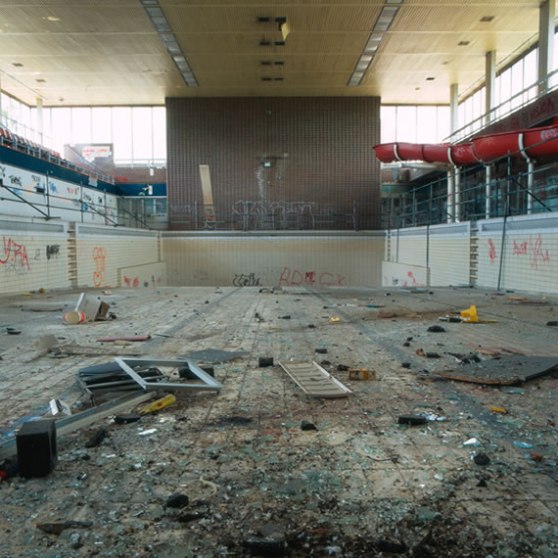
http://www.ballardian.com/drained-london 

No, my wife’s death, in 1964, came ten years after I began writing, and by then I had published 2 novels, and 2/3 book of short stories.

Trauma, repetition and writing?

I’m not sure that I have ever suffered irreparable trauma – the experience of psychotherapists is not a reliable guide, since they are dealing with a small number of genuinely wounded patients, who perhaps lack the constitutional strengths that allow most people to recover.

Of course the death of my wife was a devastating blow, and to some extent I still mourn her over 30 years later – I think it’s “inexplicable” cruelty (in fact, sadly, mortality often unexpected, is the ocean we swim in) led me to embark on the Atrocity Exhibition, with its attempt to make sense of another inexplicable death, that of J.F.K. – “he wants to kill Kennedy again, but in a way that makes sense,” someone says of the Traven figure.

I’ve never claimed that Empire and Kindness of Women were straight or were largely autobiographical. They are my life as seen through the mirror of the fiction generated by my life – I hope that all my fiction is optimistic, since it is a fiction describing various journeys of psychological fulfillment – my characters, including Jim in Empire, devise strategies that allow them to remythologize themselves – though often their behavior seems superficially paradoxical and even self-defeating – (Kosinski, from what one of his then British publishers told me, was a deeply unhappy man, obsessed with pornography, of which he had a huge collection that he swapped with another wayward Pole, Polanski – but I suspect he would have been deeply unhappy even if WWII had never occurred – I doubt if his suicide was a victory for the Nazis, since he was never interned and the ordeals he witnessed were those of a child – the older concentration camp victims were the true sufferers.

thekindnessofwomen1sted

Céline, if I remember, was wounded in the first World War, and this may have acted as a facilitator, revealing a thread of vicious misanthropy that found its most concentrated form in anti-Semitism – a brilliant writer, but deeply nasty man probably from childhood – Burroughs, whom I knew on and off for over 30 years, seemed to me to have entirely created his own world from his imagination, from his homosexuality and the worldview generated by heavy drug use – I never had the sense that any events of his childhood had profoundly influenced him – Woolf, I assume was flawed from the word go, a depressive who might have survived but for the war.

The sexuality portrayed in Atrocity Exhibition and Crash has very little to do with my own. I own no pornography, soon become bored with the films on the “adult” channels in European hotels, and have been lucky enough to have had long and emotionally close relationships with a remarkably few women. On the other hand, I am interested in the ‘idea’ of pornography and how our sexual imaginations are influenced and shaped by the alienating effects of late C20 life – as I keep saying, Crash is a love story, describing how a man and his wife rediscover their love for each other, a fierce love that may be its own [warning? I was unsure of the original handwritten word]. Atrocity is one sustained attempt to make sense of the dislocations of the world.

A User’s Guide – the pieces go back to the 1960’s, when I was still writing s-f, and when I certainly considered myself in part an s-f writer and still had hopes that the genre could escape its juvenile origins and amount to something. But todays -s-f, largely dominated by cinema, is wholly different, a form I suppose of commercial space fantasy – but I’m still interested in science and its handmaiden, technology, and how these play into the hands of our own latent psychopathology. Indeed the normalizing of the psychopathic is the main enterprise on which late C20 mankind has embarked – Crash, the film? A superb and brave adaptation by Cronenberg – I think it will prove to be a landmark film, the Psycho of the 90’s – in the future all films will try to be like Crash —–

Best Wishes,

J.G. Ballard

A Proposition for a Counter-Curriculum in Healthcare Education and Practice

This is a copy of the blog post that I published in the member’s blog of the Academy of Integrative Health & Medicine 8/11/16.

By AIHM Member Dave Kopacz

jhp53db8b682bd57[1]

What is a counter-curriculum and why do we need it?

A counter-curriculum is a course of self-study (which includes the study of the self) alongside the technical curriculum for training healthcare professionals.

We need it because something important is missing from the contemporary curriculum of healthcare providers.

I first developed this concept of a counter-curriculum when I was in medical school, actually even before that, back in high school when I realized that there were important areas I needed to be educated in that were outside of what I could learn through schools. My counter-curriculum included the works of Carl Jung, and writings in Zen Buddhism, poetry, literature and mysticism. It included looking at the best of being fully human, as well as the worst, so I had to study the “forgotten histories” of genocides of Native Americans and other marginalized peoples and cultures. I had to study the assumptions of the current facts that were being taught, which led to the philosophy of science and history of medicine as well as of different cultural and historical models of health and illness.

The counter-curriculum is more than reading books, however.  In order to be fully human, to counteract the dehumanizing aspects of professional training, in order to be the best doctor and the best human being I could be, I practiced various forms of meditation, yoga, tai chi, martial arts, fencing, going to various gym classes, working out, running, free and easy wandering in the woods with Thoreau and Chuang Tzu in my pack. The counter-curriculum led me to study various forms of healing, of energy, life force, breath and consciousness. It led me to seek out different forms of education and experience. It recently led me to start working with Native American visionary Joseph Rael (Beautiful Painted Arrow), who taught me that we only truly exist in moments when we are raising our consciousness, the rest of the time we are just busy trying to keep everything the same, which is persistence―not existence.

And, finally, the counter-curriculum led me to write my book, Re-humanizing Medicine. And it led me to write this blog post and to encourage you to find your own counter-curriculum, so you can be a whole person, so you can be fully human, so you can truly exist.

Dave Kopacz is a psychiatrist, a founding diplomate of the ABIHM, and is recently certified through the ABoIM. He works in primary care mental health integration at the Puget Sound VA and is on faculty at the University of Washington. He has worked in a number of practice settings in the US and New Zealand. His first book, Re-humanizing Medicine: A Holistic Framework for Transforming Your Self, Your Practice, and the Culture of Medicine develops the concept of a counter-curriculum and presents a guide for being a whole person to treat a whole person. His latest book, with co-author Joseph Rael (Beautiful Painted Arrow), is called Walking the Medicine Wheel: Healing Trauma & PTSD and is due out October 15th, 2016.

front-cover-final

Last Conversations with Susan MacGregor

Susan MacGregor passed away this past week.

Over the past year Susan and I have exchanged emails as she lived through her “deathing life” and this week she completed that process.

I got to know Susan through our Auckland Holistic Writer’s Group in New Zealand. We met monthly at Time Out Books in Mt Eden in Auckland.

Susan wrote sweet poetry that was very spiritual and she shared this with us in the group, but she dropped out of the group due to some health problems that eventually turned out to be Glioblastoma Multiforme brain cancer. She lived way past the usual time frame for such a tumor and she maintained a positive outlook, although it was clear she had great struggles at times. I hadn’t heard back from her over the past few weeks and a few weeks before that she typed only brief messages and often had many typos in them, a change from her previous communications.

As time went on, I would just send Susan pictures of flowers from our yard and tell her that I was thinking of her.

Please find here some of our final conversations. Even though this is a bit long for a blog post, I will make a long post and include some extra photos…

Turning To The Light

Turning to the Light, Susan MacGregor, 2016

24 May, 2016 (Susan)

Dear David,

Feeling I am starting to walk in the light now. Last night had these dreams:

First

Mahmoud & I were sitting in hilly country having a cup of tea together whilst watching a man chisel away at the outer covering of a large boulder, the covering was a greyish white. As he struck away the last chunk of stone there was a brilliant blinding release of amber coloured light. When we looked again we could see the man had found a huge boulder of citrine crystal, it was a massive boulder of very clear bright colour.

Next Dream

A large brilliant white Angel stood in front of me with a sword of white light. It turned the sword point toward the earth then plunged it into the ground. It stood there still holding the hilt of the sword as if on guard.

Next Dream

I was joined by someone in white, emitting light who gave me their hand & invited me to walk with them.

Possible Interpretations

I was thinking about the way you seemed to be able to move above things & continued to be inclusive & responsive to all of us when we were in the writers group. Thus I think the man in the first dream was you. I believe the citrine showed you have a huge power of creativity & will be highly successful in your writing work. I believe it also showed the immense level of protection around you & your ability to rise beyond negativity. Also that citrine’s light was helping me to release my negative energy.

Then the Angel & the offer to walk with a light being. The Angel felt protective, & both felt like signs that my death is not far off.  I feel that Angel will be beside me all the way. When I got up today all the negativity was gone.

Many blessings

Susan xx

The Chalice & The Rose 9f33d6b1-48d2-4b30-88ce-dd048adfe60f (1)

The Chalice & The Rose, Susan MacGregor, 2016

May 24 (David)

Susan, thank you for sharing such amazing dreams. I have had a very active dream life this week as well and was in New Zealand and US last night.

We all labour through our lives to release the brilliance within us!

Thank you for your kind words and your blessings and being an angel of my work!

David xx


May 25 (Susan)

Dear David,

Hope you are making headway with your latest project. Do you keep a dream journal? Maybe that could be an interesting addition to your own biography one day?

I am mindful that if something causes a ripple on my inner calm there is inner work for me to do as otherwise it couldn’t take root in me.  That doesn’t mean other’s energy & negative thoughts can’t impact me, nor that their issue is mine, but rather that the negativity can’t cause turmoil or remain in me when there is nothing for it to attach to. The only fully self realized being I believe has walked this earth is Jesus, whom was Christed. Thus though endeavouring to improve myself I find I also need “outside” help.

Love from Susan xx

20160721_055553

25 May, 2016 (Susan)

Hi,

The rose is such a pretty colour & full of new buds, looks like it will be covered in blooms soon.

My function is deteriorating, some difficulty talking, tripping over words, some stuttering. Getting some laughs out of that currently.

Mild nausea, blurred vision, breathlessness, dizziness, fatigue, tremors. Had lots of lovely visitors, 16x peeps over past 6 days. Stopping visitors except family & extended family now as most others have had opportunity to come whilst I could still talk to them.

Poems were sent last Sat. Mail is lot slower than it used to be so probably arrived to destination midway through this week. Hoping there is some merit to them. If not I will ask someone to bind them into a soft cover for family & friends.

In light & love,

Susan x x
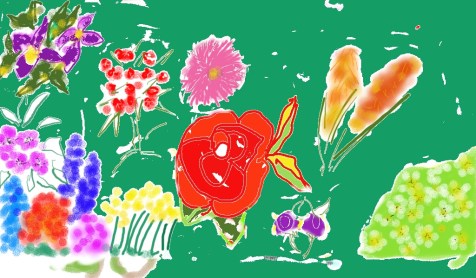
The Central Rose

The Central Rose, Susan MacGregor, 2016

25 May, 2016 (David)

Hi Susan, thank you for sharing with me how you are doing. I was thinking about the roses, how each one is so beautiful and bursts into the world, bringing sweet fragrance and beauty (these Angel Face variety roses have a nice scent). And then the flower gradually fades, loses a few petals and then passes away, yet in each individual flower’s passing, new space is created for the other buds that are overflowing with desire to burst forth into the world, giving of themselves and becoming themselves. Even once the flower blossom is gone, though, then the not so beautiful work begins of transforming dead flower into seed – for the rose, it turns into a bright red rose hip berry and becomes beautiful again, until once again, at its ripest, falls from the plant and begins to decay, which allows the seeds of new life to sprout and take root. It seems so beautiful with plants, with people it is a bit harder to stretch the metaphor…

When you say you sent the poems, whom did you send them too?

I have a batch that you sent me some time ago electronically. At first you said you didn’t want them posted as they were copyrighted and you were looking to publish, later, you said to go ahead and publish. I haven’t put any up yet. I’ll do a blog now and put maybe a poem, an update from you and a picture.

Here are some pictures of my little shrine on my desk where I write. I probably have a solid day or two left of editing the manuscript.

May God’s Blessings sustain and surround You,

David xoxo

20160528_063626

28 May, 2016 (Susan)

Dear David,

That’s wonderful, again my appreciation & thanks. Metaphor about roses very apt.

My friend from Perth is here, we are having a lot of laughs together. Having known each other from babies we have covered a lot of territory together, I will forward her contact details. Such a special person I think it will be a good link.

Re tripping up on words, in saying goodnite to Mahmoud last nite I said byebye banana, getting stuck on the ‘b’of the byebye his name then becoming banana. A bit like when I called my friend Pam Lamb, then blamed it on her having moved to a farm, lol, but of course it was pressure build up in the language areas of the brain.

You asked about the poetry I have sent it to the NZ poetry Association for review, to see what needs to be done to prep them for sending to a publisher or competitions.  I have put copyright on them but don’t mind people reading them just they wouldn’t be able to use them or copy them.  I don’t know how this would work for you except for me to give you permission to post them?

Blessings,


1 June, 2016 (Susan)

Dear David,

Feedback arrived from the reviewer, very useful.  My “poetry” doesn’t fit into the current definition of poetry & is more akin in layout & content to 19th Century poetry. Not suitable for competitions nor publishers.  It fits into rhyme, & bush poetry, but would be more accurately titled selected rhymes.

On the plus side I’m told I have an exceptional gift for rhythm & on the whole not too bad with rhyme. I am excited by the creative challenge of reworking a few of my rhymes into a modern layout & writing style. Not sure how far I’ll get but will just keep it going until I can’t do anymore. Really the most time consuming part is done, which was cataloging the key experiences in some way. Any leftover rhymes can easily be made into a booklet for family. Well worth getting the review.

Recently been told another friend is being investigated for stomach cancer. Same age as me. And my friend Kay, from Perth, who is visiting me daily lost another friend in the past few months from brain cancer & her hubby about 2yrs ago, started in his 40’s. Don’t know if I’m just more cued into things like this now due to my own experience or if its a life stage thing due to age, but seems getting more common. Also wished to ask, my friends hubby was from Polish immigrants The names Pak & Kopacz sound similar? M just arrived.

Bless, Susanxx
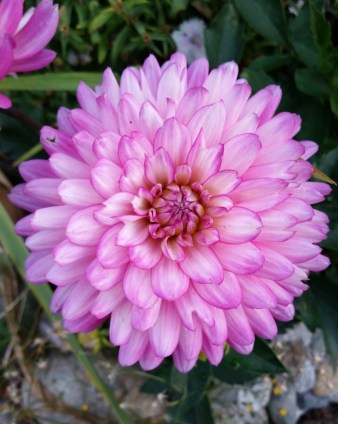
20160721_055640

3 June, 2016 (David)

Hi Susan, editing more today…but it is a beautiful day here! Very summery.

One of the things I like about your poems is the elegant language. I remember Jung said that when the archetypes were speaking, they would often use Victorian language or old formal usages. It gives a kind of timeless quality and stature to language. It is not always a good thing to be accepted by contemporary society, most great artists are not great until time passes….

[Here is one of the first poems that I remember Susan sharing with our Auckland Holistic Writers’ Group in New Zealand]

20160626_075229

Misty Lake Magic

Behold, your ethereal waters wrapped around

In a cloak of soft white fairy down

Oh spell-cast land of watery hues

 Helpless, I am enraptured by your views


Mossy garlands festoon verdant banks

Sentinel trees guard watery flanks

Ensconced in hues; green, gold and red

Persephone to you has surely fled


Willows, with heads bent in respectful bows

Send tendrils to caress you from their boughs

Whilst gossamer threads of droplets fall

Down soft green leaves into your thrall


Gliding effortlessly, propelled by unseen hands

Snow white swans dance in your watery land

Slicing through mists which then quickly enfold

Them once again in your wispy hold


A hush has fallen, I dare not breathe

Lest this vista before me depart & leave

Or your stillness echo a disquieting sound

Dispersing this magic, exquisitely profound


Should something now disrupt this scene

I would wake violently, as if from a dream

For this vision, disconcertingly surreal

Has me fully lost within its appeal


A myriad soft lights begin to appear

Creating a shimmery stratosphere

A magical mirage before my eyes

Promising some deeper watery surprise


Continuing to look with transfixed gaze

Upon your mystical watery maze

I think I see, in your soft misty light

A fairy citadel of beauty bright


And a glimpse of creatures from another world

Messengers of magic who seemingly herald

The coming of a miracle dawn

In which all the world as this be born


And then the vision begins to fade

Your mossy banks now reveal a glade

The mists enfolding you vanish away

But not my memory of your splendour today


Copyright: 2011, S. D.Mac Gregor

20160626_075238

MP’s birthday today! We’re off to one of the local pubs in a bit…

Sending some extra sunshine your way….

David xx


12 June, 2016 (David)

I think I commented on the comments of the reviewers in another email, but I think you are from a different time, or perhaps timeless…I think the 19th Century suits you…


11 June, 2016 (Susan)

Dear David,

Following small seizure last Friday am unable to stand or walk without 2x staff. Although previously being averse to having a catheter I have accepted the need & looked for a positive to help me adapt, the positive is I can now drink as much coffee as I like. Previously I limited coffee as it made me need to pee too much & sometimes I wasn’t able to make the toilet in time. Hope that’s not too much information?

Mahmoud stayed over one night this weekend he plans to do that once a week now. I had hoped to make my next birthday, on 25th Aug, but going by my current status predict mid-July which is ok. Have really enjoyed spending time with my life-long friend from Perth, Kay, she has been in every day until recently when she had to go to Matatmata to sort out some things for her mother who is in a Private Hospital there. Kay returns to Perth on the 17th July. We have reminisced at length, laughed, cried, listened to favoured music from our past. I am so lucky to have such a great friend!

God Bless,

Susan x x

stepping stones with petals 688e3ccd-3499-409c-a1cc-79d00eef0768

Stepping Stones with Petals, Susan MacGregor, 2016

11 June 2016 (David)

Hi Susan, you are an unfailing optimist – seizure and then can’t stand, but you are able to drink as much coffee as you like! Well, I hear you on the coffee, I would really miss that if I couldn’t have it. That is not too much information about the catheter. I had to go through medical school to become a psychiatrist.

I am glad you had such a good visit with Kay.

Every day is your birthday now…

I am so happy to see your paintings. Please keep sending them.

I have been bogged down in editing for weeks now. I thought we were getting close with the book after it went through these last edits, but there are still substantial conceptual and structural issues that need to get sorted with the book, so I have been doing long days on the weekends editing…

I did my first presentation that was starting to introduce the book a little bit. I was on a national VA conference call for the Post-Deployment Integrative Care Initiative. My talk was on “Pathways to Moral Healing.” I’ll send the PowerPoint if you can open that…

It is always so nice to hear from you, thank you for sharing yourself and your journey. Mary Pat and I were talking about you this morning and thinking we probably met about 5 years ago. I can’t remember when we started the writing group, I think maybe 2011?

Blessings

David xx

sunshine on my window makes me happy

Sunshine on My Window Makes Me Happy.1, Susan MacGregor, 2016

14 June, 2016 (Susan)

Dear Friend,

Hope you are making headway with the editing? I am doing ok, not suffering, started morphine syrup….  Yuk taste but so lucky to have this option, staggered with panadol for consistent pain relief. Was nervous about taking morphine as never taken much other than panadol or Brufen so didn’t know what to expect. Wouldn’t know except no pain & slept well.

Mahmoud is staying over once a week. It is reassuring to have him with me & he does so many extra little things that make life more comfortable like massaging my feet, legs & bringing me my favourite foods. He is being strong but I see him crying when he thinks no one is watching. It breaks my heart to see his grief but be powerless to help. He, at least, will have the support of my brother whose experience of losing his first wife Ann unexpectedly at 50yrs old has given him a real understanding of the impact things will be having on Mahmoud.

Going back to the morphine I find it is rather weird,  as if the Death Eaters from Harry Potter have swooped in & withdrawn life & emotion causing everything to be bland, dampened down, monotone from my norm. Not sure if that is typical. Am wondering how it will impact on the experience of dying.

Have you got someone who can give you help to edit your book?

All the best.

Love & bless,

Susan xx

sunshine on my window makes me happy.2

Sunshine on My Window Makes Me Happy.2, Susan MacGregor, 2016

14 June, 2016 (David)

Hi Susan, that is interesting with the Morphine. I think it can cause some of that emotional blunting for people. A lot of people who get addicted to it use it for that purpose to dull emotional pain as well as physical pain.

I’m sorry for you going through all this, but I see how you are worrying about Mahmoud, too. How difficult this deathing life can be at times. It is quite an initiation process you are going through and it changes those around you as well.

With my book, Mary Pat is doing some of the editing. It is gradually shaping up. How nice it would be for us all to get together again at Time Out Books and talk over our writing and our lives…

Love & Blessings for you

David xx


14 June, 2016 (Susan)

Dear David,

Yes indeed re the meetings at Time Out. Those were good times, a great venue plus group of people. Yes it is that blunting I’m not used to. I’m glad I’ve never felt the need to do that to myself deliberately as have been able to experience so much emotionally both ups & downs that it has opened the door to being able to experience more joy, more love, more sensory pleasure.

I’m sure Mary Pat is invaluable help with editing.

As always my best wishes to you and yours.

Love & light.


21 June, 2016 (Susan)

Dear David,

Congratulations on birthing your latest work. Thank you for forwarding to me, what a treasure…I recall Chris James singing peoples’ stories to them surrounding them in a circle of voices, how moving that was for each person, used for healing from physical health issues.  Also singing their names along with personal qualities. I used that in some of the group work too within mental health rehabilitation services. It’s a shame I had to hide what I was doing from more traditionally trained workers as results were good. What I hope is that mental health workers move toward a more encompassing approach of methodologies that do produce results even though they may not be mainstream. It seems easier for some people to do that within a cultural context than apply same principles to every, living being, I hope Joseph’s explanation of the principles convinces these people of the universality of the approach. Surely it will.

When added to better outcomes for the veterans you are working with.
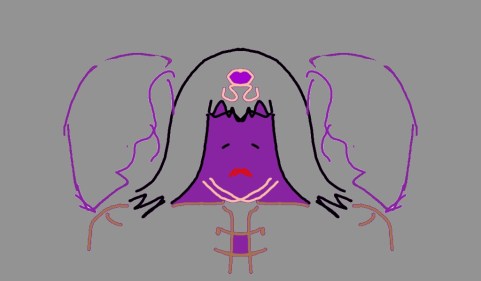
Grumpy and Down, But Not Alone

Grumpy and Down, But Not Alone, Susan MacGregor, 2016

19 June, 2016 (Susan)

Hi,

I’ve had the worst day of all today since being diagnosed, nausea, constipation pain in neck from old neck injury being disturbed by being pulled up the bed etc…Getting into grapes, kiwifruit etc as lactulose is disgusting.  My room mate puss is now dubbed Beethoven as keeps rattling his collar bells throughout the night…his Moonlight Sonata perhaps, I would love to try him on keyboards. He is such a treasure.

Puss

Beethoven, Susan MacGregor, 2016

21 June, 2016 (David)

Hi Susan, sorry to hear it is such a rough time at the Solstice.

Beethoven makes me smile.

I am just finishing the acknowledgements. Do you prefer your surname as:

MacGregor

Or

Mac Gregor (with a space)?

Prayers, love, and lots of sunshine on this longest N Hemisphere day down to your darkest S Hemisphere day…

David xx


20/6/16 Susan

Dear David,

Glad to hear you are at the other end with editing. The no space option is preferable for my surname “MacGregor,” thanks. Feel much better now no nausea kiwifruit are working. Thank God for Mahmoud who thinks nothing of going all over town to find what I need.  Yes interesting I had my darkest day on the darkest day in our hemisphere. Weather is still very mild. Supporting a friend & wife currently, just been diagnosed with stomach lymphoma. 58yrs old, comparatively I’ve had it easy. Had good role models too, a friends hubby used to be in the room opposite me same diagnosis but worse than me couldn’t talk, couldn’t walk or move independently but always kept good sense of humor, loved a joke, & exceptional self management of frustration, I used to watch over him for my friend, it seems his gift to me is in showing that even on dark days I can still be better off than others & can always access fun & laughter to lift stress. Such an exceptional person.

Lts of love,

Susan x x
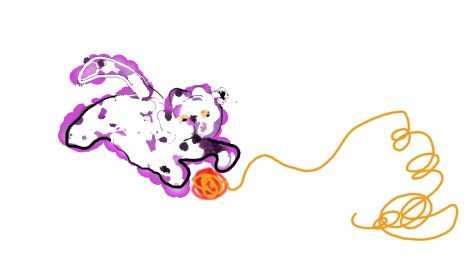
playful kitty.2

Playful Kitty, Susan MacGregor, 2016

21 June, 2016 (David)

Hi Susan, glad to hear the nausea is better. Those kiwi fruit are good for everything, eh?

I’m just sending out the manuscript to potential endorsers tonight – it being the Solstice and the Full Moon, seems like a good time for that….

Here is the possibly final version of the manuscript for you to skim if you have the interest and energy, no worries if it is too taxing.

Keep on Susan-ing, as Joseph Rael would say….

David xx


24 June, 2016 (Susan)

Hi

Getting lots of rain, which I am enjoying being wrapped up warm & cosy. As the song goes… “I love a rainy night, I love a rainy night”… good there are so many things to be enjoyed still as slowly my world is becoming flatter with side effects from meds causing issues plus unpleasant aftertaste so not enjoying food at all…Nausea, constipation dealing with daily but that’s ok they are easy enough to modify with other preparations. Don’t know what to do re the unpleasant taste, except finding hot milky milo [hot chocolate] helps for short while. Picked that up from friend who died from bladder cancer, the only thing she could keep down. Thank you Erina.

the worlds gone flat 940631b8-2144-46f6-b9d7-b067f45c9c77

The World has Gone Flat, Susan MacGregor, 2016

12 July, 2016 (David)

Can you see the

Angel of the

Sun?
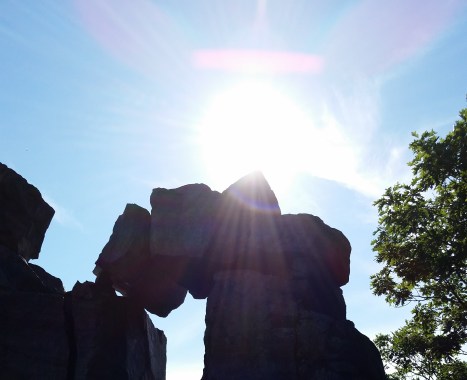
20160710_153915

17 July, 2016 (David)

Lilly from Madison, Wisconsin
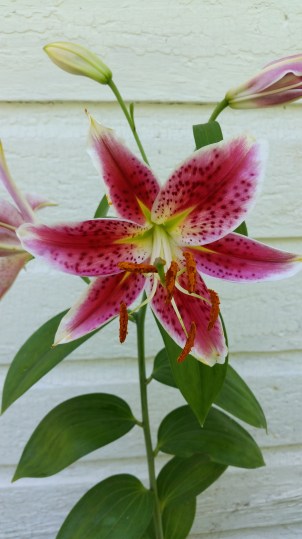
20160716_131320

18 July, 2016 (Susan)

Thanku, this is wat M & I call the Susan Lilly as Susan means lilly. M buys these ones for me regularly. Having sum fun he feel bit better each day. xx


20 July, 2016 (Susan)

:).xx


21 July, 2016 (David)

🙂

xx


31 July, 2016 (David)

Sunny here today, will send some your way…

Love,

David

xx

20160721_055706

4 August 2016 (David)

Hi Susan!

I think of you often and send my thoughts and prayers to you…

Love,

David

Xx

20160627_194307

4 August 2016 (Susan)

Tha k nk youDazvid those thought s &

Prayershelp me through my worst days I am certain I Wouldn’t cope sometimes otherwise.

Love & blesz .xx


[Susan’s emails ended and I received a couple updates from her brother, Rob. He wrote that she passed away peacefully on 23 August, 2016. Susan had said that she hoped to make it to her next birthday of 25 August, which she very nearly did. She lived through what she called her deathing life far longer than is generally predicted for her type of cancer. We’ll close with one of Susan’s poems, which seems very appropriate around her death. I sent Susan a painting a few weeks ago, I’ll also include a photo of that as it was in progress.]


Separation

If I can’t hear you

Does it mean you’re not there?

If I can’t see you

Does it mean you’re not near?

If I can’t feel you

Does it mean you are gone?

If I believe I am alone

Would that perception be wrong?


How may I reach you

Without sight, touch, or sound?

Is there another truth

Perhaps, much more profound?

Do we all have a connection

Beyond what appears

To be a continual resurrection

Of endings and tears?


2011, S. D. Mac Gregor

20160730_172055


Treating All of the Patient Physio Matters Interview, August 2016

The following is the text of an interview I did for Physio Matters, (member magazine of Physiotherapy New Zealand) August 2016.

FEATURE 22 | PHYSIO MATTERS AUGUST 2016

Treating All of the Patient
Interview by Rhonwyn Newson

David Kopacz, author of the book, Re-humanizing Medicine: A Holistic Framework for Transforming Your Self, Your Practice, and the Culture of Medicine, defines a holistic approach to healthcare means taking into account all human dimensions that influence health and illness.

These include not just the physical, but also the emotional, relational, mental, creative and spiritual dimensions of the person.

“To be holistic is the opposite of being reductionist. In addition to focussing on the physical body, we also are heartcentred, bringing caring and compassion to our work,” Dr Kopacz says.

How can physiotherapists provide a more holistic approach to treating patients?

Dr Kopacz believes clinicians can only provide holistic healthcare by first developing one’s own ‘wholeness’.

“We cannot give to someone else what we have not first developed in ourselves. Healthcare is both an art and a science, although we often forget the art and only focus on the science. If we want to give more compassionate care, we must cultivate our own compassion.”

‘Counter-curriculum of self-care’

Dr Kopacz notes that healthcare workers are often not trained to take care of themselves.

“If we do not care for and replenish ourselves, we end up with professional burn-out, which leads to a loss of caring in healthcare, and ultimately a loss of health for both the healthcare worker and the client.”

The basics are a great place to start – stretching, exercise, regular movement and engagement in life. Proper nutrition and relaxation techniques are helpful too. From there, the concept of mind-body-spirit should be looked at, and this applies to both the clinician and the patient.

DSC_7647

David Kopacz at Re-humanizing Medicine book signing at University of Washington Bookstore, January 2014 (Photo: Salin Sriudomporn)

According to Dr Kopacz, there are nine dimensions that need to be looked at:

  • How can a person engage their body for health?
  • How can a person engage their emotions for health?
  • How can a person engage their mind for health?
  • How can a person engage their heart for health?
  • How can a person engage their creativity for health?
  • How can a person engage their intuition for health?
  • How can a person engage their spirit for health?
  • How can a person engage their context and surroundings for health?
  • How can a person engage their time for health?

Looking at these nine dimensions gives a holistic view of a person, and each dimension has health benefits. Physiotherapists can individualise a treatment plan by finding out how to support a person to engage all of the dimensions of their health. “We don’t have to be an expert at working with each of these different dimensions, but as healthcare workers, we need to have basic fluency in each dimension.”

Treating more than just an injury

“When people are injured or have a movement disorder, it doesn’t just affect the physical body as a machine – the body also ‘thinks’,” Dr Sandra Bassett, senior lecturer in Physiotherapy at AUT says.

Dr Bassett believes a biopsychosocial healthcare approach means taking into account the beliefs people have about their treatment and their injury.

“It means taking the time to talk to a patient about any limitations to adhering to treatments – what their time and social commitments are.”

From Dr Bassett’s perspective biopsychosocial healthcare is different to providing holistic healthcare.

“It’s about finding out and respecting what a patient thinks. What their commitments are, and how they think their bodies work.”

She also believes patient education is so important. Knowing how the body works, and how treatment will help, means patients are more likely to adhere to their treatment and manage their disability.

“I often hear physios saying, ‘But I’m not a counsellor’, and that’s true,” she says. “However, physiotherapists are well-placed to connect with people, and get them to think about their day and when they might be able to fit in their treatment exercise regime, for example.”

Physios can also place responsibility on a patient to encourage self-efficacy. “Our research shows that when patients take responsibility and ownership of their treatment, they cope much better. Patients feel better about themselves and think more positively.” In this sense, the physiotherapist may act as more of a coach by setting goals, and providing encouragement and support, as well as educating the patient.

Dr Kopacz says an injured person may also suffer from grief over lost physical functionality, anxiety over being re-injured, and even depression around an injury. These emotional and mental elements need to be addressed in order for a person to even have the motivation, and commitment, to doing the exercises that physiotherapists know would help them.

“A key question is asking a patient, ‘What do you want your health for?’ This helps to motivate a person, and individualise their care. It’s not enough to provide information or appeal to a person’s intellect. We need to focus on engendering hope as much as providing an evidence-based physical treatment,” he says.

Although this may seem like a lot to take on in a busy clinical setting, it is a vital component of providing care.

“…really, it comes down to making sure that we are good human beings to each other as well as being a good technician or clinician. Kindness and caring only take a moment and we need to make sure that we make space for that moment to occur.”

DSC_9344_color_corrected

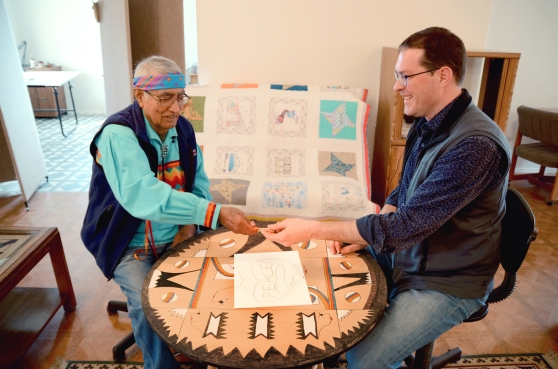
Joseph Rael (Beautiful Painted Arrow) and David Kopacz working on their new book, Walking the Medicine Wheel: Healing Trauma & PTSD. (Photo: Karen Kopacz, 2016)


Conversations with Susan.4

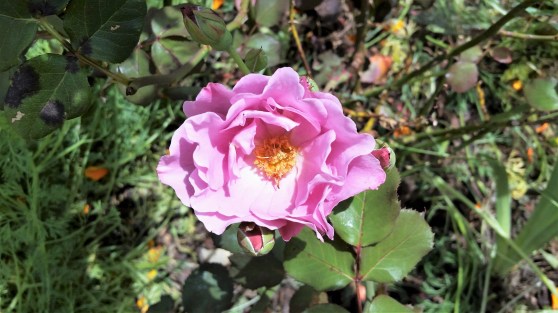
Angel Face Rose

Angel Face Rose

26 May, 2016 (Susan):

Hi,

The rose is such a pretty colour & full of new buds, looks like it will be covered in blooms soon.

My function is deteriorating, some difficulty talking, tripping over words, some stuttering. Getting some laughs out of that currently.

Mild nausea, blurred vision, breathlessness, dizziness, fatigue, tremors. Had lots of lovely visitors, 16x peeps over past 6 days. Stopping visitors except family & extended family now as most others have had opportunity to come whilst I could still talk to them.

Poems were sent last Sat. Mail is lot slower than it used to be so probably arrived to destination midway through this week. Hoping there is some merit to them. If not I will ask someone to bind them into a soft cover for family & friends.

In light & love,

Susan x x

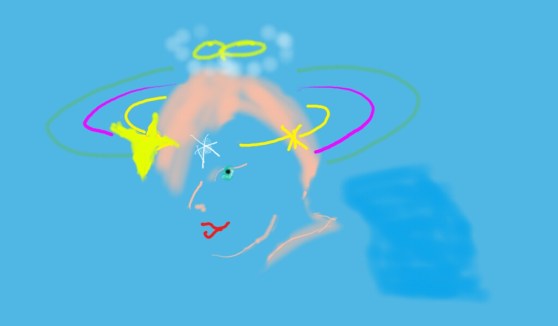
An Angel Without Wings

An Angel Without Wings, Susan Mac Gregor, May 2016

28 May, 2016 (Dave):

Hi Susan, thank you for sharing with me how you are doing. I was thinking about the roses, how each one is so beautiful and bursts into the world, bringing sweet fragrance and beauty (these Angel Face roses have a nice scent). And then the flower gradually fades, loses a few petals and then passes away, yet in each individual flower’s passing, new space is created for the other buds that are overflowing with desire to burst forth into the world, giving of themselves and becoming themselves.

Even once the flower blossom is gone, though, then the not so beautiful work begins of transforming dead flower into seed – for the rose, it turns into a bright red rose hip berry and becomes beautiful again, until once again, at its ripest, falls from the plant and begins to decay, which allows the seeds of new life to sprout and take root. It seems so beautiful with plants, with people it is a bit harder to stretch the metaphor…

When you say you sent the poems, whom did you send them too? Was it to XLIBRIS?

I have a batch that you sent me some time ago electronically. At first you said you didn’t want them posted as they were copyrighted and you were looking to publish, later, you said that I should post some of them on the blog. I haven’t put any up yet. I’ll do a blog now and put maybe a poem, an update from you and a picture.

Here are some pictures of my little shrine on my desk where I write. I probably have a solid day or two left of editing the manuscript.

Here are the plans for my future books:

Becoming Your Own Medicine, with Joseph Rael (Beautiful Painted Arrow)

Art Medicine, with Joseph Rael

Healing Circles of the World, with Joseph Rael

Return: The Hero’s Journey Home after War and Other Life Events

Re-spiritualizing Medicine

Every Thought Leads to Infinity: The Role of Visions in the Life & Work of Carl G. Jung and Philip K. Dick

That should keep me busy for a while…


May God’s Blessings sustain and surround You,

Dave xoxo


Earlier email with update for Susan’s bio…


15 May, 2016 (Susan)

Dear David,


This is a more accurate reflection of my early life.

As a young girl I was identified as being brighter than my peers. My teachers wished to advance me 1yr but my parents, sensibly, declined. However this advantage stood me in good stead later in life, achieving honours passes in all fields of my post school study, both theory & practice. My weak area was maths. My good fortune led to job offers in some instances & to offers of sponsorship into further study. None of which I pursued, instead prioritizing my desire to have a freehold property. As I was single until my late 20’s that meant putting in overtime shifts. When I did marry I made a poor choice, which delayed things somewhat. I then put myself into high debt to buy a house in Auckland that could accommodate taking in my sick parents. I was glad to do that, those years with them being very special, though stressfull. After they passed away I began to experience a series of illnesses requiring surgeries then was diagnosed with the cancer. Prior to my parent’s deaths I met Mahmoud. We have known each other 13yrs. Throughout that time he has helped me & my parents. The home in Papamoa Beach Tauranga is slowly being paid off as it is rented out.

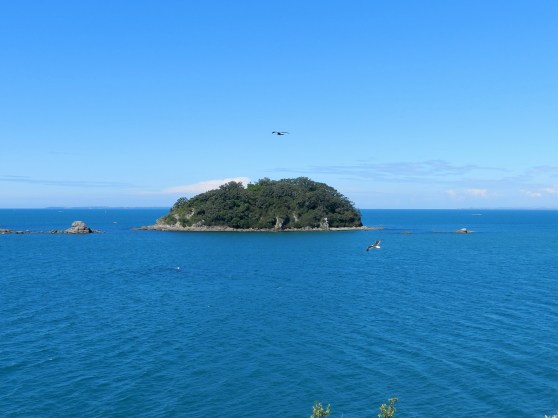
Motuotau Island, Tauranga, 2013 Jan.March

Motuotau Island, Tauranga, New Zealand


Though my childhood home was full of love, music, laughter & creativity, my parents were poor. We could stay at Tauranga Bay Motor Camp free of charge because mum had divined their water supply. Access to bush, beaches, nature was close by. But sometimes my parents had no money for food except bread & milk. There were no WINZ benefits then & though Social Welfare paid a clothing allowance for my 4x fostered siblings, they didn’t pay any other expenses relating to their care. My clothes & shoes were hand me downs from other families. We did what we could collecting windfall fruit to eat from orchardists who knew the situation. We also collected shellfish from the beaches, & dad built one of N.Z.s first Kontikis to fish with which was a success. However there were days when our tummies were only filled with bread & milk. This occurred between my years of 11yrs to 13yrs, spiralling into my mother’s ill health & lengthy hospitalisation when I was 11yrs. She had uncontrolled hypertension & was having blackouts. Being the eldest daughter I took on her duties, caring for my siblings, doing household washing, ironing, helping Dad with food preparation, bathing younger siblings, & organizing the housework rota. When mum was back home I stayed off school often, as she was anxious to be left on her own. Eventually my father secured work as a Carpenter at Kingseat Hospital, Sth Auckland, which job came with a small house. Due to the size of the house & mums ongoing poor health they decided to move only with their two natural children, my brother & I. Amongst others, I was heartbroken by that decision. Mum soon found work too at the Hospital, as a Domestic Supervisor. The move did mean my parents were able to get out of debt.  Plus they were able to feed & clothe my brother & me. Thus life improved despite the continued sadness re my fostered brothers & sisters.

The rest of the previous bio still applies, only I had glossed over the financial situation, & omitted a key aspect of my fortunate genetic inheritance.

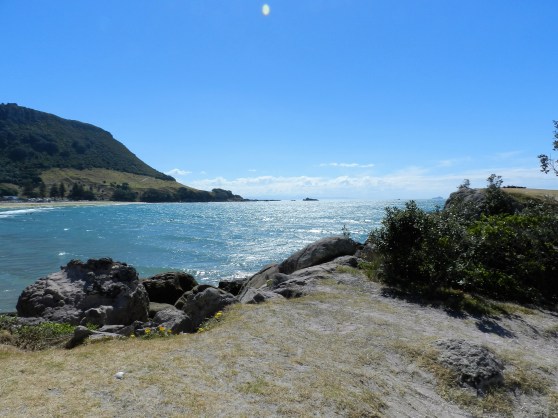
2013 Jan.March, Kopacz 132

Mt Maunganui, Tauranga, New Zealand

Good cheer to you,

Susan xx

Tauranga, 2013 Jan.March

Tauranga, New Zealand


Conversations with Susan.3

Susan’s health has been deteriorating lately. We have been emailing back and forth, but I have not been getting these up as posts very quickly. I’ll be putting up posts more regularly now, starting with our earliest emails in this post and I think I’ll also put up a separate post with more recent updates. While we human beings usually have a bias for a linear narrative, my work with Joseph Rael has been opening me up to non-linear narratives, which is what this series of blog posts is ending up being…I will include some of Susan’s artwork and some of my photos in the mix.

My picture b16eea51-9c6f-475e-b009-856c8c3f730c (1)

Susan Mac Gregor, May 8, 2016

Susan to David: February 7, 2016

Hi,

How are you & Mary-Pat?

Seem to have got so tied up on Facebook that other communications have lagged. Mahmoud & I have had a great Xmas & summer with lotsa socialising amongst friends & family, a trip away to Tauranga, & some lovely local outings. Though the cancer did return, following further radiotherapy, I am again in remission. Looking at things overall I’ve well exceeded the norm for this thing, the cancer having started in Oct 2012. I am not “fighting” it, just accepting it & taking one day at a time.

On other matters finally I’ve contacted a publishing company re a selection of my poems. They distribute through AU, UK, NZ & USA. Not having great expectations, but it will complete a goal I’ve had for some time. The company is ‘XLIBRIS’.

We are off to the exquisite beaches, hot pools & restaurants of Tauranga again in early March. I expect this will be my last visit there, as prognosis now months, not years. Frankly I am ready to “go home” & shall welcome that journey when it comes. My brother is tasked to inform everyone on Facebook so that no one is left wondering. His name is Rob MacGregor, so please don’t be surprised when you get an email from him.

Look forward to your news.

Kind regards,

Susan MacGregor

David to Susan February 16, 2016:

Hi Susan, thank you for writing. Your trip to Tauranga sounds great and I hope you enjoy it thoroughly.
I am sorry to hear about the recurrence and that the doctors are giving you months now rather than years. Just remember, time and life is not really a doctors to give in the first place…

Good luck with your publishing. If you ever want to put a poem “out there” I’d be happy to put one up on my blog with some info about you.

I’ve been working on a book with Native American visionary, Joseph Rael, it has turned into two books. Working with his publisher is great as they are a small press and are really moving things along. July publication date for Walking the Medicine Wheel: Healing PTSD [this has since been pushed back to September, 2016]. I’ll send you a draft and also a draft of Becoming Your Own Medicine, which will be the second book, but hasn’t been edited yet.

I just started reading The Tibetan Book of Living & Dying by Sogyal Rinpoche and also read the Tibetan Book of the Dead. I am preparing to give a series of talks to patients, family and caregivers at a hospice programme out in Colorado on end of life decisions. Do you have any advice for me for the talk? I’ll send you the PowerPoint when there is a PowerPoint to send…maybe in a month…I am thinking about some topics like Death Stewardship, using the Red Road of the Medicine Wheel which orients one to the emotional and spiritual to balance our culture’s over-focus on the mental and physical, and then something on holistic decision-making, using the 9 dimensional model from my book.

The Tibetans sure know how to die, I am learning from these books. The view it as a very important and sacred time in transitioning from this realm to the next. As they believe in reincarnation, the emotional and spiritual state at the time of death is very important in determining the next birth.

Please keep in touch as your time and energy allows.

Here are very rough draft copies of the writing I am doing. [attachment to email] Please don’t feel any need to read them, but if they are of interest, enjoy!

Blessings upon Your Beautiful Soul,

Dave

Oh, have you ever heard of Nevit O. Ergin? I just read The Sufi Path of Annihilation by him and found it quite interesting.

Guest Post: Sandy Carter on Bonsai, Simplicity, and Joy

Marie Kondo writes of love, joy and the beauty of simplicity in a manner that inspired me to utilize her principles in a recent downsizing experience, which changed my life. For years, I have intuitively created space I felt appreciative of, but our recent move presented challenges we hadn’t faced before as we reduced our living space by seventy-five percent.

Bonsai Tree

Our house was filled with possessions we had collected over many years from travels; heirlooms passed onto us by family members and childhood mementos from our children’s growing up years. We felt attached to most everything, and knew what displayed beautifully in our present home would clutter our new space and over stimulate us and we had to make a huge change.


Using Ms. Kondo’s book as a reference, we let go of our things in layers over time and succeeded in choosing what we needed to accompany us as we opened a new life chapter. With her philosophy guiding us, we now live in beautiful and joyous space. The process was not easy, but well worth the effort.


My life has personally changed because I’m been more mindful of the choices I’m making. Surrounded only by things I love has helped me embody wellbeing in more depth. Another gift related to experiencing joy is co-writing a blog with Dave on the topic. Because of this, I’ve trained myself to be aware of joy’s presence again and again. As I’ve focused my attention, I’ve engaged with more subtle experiences of joy in others and myself.


One such joyous occasion occurred with a recent experience between my father and me. Dad told me he was going to buy himself a birthday present. I listened half amused and half curious, wondering what my 88-year-old father had in mind. My father is an example of graceful aging. He is continually appreciative of life’s blessings and surprises my siblings and me all the time, as he lives his life with zeal, seeking new opportunities to learn and grow. Unpredictable as ever, when Dad declared he was going to purchase a Bonsai Tree I was stunned, and asked him if I could go along. I had no idea Dad was interested in this ancient Chinese art form and thought sharing this experience with him would be worthwhile. An idea I am grateful I had, as there are times when I’m too caught up in my world to take advantage of such gifts.


Although the word Bonsai is Japanese, the practice originated in China. In 600 AD the Chinese started using special techniques to grow dwarf trees and they eventually became very valuable and were offered as luxurious gifts throughout China. Later, Japan adopted the Chinese tradition basing the art on Zen Buddhism influence and referred to the practice as Bonsai. Not long ago, the idea spread beyond Asian culture and into other countries. My Dad researched possibilities for a Bonsai Tree purchase in his area, and we headed to a retail establishment called the Bonsai House.


The Bonsai House is a small house transformed into a retail shop for the sale of Bonsai trees. The space is filled with hundreds of Bonsai trees of various shapes, sizes and varieties. A Chinese couple owns the business and the woman not only has a passion for Bonsai trees, but a vast knowledge regarding them. While Dad and I looked at the Bonsai’s, she educated us on the history, types and care of these ancient and beautiful trees. What we discovered is that Bonsai trees can live for several generations, and caring for them can be a deeply satisfying personal experience. Dad insisted we choose a tree together. Although, we did not speak of it in so many words, we knew the tree’s care could be passed onto me and possibly outlive both of us. We had no idea Bonsai shopping would bring us face to face with our mortality. This could have been a depressing thought, but instead it had the opposite effect as we decided on the tree that needed to go home with us.


After our purchase, we left to drive back to the retirement community. As my Dad and I sat side by side in the car we shared a joyous silence reveling in our good fortune of being together and sharing this experience. Later, we put into words what we’d both been feeling. We agreed, no matter what hardships have passed or what may come, having these precious times together brings us much joy and happiness!

Choose Joy