Guest Post: Sandy Carter on Bonsai, Simplicity, and Joy

Marie Kondo writes of love, joy and the beauty of simplicity in a manner that inspired me to utilize her principles in a recent downsizing experience, which changed my life. For years, I have intuitively created space I felt appreciative of, but our recent move presented challenges we hadn’t faced before as we reduced our living space by seventy-five percent.

Bonsai Tree

Our house was filled with possessions we had collected over many years from travels; heirlooms passed onto us by family members and childhood mementos from our children’s growing up years. We felt attached to most everything, and knew what displayed beautifully in our present home would clutter our new space and over stimulate us and we had to make a huge change.


Using Ms. Kondo’s book as a reference, we let go of our things in layers over time and succeeded in choosing what we needed to accompany us as we opened a new life chapter. With her philosophy guiding us, we now live in beautiful and joyous space. The process was not easy, but well worth the effort.


My life has personally changed because I’m been more mindful of the choices I’m making. Surrounded only by things I love has helped me embody wellbeing in more depth. Another gift related to experiencing joy is co-writing a blog with Dave on the topic. Because of this, I’ve trained myself to be aware of joy’s presence again and again. As I’ve focused my attention, I’ve engaged with more subtle experiences of joy in others and myself.


One such joyous occasion occurred with a recent experience between my father and me. Dad told me he was going to buy himself a birthday present. I listened half amused and half curious, wondering what my 88-year-old father had in mind. My father is an example of graceful aging. He is continually appreciative of life’s blessings and surprises my siblings and me all the time, as he lives his life with zeal, seeking new opportunities to learn and grow. Unpredictable as ever, when Dad declared he was going to purchase a Bonsai Tree I was stunned, and asked him if I could go along. I had no idea Dad was interested in this ancient Chinese art form and thought sharing this experience with him would be worthwhile. An idea I am grateful I had, as there are times when I’m too caught up in my world to take advantage of such gifts.


Although the word Bonsai is Japanese, the practice originated in China. In 600 AD the Chinese started using special techniques to grow dwarf trees and they eventually became very valuable and were offered as luxurious gifts throughout China. Later, Japan adopted the Chinese tradition basing the art on Zen Buddhism influence and referred to the practice as Bonsai. Not long ago, the idea spread beyond Asian culture and into other countries. My Dad researched possibilities for a Bonsai Tree purchase in his area, and we headed to a retail establishment called the Bonsai House.


The Bonsai House is a small house transformed into a retail shop for the sale of Bonsai trees. The space is filled with hundreds of Bonsai trees of various shapes, sizes and varieties. A Chinese couple owns the business and the woman not only has a passion for Bonsai trees, but a vast knowledge regarding them. While Dad and I looked at the Bonsai’s, she educated us on the history, types and care of these ancient and beautiful trees. What we discovered is that Bonsai trees can live for several generations, and caring for them can be a deeply satisfying personal experience. Dad insisted we choose a tree together. Although, we did not speak of it in so many words, we knew the tree’s care could be passed onto me and possibly outlive both of us. We had no idea Bonsai shopping would bring us face to face with our mortality. This could have been a depressing thought, but instead it had the opposite effect as we decided on the tree that needed to go home with us.


After our purchase, we left to drive back to the retirement community. As my Dad and I sat side by side in the car we shared a joyous silence reveling in our good fortune of being together and sharing this experience. Later, we put into words what we’d both been feeling. We agreed, no matter what hardships have passed or what may come, having these precious times together brings us much joy and happiness!
Choose Joy

Conversations With Susan

I have been having email conversations with my friend from New Zealand, Susan Mac Gregor. We were in a writer’s group together when I was in Auckland. We periodically have been emailing, but recently we’ve been having more frequent conversations around the topic of what she calls “deathing life,” Susan was diagnosed with Stage 4 Glioblastoma Multiforme, a serious brain cancer, and she has been sharing her insights and experiences with me. Part of what initiated our increased emails is the fact that I have been preparing to give a series of lectures in Grand Junction, Colorado, on Health Care Decisions Day. These talks will be on end-of-life decision-making, holistic decision-making, and also staff wellness for hospice workers. I had asked Susan to give some feedback on a draft for my talk and this really sparked off our conversations. As I have been wanting to expand the focus of this blog, Being Fully Human, it seemed like a good idea to post these conversations as Susan shares her honest insight and experience about the process of “deathing life,” living life right up to the point of death.

Susan has written a fairly long biography, and we’ll publish that at some point, but for this post, I’ll excerpt it and then also start with a summary that she has written about her “deathing life” process. I asked Susan about an image to include in the blog post and she said,

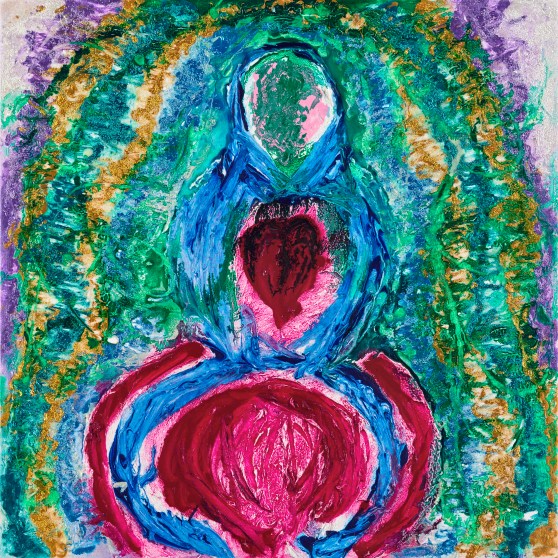
“Having only now read your email the things that come to mind as a picture for the blog could be based on what has been shared…perhaps something with swirling patterns of coloured light, transposed with transparent images of symbols, angels or such.” So I will put a few of my paintings in the blog that fit that description.

Kopacz 02

My name is Susan Diane Mac Gregor. I was born in Whangarei, New Zealand, on 25th August 1958. I grew up in Northland enjoying its beautiful beaches, native forests, waterways, & small town lifestyle. When not reading much of my time was spent exploring nature, swimming, rescuing damaged birds or small animals & swimming. There were cats, pidgeons, chooks [chickens], sheep, dogs, canaries as pets, plus my blood brother & four fostered siblings to share time with. Despite some financial crises for my parents, it was an idyllic childhood. 

As a young adult I entered training in Psychiatric Nursing, having chosen to diverge from my training at the Auckland Institute of Technology, where I qualified as an Industrial Cook. This led into my Career in Mental Health, & interest in Psychological methodologies. Upon qualifying I further developed my interest in caring for the Elderly, plus Special Interest in working with people with Dementia. Post Graduate study included a Diploma in Gerontology. Next I began developing qualifications & skills in Psychological Therapies, successfully completing the first year of study in a Diploma of Psychotherapy with Auckland University of Technology.

In addition to Susan’s health profession credentials, she is also a poet and spiritual seeker and we will hear more about that in further posts.

For today, we’ll include the email that Susan sent me that gave me the idea of posting her insights to share with others. I think she gives such a great, heartfelt, and wise words and experience.

25/2/16 (Susan)

Dear David,

It was with interest that I read about the latest books you’ve been reading. I have read many of the books you have cited in references, etc., including The Tibetan Book of the Dead, however not the recent Sufi book you mentioned.

I can’t give advice for your talk at the Hospice, as everyone’s experience differs, however I can write about my experience.

Initially I experienced shock & grief at receiving such a finite diagnosis. I remember looking around the rooms in my house at the things I had built up & worked hard for, & thinking what did all of that mean, was what I had invested to get those things worth it?  The answer that came back in response to that question was a feeling of emptiness. Then my heart filled with sadness thinking about my 3x beautiful cats & Mahmoud being left behind & I was glad at least that Mahmoud’s life would be more comfortable, as a result of my previous efforts.

Within 2wks I was trundled off for brain surgery, after which my life completely changed. The surgery caused damage within my brain, leaving me with left sided paresthesia.

Mahmoud was devastated. His welfare was always on my mind, as was mine on his. I had a large amount of time left lying in my hospital bed with nothing to do but think.

Years prior I had experienced a “healing” at a Buddhist retreat, in which my “difficult to control” hypertension completely dissappeared, leaving my GP astounded. During that retreat I learnt that even illness has a beneficial purpose, i.e. to teach us something, to deepen us in some way spiritually, to raise our awareness or break through unhelpful patterning.  Thus I started to look for the lessons in this experience.

For me cancer has done all of the above plus brought me to an awareness of how much love surrounds me. It has deepened my relationship with Mahmoud, with God, & given me fresh hope for humanity. I have been shown so much love & kindness, even from complete strangers.  Often those with little in the way of possessions have given me the most. I have been able to see the busy, tense person who “didn’t have time “ that I used to be, reflected in people around me, & their counter balancers in the people who will let me que jump, or help me out in getting something in a supermarket, etc., because they see I’m disabled.

As a consequence of my health & disability mine & Mahmoud’s lifestyle has dramatically changed. We have needed to offload a lot of possessions & have moved to a two bedroom rental unit. The money from my salary no longer flows in & the goal of being mortgage free in 3yrs has disintegrated. However I have found that I am surrounded with so much love & kindnesss that my soul & heart are completely full.

From this point of realisation forward I have been able to take inventory of my life, looking at past regrets & losses, & freeing myself of built up emotions through self forgiveness & forgiveness of others. This has been aided by gratitude & compassion, both of which have deepened within me exponentially.  I have become free again, letting go of pursuing goals, things, dreams…. most of which are erroneous now. Being present in each moment, with each breath, is how my days unfold. The natural world around me is exquisitely defined, colours, shapes, contrasts, each being impressed into my being through every sensory system I possess.

I still give … a smile, a kind word, my knowledge or time. My “deathing” life continues to have purpose & meaning, people ask me “what is this like”, “how do you stay so optimistic”, “are you afraid”, etc, etc. I do experience moments of fear, but at the end of the day my answer to all of these questions is, “this is life, I am blessed to have lived it, I believe in an after life, & it is my faith in God & Jesus Christ that sustains me when all else fails.

May your love-light continue to shine.

Love & Blessings, Susan xx

Kopacz 03


A Work of Joy.5 Spark Joy: What Sparks Joy for You?


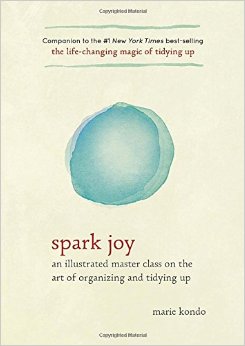
This is the fifth of a series of blog posts examining Joy in Work. We have been calling it: A Work of Joy! It is part of an ongoing discussion between Dave Kopacz and Sandy Carter on this topic and will include each of our thoughts individually as well as our dialogue on Joy in Work. This fifth blog looks at the work of Marie Kondo (who has been called the Beyoncé of Organizing), The Life-Changing Magic of Tidying Up, and her new book, Spark Joy: An Illustrated Master Class on the Art of Organizing and Tidying Up. Sandy had consulted Kondo’s first book when she was recently down-sizing. We turn to her second book, Spark Joy, not so much for tidying up, but rather for her method of determining whether or not something brings you joy. Kondo writes, “I am convinced that the perspective we gain through this process represents the driving force that can make not only our lifestyle, but our very lives, shine,” (xii).

spark-joy-contest-package

Kondo’s method is surprisingly simple, yet helps to get you out of your logical mind and in touch with your heart.  Here is what she says to determine if something sparks joy for you.


“When deciding, it’s important to touch it, and by that, I mean holding it firmly in both hands as if communicating with it. Pay close attention to how your body responds when you do this. When something sparks joy, you should feel a little thrill, as if the cells of your body are slowly rising. When you hold something that doesn’t bring you joy, however, you will notice that your body feels heavier,” (8).

20160303_082657

In regards to organizing, she writes that you should focus on what things bring you joy and that you want to keep, not on trying to get rid of things just for the sake of getting rid of things. Even with the things you discard, however, Kondo invites you to connect with and communicate with.


“Keep only those things that bring you joy. And when you discard anything that doesn’t, don’t forget to thank it before saying good-bye. By letting go of things that have been in your life with a feeling of gratitude, you foster appreciation for, and a desire to take better care of, the things in your life,” (8).


What Kondo is doing is inviting us to get in touch with the soul of things, to see how your heart resonates with the soul of the object, and if you are going to discard it, to honor the soul of the objects that are exiting your life. This reminds me, in some ways, of the world view of many Native American people, that all things are alive and are our brothers and sisters. Maybe this part of mainstream American culture’s emphasis on the accumulation of things, we do not connect to the soul of things and thus we never feel joy in our hearts and keep on accumulating objects.

70ede52a4b764ac3229190a1d3cc0578

When starting to practice determining what sparks joy in your life, Kondo recommends starting with the clothing that you wear closest to your heart, “Because that’s where you feel joy―in your heart, not in your head,” (18). This reinforces that joy, whether in tidying or in work, comes from the heart, not the head. It shows why an intellectual solution to a lack of joy will not be successful unless it partners with the heart.


After going through your belongings, object by object, you can get to where everything you have sparks some joy. “When you wear and surround yourself with things you love, your house becomes your own personal paradise,” (26). Kondo also sees objects as being capable of being transformed by love and that this can be felt as well as the physical elements of the object. So the act of loving something is part of how that object brings joy.


“I’m convinced that things that have been loved and cherished acquire elegance and character. When we surround ourselves only with things that spark joy and shower them with love, we can transform our home into a space filled with precious artifacts, our very own art museum,” (47).

410sn-mdGaL._SY344_BO1,204,203,200_

In looking at Marie Kondo’s book, Spark Joy, and her method of tidying, we can use this in several ways in regard to our larger focus of Joy in Work. The first level is the level of our surroundings and our physical workspace. We could use this method of looking at the objects around us and asking if they bring joy. Many things in a medical environment are necessary and utilitarian, we may not be able to say, “This blood pressure cuff does not bring me joy, so I am going to let it go!” We can declutter both our own personal workspace as well as shared work spaces. Shared workspaces tend to accumulate things that apparently belong to no one and we just work around them. The next aspect of this level is adding some seasoning to our work space, bringing in something that sparks joy for us. Again we may have restrictions on certain items in a medical setting, but a plant, a small vase, a little animal figurine, a favorite book, a nice pen, a colorful note pad, even an inspirational saying written on a notecard can bring joy to a personal work space. Some people in medical settings do not have a personal work space, in that case, you have to put the joy on your person (a pin, jewelry, a pen you like) or you could take on the task of bringing some joy to your collective workspace – see if you can put up a picture, bring in a plant, or even something temporary like a small vase of flowers.


Kondo teaches us that there are three common elements that determine joy, “the actual beauty of the object itself (innate attraction), the amount of love that has been poured into it (acquired attraction), and the amount of history or significance it has accrued (experiential value),” (45). Thus, it is important to realize that joy is not a static trait of an object, it is also increased by the love and enjoyment that we have with an object. For instance, I have a pair of non-descript gardening gloves. I didn’t feel joy necessarily when I bought them, but they are very comfortable and now, after using them for a couple years, they bring me joy. Also, the factor of time, I have been using them now for a while and they hold many happy memories of digging in the dirt. I like using my bare hands too, and getting dirt under my fingernails, but some jobs, like pruning a rose bush are better done with gardening gloves. These gloves now feel like a second skin to me. It is important to realize that even something plain and utilitarian can be infused with joy from years of love and use. Joy is not a one-way street. We are not separate and isolated from the physical world, but can be in a love relationship with the earth and the physical world of matter.


Our surroundings are an important part of our health, although medical settings often do not create joyful or healing environments. At the VA, we are implementing work coming out of the national VA Office of Patient Centered Care & Cultural Transformation. In particular, we are using the Circle of Health and have developed a Whole Health Class that rotates through 8 different health domains over 8 weeks. One of those domains is “Surroundings: Physical & Emotional,” and we work with Veterans to generate ideas around little ways that they can make their surroundings more health promoting. In my book, Re-humanizing Medicine, I also have a dimension of “context” which looks at our physical and situational environment.

COPHAWB

VA Circle of Health

The main reason I wanted to blog about Marie Kondo’s book was not simply for the physical work space issues, but for the method she uses of helping us sensitize and train our hearts to be open and attuned to joy in our lives. Joy is not something you can mandate and joy will be different for each person. To spark joy, we need to make room for our hearts in our work. Administration can do many things to either diminish joy or enhance joy, but ultimately, it is up to us to show up for the joy revolution, by attending to our hearts and bringing them to work each day, and by discerning what it is that we need around us in order to nurture our joy.


There Are Those Few Who Go Off to War

A Review of The Theater of War

Performance by Bryan Doerries, David Strathairn and Heather Goldenhersh


Beacon Hill Church of Nazarene – Seattle

Theater of War: Soldiers & Citizens Tour

Friday, August 28, 2015

(We were a bit slow in getting this finalized, but still wanted to put this review out)


There are those few who go off to war.

There are their partners, parents, families and other loved ones who wait their return.

And then there are the rest of us, the multitudes who observe and comment from the edges. (Less than 1% of the population of the United States serves in the military).

This drama of observation from the edges has been playing out, day in and day out, over the past decade as we, health care workers, have sat with Veterans returning home from the wars in Iraq and Afghanistan: over two and a half million Veterans, more than half of whom have been seen in our VA clinics.

Intermingled with stories of celebration and reunion we have heard stories filled with pain, loss, emptiness, rage, fear, sorrow, loneliness, yearning, hopelessness …stories told by both those who have been off to war as well as those to whom they returned.

Then one day as we sat with a diverse group of community members in a small church on Beacon Hill in Seattle, it slowly dawned on us that the language of war has not changed in any significant way even as the words of those in battle have churned through every language ever spoken. And even beyond the fact that there is a transcendent language of war, the structure of the story of war is similarly immutable: there are those who are thrust into battle, there are those who love them and await their return and there are the rest of us, who at best approach with an earnest desire to play our part in the drama, if only as part of the chorus, or part of the audience.

These realizations occurred as we watched, fully engaged but helpless, the Outside the Wire production of Bryan Doerries translation of Sophocles’ Ajax. David Strathairn and Heather Goldenhersh were jarring in their roles as Ajax and Tecmessa. His relentless march toward suicidal doom, her desperate attempts to avert the inevitable as she shifted her gaze and grasp from him to the chorus, while the rest of us struggled to let go and hold on simultaneously. Tecmessa calls to the chorus, Ajax’s soldiers, and through them to us in the audience when she pleads for help where help is not easy to give, “for our hero sits shell-shocked in his tent, glazed over, gazing into oblivion.”

The_Belvedere_Torso_depicting_Ajax

The Belvedere Torso, a marble sculpture carved in the First Century BC depicting Ajax.

And again she speaks to all of us as citizens of the United States as well as to the chorus, “Tell me. Given the choice, which would you prefer: happiness while your friends are in pain or to share in the suffering?”

The chorus, as many Americans, initially prefers not to get caught up in this ugliness and pain, prefers not to peer into the open and un-healing wound. Yet, eventually, they commit and say, “We will stay and share the pain.”

Perhaps that is all that we can do, and yet doing that may be enough, just simply not to turn away but rather to stay and feel the pain of another who is also part of us, part of our nation.

Watching the drama felt a bit like an ambush inside the wire, leaving us feeling stripped of the professional armor and weapons and sense of hope and healing that we generally carry with us into our work. The performance is a window into the past, 2500 years ago, yet feels as raw and powerful as listening to today’s painful stories of a Veteran who has served in Iraq, Afghanistan or Vietnam. We could do nothing but watch. We could do nothing but be there. The one thing we could do was commit ourselves to do what those in the chorus committed themselves to do, “We will stay and share in the pain.”

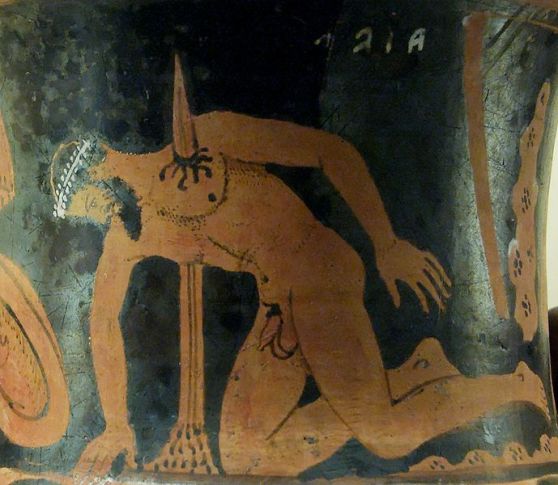
We witness the suffering of Ajax, who has been away at war for 9 years without leave, who has seen the horrors of the battlefield, who served honorably until losing Achilles, his closest brother-in-arms. When Ajax was disgraced by the Greek military command, who played politics and denied him the honor of receiving Achilles’ armor, Ajax goes berserk and slaughters innocent animals while in a delusional blood rage. In the aftermath, Ajax is consumed with unbearable shame – “What a joke my life has become” – and despite the desperate pleas of his wife, Tecmessa, and before his bewildered infant son, and despite the presence of his brothers-at-arms, he ends his life by suicide, the violent end of so many still who have gone to war.

689px-Ajax_suicide_BM_F480

These themes of suffering, betrayal, rage, moral injury, shame, and self-sacrifice feel as potent in the invisible, but lethal wounds of Ajax as they do in our current Veterans. After the performance, a panel discussion included two health care workers and two Veterans who had served in Vietnam and the other in Iraq.

It further squeezed the audiences’ hearts as one Veteran, overcome by raw emotion, said, “I have lived the life of Ajax.” And the next day, other Veterans who had seen the performance said the same thing.

Bryan Doerries spoke of a performance for active duty personnel where he asked, “Why do you think Sophocles, a Greek general, would write such a play?”

“To boost morale,” a soldier in the audience said. When Bryan asked how that could be, the soldier replied, “Because it is the truth.”

Sitting in the audience of Theater of War makes one feel helpless but also hopeful, because we can catch a glimpse of “the truth” of the aftermath of war that has remained unchanged throughout time. It is a sacred moment to share with our nation’s warriors; and it is a loving act, because listening is an act of love.

As Bryan said to conclude the discussion, “I used to think our role as civilians was about empathy, but I have come to see that it is about a shared sense of discomfort.”

Perhaps by being there we learn. Perhaps by learning we grow. Perhaps by growing we change, both in who we are and what we do, as individuals and as Nations.

The idea of drama, trauma and healing is ancient. VA psychiatrist Jonathan Shay has written about the role of the Greek tragedies and the healing function they served for the actors (many of whom were Veterans) and for the audience and culture, itself.

“We must create our own new models of healing which emphasize communalization of the trauma. Combat veterans and American citizenry should meet together face to face in daylight and listen, and watch, and weep, just as citizen-soldiers of ancient Athens did in the theater at the foot of the Acropolis.We need a modern equivalent of Athenian tragedy. Tragedy brings us to cherish our mortality, to savor and embrace it,” (Shay, Achilles in Vietnam, 194).

This is exactly what Bryan Doerries has done through his productions for active duty military, Veteran, and civilian audiences, bringing together all to participate in a shared sense of discomfort and to participate in witnessing, dialogue and discussion after the performance.

Theater of War Book

In his new book, Theater of War: What Ancient Greek Tragedies Can Teach Us Today, Bryan writes that his book “is about the power of tragedies to transcend time, to comfort the afflicted and to afflict the comfortable. At its core, it is about how stories can help us heal and possibly even change, before it’s too late.” (8). Bryan also has a book of his translations, All That You’ve Seen Here is God, that are used for different performances by Outside The Wire.

all that you have seen here is god

Outside the Wire has presented the Theater of War over 300 times across the United States. You can visit the website for information on performances .

UPCOMING PRESENTATION AT THE ACGME:

Feb 26, 2016 Theater of War, THEATER OF WAR: Accreditation Council for Graduate Medical Education Conference
Baltimore, MD


Review, which express our own views, written by:

Stephen Hunt, MD, National Director, VA Post-Deployment Integrated Care Initiative (PDICI), Associate Professor, University of Washington

Craig Santerre, PhD, Clinical Lead Primary Care Mental Health Integration, VA Puget Sound Health Care System

David Kopacz, MD, Staff Psychiatrist, Primary Care Mental Health Integration, VA Puget Sound Health Care System; Acting Assistant Professor, University of Washington


2015 in Review

What a big year it has been! My first book came out at the end of 2014 – Re-humanizing Medicine: A Holistic Framework for Transforming Your Self, Your Practice, and the Culture of Medicine. I have traveled a lot this year for speaking engagements: from here in Seattle to Denver, Colorado, Auckland, New Zealand and Melbourne, Australia.

jhp53db8b682bd57[1]

I just picked up Jean Houston’s book, The Search for the Beloved: Journeys in Mythology & Sacred Psychology. I was surprised to read her introduction to the second edition. She describes that in September of 1992 she stood at the northern-most point of New Zealand, Cape Reinga and watched the waters of different oceans come together. She asks her companion if “this is the place where the planetary DNA gets coded anew?” He replies, “it is…the place where all Maoris go when they have died to lift off to the Other World,” (vii).

The Search for the Beloved

This is the place, right by this tree in the photo, named Te Aroha (love), where the Māori believe that departing spirits leave this world for the other after death. Houston’s guide continued, “It is because of places like this…where the spirits of many people and many lands can meet and refresh themselves. And it is here as well…that we remember who we are and…And call our spirits home,” (viii).

DSCN0339

I, myself, stood in this same place, looking down on the coming together of masculine and feminine waters and of the place where souls leave this place after death – during my last month living in New Zealand, November 2013. See my blog about this trip.

Now, 2 years into living back in the United States, but in a new region, Seattle in the Northwest, I am at this point. Sorry, I know that sounds like Yoda-speak, I just saw “Star Wars: The Force Awakens.” Where am I now? Where is my home? Is my home here in the Northwest?

My wife and I went up to Victoria, British Columbia on the Victoria Clipper for an overnight weekend for our 24th wedding anniversary last weekend. Here are a few photos from that trip.

20151219_143558


20151219_170211

We are still exploring this region, so it seems difficult to call it home when it is so new and so far from where we grew up and where most of our relatives live. I have been reading a lot of Joseph Campbell lately, as well as other authors (whom I will discuss below). This has been a big part of my transition from “down under” back to the Northern Hemisphere. At age 48, this has been my mid-life transition, like Dante taking his mid-life journey:

Midway along the journey of our life

     I woke to find myself in a dark wood

I have developed a class for veterans based on Joseph Campbell’s hero’s journey. The hero hears a call to adventure, crosses a threshold, meets mentors and challengers, has a descent into the unknown world, comes to a challenge which is both external and internal, comes to terms with the inner/outer feminine as well as the authority of society, re-crosses the threshold to the known world, but here finds himself or herself a stranger in a strange land and must work to re-acculturate to their own home. What the hero finds at the furthest point of the journey is the gift or boon which transforms the self and has the potential to renew and transform society as well. But often, this gift is hard to see and the physical treasure might even be lost, as happens to Gilgamesh when he sets down the herb of immortality that he has brought up from the deepest ocean and it is eaten by a snake. This means that the real treasure is the transformation of the self – not some material item. This framework is so useful for returning veterans who have been away in the military world and have difficulty returning back to the civilian world. The book and class I have developed are at the point where I have just submitted it to a publisher for review with a tentative title of, Return:  The Hero’s Journey Home – for Veterans & Society After War.

Hero's Journey

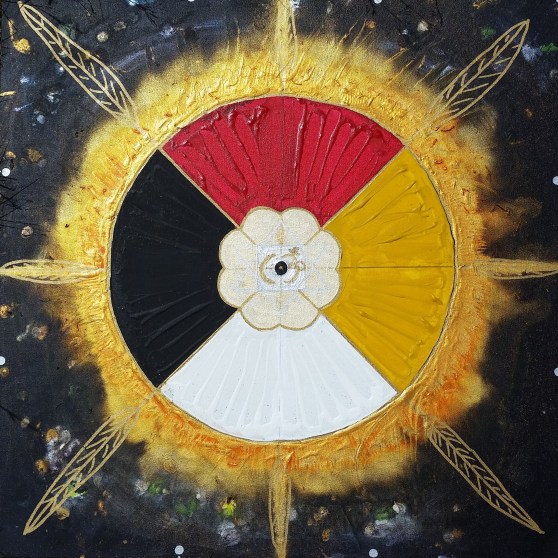
I have found this framework helpful for my own return and I have felt fellowship with these lost souls I have been working with. Reading Houston’s introduction, my mind returned to that rocky outcropping where Te Aroha clings to the cliff, serving as a guidepost for those who have died and transition on to another world. The end of my life in New Zealand really was a kind of death for me, while I am living here in the Northwest, I am still waiting in some ways to be reborn, to find out who I will be and what my life will be like here. The Northwest is the boundary between the physical West and the spiritual North on the medicine wheel. This brings me to the other major project I have been working on, co-authoring a book with my friend and Brother Joseph Rael (Joseph likes to think of us as verbs, rather than nouns, thus “Joseph-ing”), whose Tiwa name is Tsluu-teh-koh-ay (Beautiful Painted Arrow).

20141019_141911

Joseph Rael (Beautiful Painted Arrow)

I met Joseph in October of 2014 and he and I have met in person a few times and been talking on the phone and exchanging letters for work on our book, which we are calling Becoming Your Own Medicine. I have thoroughly enjoyed working with Joseph. Not only does he make me ponder spiritual questions, he is really fun to work with and I always laugh with him. We are getting to the point of doing some editing work on the manuscript for the book and it is very much my own personal journey, my own hero’s journey as much as it is about Joseph’s teachings. Of course I have been reading and re-reading Joseph’s books and he just re-released a new version of his classic, Being & Vibration: Entering the New World. Hopefully the hero’s journey book and Becoming Your Own Medicine will be released in 2016/2017.

20150621_113254 (2)

In addition to my work with veterans and my collaboration with Joseph, I have been doing some deep study of various topics and authors. 2014 was largely reading Henry Corbin and Tom Cheetham’s works on esoteric Islam and Sufism. This also included a lot of the well-known poets, Rumi and Hafiz, but also one of my favourite books of that time, The Unveiling of Secrets: Diary of a Sufi Master by Ruzbihan Baqli. In 2015, I met Richard Miller, who was kind enough to spend some time talking about iRest & yoga Nidra, when he was up here for a conference. This year has been defined by reading a lot about Hinduism and Kashmiri Shaivism with the principle of non-duality being a primary focus, as well as the concept of spanda, the divine creative pulsation which corresponds so well to Joseph Rael’s teachings about reality. These books have primarily been by Jaideva Singh and Mark S. G. Dyczkowski.

The Unveiling of Secrets

Another topic that has been of interest to me is understanding the foundation of American democracy and seeing how we have lost touch with that and how we can re-invigorate the sense of non-denominational spirituality and human rights that were foundational for our country. I think this has been a kind of re-acquaintance with the U.S. for me. Parker Palmer’s Healing the Heart of Democracy: The Courage to Create a Politics Worthy of the Human Spirit, Jacob Needleman’s The American Soul: Rediscovering the Wisdom of the Founders, Steven Hermann’s two books Spiritual Democracy: The Wisdom of Early American Visionaries for the Journey Forward and Walt Whitman: Shamanism, Spiritual Democracy, and the World Soul have helped me to come to a re-imagining of the idea of America.

George Kirazian

George Kirazian

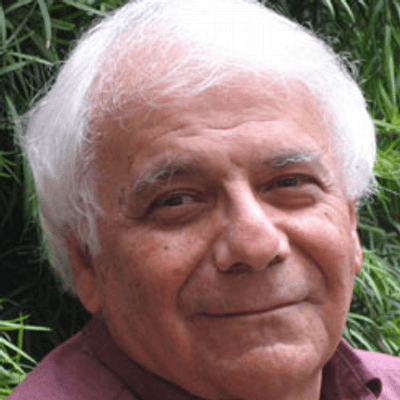
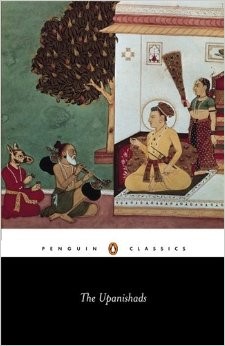
Another highpoint of the year was working with George Kirazian on an interview with him about his friendship with translator Juan Mascaró, whose renderings of The Upanishads, The Bhagavad Gita, and The Dhammapada are still readily available in the Penguin Classics series.

Juan Mascaro

Juan MascaróUpanishads


In addition to my own writing, I look forward to continued collaboration with Joseph Rael, as well as some other friends of mine: Gary Orr, Hilton Kopp, and Sandy Carter. I met Gary and Hilton during my time down under and we have some great ideas – stay tuned…I met Sandy when she did a book review of Re-humanizing Medicine for the Courage & Renewal blog. She and I put together a conference proposal on Joy in Work, which was turned down, but has led to our long-distance collaboration on a project on this same topic, which I have been calling, A Work of Joy. This examines finding joy in work at a time when there are high rates of stress and burnout in health care.

20151219_181524 (2)

At the VA, I have a couple projects I have been working on that are specific to the VA. Along with Nicola De Paul, Craig Santerre, and Jenny Salmon, we have been developing a Whole Health class that provides holistic support and inspiration to veterans who are interested in taking a more active role in their health care. I have also been working with Laura Merritt on an adaptation of Re-humanizing Medicine for VA staff, which we have been calling, Caring for Self. It is great to be able to apply some of the ideas I developed in my book to self-care for staff as well as for patients.

I’ll close in returning to what Houston writes in the introduction to her book, The Search for the Beloved: Journeys in Mythology & Sacred Psychology.

“The premise of this book is that we must call our spirits home, lest we forsake our origins, and lose hope, meaning, health, and the ability to serve and participate in the greatest challenge that history has ever known…We are all being asked, both singularly and collectively, to cross a bridge and to meet halfway a rising reality, a sacred reality. Thus the need for training in journeys into the Sacred,” (viii).

Houston develops this concept of Sacred Psychology and training in journeys into the Sacred. I feel that this is also the focus of my work in the past two years. My understanding of the hero’s journey class is that it is a form of initiation rite to help veterans move from a state of being of war to a state of being of peace in order to make the transition back into the civilian world. One of the primary ways of doing this is a kind of spiritual awakening that accompanies a shift from a materialism-based separation to a spiritual-based sense of connection and even oneness with others. I have also come to understand my work with Joseph as being a guidebook on how to become a visionary in order to move from war to peace and again to move from a state of isolated separation (which is a state of conflict) to a state of Unity as expressions of the Vast Self. This requires dying to the old self and being reborn, continuously.

Hero's Journey Reflection

20151220_132526

Here is how Joseph ends his book, The House of Shattering Light:

The House of Shattering Light

Each of us is a ceremony, a vibration of the All-That-Is. We ourselves are the Vast Self, that One Actor in the universe, who creates continually in all moments. We are the Vast Self playing in creation as creatures, as individuals.

In the experiences of my life, through loss and transformation, ceremony and story, I learned how to emerge continually from the individual self that is Joseph Earl Head Rael into the Vast Self again. In the kiva, in the sweat lodge, in the sun dances and long dances. I have learned to die to myself in order to know the Self, dying from this House of Shattering Light into states of ecstasy, and then returning again, that the Vast Self might drink continually of the light that It is creating.

To know ourselves as the Vast Self playing is to be both human and divine. It is for this we all are born, to be mystics, fully alive and dancing, (199-200).

My return to North America and my transition into the second half of my life have brought me to look less for a physical place of home and more for a spiritual, internal place – a place that also includes many places in the world as well as the whole world, or as Houston writes, “a citizen of the universe.”

kopacz.tree.2016

Review of Marsha Snyder’s Positive Health: Flourishing Lives, Well-Being in Doctors

Positive Health

I first met Marsha Snyder, MD, MAPP, an American psychiatrist, at the Health of Health Professionals conference in Auckland, New Zealand, 2011. I have sat in on her presentations over the past three offerings of the Australasian Doctors’ Health Conference/Health of Health Professionals conference. Marsha sums up her years of work and personal experience in this book, Positive Health: Flourishing Lives, Well-Being in Doctors, published 2014 – the same year as my book, Re-humanizing Medicine. Marsha’s book adds to what I have been calling the counter-curriculum of self-care and compassion revolution in health care.

Snyder

Marsha describes a curriculum that builds on positive psychology, which she studied under Dr. Martin Seligman for her Master’s degree at University of Pennsylvania. She creates an expansive curriculum of positive health and builds upon evidence-based principles of resilience and positive psychology to transform “physician ill-being” into well-being and flourishing.

Marsha describes five themes for her book:

 
1) The “cause of ill-being in medical students extends beyond the students, into issues with faculty and administration.”

2) Many “physicians who are troubled or burned out relate some of their difficulties to ethical issues in the system.”

3) There is a need for “understanding, defining, and teaching of resilience skills to physicians.”

4) The “creation of well-being in doctors and the rest of society by incorporating the science of positive health.”

5) Medical “training and practice must move out from an outdated pathology-based model to a health-based/prevention-based model,” (page 2).

Marsha adds in various exercises, including mindfulness, and discussion questions to the curriculum and stresses the need for “spirited multi-disciplinary teams.” She includes a chapter on “Spirituality and Well-Being,” defining spirituality as “a search for the sacred,” (240) and she reviews the links between spirituality and health. I particularly like the chapter, “Posttraumatic and Post-Ecstatic Growth in Medicine.” I was familiar with posttraumatic growth which describes the potentially transformative response to trauma, but I had not heard of “post-ecstatic growth,” which describes how highly positive experiences can also lead to transformative growth of “different areas of the self, including meaning in life, self-esteem, or social bonds,” (233).

Positive Health: Flourishing Lives, Well-Being in Doctors is a welcome addition to the growing literature on the need for self-care and personal growth in doctors and health care workers. Marsha’s focus goes way beyond limiting the negative to expanding joy and flourishing in the lives of those working in health care.

A Work of Joy.4: Dave’s Personal Reflections on Joy

This is the fourth of a series of blog posts examining Joy in Work. I have been calling it: A Work of Joy! It is part of an ongoing discussion between Dave Kopacz and Sandy Carter on this topic and will include each of our thoughts individually as well as our dialogue on Joy in Work. This fourth blog follows Sandy’s personal reflections on joy with Dave’s personal reflections. These personal reflections then will set the stage for our later writings on Joy in Work.

Dave Kopacz, M.D. works as a psychiatrist at the VA in Primary Care Mental Health Integration. Prior to this he was Clinical Director at Buchanan Rehabilitation Centre in Auckland, New Zealand. He is Board certified in Psychiatry and Integrative & Holistic Medicine. He is the author of Re-humanizing Medicine: A Holistic Framework for Transforming Your Self, Your Practice, and the Culture of Medicine.


Sandy: “How about you Dave? Has joy always been a part of your life? If not, when did you first experience it and what is your relationship with joy now?”

Dave’s Personal Reflections on Joy:

WIN_20150525_182313

Sandy, thank you so much for your story of opening to joy in your life. I like the descriptions you give of joy and I think similarly, that it can happen in the most ordinary moment, and yet it is transformative. Creative, surrender, flow, deep connection, expansion, light, grounded – all these words you use I relate to.

For me, I think I have always had moments of joy at different points in my life, while at the same time I have had painful times with a lack of that feeling. The essence of my personality is introverted, creative, and idealistic. These aspects of my personality can both contribute to and hinder my experience of joy. I think I am a serious person with a good sense of humor and when my seriousness and humor are balanced, it is easier to be open to feeling joy. When I have time to myself, when creativity is flowing, and when I feel a sense of meaning and purpose in my life, I am more open to the possibility of joy.  But when I feel overly pulled into the mundane demands of the external world, when I don’t have a creative project or outlet, and when I don’t live up to my own ideals or the world does not live up to my idealistic view of how it should be – I become overly serious and can get quite pessimistic and negative.

Since at least when I was in high school, I have embarked on a conscious project of personal growth. I have become more capable of enjoying extroverted activities and I think this has increased my capacity for joy. Deep connection is an integral part of the joy experience for me – generally connecting Self, others, and nature. I have come to think of this like an epiphany or a theophany – a sudden in-breaking of the Divine into my life. This can be very expansive, as you say, but it can also be very grounding, maybe the most mundane thing suddenly takes on a vast and important meaning.

With joy, there is this component that it comes unbidden (theophany, epiphany), but there is also a component of making one’s self capable of joy. It does have a paradoxical nature, as you note. The scholar of esoteric Islam, Henry Corbin, writes of “making oneself capable of God,” (Alone with the Alone: Creative Imagination in the Ṣūfism of Ibn ʻArabī). That has stuck with me since I read it. He goes on to speak about how we can only experience that which we are capable of experiencing. To me, this means our baseline capacity for joy. However, he also implies that we can make ourselves more capable of God/joy through inner, spiritual work. What this means to me is that, through spiritual work, we can experience deeper and more frequently God/joy in our lives.

I equate God with Joy and I think this can thus apply in a secular or spiritual framework. To me, the two words are interchangeable. We could also use words like the Divine, or a word that Jung uses frequently, the numinous. In the Kashmiri Shaivisim tradition, which flourished in Northern India around 700 to 1100 C.E., the ultimate reality is described as a “compact mass of bliss” (Dyczkowski, The Doctrine of Vibration).  I think this is what is meant in the Christian tradition when it is said that “God is Love.” Love and joy are deeply connected. When I come home from work and our dog (who happens to be named Henry Corbin) greets me – bouncing, spinning, barely able to contain himself – I feel the experience of love & joy.

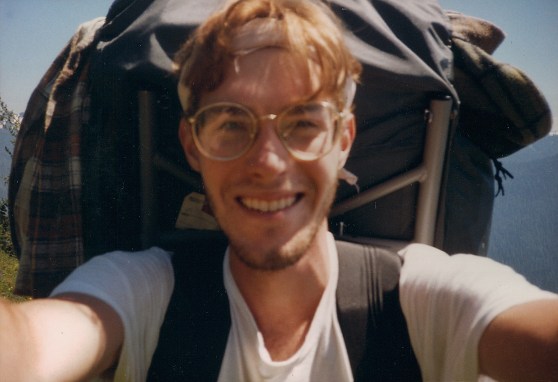
I’ll include two photos of myself that capture this sense of joy. This first one is from a journey I took after I graduated from university. I took a backpack filled with books and food and camping gear, took a 50 hour bus trip from Chicago to Seattle, and went on a solo backpacking trip in the Olympic National Park. There was a great deal of physical and emotional suffering that I went through in the early part of the trip. I think that suffering and joy are not necessarily opposites. I do think that suffering is sometimes necessary to help break us down and open us up in order to become more capable of joy. Just as you describe, Sandy, your opening of joy following a sense of suffering, I think this can often be the case. Native American visionary, Joseph Rael, even speaks of the use of “intentional suffering” (fasting, physical exertion) as being a necessary part of vision quest. This “crying for a vision” is what helps us to become more capable of God/joy. I took this photo as I crested a mountain ridge and a panoramic view opened up before me.

05

Here is my journal entry from that day:

7/25/89

Today I am born.  I AM ALIVE.  Today alone was worth the price and troubles of the trip.  I am seated atop a mountain.  The view is breathtaking and it is even more spectacular because I climbed up the whole damn thing!  I passed snow in the shady spots coming up.  Except for a couple of chirpers and a multitude of bugs…it is silent.  What more could there be?


When nothing is lost

nothing is gained

When nothing is gained

things are not as they should be


With a hat on my head and a sack

at my side

I walk with the breeze and the

moon on my staff


And here is my journal entry for the next day:


7/26/89

Right now I am at Kyak.

Yesterday…well, there is that earlier entry.  After that I went up still higher and a view opened up that was indescribable.  I had been on the north face of the mountain and had been viewing the smaller mountains to the north.  After I crossed over to the south side and climbed a bit higher, I could see the entire Olympic Range, along with snow/glacier covered Mount Olympus.  Breathtaking is the only way to describe the section of mountain I stood on.   There was about a 60 degree slope of about 150′ without trees.  The only thing between the mountains and valleys beyond and myself was air.  I stood and stared for quite a while.  I think it would be hard to say that you had been alive if you have not seen something so spectacular.

By the time I had hiked 9.2 miles and found a decent site, I was in a foul mood once again.  If I would have seen the guy who wrote that shit about nothing lost, nothing gained, I would have pushed him off a cliff.  In the last dying light of the day I opened Zen Mind, Beginners Mind and the only word I could make out was “constancy.”

Yesterday was anything but constancy, from the highest of highs to the lowest of lows.  I don’t want constancy in the form of a continual mellow, but it’s just that the way I felt last night seems so childish.  Can that be overcome while still maintaining the ability to feel and express anger and frustration?


I think my journal entry points to some of the things we have been discussing with joy. This episode came following intense physical and emotional suffering as I got my feet under me, adjust to being alone and the constant neurotic chatter of my own mind, and as my body gradually built up strength for mountain hiking.

Then – comes this sudden epiphany, I take a photo, write some lines and have an intense experience. (A note on the photo, the most important thing is seeing my face and remembering that experience, but I have so much “baggage” that you can barely see the scenery around me – well, anyway, that was not the important thing at that moment). Then, this experience is blown away by an even greater experience of joy – the joy beyond describing – and I don’t write about it or take a photo, there is nothing but pure experience. Then, this is followed once again by a descent into despair and I turned to my friend Shunryu Suzuki and he said, “constancy.” Maybe that literal peak experience was only possible from the suffering that led up to it. Maybe the constancy is allowing ourselves to be pulled apart by the extremes of life, while still resting on some inner sense of being that is constantly expanding which is both painful and joyous.

Here is another photo that comes to mind when I think of a joyful moment that has been captured on film. This is a photo from a Holi celebration we had at Buchanan Rehabilitation Centre, where I was working down in New Zealand. We had a small group of amazing and fantastic staff who put on the Exploring Mental Health through Yoga group. Sneh, a wonderful Fijian Indian social worker led us in the yoga and would put on these holiday feasts for us. Sneh would often have us do “laughter yoga” at the end of our sessions. Hearing her spontaneously laugh always made me laugh really deeply.

close-up-holi-photo

The Hindu festival of Holi involves throwing handfuls of colored powder at each other. It is kind of like a water balloon fight, only with colored powder. We were so covered with colored powder – it was everywhere! My friend, Arishma, took this photo of me, but right as she was taking the photo, I threw a handful of color at her. While this was all a blast, she did get some powder in her eyes while taking the photo and I felt bad about that, but this photo is right before that happened. This photo captures, for me, the joy that I had working at Buchanan in New Zealand.

What is my personal relationship to joy at this time in my life?

Joseph Campbell coined the popular phrase, “Follow your bliss.” He took this from the Hindu concept of reality as consisting of Sat Chit Ananda, which means Being, Consciousness, Bliss. Campbell wasn’t sure he knew what proper Being or proper Consciousness was, but he did have an internal sense of what brought him joy, Bliss, and rapture. He choose to follow that. While this has often been taken to mean some kind of hedonism in popular culture, Campbell did not mean it in that way. In fact at a later point he said in an interview, “I should have said, ‘Follow your blisters!” This perhaps captures it if we combine both – follow where you are pulled and called to go through your Bliss, but be prepared to develop a lot of Blisters in the process!

Ok, well, for me, at this point in my life, I am trying to have an awareness of the deep reality of joy that is the fundamental nature of Consciousness, Being and Reality. The emotions on the surface are often not joyful, sometimes they are, but sometimes they are not. I am always working (Joseph Rael’s grandmother told him, “work is worship”) to create more capability for joy in my life. This is what makes life worth living, opens us up to colorful, peak experiences, and sustains us through the inevitable trials and tribulations of life.

How about some pet photos to end with? These always make me smile and feel joy in my heart!

DSC_8221

Henry Corbin


20151114_150737_resized (2)

Also known as “Sea Biscuit” as he loves to drink the ocean, but too much isn’t good for him.

Sofia.jpg

Sofia

Neo in closet

Neo

01

Glory

Review of Re-humanizing Medicine on Gold Foundation Blog

jhp53db8b682bd57[1]

There is a new review of my book, Re-humanizing Medicine: A Holistic Framework for Transforming Your Self, Your Practice, and the Culture of Medicine, up on the Arnold P. Gold Foundation Blog. The Foundation focuses on promoting humanism in medicine and their motto is: Working to keep the care in healthcare.

Check out their blog. I also did a guest blog a couple months ago on “A Counter-curriculum of Self Care.”


Joy: Personal Reflections by Sandy Carter

What is Joy in Work, Where has it gone, How can We bring it Back?

This is the third in a series of blog posts examining Joy in Work. It is part of an ongoing discussion between Dave Kopacz and Sandy Carter on this topic and will include each of our thoughts individually as well as our dialogue on Joy in Work. This third blog gives some background on Sandy’s personal reflections about the nature of Joy.

Sandy Carter, Ph.D. works as a physician coach and consultant in Michigan. Sandy is a professional certified coach, holds a PhD in organizational management with a specialization in leadership, and Masters in Business Administration and Social Work. Her research is in the area of transformational leadership with physicians, and wellness and resiliency.

 Sandy.2

When did I first consciously feel joy as an adult?

When I reflect back on a childhood experience that feels joyful, roller-skating is my earliest memory of fully embodying joyfulness. I was in elementary school when my parents enrolled me in a roller skating class. Reflecting on this memory many decades later, I can relive sensations of joy and happiness as I go back in time to those early years when I was first learning how to skate. At the time, skating made sense to me in a way nothing else in my life did. It brought everything together and I was fully engaged and present. After mastering the basics, I would spend hours practicing at the Rolladium Skating Rink by our house, circling around the rink again and again. As I gained confidence, I took greater risks and brought my whole self into the experience. I think that’s why it felt so joyful – I was immersed in the present moment and felt a heightened sense of aliveness and as much as a child can – felt completely on purpose. Unfortunately, my skating opportunities diminished as my parents were forced to cut back on expenses. My parents felt terrible, and I know this must have been a terrible loss for me. Strangely, I don’t have a memory of the loss. Now, all that’s left is the memory and a felt experience of those joyous days when I let skating consume me. My parent’s promised to get my brother and I back into skating when times were better. However, those better times never came for my parents. At least, they didn’t come until my brother and I had left home and took responsibility for our own lives.

It would be many years later before I would feel the lightness of joy again in my life. I had disconnected from this earlier childhood experience and buried it very deep. I had no sense of what it even felt like to feel joyful by the time I completed grade school.

As I entered adulthood my life often felt heavy. All of my earlier role models were burdened as they struggled and suffered from life events. In fact, my first adult experience of deeply feeling joy didn’t happen until I was in my mid-forties. I had experienced happiness and excitement many times over the years, but not Joy. Of course, not having a point of reference – I didn’t even know what I was missing.

My first conscious experience with Joy in my adult life happened in an ordinary moment. I was driving my car on a winter day. I remember feeling how good it was to be alive for no particular reason. There wasn’t anything special about this day from any other day.

As I drove, I remember feeling fully present taking in and completely accepting everything around me. I wasn’t thinking about the past or the future. I was not judging nor wanting to change anything or even defining experiences as good or bad – I was just “being.” That’s when it happened – trying to describe what “it” is feels paradoxical. I felt myself EXPAND, connect to an energy source that was both ethereal (graceful, light and spacious) and resilient (substantial and grounded). Suddenly, I felt uplifted and a part of everything. I also remember having a sense that I had opened a channel, a place where energy moves through me and not a place where I push, pull or demand things to happen.

I intuitively knew this was a defining moment. A few nights previous to this experience I had been working in my home office until 3:00 in the morning. As my family slept, I got up from my desk and walked a file box down the stairs to the basement to place next to the 2-dozen other file boxes with taxes and other organizational papers, that had accumulated over the years. As I heard the box hit the floor, something shifted in me. The clunk got my attention in a way I had never experienced prior. I found myself taking stock and asking myself why was I allowing work to burden me? Why was I sacrificing my health and wellbeing and even my happiness to work so hard? I decided I did not like being driven – it was sucking me dry. I allowed myself to feel completely how unhappy I was in that early morning moment in my stark, cold basement amongst the piles of file boxes. I felt the meaning of this fully, shuttered, shook off the depressing feelings and went to bed.

It was only a few days later that I experienced (what I’ve come to realize) was Joy! I often think about that day. I know I opened a portal into creative space that allows my work to come through me. Somehow that night I set an intention to let go of the push/pull and drive and making things happen exclusively through my willpower. Instead, I found a new source of working/creating where I am in flow if I surrender control, ask for guidance and maintain presence. A by-product is a state of wellbeing and gratitude that supports me in my relationships and work. Sometimes I forget when I feel performance pressure or am outside of my comfort zone and I will start to engage in that heightened state of driven frenzy, but once I start to feel burdened – I know I am not working from my best self, and most often I can shift. I smile as I reflect on my childhood experience of roller-skating and recognize the portal I opened was in part, reclaiming that child who loved, loved, loved to roller-skate!

Tea Party

My sister, father, me, and my mother having a tea party!

I feel most fortunate to have reclaimed that little girl as now I have a grandson (Carter), and the child in me can really relate to this little guy. I can fully immerse into his joyous world of 2-year old play in a way I would not have been capable of earlier in my life. I would have “tried” very hard because I would have felt guilty (sad) by not playing with my grandson. I know now, that “exerting effort” restricts my capacity for joy, and that letting go of “trying” opens up space for freedom, discovery, and playfulness, rippling into JOYFULNESS!

Sandy with Carter

With Carter when he was born!

Carter Drunk on Bliss

Carter celebrating his first birthday – Drunk on Bliss!

Being out in nature really brings me back to that experience I mentioned earlier of being both light and spacious and feeling grounded. I love the peace and isolation of wilderness hiking. I instantly expand and connect deeply while in nature. In many ways, I am continually connecting to nature and don’t necessarily have to go into the wilderness, but in such settings I go deeper into self-reflection and experience profound peace. And, playfulness and adventure (in spite of the challenges) are very joyful experiences for me!

Sandy on Appalachian Trail

Backpacking the Appalachian Trail

Sandy hiking

Wilderness Hiking

How about you Dave? Has joy always been a part of your life? If not, when did you first experience it and what is your relationship with joy now? 

Answer – next week…