

My friend Lucy Houghton and I have been working on this idea of post-burnout growth, analogous to the concept of posttraumatic growth. We published a preliminary essay in Closler October 18, 2022 called A New Paradigm for Growth.
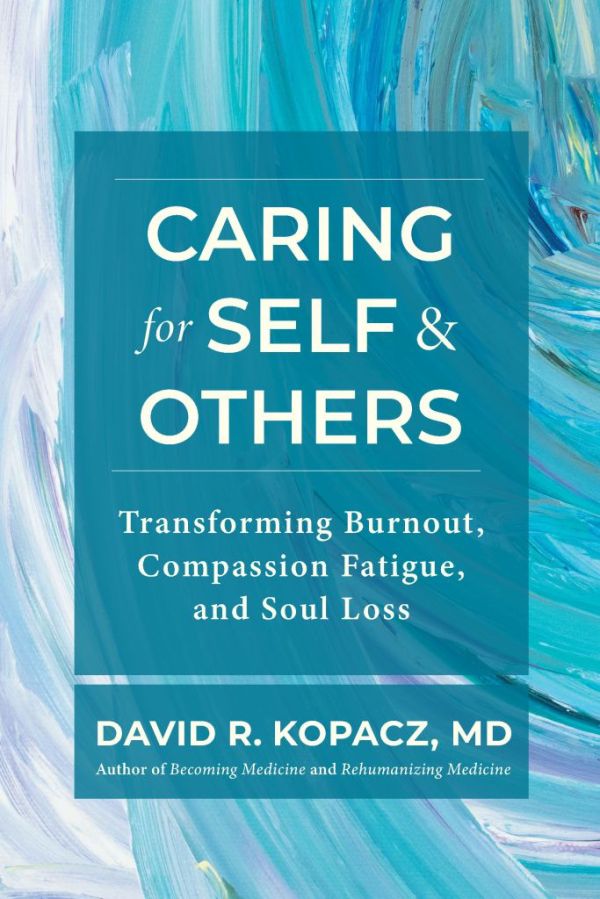
Since then I have continued to elaborate this concept and wrote about it in my latest book, Caring for Self & Others: Transforming Burnout, Compassion Fatigue, and Soul Loss. I would like to offer some sections of the book on the topic of post-burnout growth as a new paradigm for growing through suffering – burnout, compassion fatigue, and soul loss.
Transforming Suffering
Initiation is a model of transformation that is ancient and is found in many Indigenous traditions as well as in the wisdom stories of many religions. In Becoming Medicine, Southern Ute elder Joseph Rael (Beautiful Painted Arrow) and I structured our book based on the three stages of initiation: separation, initiation, and return. While Joseph Campbell came to these stages through the study of stories and cultures, Joseph Rael has lived them through various initiation ceremonies in his education at Picuris Pueblo and the Southern Ute Reservation. Since 2014, Joseph and I have been working together, focusing on different ways that people can transform their own trauma and suffering by becoming healers―that is what it means to be becoming medicine: becoming a healer for yourself, others, and the world.
This kind of transformation is what Lucinda Houghton and I have been working on in regard to burnout. We have been calling this post-burnout growth, similar to posttraumatic growth―where suffering is used for personal and professional growth.[i] Posttraumatic growth has been described as: increased appreciation for life, more meaningful interpersonal relationships, increased sense of personal strength, changed priorities, and a richer existential and spiritual life.[ii] These are changes both in self as well as in relationships with others. We view post-burnout growth as not simple resilience of returning to who we were, but actually using suffering as a tool for growing beyond who we were into who we can become.
We can view burnout, compassion fatigue, and even soul loss as calls to initiation, just as Joseph Campbell described the call to adventure in the hero’s or heroine’s journey.[iii] The quest to reconnect with the soul is a kind of heroism that leads to healing. As storyteller Michael Meade tells us, “Life is change and the life of the soul is transformation.”[iv]
David Kopacz, Caring for Self & Others: Transforming Burnout, Compassion Fatigue, and Soul Loss. Palisade: Creative Courage Press, 2024, (pages 19-20)
While burnout and compassion fatigue can feel like we have lost our souls, it is not so much our souls that are lost as we who are lost—we have lost touch with the innermost being of ourselves. As Joseph Rael teaches, Wah-Mah-Chi, Breath-Matter-Movement, holds back a place of goodness in each of our hearts, no matter what we have done and no matter what has been done to us. Burnout and compassion fatigue can be viewed as disorienting dilemmas that start the initiation of transformative learning―post-burnout growth! In this way, periodically losing touch with ourselves (our souls) is actually an ongoing invitation to enter into the healing space of transformational initiation. Our troubles, disorienting as they are, can be the call of transformation. “Thus,” writes Meade, “the troubles we find ourselves in are intended to wake us up to a greater sense of life and awaken the underlying soul, which knows better than us what our life is for.”[v] The loss of energy in burnout and compassion fatigue creates a space that offers us the opportunity to be guided by our inner knowing and inner wisdom of the soul. For, as Meade tells us, “when our energy drains from life’s outer projects, our attention is drawn inward, downward and back towards the original spark of our lives and the genuine project of our soul.”[vi]
Kopacz, Caring for Self & Others, pages (148-149)
Beyond Resilience to the Joys of Caring
While resilience and self-care are part of the puzzle for recovering from burnout and soul loss, to only focus on these individual responsibilities runs the risk of blaming the victim. Are high rates of burnout actually due to the way our systems are designed? Swensen and Shanafelt think so, writing that the “current health care delivery system is perfectly designed to create high rates of professional burnout in physicians, nurses, advanced practice providers, and other health care professionals.”[vii] The problem, then, is not a lack of resilience within staff, but an institutional structure that does not support human flourishing. To address burnout and compassion fatigue, we have to go beyond individual resilience.[viii]
resilience (n.) “act of rebounding” … from Latin resiliens, present participle of resilire “to rebound, recoil,” from re- “back” … + salire ”to jump, leap”[ix]
While the ability to bounce back is important, we also need to transform, which means to grow beyond our previous limits. Transformation means we are not trying to be who we were, rather we are growing into the potential of who we can become. Many are questioning whether resilience is really the answer to the burnout pandemic, particularly within the field of posttraumatic growth. As Edith Shiro writes in The Unexpected Gift of Trauma: The Path to Posttraumatic Growth, “resilience doesn’t help us grow from adversity, it helps us cope with it, and further, “sometimes resilience actually hinders the possibility of achieving” posttraumatic growth.[x]
Richard Tedeschi and Lawrence Calhoun have been studying posttraumatic growth for years and they point out that “continuing personal distress and growth often coexist.”[xi] In this sense, the goal is not to be free of suffering, but to grow from it. This distinguishes a transformative growth paradigm from the prevention and recovery focus on work-readiness of the resilience paradigm. Rather than bouncing back to our previous level of adaptation, transformation helps us grow beyond it. Just as Chenrezig was not put back together with two arms and two eyes, we want to grow in the ability to see and touch suffering. Tedeschi and Calhoun describe posttraumatic growth as an experience where development “has surpassed what was present before the struggle with crises occurred,” and that this is not “simply a return to baseline―it is an experience of improvement that for some persons is deeply profound.” Posttraumatic growth “has a quality of transformation…unlike…resilience.”[xii]
Resilience and subjective well-being can be part of the approach to burnout, compassion fatigue, and soul loss, but only take us so far―they can restore previous functioning, but do not help us grow as healers or as human beings. Posttraumatic growth and post-burnout growth are transformation paradigms that take us beyond resilience, however we still need to look beyond the individual to the health care ecosystems we work in and the institutional variables that contribute to burnout, maintain it, and limit our focus to being the same productive work unit we were yesterday instead of supporting a transformational growth mindset. It is worth re-examining the costs of caring again, this time looking at the systemic and organizational issues, as we have been covering the personal and individual levels. We can look at the costs of caring from a different perspective after taking the journey of caring for self & others. Each cost of suffering can be seen as having a joyful counterpart: from burnout to post-burnout growth, from trauma to posttraumatic growth, from dehumanization to re-humanization, from demoralization to remoralization, from soul loss to soul recovery, and from suicide to finding meaning and purpose which leads to joy and flourishing. It is not easy work to dig ourselves out of the abyss of the costs of caring and to return, transformed, back into the health care world armed with our rejuvenated joys of caring.
Working with people is stressful and exposes us to direct and vicarious trauma. We can’t eliminate exposure to suffering from our work. But we can build in ways to grow in our capacity for caring―this doesn’t mean never suffering, but developing a greater capacity to work with suffering. In addition to individual approaches, we also need to go beyond resilience to create organizations that measure employee idealism and well-being as well as measuring productivity. As the late Alessandra Pigni, a former Doctors Without Borders psychologist, stated:
But is self-care enough to prevent burnout? Yes and no. There is self-care as in “a day at the spa,” recreational self-care, and there is self-care as “care of the self,” a deeper kind of attention to ourselves, the sort that asks questions like, “What am I doing in this group/organization/community? Do I still belong here?” We call this transformational self-care.[xii]
Alessandra Pigni, The Idealist’s Survival Kit: 75 Simple Ways to Avoid Burnout
Transformational “care of the self” challenges us to look not just at ourselves as individuals, but how we fit in the larger institution. If an institution is not supporting our humanity and for whatever reason we are not able or in a position to transform the institution, that may mean we care for ourselves by changing jobs. If transformation is possible, then we roll up our sleeves and contribute to the challenging work of transforming systems and institutions.
Kopacz, Caring for Self & Others, pages (209-212)
References
[i] David Kopacz and Lucinda Houghton, “A New Paradigm for Growth,” CLOSLER, October 18, 2022, https://closler.org/lifelong-learning-in-clinical-excellence/a-new-paradigm-for-growth.
[ii] Richard G. Tedeschi and Lawrence G. Calhoun, “TARGET ARTICLE: ‘Posttraumatic Growth: Conceptual Foundations and Empirical Evidence,’” Psychological Inquiry 15, no. 1 (2004): 1–18, https://doi.org/10.1207/s15327965pli1501_01.
[iii] Campbell focused primarily on the masculine hero’s journey. Other authors have further developed the heroine’s journey, for instance Maureen Murdock’s The Heroine’s Journey and Marina Tatar’s The Heroine with 1001 Faces.
[iv] Michael Meade, Awakening the Soul: A Deep Response to a Troubled World (Vashon, WA: Greenfire Press, 2018), 73.
[v] Ibid., 120.
[vi] Ibid., 128.
[vii] Swensen and Shanafelt, Strategies to Reduce Burnout, 37.
[viii] Kopacz, “Beyond Resilience.”
[ix] Online Etymology Dictionary, s.v. “resilience,” accessed April 7, 2022, https://www.etymonline.com/word/resilience.
[x] Edith Shiro, The Unexpected Gift of Trauma: The Path to Posttraumatic Growth (New York: Harvest, 2023), 60–61.
[xi] Tedeschi and Calhoun, “Posttraumatic Growth,” 2.
[xii] Ibid., 4.
[xiii] Alessandra Pigni, The Idealist’s Survival Kit: 75 Simple Ways to Avoid Burnout (Berkeley, CA: Parallax Press, 2016), 55.

 Being Fully Human